

Home & Decor Blogs: DIY, Interior Design & Lifestyle Ideas
Stop Wasting Money on HVAC Repairs in Picture Rocks

Picture Rocks summers regularly push past 99°F in June and hover around 97°F through July and August. That’s three straight months where your air conditioning isn’t a luxury, it’s the only thing standing between you and genuine misery. Winter drops to the low 40s, which isn’t brutal by national standards, but it’s cold enough that your heating system needs to work properly when December rolls around.
The desert climate here is uniquely rough on HVAC equipment. Dust gets into everything. Humidity drops as low as 18% in June. The temperature swing between a summer afternoon and a winter night can span 55+ degrees across the year. All of that puts stress on mechanical systems in ways that a temperate climate simply doesn’t.
Americans spend over $10 billion a year on HVAC repair and maintenance. A big chunk of that money goes toward fixing problems that basic upkeep would have prevented. The U.S. Department of Energy estimates that a system without regular maintenance uses up to 25% more energy than one that gets serviced. In a place like Picture Rocks, where AC runs nearly non-stop for months, that 25% adds up fast on your electricity bill.
Filters: The Boring Thing That Matters Most
Changing your air filter is the single most impactful thing you can do for your system, and it takes about 90 seconds. A clogged filter restricts airflow, forces the blower motor to work harder, drives up energy consumption, and accelerates wear on components that are expensive to replace.
The EPA says regular filter changes alone produce a 5–15% reduction in monthly heating and cooling bills. In Picture Rocks, where dust levels are higher than the national average, the area’s air quality index runs about 12% worse than the US norm. Filters clog faster than they would in, say, Portland or Charlotte. Monthly checks during heavy-use months are worth the two minutes. Swap the filter every one to three months, depending on how much dust your home collects, whether you have pets, and how many hours a day the system runs.
What a Proper Seasonal Tune-Up Covers
Picture Rocks heating and cooling professionals handle the stuff that’s beyond a filter swap, the mechanical and electrical checks that catch small problems before they turn into $1,500 emergency calls on the hottest Saturday in July.
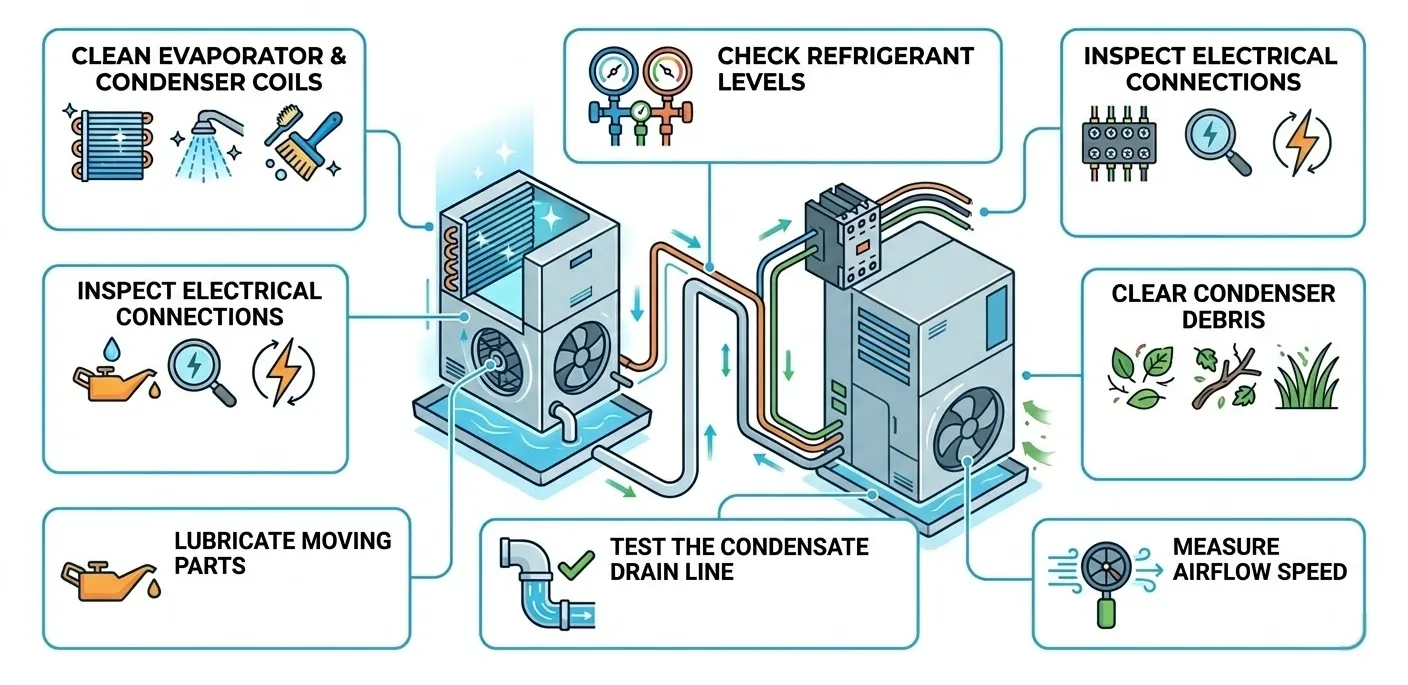
A proper seasonal service should include:
- Cleaning evaporator and condenser coils (dirty coils kill heat transfer efficiency)
- Checking refrigerant levels (low refrigerant means the system runs longer to cool the same space)
- Inspecting electrical connections for wear, corrosion, or loose wiring
- Lubricating moving parts to cut friction and reduce motor strain
- Testing the condensate drain line (clogged drains cause water damage and mold inside the cabinet)
- Clearing debris, leaves, brush, and weeds from around the outdoor condenser unit
- Measuring airflow speed to confirm the blower operates within factory specs
ASHRAE (the American Society of Heating, Refrigerating, and Air-Conditioning Engineers) found that regular maintenance can reduce the risk of breakdowns by up to 95%. Emergency HVAC repairs typically cost 50–100% more than a standard service call. The math is pretty simple.
Your Thermostat and Your Ductwork Are Probably Wasting Money
Two things that homeowners rarely think about until something feels off: thermostat accuracy and duct integrity.
Digital thermostats drift over time. Batteries die. Sensors lose calibration. If your thermostat reads 72°F but the actual room temperature is 75°F, the system cycles differently than it should, sometimes running too long, sometimes not long enough. Either way, you’re paying for imprecision. A programmable or smart thermostat is worth the upgrade. ENERGY STAR says homes with smart thermostats save roughly $100 a year, and in a desert climate with extreme seasonal swings, the real savings can run higher.
Ductwork is the other quiet money drain. Small gaps at joints and connections let conditioned air leak into attics, crawlspaces, and wall cavities where it does absolutely nothing for your comfort. ENERGY STAR estimates that sealing and insulating ducts can improve system efficiency by as much as 20%. In a house where the AC runs eight or ten hours a day through summer, that’s a meaningful number.
How Long Should Your System Actually Last
The average HVAC lifespan sits around 15 to 20 years with proper maintenance. Heat pumps tend to have shorter lives, closer to 10 to 15 years. Furnaces can push toward 20. But those numbers assume regular servicing. A neglected system might need replacing in as few as 10 years, and the performance drops off well before the final breakdown.
Systems with consistent maintenance last 5 to 7 years longer on average than neglected ones. Given that a new HVAC installation in 2025 averages around $14,000 for a typical home, stretching another five to seven years out of your existing equipment is worth thousands of dollars in delayed replacement costs.
| What Maintenance Does | The Numbers |
|---|---|
| Energy savings from proper upkeep | 5–20% annually (U.S. Dept. of Energy) |
| Energy waste from skipping maintenance | Up to 25% more consumption |
| Breakdown risk reduction | Up to 95% (ASHRAE) |
| Extra lifespan with regular service | 5–7 additional years |
| Efficiency gain from sealing ductwork | Up to 20% (ENERGY STAR) |
| Savings from filter changes alone | 5–15% on heating/cooling bills (EPA) |
Air Quality in a Dusty Desert
Picture Rocks sits in the Sonoran Desert with about 290 sunny days a year and minimal rainfall. All that dry, dusty air doesn’t stay outside. It circulates through your HVAC system and into every room. The area’s pollution index is 49% worse than the national average, which means your system’s filtration is doing heavier lifting than most.
Modern filters trap fine particles that cause respiratory irritation, trigger allergies, and build up on internal sensors and components. A clean system with fresh filters keeps indoor air healthier and prevents dust from coating the blower wheel, evaporator coils, and other internals where buildup creates drag, reduces efficiency, and eventually causes mechanical failure.
Balanced humidity matters too, even in the desert. Winter in Picture Rocks is dry enough to crack wooden furniture and generate constant static. Summer monsoon season (July and August get the heaviest rainfall ) flips the script with humidity spikes that can breed mold inside ductwork or the air handler cabinet if drainage isn’t working properly.
The Stuff You Can Do Yourself
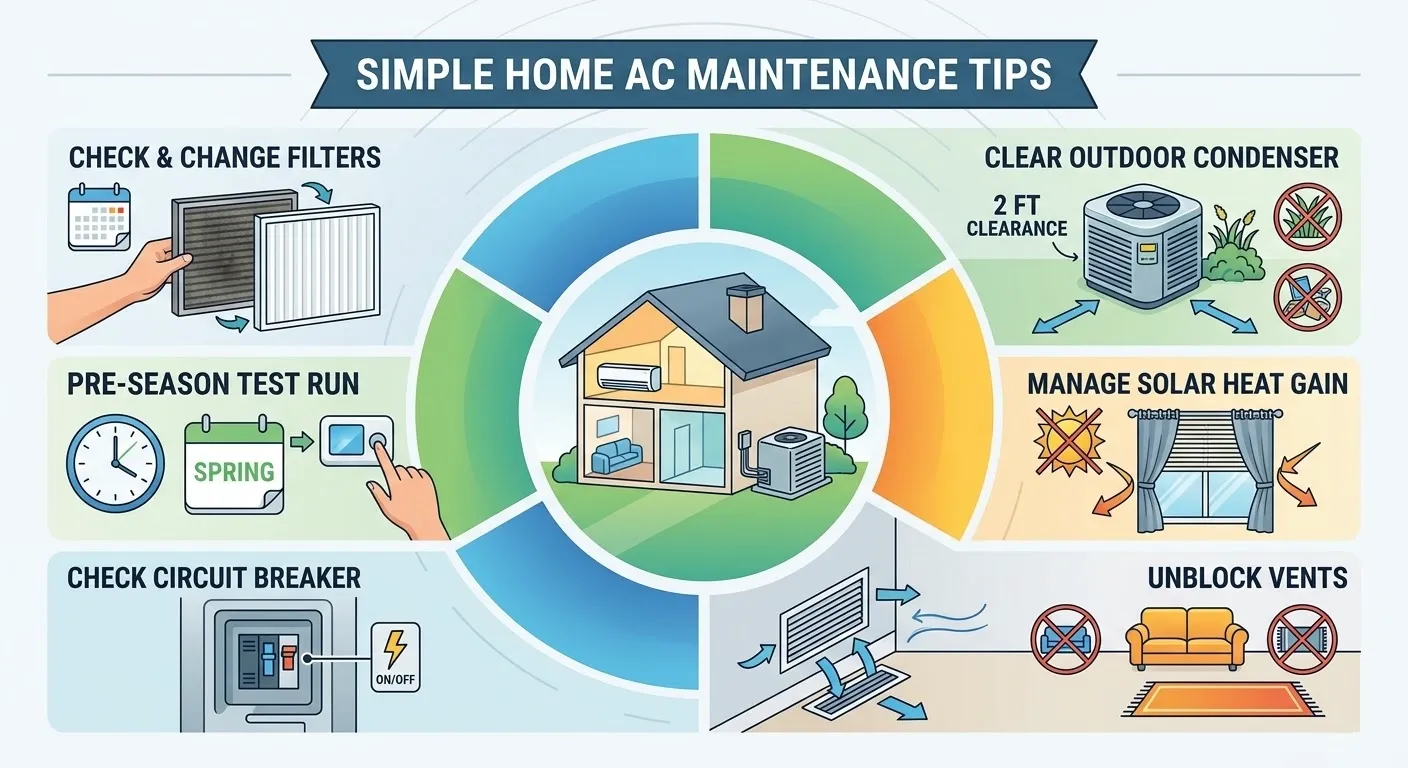
Not everything requires a technician. Between professional service visits, homeowners can handle several things that genuinely make a difference:
- Check and change filters monthly during heavy-use seasons
- Keep the area around the outdoor condenser clear, with at least two feet of clearance from plants, debris, and stored items
- Close curtains and blinds during the day to reduce solar heat gain (your AC doesn’t need to fight the sun harder than necessary)
- Make sure all supply and return vents inside the house are open and unblocked by furniture or rugs
- Check the circuit breaker for the HVAC unit. If the system cuts out a tripped breaker during high-use periods isn’t unusual
- Run the system briefly before the start of each season to catch obvious problems before you actually need it
The professional stuff, refrigerant checks, electrical testing, coil cleaning, and blower calibration should happen at least once a year. Twice is better if you can budget for it, especially in a climate that punishes equipment the way Picture Rocks does.
Putting Real Money Numbers on It
ENERGY STAR-certified HVAC systems save between 10% and 30% on heating and cooling costs compared to standard systems. Upgrading to a high-efficiency unit can cut energy consumption by 20% to 50%, depending on what you’re replacing. Energy-efficient upgrades can add up to 8% to a home’s resale value.
But you don’t have to buy a new system to see savings. Just keeping your current one properly maintained, and clean coils, fresh filters, sealed ducts, correct refrigerant charge, calibrated thermostat gets you most of the efficiency gains without the five-figure price tag. The Department of Energy puts the savings from maintenance best practices at 5–20% annually on energy bills. For a household spending $200–300 a month on cooling through a Picture Rocks summer, that’s real money coming back.
A well-maintained system also preserves the manufacturer’s warranty. Most warranties require documented professional maintenance, and skipping it gives the manufacturer an easy reason to deny a claim on a compressor or heat exchanger that fails at year six of a ten-year warranty.
 Decor & Improvement Accessories