

Home & Decor Blogs: DIY, Interior Design & Lifestyle Ideas
Mississauga’s Housing Market in a Buyer’s Favour — Broker Joe Battaglia on What Is Actually Happening


The property market in Mississauga has changed over the past eighteen months. The average residential sale price decreased by six percent from about $1,067,000 in 2024 to approximately $1,003,500 in 2025. Early figures for this year have ranged from $959,000 to $966,000, depending on the month. From 13,562 in 2024 to 15,553 in 2025, the total number of postings increased 14.7% year over year, bringing months of inventory to roughly 4.3 to 4.5, well within buyer territory. The Bank of Canada rate has remained constant at 2.25% since late last year and has not changed during the spring, which was meant to entice sidelined purchasers to return, but it hasn’t done so as most people had anticipated. When you factor in the continuous uncertainty surrounding U.S. tariffs on building materials, which range from 25% to 50% on steel and aluminium, 10% on softwood lumber, and 25% on wood items like cabinets, you have a market where confidence is brittle despite the data suggesting opportunity.
We had a conversation with Joe Battaglia, a Mississauga real estate broker who has been selling in this market since 1995, to get his opinion on the current situation and what he is saying to his clients.
Mississauga’s inventory is up 14.7% year over year, with months of inventory ranging from 4.3 to 4.5. Early this year, the average sale price dropped to between $959,000 and $966,000. Does this feel like the window that everyone is talking about to purchasers who have been waiting?
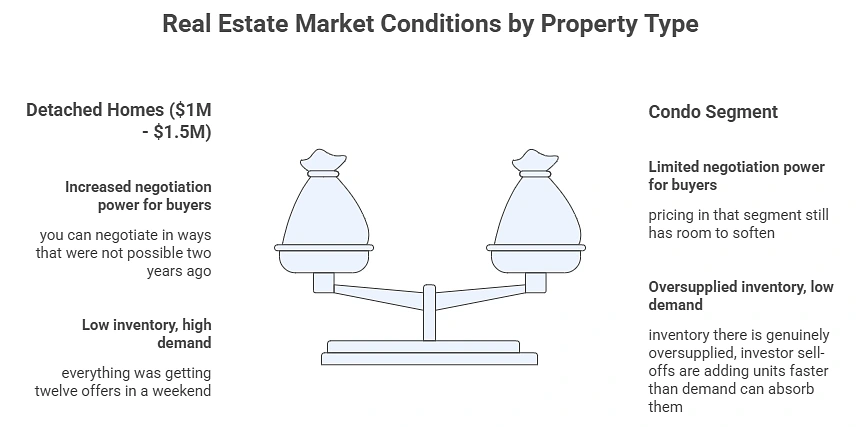
It depends on what you are buying. If you are looking at detached homes in the one to one point five million range, yes, the leverage has shifted, and you can negotiate in ways that were not possible two years ago when everything was getting twelve offers in a weekend. But the condo segment is a completely different situation — inventory there is genuinely oversupplied, investor sell-offs are adding units faster than demand can absorb them, and pricing in that segment still has room to soften. So when someone says “it’s a buyer’s market” as if that applies to everything uniformly, that is not what I am seeing. It is neighbourhood by neighbourhood and property type by property type.
You mentioned condo oversupply. How much of that is driven by investors offloading units versus actual market softness?
A significant chunk. What happened is a lot of investors bought pre-construction condos during the run-up expecting to either flip at completion or rent them out at high returns. But rental prices have come down, vacancy is up, and the carrying costs on a unit with a mortgage at four and a half to five percent fixed do not make sense when your rental income has dropped. So they are selling, which adds supply to an already oversupplied segment, which pushes prices down further, which makes more investors want to exit. It is a cycle and it has not fully played out yet.
The detached and semi-detached side is structurally different because Mississauga is essentially built out. There is no meaningful land left for new freehold development. So that supply constraint creates a price floor that condos do not have.
The tariff situation — U.S. tariffs hitting 25% to 50% on steel and aluminium, 10% on softwood lumber, 25% on wood products including cabinets. How is that affecting the market practically, not just theoretically?
Two ways. First, construction costs on new builds have gone up meaningfully. The NAHB estimated roughly $9,200 to $10,900 added to the average cost of building a new single-family home from tariff-related material increases alone, and that filters through to pricing on anything under construction or recently completed. So new inventory is coming to market at higher price points, which creates a weird dynamic where resale properties — even older ones — start looking more attractive simply because they were built before the cost increase.
Second, and this is the less obvious part, it has made developers hesitate. Projects that were in the planning stages are getting delayed or shelved because the cost projections no longer work at the price points the market will bear. Which means less new supply in the pipeline for the next two to three years. Right now that feels like it does not matter because inventory is high, but in a couple of years when demand comes back and there is nothing new to absorb it, that is when you will feel the squeeze.
CREA’s latest forecast projects about one percent growth in national sales and roughly 1.5% in average home prices this year — which is a lot more cautious than the three to seven percent numbers people were throwing around earlier. Does that more conservative outlook match what you are seeing in Mississauga?
Honestly, it feels more realistic than the earlier projections. Those three to five percent numbers came out before Q1 activity this year turned out slower than expected and before the tariff picture got clearer. One to 1.5% nationally, sure, that tracks. But even that is misleading for a city like this, where the detached segment behaves completely differently from the condo segment, and Port Credit behaves completely differently from, say, Malton. What I am seeing is selective recovery — buyers are active but very particular. They are not chasing every listing the way they were during the peak. They are waiting for the right property, negotiating harder, and walking away from anything that is not priced precisely.
For sellers right now, that means preparation and pricing discipline matter more than they have in years. You cannot list a property at an aspirational number and expect multiple offers to push it up. If you are overpriced by even three or four percent, you sit. And every week you sit, you lose leverage because buyers see the days-on-market climbing and start calculating how much they can negotiate down.

That shift — from sellers calling the shots to buyers having leverage — how does that change the way you advise people coming to you right now?
For buyers, this is probably one of the better entry windows they will get in Mississauga, particularly in the detached segment. Bank of Canada rate at 2.25%, inventory giving them actual options instead of scrambling for whatever comes up, and sellers who are willing to negotiate. That combination does not show up often. But I am also telling them not to wait indefinitely, thinking prices will crash, because the structural supply constraint on freehold properties means there is a floor that the detached market probably will not go below.
For sellers it is a different conversation. If you need to sell, price it right from day one. Do not test the market with a high number for two weeks and then reduce — by that point you have already lost the initial interest. If you do not need to sell urgently, you could wait, but honestly the conditions right now are not bad if you price accurately. Properties that are well-presented and well-priced are still moving.
You have been in this market for years. How do you think about the next twelve to eighteen months — are we in a recovery, a plateau, or still sliding?
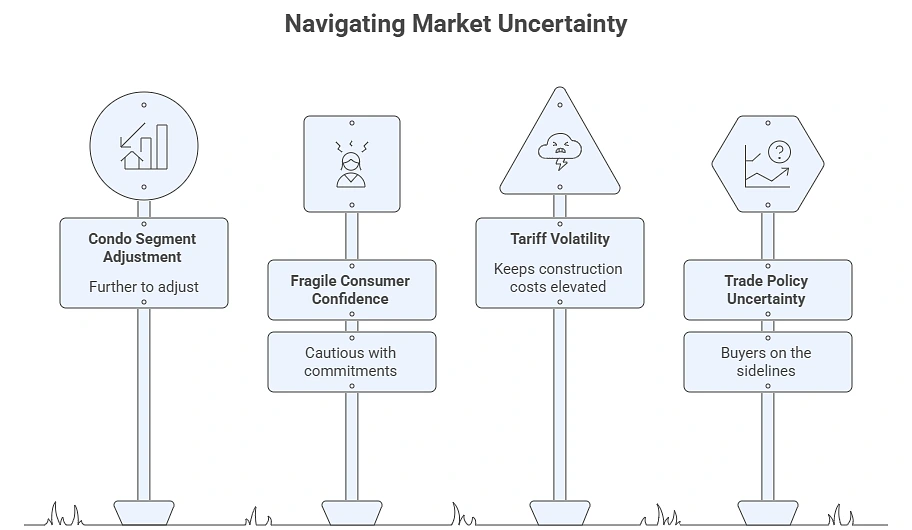
I would call it a selective recovery. The broad panic of “prices are crashing” that you saw in some headlines last year has calmed down because the numbers stabilised. But it is not a broad upswing either. The condo segment has further to adjust. The detached segment is finding a floor and in some neighbourhoods already ticking up. Interest rates are supportive but consumer confidence is still fragile, partly because of the tariff situation and partly because cost of living has gone up across the board and people are more cautious with large financial commitments.
The wildcard is what happens with the CUSMA review this year. If tariff volatility continues or gets worse, that keeps construction costs elevated and keeps some buyers on the sidelines out of general uncertainty. If there is resolution and some stability returns to trade policy, I think you will see a noticeable uptick in activity because the underlying demand is there — Mississauga’s population is around 769,000 now, household income averages sit at about $137,000, owner occupancy is at seventy percent, and immigration continues to drive long-term demand. The demand side is not broken. It is just waiting for enough confidence to act.
Last question — for someone who is reading this and genuinely trying to decide whether to buy in Mississauga right now, what is the one thing you would tell them?
Stop trying to time the absolute bottom. Nobody calls it in real time, not me, not any broker who is honest with you. What you can do is look at whether the math works for your specific situation — can you carry the mortgage at current rates, does the property meet your actual needs for the next five to seven years, and are you buying in a location where the long-term fundamentals are sound. If the answer to all three is yes, this is a good time to move. If you are buying purely as a short-term investment hoping to flip in eighteen months, this is probably not the market for that.
 Decor & Improvement Accessories