

Home & Decor Blogs: DIY, Interior Design & Lifestyle Ideas
Why The Pest Problem You’re Ignoring Right Now Is Already Getting Worse

There’s a moment, usually around 2am, when you hear something scratching inside a wall, and your brain immediately goes to the worst possible explanation. Rats. Mice. Something with too many legs. You lie there telling yourself it’s probably nothing, knowing full well it isn’t.
Most people ignore pest problems until they can’t anymore. A few ants on the kitchen counter in March. A dropping behind the fridge in October. By the time it’s obvious enough to deal with, whatever moved in has had weeks or months to get comfortable, and comfortable is exactly the word, because pests aren’t opportunists reacting to a mess. They’re patient. The house that thinks it’s clean is often just the house that hasn’t looked in the right place yet.
What Actually Costs You the Most Money
Not every pest deserves the same level of panic. Some are annoying. Some are expensive. A few are both.
| Pest | Why It’s a Problem |
|---|---|
| Carpenter ants | Hollow out wood to nest in rather than eat it, so damage stays invisible until walls or beams are already compromised |
| House mice | Active year round, not seasonal, and a single female can produce roughly 35 pups a year |
| German cockroaches | Carry an estimated 30 different pathogens, thrive fastest in multi-family housing |
| Termites | Cause an estimated $6.8 billion in property damage annually in the US, and standard homeowners insurance almost universally excludes termite damage from coverage |
Carpenter ants don’t consume wood the way termites do. They excavate it to build a nesting gallery, which is precisely why the damage stays hidden. I don’t think any notices a slowly hollowed beam until it’s already carrying less weight than it should.
Mice are the real volune problem here.
They squeeze through gaps roughly the width of a pencil, breed constantly, a single female averaging 35 pups a year, and stay active in every season, which quietly undoes the common belief that mice are only a winter concern.
The termite figure is worth naming plainly.
Six point eight billion dollars a year in property damage, and the insurance policy sitting in most people’s filing cabinet won’t cover a cent of it.
That gap between what people assume is covered and what actually is covered is where the real financial exposure lives.
What NPMA’s Own Entomologists Are Actually Saying Now
It’s tempting to frame this as “here’s what changed in 2026,” as if a single year flipped a switch. It didn’t. What actually happened is more useful to know, because it’s a real shift tracked by a real body over real time, not a marketing calendar.
The National Pest Management Association runs a bi-annual forecast called the Bug Barometer, built by its own entomologists analyzing weather patterns and pest biology across US regions. Dr. Jim Fredericks, the organization’s Senior Vice President of Public Affairs, put the shift plainly in NPMA’s own recent release:
“Spring and summer are already peak pest seasons, so we know the bugs are coming. But this year’s irregular weather patterns are accelerating pest activity, leading to earlier and more frequent encounters.”
The organization that tracks this professionally is saying the timing itself has moved, not just the volume.
Two other things are shifting alongside the timing. The EPA has been revising what pesticide products can legally be used in and around homes under FIFRA, pushing the industry toward integrated pest management, targeted treatment rather than blanket spraying, partly because regulation now requires it and partly because targeted approaches simply work better once you’re not guessing. And connected monitoring, sensors and traps that report activity before an infestation becomes visible, has moved from a novelty into something a growing share of professional services now build into a standard contract.
When to Actually Deal With What?
Pest pressure isn’t constant through the year, and NPMA’s own regional forecasting exists precisely because pest timing varies enough by geography that a single national calendar undersells the point. Still, the broad rhythm holds in most of the country.
Spring is when ants and spiders push back indoors, so a perimeter treatment around the foundation in March or April catches them before trails into the house get established. Summer shifts the concern to mosquitoes and ticks, and if there’s standing water anywhere on the property, clogged gutters, a birdbath, anything holding rain, that’s the first thing worth clearing. Autumn is when rodents start actively seeking warmth as temperatures drop, which makes it the right window for exclusion work, sealing entry points before mice get in rather than trapping them once they’ve already settled into a wall cavity.
Winter is German cockroach season indoors, since a heated building with food and water sitting nearby is close to ideal for them, especially in shared or multi-unit housing.
Why the Hardware Store Fix Usually Fails
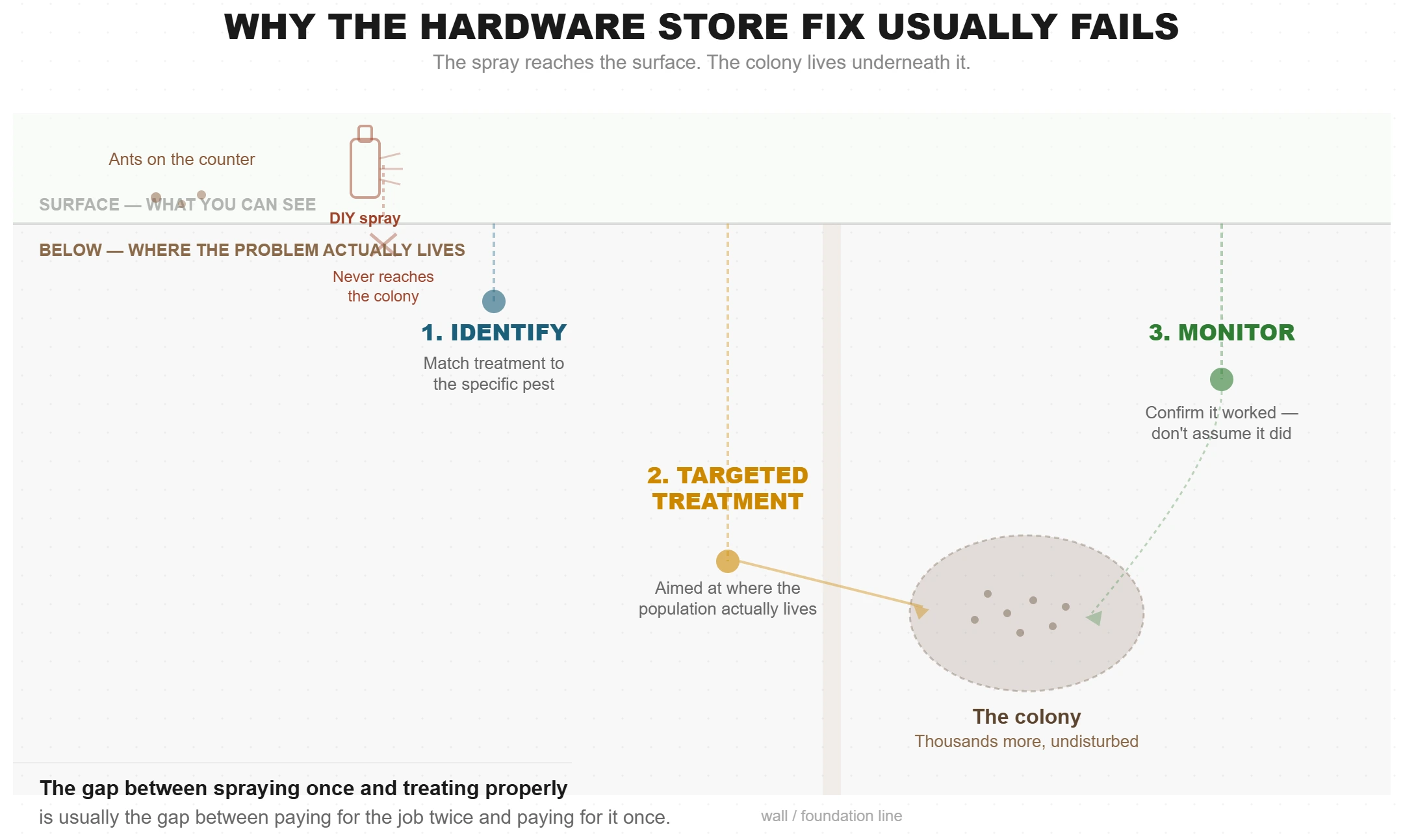
Most surface-level pest treatments, sprays, foggers, plug-in devices, fail because they’re solving the wrong layer of the problem.
They kill what’s visible while the colony, the nest, or the breeding population carries on completely undisturbed behind a wall or under a foundation. A can of spray knocks out the ants on the counter today. It does nothing to the thousands more still living in the colony that sent them there in the first place.
What separates a professional approach isn’t access to stronger chemicals, it’s the sequence. Identification first, so the treatment actually matches the specific pest rather than guessing. Targeted treatment second, aimed at where the population actually lives, not just where it’s been seen. Monitoring afterward, coming back to confirm the treatment actually worked rather than assuming it did. Professional pest control exists specifically to close that loop, because the gap between spraying once and treating properly is usually the gap between paying for the job twice and paying for it once.
Prevention That Actually Moves the Needle:
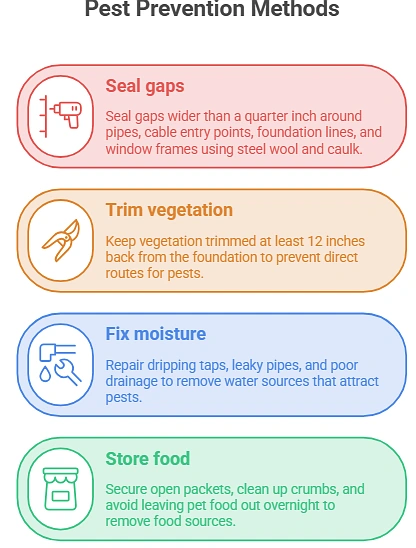
A house can’t be made completely pest-proof. It can be made significantly harder to get into and significantly less worth staying in once something does get through.
- Seal any gap wider than a quarter inch around pipes, cable entry points, the foundation line, and window frames. Mice need roughly a 6mm opening, smaller than most people assume, and packing steel wool into the gap before caulking over it stops rodents from simply chewing back through the seal.
- Keep vegetation trimmed at least 12 inches back from the foundation. Shrubs touching the house function as a direct route for ants, spiders, and rodents straight onto the exterior wall.
- Fix moisture problems early, dripping taps, leaky pipes under sinks, poor drainage around the foundation. Pests need a water source, and removing it removes a large part of what drew them in.
- Store food properly. Open packets in the pantry, crumbs under the toaster, pet food left out overnight, all of it is an open invitation, and it’s the single easiest thing on this list to fix for free.
The Shift Toward Ongoing Service
A growing share of pest control industry revenue now comes from pest control services that are subscription-styled rather than one-off call-outs, and the logic behind that shift is straightforward.
Quarterly visits with monitoring in between catch a problem while it’s still small and cheap to deal with, rather than after it’s established and expensive.
A reasonable plan typically includes scheduled inspections, treatment as needed, monitoring in known problem areas, and coverage for anything that pops up between visits. The cost varies by region and property size, but across a full year it’s usually cheaper than two or three emergency call-outs for a problem that early monitoring would have caught before it became one.
Reactive pest control, waiting until the scratching in the wall is undeniable, is slowly being replaced by preventive management. The households getting ahead of that shift are the ones spending less overall and dealing with fewer infestations that actually reach the point of real damage.
 Decor & Improvement Accessories