

Home & Decor Blogs: DIY, Interior Design & Lifestyle Ideas
Why a Consistently Clean Home Is Easier to Maintain Long Term

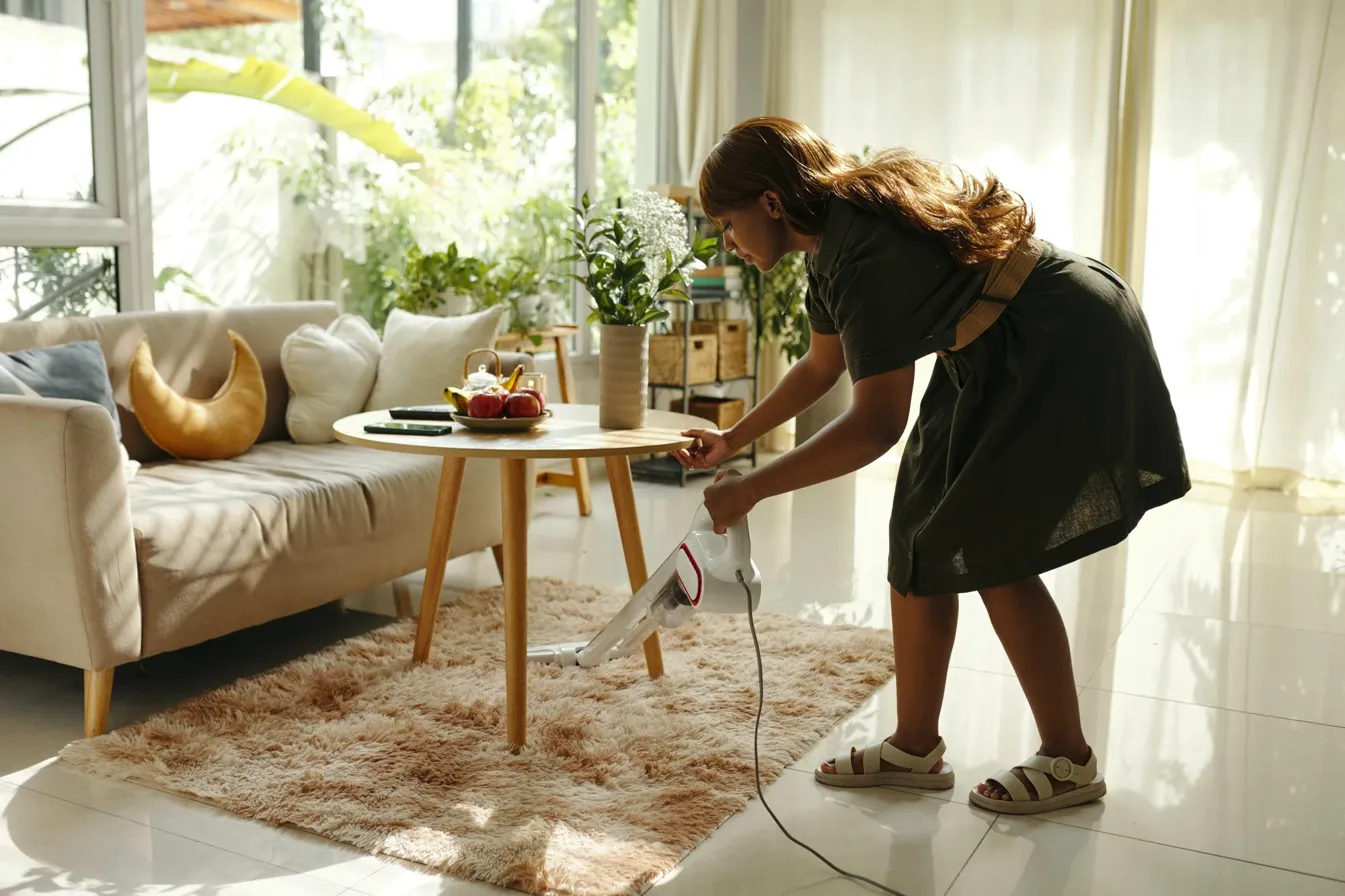
Six hours a week. That’s roughly how much time the average American spends cleaning their home. Parents with kids at home? Closer to 51 hours a month, which is a third more than childless adults, according to an Angi survey. And most of that time is catch-up — people ignoring the mess for a week or two, then burning through Saturday trying to undo it all at once.
The whole approach is backwards. You end up spending more total time cleaning by batching it into big sessions than you would doing small bits daily. But try telling that to someone staring down a filthy kitchen at 9 pm on a Tuesday when they’ve been working since 7 am, and the kids just went to bed. Consistency sounds great in theory. In practice, life makes it hard. That tension is kind of the whole point of this article.
The Compounding Problem
Coffee ring wiped up immediately: three seconds. Coffee ring left for a week: scrubbing, maybe a product, definitely annoyance. Stovetop splatter cleaned after cooking: quick wipe. Stovetop splatter after six dinners: a project.
Everything in a house works this way. Soap scum layers. Dust embeds into fabric. Grease polymerises on metal surfaces until a cloth alone won’t budge it. Two weeks of skipped cleaning doesn’t mean twice the work — it means five or six times the work because the nature of the dirt changes. Fresh mess is easy. Old mess fights back.
The American Cleaning Institute ran a national survey in 2024, and 21% of people said they skip spring cleaning specifically because it felt overwhelming. That tracks. When every surface, every room, every corner needs attention simultaneously, the scale of it is genuinely paralysing. Nobody is lazy for feeling that way. The task is objectively bigger than it should be because the compounding was allowed to happen.
What Clutter Actually Does to You
Researchers at UCLA studied 30 dual-income families and had them film self-guided tours of their homes, describing what they saw. The team ran the language through analysis software, scoring homes on how “stressful” versus “restorative” the descriptions were. Women who scored their homes as cluttered and unfinished showed flatter cortisol patterns across the day — that’s the stress hormone, and a flat slope is associated with worse health outcomes. Women who described their homes as restful had healthier cortisol curves and reported less depressed mood as the day went on.
Men in the same study didn’t show the same cortisol link. The researchers and later commentators suggested this might connect to who carries the mental load of household management — noticing the clutter means mentally processing what needs to happen about it, and that processing itself creates stress.
A separate 2025 study published in the Journal of Environmental Psychology confirmed the broader pattern: people who considered their homes more cluttered reported lower well-being, lower life satisfaction, and more negative feelings overall. Princeton researchers found that visual clutter literally competes for your brain’s attention, reducing your ability to focus on whatever you’re actually trying to do.
None of this is surprising if you’ve ever tried to relax in a messy living room and couldn’t figure out why you felt restless. Your brain was processing the disorder in the background, burning energy on it whether you realized it or not.
Daily Bits vs the Saturday Blitz
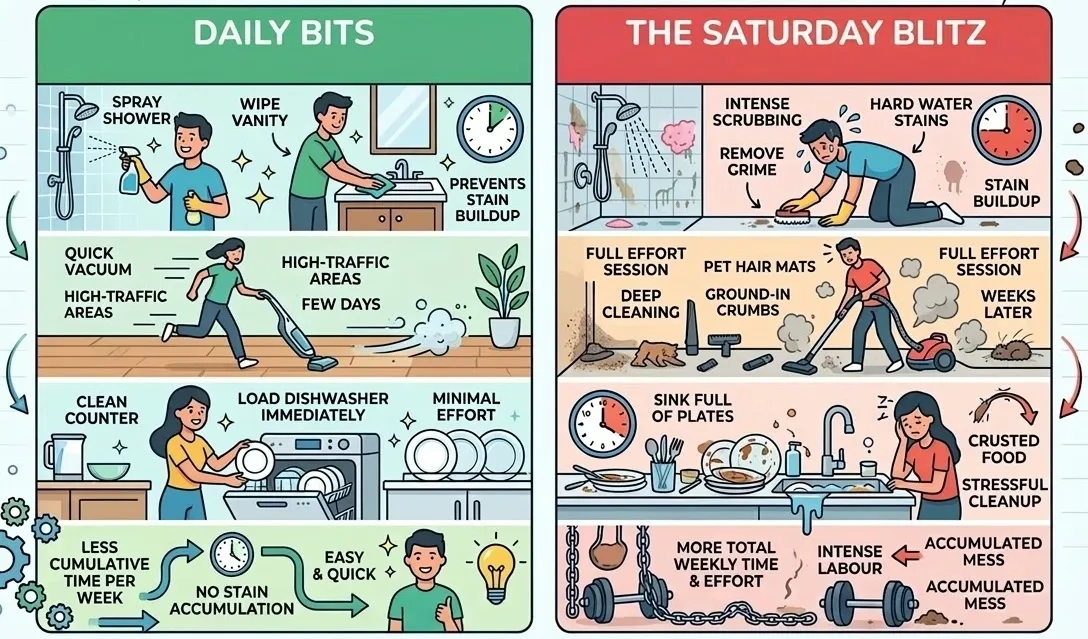
Bathrooms are the clearest example. Spray the shower walls after you use them and wipe the vanity each morning — call it two minutes total. That prevents the pink mildew, the hard water stains, the toothpaste crust around the tap. Skip it for three weeks and, you’re on your knees with a scrub brush and bathroom cleaner for forty-five minutes.
Floors same thing. Quick vacuum of high-traffic areas every couple of days: ten minutes, maybe less with a decent cordless. Wait two weeks and pet hair mats into carpet fibres, crumbs grind in, dust bunnies colonize every corner. The quick pass can’t touch that anymore. You need the full-effort session with attachments and edge cleaning.
Dishes are the one everybody fights about. Five minutes to load the dishwasher after dinner versus a sink full of crusted plates that nobody wants to deal with at 10pm. The gap between those two realities is about thirty seconds of effort right after the meal.
People who do these things daily aren’t spending more time cleaning. They’re spending less. The total hours per week drop because nothing reaches the stage where it actually requires real work.
Routine Kills the Argument
Something that doesn’t get discussed enough: consistent cleaning habits reduce household conflict. When wiping down the kitchen after dinner is just what happens — the same way everyone brushes their teeth — nobody has to ask, nobody has to nag, nobody has to resent being the only person who noticed the mess.
Decision fatigue plays into this, too. Every time cleaning is a choice you actively make, it pulls from the same cognitive pool as everything else you decide that day. Habits bypass that entirely. You don’t debate whether to wipe the counter. You just wipe it, just as you put your keys in the same spot without thinking.
Families with shared cleaning routines fight less about housework. Kids who grow up in homes where tidying is automatic — not a punishment, not a big event, just something everyone does — carry that into adulthood. It becomes their normal. That’s worth more than any single cleaning session.
When the Wheels Fall Off
42% of Americans call cleaning their least favourite household chore. But that number almost certainly reflects how most people experience it — big catch-up sessions after weeks of avoidance, dealing with compound mess that’s harder to shift, in a house that already feels stressful to be in.
Catch-up cleaning is physically harder. The grime is bonded to surfaces. The grease has cooked onto the metal. The dust has worked into textiles instead of sitting on top, where a cloth would grab it. Every task takes three or four times longer than it would have on day one.
And there’s an emotional dimension the UCLA research pointed at. Walking through a house that feels “unfinished” — stuff everywhere, visible mess in every direction — triggers exactly the stress response that makes starting feel impossible. You’re not just cleaning. You’re fighting through a cortisol spike to do something your brain is telling you to avoid because the scale of it registers as threatening.
People with consistent habits almost never experience this. Not because they have more discipline or better character. Because the conditions that create that feeling simply don’t exist in their homes.
Getting Help Isn’t Giving Up
Here’s where it gets real. Women spend about 49 hours per month on household tasks. Men spend 36. In dual-income homes with young children, that time comes from somewhere — usually sleep, personal time, or weekends that were supposed to be for rest.
Not everyone can maintain a cleaning routine alone, and pretending otherwise is unhelpful. Work schedules, health problems, caring for aging parents, managing small kids — these aren’t excuses. They’re a reality for millions of households.
Bringing in professional help, even biweekly, maintains the baseline that prevents compounding. The time you spend between visits stays short because nothing has a chance to build up past the easy-to-handle stage. The residential cleaning market is projected to reach $40.38 billion in 2025, which tells you families everywhere are arriving at the same conclusion.
If you’re considering whether outside support makes sense for your household, reading honest assessments like these thoughts on Homeaglow’s service can help you figure out what fits your budget and situation. The goal isn’t a perfect home. It’s a sustainable one.
Your Stuff Lasts Longer
Grease buildup around a stove corrodes finishes over time. Hard water deposits etch into fixture surfaces if they’re left. Carpets develop permanent matting when ground-in dirt acts like sandpaper on fibres with every step. A fridge with dusty condenser coils runs harder. A dishwasher with residue in the filter gradually stops cleaning properly.
None of this is dramatic on a Tuesday. Over three years, though, the difference between a regularly maintained home and a sporadically deep-cleaned one shows up in what needs replacing and what doesn’t. It’s the same principle as changing your car’s oil — boring, easy to skip, and much cheaper than the alternative.
Finding What Actually Sticks
A cleaning routine doesn’t mean cleaning every day. It means finding whatever rhythm keeps things from crossing the line into compound mess territory.
For some people, that’s 15 minutes every evening and one slightly longer weekend session. For others, it’s bathrooms on Monday, floors on Wednesday, and the kitchen on Friday. Some families split tasks. Some hire out the heavy work and handle daily maintenance themselves. Some manage perfectly well with a solid weekend clean as long as they do small pickups during the week.
Perfection isn’t part of this. Nobody lives in a magazine spread. There will always be weeks where life wins and the house slips. The difference is that a home with an established baseline recovers from those weeks fast. A home without one spirals into another Saturday marathon that leaves everyone exhausted and resentful.
Consistently clean homes aren’t maintained by people who enjoy cleaning. Most of them probably don’t. They’re maintained by people who figured out the minimum amount of effort that prevents everything from getting out of hand, and they do that minimum often enough that the miserable catch-up sessions stop being necessary. That’s the whole thing. Small effort, repeated. The house mostly handles itself from there.
 Decor & Improvement Accessories