

Home & Decor Blogs: DIY, Interior Design & Lifestyle Ideas
3 Tiles That Survive Constant Dampness Without Cracking, Staining, or Growing Mould
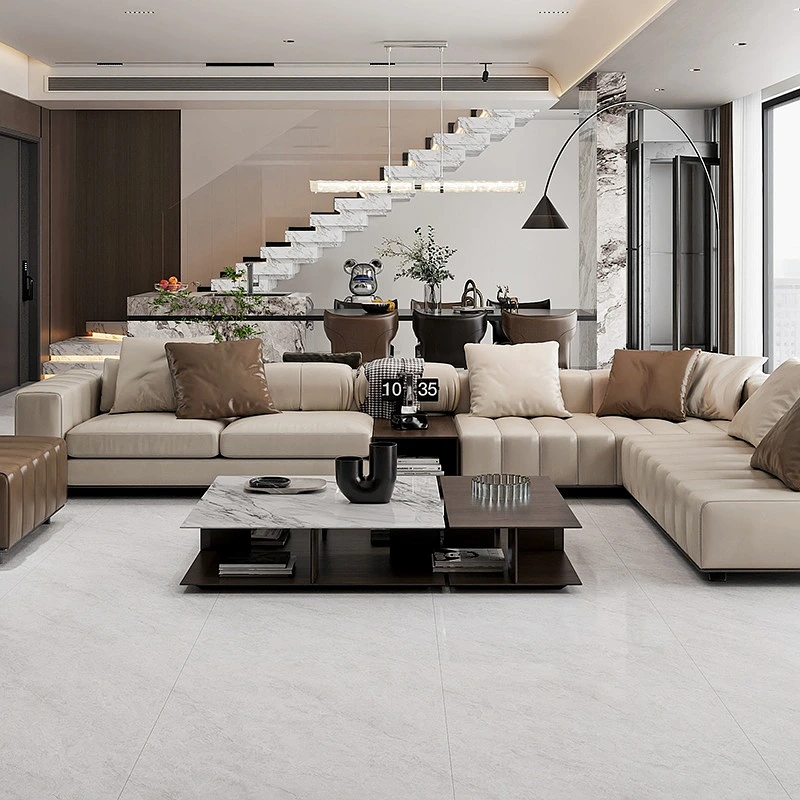
If your home stays damp — a basement bathroom with no window, a laundry that never fully dries, a ground-floor kitchen in a humid coastal climate — your tile choice comes down to three: porcelain, vitrified, and glazed ceramic with a Class III or higher PEI rating. They resist moisture differently, cost differently, and fail differently when picked for the wrong room.
Porcelain: Less Than 0.5% Water Absorption
That 0.5% figure isn’t marketing — it’s the ISO 13006 classification. Any tile exceeding that threshold can’t legally be sold as porcelain in most markets.
Porcelain gets pressed at roughly twice the pressure of standard ceramic, then fired between 1,200–1,400°C. At that heat, the silica particles partially melt and fuse into a glass-like matrix. Dense enough that liquid physically can’t penetrate it. Water that can’t enter the tile body can’t freeze inside it, can’t feed mould underneath, can’t cause expansion that pops tiles off the adhesive bed.
The raw mix is fine-grade kaolin clay (25–30%), feldspar (35–45%), silica sand (20–25%), and ball clay (5–10%). Feldspar is what does the work — it melts at a lower temperature than surrounding clay and fills the microscopic gaps. Cools into glass. Standard ceramic tiles run 3–6% open porosity. Porcelain sits below 0.5%. That gap explains why porcelain doesn’t stain, doesn’t harbour bacteria in damp conditions, doesn’t degrade under repeated cleaning chemicals.
Full-body porcelain — where colour runs through the entire thickness rather than sitting only on the surface — handles chips better in wet high-traffic areas. A chip on a through-body tile is still the same colour. A chip on a surface-finished tile exposes whatever’s underneath.
One thing worth checking before you buy: not every tile labelled “porcelain” actually meets the absorption standard, particularly from unregulated suppliers. Ask for the water absorption test result or pull up the product data sheet.
Ground-floor bathrooms, basements, laundries — rooms where standing water or persistent humidity is just normal — this is where porcelain makes most sense.
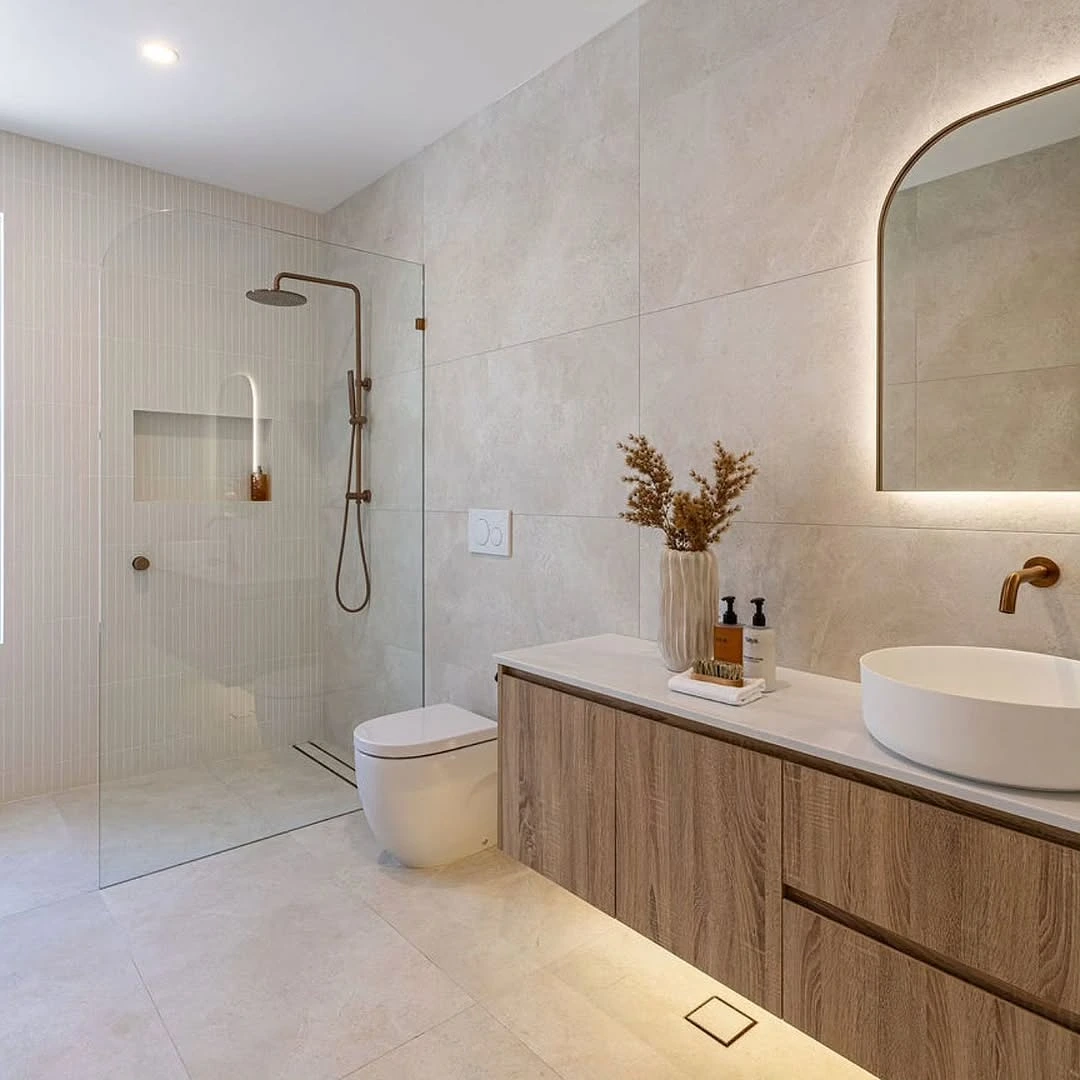
Vitrified Tiles and What “Double-Charged” Actually Means
Vitrified tiles push the same high-temperature firing process further. More complete vitrification, water absorption often below 0.1%. Some double-charged vitrified tiles test at 0.05%.
Double-charged refers to a manufacturing step where two layers of pigmented material get pressed together before firing. Top layer carries the design. Bottom layer provides structural strength. They fuse during firing into one body — no glaze sitting on the surface that can wear away over time. That’s why vitrified tiles hold up in commercial environments like hotel lobbies and hospital corridors where glazed ceramics eventually fail.
The composition is silica (40–45%), clay (25–30%), feldspar (25–30%), with small alumina additions — higher silica-to-feldspar ratio than porcelain, which increases the glass content in the finished body. Firing happens between 1,250–1,350°C, held at peak temperature longer than porcelain. That extended soak allows more of the clay body to convert to glass, leaving fewer microscopic channels for water to travel through.
They’re denser than most porcelain. Harder to cut — diamond-blade wet saw, not a score-and-snap — but more resistant to impact. In a damp laundry where heavy appliances move across the floor, that matters.
The price is 15–30% higher than equivalent porcelain. For a single bathroom, marginal. For a full ground floor in a damp-climate home, that adds up fast — and porcelain at 0.5% absorption is often more than adequate anyway. Tropical or subtropical homes where humidity rarely drops below 70%, basement conversions with known rising damp issues — that’s where the extra density of vitrified tiles justifies the cost difference.
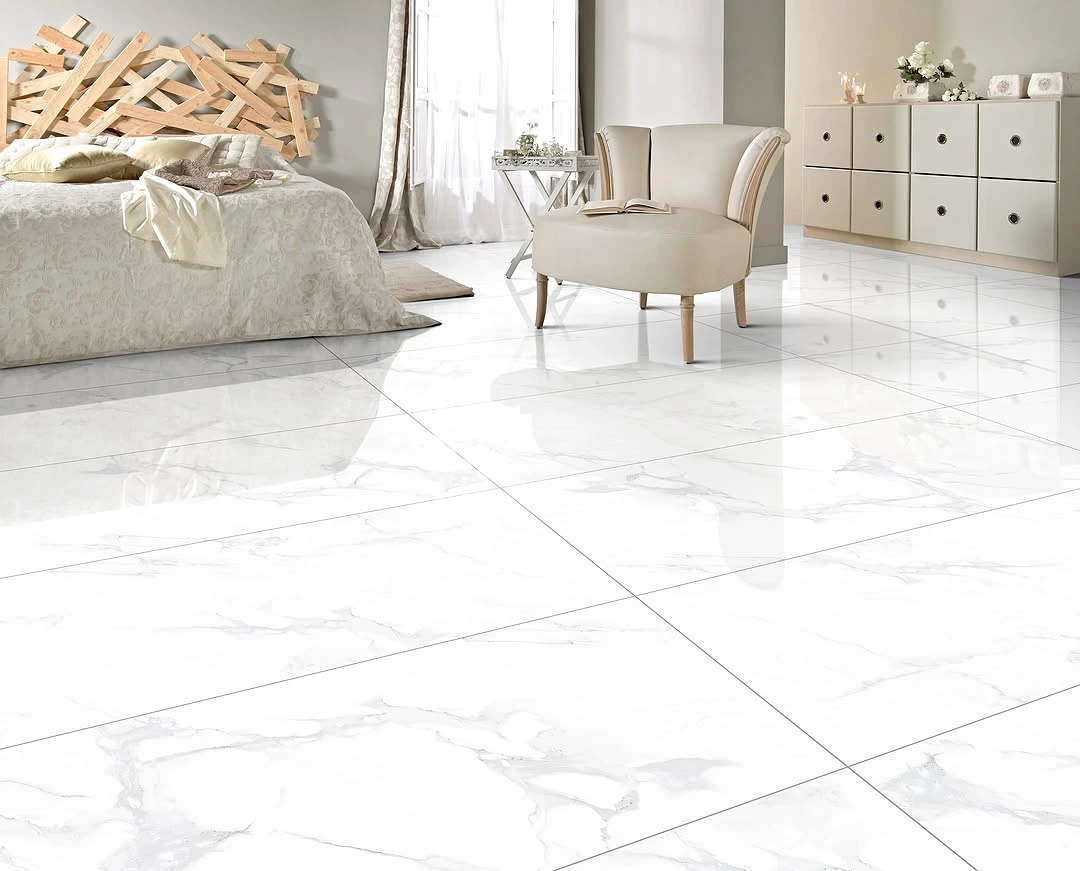
Glazed Ceramic: The Rating That Separates It From the Cheap Option It’s Usually Dismissed As
Standard ceramic with a PEI I or II rating absorbs 3–6% water and will stain, grow mould in grout lines, and deteriorate in any permanently damp room. That reputation is earned.
Glazed ceramic rated PEI Class III or above is a genuinely different product. The glaze — liquid glass applied before final firing — seals the porous clay body underneath. Water hits the surface and runs off without reaching the absorbent core.
PEI stands for Porcelain Enamel Institute. Despite the name, the rating covers all glazed tiles. It measures surface hardness and abrasion resistance, Class I through V:
Class I — wall-only, no foot traffic, purely decorative glaze. Class II — light residential, bedrooms, bathrooms with slippers. Repeated scrubbing degrades the glaze, so not suitable for damp areas with regular cleaning. Class III — moderate residential traffic, the minimum for a damp bathroom floor. Withstands regular cleaning with standard bathroom products without wearing through. Class IV — heavy residential and light commercial, kitchen floors, laundries, hallways. Tolerates abrasive cleaning products and grit tracked in from outside. Class V — heavy commercial, shopping centres, restaurants. More than a home needs, sometimes specified for garage or workshop floors.
The critical detail: PEI measures abrasion resistance, not water resistance. A PEI V tile with 6% body absorption still fails in a wet environment if the glaze gets damaged. The rating tells you how long the glaze holds — which in a damp room directly determines how long the moisture barrier stays intact.
A chip from a dropped pot or dragged appliance exposes the clay body underneath. In a dry living room that’s cosmetic. In a damp bathroom it becomes a mould entry point within weeks.
Bathroom walls, kitchen splashbacks, laundry walls — glazed ceramic PEI III+ works well and costs significantly less per square metre than porcelain. For damp-area floors where impact is likely, porcelain or vitrified is the safer long-term call.
In practical terms:
Permanently wet floors — basements, ground-floor bathrooms, pool surrounds — need porcelain or vitrified, no exceptions. High-humidity rooms with occasional water, kitchens and laundries, porcelain is the best value. Damp-area walls and splashbacks, glazed ceramic PEI III+ does the job for less. If the product data sheet shows water absorption below 0.5%, it handles any damp condition. Above 3%, keep it off wet floors.

 Decor & Improvement Accessories