

Home & Decor Blogs: DIY, Interior Design & Lifestyle Ideas
5 Best Shower Filters for Chlorine and Chloramine and How to Check Which One Your Water Actually Has

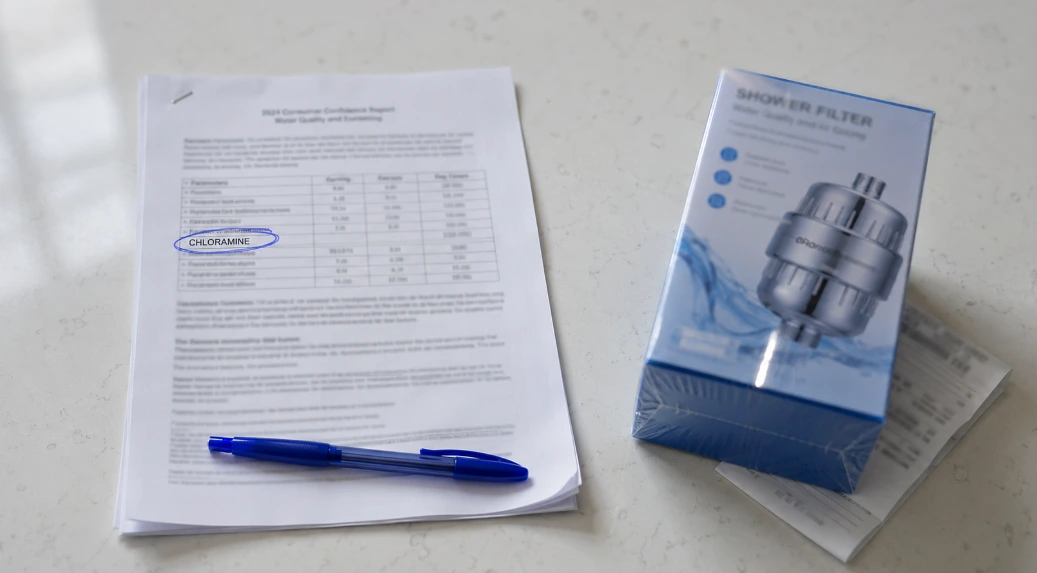
There is a decent chance you are about to spend money solving the wrong problem, and the check that would tell you takes about two minutes.
Water utilities disinfect with one of two things. Free chlorine, which is what everyone assumes and what every shower filter on the market is built around, or chloramine, which is chlorine bonded with ammonia and deliberately more stable so that it survives the long journey through the distribution pipes without breaking down.
That stability is the whole problem. The thing that makes chloramine useful to a water utility is exactly the thing that makes it difficult to strip out at your showerhead, and a filter designed around free chlorine will not do a great deal about it.
Your utility publishes an annual water quality report and the disinfectant is named in it. Go and look before you buy anything, because that one word decides whether the rest of this article is useful to you or not.
Your Shower Filter Has About One Second To Do Its Job
This is the bit that made me look at the whole category differently, and once you understand it you can throw out about half of what gets sold.
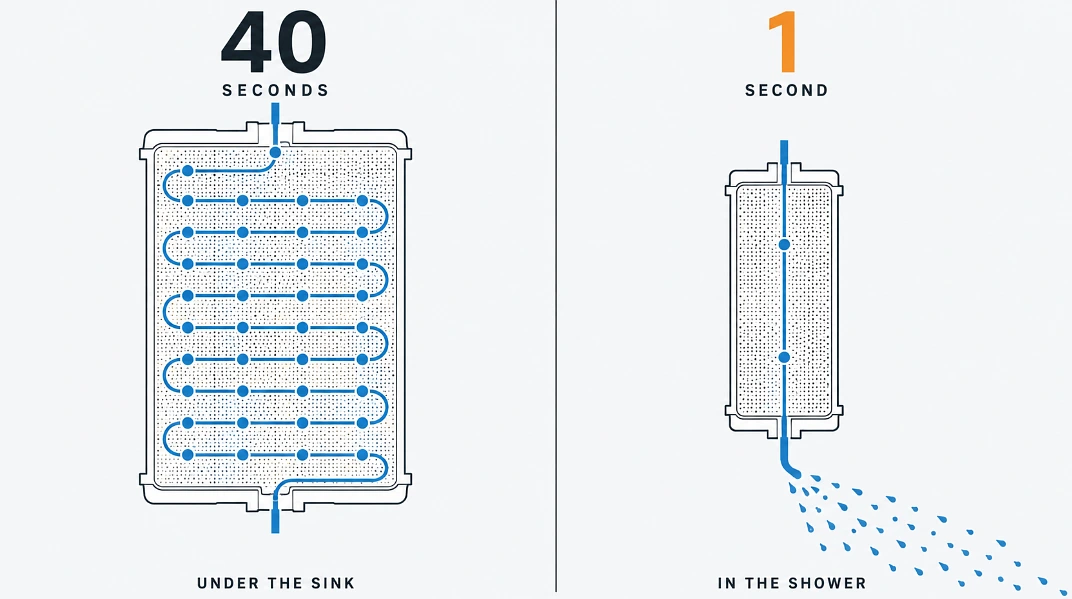
A drinking water filter sits under your sink and water moves through it slowly. Your shower is the opposite situation entirely. Water is arriving at pressure, it is passing through a small plastic cylinder, and the contact between the water and the media is measured in something like a second. Then it is out of the showerhead and running down your back.
Activated carbon, which is what most cheap filters are packed with, works by adsorption. The chlorine molecules have to physically stick to the surface of the carbon pores, and that process wants somewhere between twenty-five and forty seconds of contact time to work properly.
You are giving it one.
And then it gets worse, because carbon’s ability to hold chlorine drops off as the water gets hotter, and you are showering at somewhere around a hundred to a hundred and ten degrees Fahrenheit. So a carbon shower filter is being asked to do a job it needs forty seconds for, in one second, at a temperature that reduces its capacity anyway.
Which explains a great deal about why people replace these things every three months and are never entirely sure whether they are working.
What Does Work In A Hot Shower
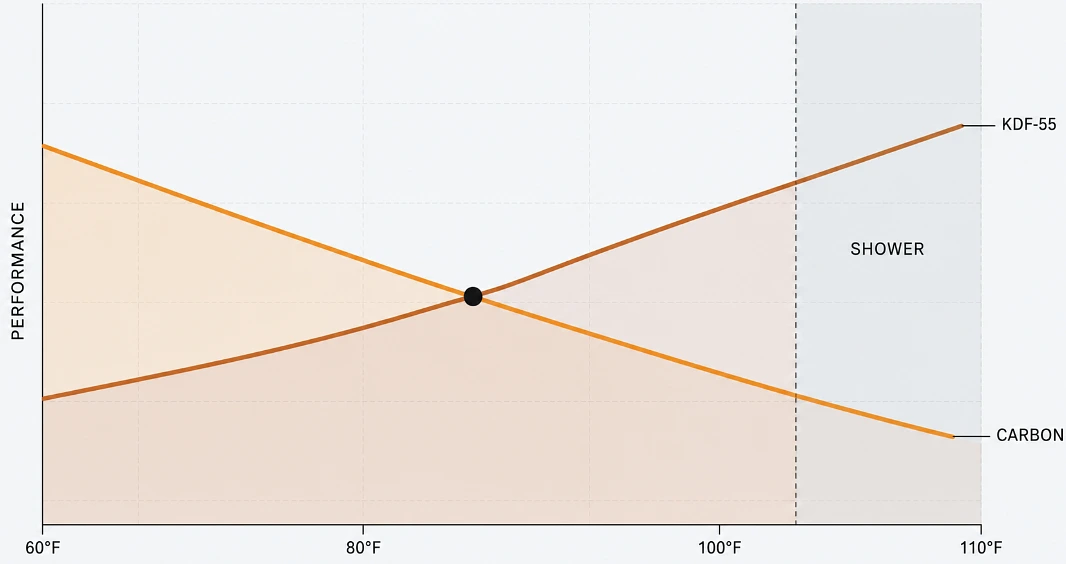
- KDF-55 is a copper-zinc alloy, roughly fifty-five percent copper and forty-five percent zinc, and it does not rely on sticking anything to a surface. It runs a redox reaction, donating electrons to chlorine molecules and converting free chlorine into harmless chloride, and that reaction happens on contact rather than needing dwell time.
Here is the part I genuinely enjoy. The reaction speeds up as the water gets warmer. Heat is the one variable in a shower that helps KDF rather than hurting it, which makes it more or less the only media in this category that likes the conditions it has been put into.
- Calcium sulfite is the other one that holds up in hot water, and it is commonly layered alongside KDF so that between them they cover more of the flow. Combinations of the two are what sit inside most of the filters actually worth buying.
Carbon still has a role, and it is a supporting one. It handles odours and some organics reasonably well. It is simply not the thing doing the chlorine work, whatever the packaging says.
Aquabliss, And The Stage Count Nonsense
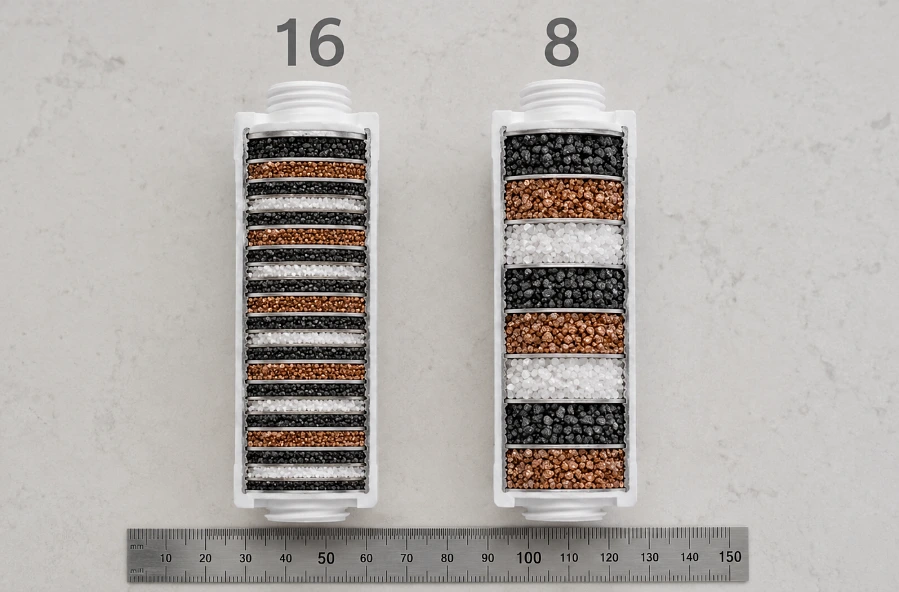
Aquabliss is the one most people land on first, counted as a best filter for removing chlorine, largely because the multi-stage cartridges do genuinely combine media rather than relying on a single material, and combinations are the right approach here.
But since Aquabliss is also where most people first meet the stage-count marketing, let us deal with that here.
A sixteen-stage filter and an eight-stage filter frequently contain roughly the same quantity of media. The stages are layers, and layers can be made thinner. Doubling the number on the box does not double what is inside it, and the number of stages tells you nothing at all about how much KDF or calcium sulfite is actually packed in there, which is the thing that determines how long it lasts and how well it works.
What to look at instead:
- Which media are named, specifically, not “proprietary blend”
- The rated cartridge life in gallons, not in months, since months assume a household size that may not be yours
- Whether the flow rate drops enough to annoy you, because a filter that turns your shower into a dribble gets removed within a fortnight
Sprite And Aquasana, Where The Certification Question Lives
These two go together because they are among the few brands with shower products that have pursued NSF/ANSI 177, which is the shower-specific standard for free chlorine reduction.
Sprite has been making shower filtration for decades and uses its own Chlorgon media alongside KDF. Aquasana is a broad water filtration company whose shower line is built to pair with a separate showerhead. Both are established, both are reasonable, and both are where you should go if verified testing matters more to you than a long list of stages.
Now the thing to actually do with that information, and it is more important than which of the two you pick.
A brand holding a certification on one model does not certify the rest of its catalogue. Check the specific model number you are about to buy against the NSF listings database directly, rather than trusting a badge on a product page. Very few shower filters worldwide hold the 177 listing, so any brand that has it on a particular model has earned the mention, and any brand implying it applies across the range has not.
The Aquasana AQ-4100 is one of the models people commonly point to as carrying certification. Verify it yourself anyway. It takes a minute and it is the only claim in this entire category that can be independently confirmed.
Jolie
Jolie built its reputation on looking like a showerhead rather than looking like a plumbing attachment, which sounds like a shallow reason to buy something until you have lived with a grey plastic cylinder hanging off your shower arm for two years.
Underneath the design, the cartridge is a KDF-55 and calcium sulfite blend, which is the correct pairing for a hot shower.
They also publish clinical testing showing reduced hair shedding, around forty-six percent less on average in their study, and I want to be even-handed about that. It is unusual for a brand in this category to run any clinical work at all, and that deserves credit. It is also testing commissioned by the company selling the product, which is how almost all testing in this industry works, and you should read it with that in mind rather than as independent proof.
Berkey
Berkey is a countertop drinking water company that also makes shower filters, and there is nothing wrong with that.
The shower products use KDF media, installation is uncomplicated, and if you already own their gravity system and trust the company, extending that to the shower is a perfectly sensible thing to do. That is genuinely the whole entry. Not every brand needs three paragraphs.
The Chloramine Question, Where Everybody Is Selling You Something
Back to where we started, because if your utility uses chloramine this is the section that matters and I am not going to pretend it is settled.
Companies selling vitamin C filters will tell you that KDF-55 falls below ten percent effectiveness against chloramine within about sixty days, and that ascorbic acid neutralises both chlorine and chloramine through a reaction fast enough for shower flow rates.
Companies selling KDF will tell you it is the gold standard for chloramine precisely because it does not depend on carbon pores clogging with ammonia byproducts.
Both of those are being said by people with something to sell, and the independent testing that would settle it is thin. What most of the neutral sources agree on is narrower and more useful: chloramine is harder to remove than free chlorine, it needs different chemistry or considerably more contact time, and a standard chlorine filter will underperform against it.
So if your water report says chloramine, treat every product claim in this space with more suspicion than usual, ask specifically what testing exists on chloramine rather than chlorine, and accept that you may be choosing between imperfect options rather than finding a clean answer.
Two Claims To Walk Away From
Fluoride removal. No shower filter is doing this. The media required needs extended contact time that shower flow rates simply do not allow, so a filter advertising fluoride reduction is telling you something about the company rather than about the product.
Bacteriostatic protection. This one is usually true but meaningless as a selling point. KDF inhibits bacterial growth inside the cartridge housing, which is a useful property of a media you were buying anyway. It is not a separate feature and it does nothing for your water.
What It Costs Over A Year, Which Is Not The Sticker Price
The number on the box is the entry fee and the cartridges are the actual cost.
A forty dollar filter taking twenty dollar cartridges every three months runs you a hundred and twenty dollars a year, and a more expensive unit with a longer-lived cartridge can come out cheaper over the same period. Work it out before you buy rather than discovering it at the third replacement.
And replace on schedule. A spent cartridge is not a weak filter, it is a plastic cylinder with used media in it, and there is a reasonable argument that it is doing worse than nothing at that point because you believe you are protected.
So, In Order
- Find your utility’s water quality report and read which disinfectant they use.
- If it says free chlorine, look for KDF-55 and calcium sulfite together, and treat carbon as a bonus rather than the main event.
- If it says chloramine, slow down, ask harder questions, and expect a compromise.
- Check the specific model against the NSF database rather than the badge on the page.
- Ignore the stage count and look at the gallon rating.
- Do the annual maths including cartridges before you decide anything.
None of the five brands here is a bad choice for the right water. The mistake people make is not picking the wrong brand, it is buying before finding out what is in the pipe.
 Decor & Improvement Accessories