

Home & Decor Blogs: DIY, Interior Design & Lifestyle Ideas
Wood to Concrete Fasteners for Decking: 5 Types That Survive Treated Lumber Contact

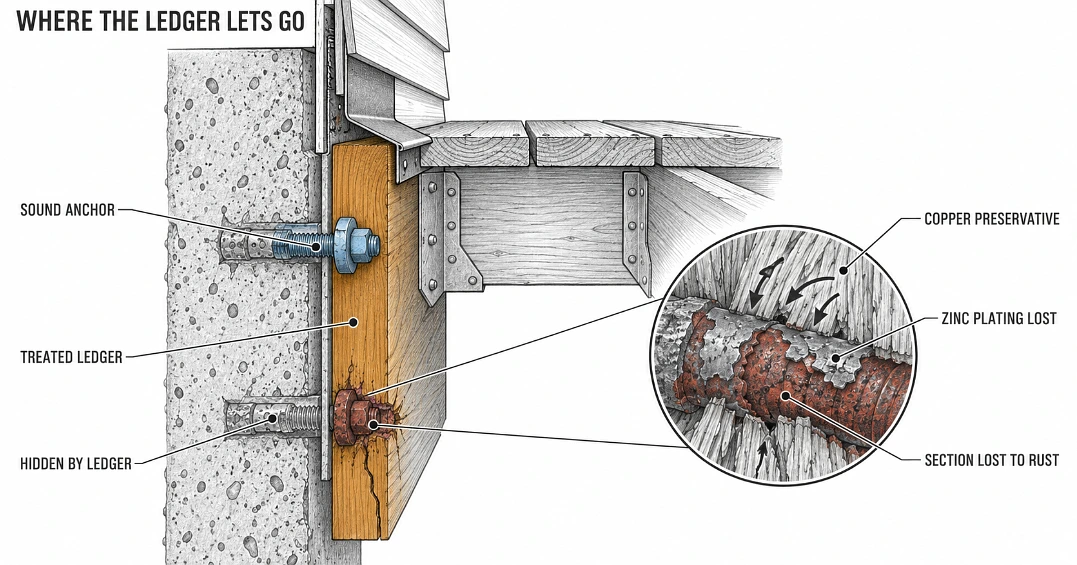
A deck ledger fails at the bolts, not at the wood. The lumber is pressure treated with copper, the copper eats ordinary zinc plating, and the bolt that looked fine on the day of the build is rust behind the ledger within a few seasons. It stays out of sight until the ledger lets go.
So the whole question of fastening a ledger to concrete comes down to 2 things. Can the steel live against copper treated lumber, and is there an evaluation report that says the anchor holds what it claims to hold in concrete. Everything else, price, availability, how many steps the install takes, is secondary to those two.
Five systems meet both tests. They are ranked below from the one that suits most ledgers down to the budget option that still passes code, and the ranking turns on how well each one handles corrosion, what the published numbers say it will carry, whether an ICC-ES or IAPMO report backs those numbers up, and how forgiving it is to install.
1. Stainless Concrete Screw Anchors Suit Most Deck Ledgers
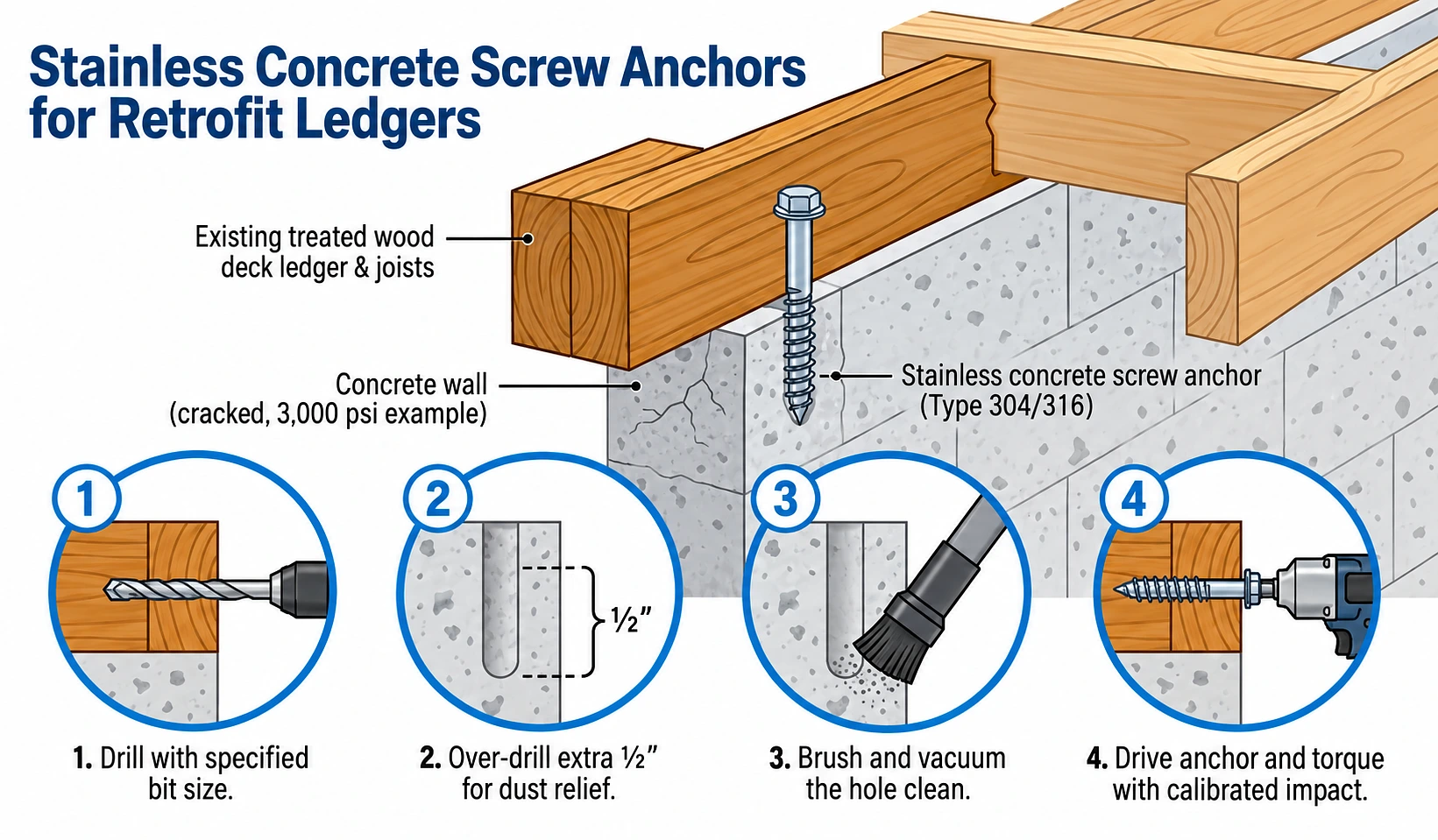
Before sizing a single anchor, open Simpson Strong-Tie’s Deck Connection and Fastening Guide. The ledger page says the Titen HD heavy duty screw anchor can go in as a direct 1 to 1 replacement for half inch bolts fastening a deck ledger to concrete or grout filled masonry under the International Residential Code. The Titen HD comes in Type 304 and 316 stainless and in a mechanically galvanised finish.
That guide is also the clearest reference going on wood to concrete fasteners for decking, since it draws the ledger to concrete and ledger to block details with the anchors staggered vertically and spaced to Simpson’s engineering letters. Keep it open while confirming the spacing for your own wall.
A screw anchor goes in without hammering and leaves no stud sticking out. Drill, drive, tighten. The self cutting threads suit narrow stem walls and walls full of rebar, and if the ledger is already framed, the anchor can be driven straight through it. If the ledger needs shifting a touch, the anchor backs out and resets within the limits in the evaluation report, which is something no wedge anchor will do for you.
It still wants doing properly. Use the bit the maker specifies, drill a little deeper than the embedment so the dust has somewhere to go, clean the hole, and drive with the tool they name. Over torque and the concrete threads strip. Under torque and the ledger is loose. Hilti and DEWALT both make stainless screw anchors with their own evaluation reports if Simpson is not what the yard stocks.
Type 316 for salt, pool or de icing exposure, Type 304 for an ordinary exterior deck. And skip the bi metal versions where only the tip is stainless, because the tip is not the part touching the treated lumber. The body is.
2. Stainless Wedge Anchors For Solid Concrete With Room To Swing

Where the concrete is sound and there is space to hammer an anchor through the ledger, a full body Type 304 or 316 stainless wedge assembly is a strong second. Bolt, clip, nut and washer all in the same stainless.
Simpson’s Strong-Bolt 2 comes in 304 and 316 and in mechanically galvanised, and it is listed under ICC-ES ESR-3037 for both cracked and uncracked concrete. Hilti’s KB-TZ2 and DEWALT’s Power-Stud+ SD6 are the stainless wedge options from the other two, each with its own report.
Installation is the simplest on this list. Drill the specified hole, clear the dust, drive the anchor through the ledger, tighten to the listed torque.
It sits second rather than first for 2 reasons. It needs more room to install than a screw anchor, and once it is set it is set. There is no backing it out and trying again.
3. Adhesive Anchors With Stainless Rod For Concrete You Do Not Trust

Thin concrete that might split. A patched hole that a mechanical anchor would just spin in. Rebar exactly where the anchor needs to go. In any of those, a qualified adhesive with full length stainless threaded rod is the safer route.
The advantage is that you choose everything. Rod diameter, how far it projects, how deep it embeds, all matched to the concrete you have rather than to a fixed anchor length. No expansion forces either, which means less breakout near an edge. Simpson SET-3G, Hilti HIT-HY 200 V3 and DEWALT AC200+ Gold all carry published evaluation reports, and the report is where the rod size, embedment and concrete condition get confirmed before ordering.
Where adhesive goes wrong is cleaning and curing. Drill with an approved bit, brush and vacuum the hole until it is clean or use a listed hollow bit that does it for you, fill from the back of the hole forward, turn the rod as it goes in, and then wait. Full cure. The temperature and the cartridge label decide how long that is, and nothing else does.
Corrosion rules do not change because there is resin involved. Type 316 rod, nut and washer near salt, pools or de icing, Type 304 for an ordinary deck. The adhesive is structural glue, not a coating, and it protects nothing.
It costs more. One cartridge, a nozzle and a rental gun can outprice a box of wedge anchors. On irregular or hollow substrates the saving in redrills tends to pay that back, and on a straightforward wall it does not, which is why this ranks third rather than first.
4. Cast In Bolts And Standoff Post Bases For New Concrete

When the footings or piers are still to be poured, the anchor goes in before the concrete hardens and the whole drilling problem disappears. No dust, no torque check later.
Set a plywood template the width of the post, push half inch bolts through it at the required projection, often 2 and a half inches above the form, brace it level and let the concrete cure. Once the forms come off, a listed standoff post base slips over each bolt and the nut snugs down. Simpson’s ABU44SS is the usual pick, 316L stainless with a built in 1 inch standoff, so the wood sits an inch clear of the slab and out of standing water.
Because the hardware is inside the concrete for good, the metal gets chosen once. Type 316 stainless in salt, pool or de icing zones, ASTM A153 hot dip galvanised inland. Nut and washer in the same metal family as the bolt, since mixing metals is how galvanic corrosion starts.
This ranks fourth only because it suits new work and nothing else. It cannot retrofit. When you control the pour, though, each bolt lands exactly where the post needs it.
Check the template twice before the truck arrives. A bolt in the wrong place afterwards means drilling and epoxy, which is the exact labour this method exists to avoid.
5. ASTM B695 Class 55 Mechanically Galvanised Anchors When Stainless Is Not In The Budget

Stainless is not always affordable, and on an inland deck it is not always necessary.
IRC R317.3.1 accepts mechanically deposited zinc to ASTM B695 Class 55 or better for fasteners in preservative treated wood. Class 55 means at least 55 microns of zinc, about 2.2 mils, which is a different thing entirely from the thin electro plating on a retail anchor.
Simpson offers the coating in both styles, the Strong-Bolt 2 wedge and the Titen HD screw anchor, and installation is identical to the stainless versions. Right bit, clean hole, drive or torque to spec. The saving against the same size in stainless is real, and on a ledger that wants a dozen anchors it adds up to money better spent on flashing or sealer.
The limits are in Simpson’s own guide. Ocean salt air, de icing salt, pool and hot tub chemicals all raise corrosion risk, and for high and severe exposure the guide says stainless. Check the current ICC-ES or IAPMO report for the specific product too, because some mechanically galvanised SKUs are listed for uncracked concrete only.
Used where it belongs, a mild inland environment, Class 55 passes code and lasts.
Which Fastener Fits Which Deck
| Situation | Recommended system | Key material note |
|---|---|---|
| Ledger on a poured concrete or grout filled block wall | Stainless concrete screw anchor | Type 304 inland, Type 316 coastal |
| Solid concrete with room to hammer | Stainless wedge anchor | Verify the current evaluation report |
| Old, irregular or lightly cracked concrete | Adhesive anchor with stainless rod | Observe full cure time |
| Hollow masonry or questionable fill | Adhesive or mechanical anchor listed for block | Add screen tubes if required |
| New footing or pier | Cast in bolt with standoff post base | Choose stainless or hot dip galvanised before the pour |
| Inland budget deck away from salt and pool chemicals | ASTM B695 Class 55 mechanically galvanised anchor | Not for chloride or pool splash areas |
| Coastal spray, de icing salts or pool splash | Any anchor in Type 316 stainless | Full stainless assembly, bolt, nut and washer |
Fasteners That Do Not Belong On A Ledger

Some hardware looks tough enough and is not. Unless an ICC-ES or IAPMO report lists it specifically for exterior concrete ledger work, leave it in the box.
- Ordinary deck or drywall screws. Not rated for ledger loads, and the thin electro zinc coating corrodes fast against treated lumber.
- Wood to wood structural screws like GRK RSS or LedgerLOK. Fine in framing, but with no masonry thread and no concrete report they strip or split the hole rather than gripping it.
- Zinc plated retail sleeve anchors. The plating is meant for dry interior use and sits far below Class 55. Outdoors it rusts behind the ledger, out of sight.
- Powder actuated pins. Fired by a powder load, holding by friction rather than thread, and not a ledger anchor by any report.
- Anything shot through brick veneer into the air gap. The veneer holds almost nothing, and the structure that would hold is several inches further back.
The One Line To Read Before Buying
The right fastener for a deck ledger is a complete stainless or properly coated assembly with a current evaluation report for exterior use. Screw anchors suit most ledgers, wedge anchors suit sound concrete with room to work, adhesive and rod suit edges and poor concrete, cast in hardware suits a fresh pour.
When in doubt, read the first line of the evaluation report. If it does not mention concrete ledger, preservative treated lumber and exterior exposure, the fastener goes back on the shelf.

 Decor & Improvement Accessories