

Home & Decor Blogs: DIY, Interior Design & Lifestyle Ideas
The Tide Mark On The Furnace Decides Everything After A Basement Flood
The water has gone down, the basement smells like a river, and the furnace is standing there with a brown line across its cabinet about a foot off the floor. That line is the whole story. Before the insurance adjuster, before the heating company, before anyone has opinions, go down with a tape measure and a phone and read it, because every decision that follows is going to be made from that height and you are the only one who can measure it while it is still fresh.
We spent a week in the trade guidance and the heating forums on this and the rule underneath it is firmer than the usual “have it inspected” line lets on. Some parts of a furnace dry out. Some parts, by the makers’ own rule, are replaced the moment water touches them, whatever they look like after. Which parts those are depends on how high the line sits, and on something about the furnace that almost no flood guide mentions.
Measure The Tide Mark Before Anyone Arrives
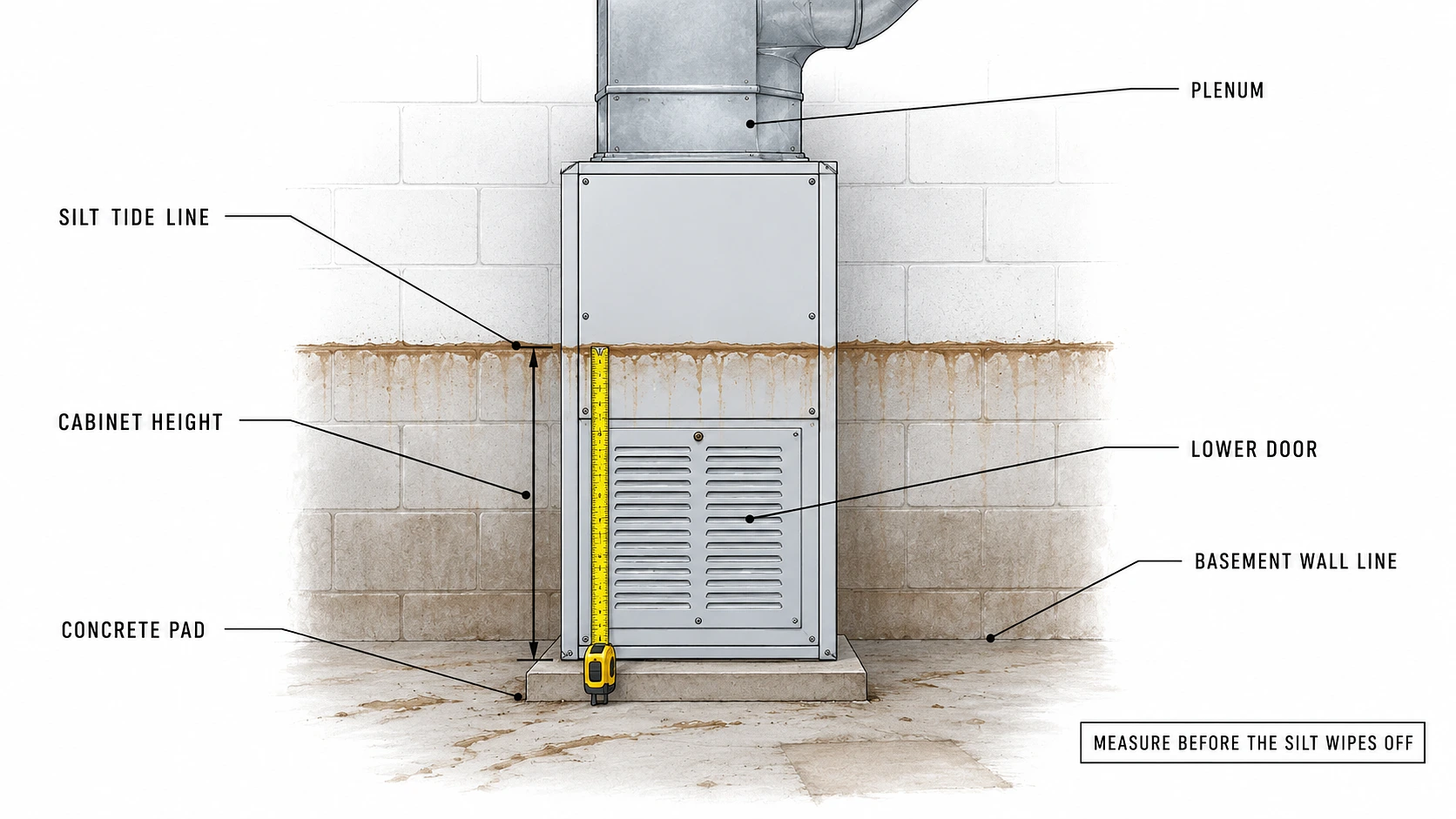
Floodwater leaves silt, and the silt dries into a line on everything it touched, the way a bath leaves a ring. Measure it in 4 places and photograph each one with the tape in the shot:
- On the wall, floor to the line. That is how deep the water was in the room.
- On the furnace cabinet, floor to the line. If the furnace sits on a concrete pad or on blocks, this number is lower than the wall by the height of the pad, and both numbers get written down, since the furnace only cares about its own.
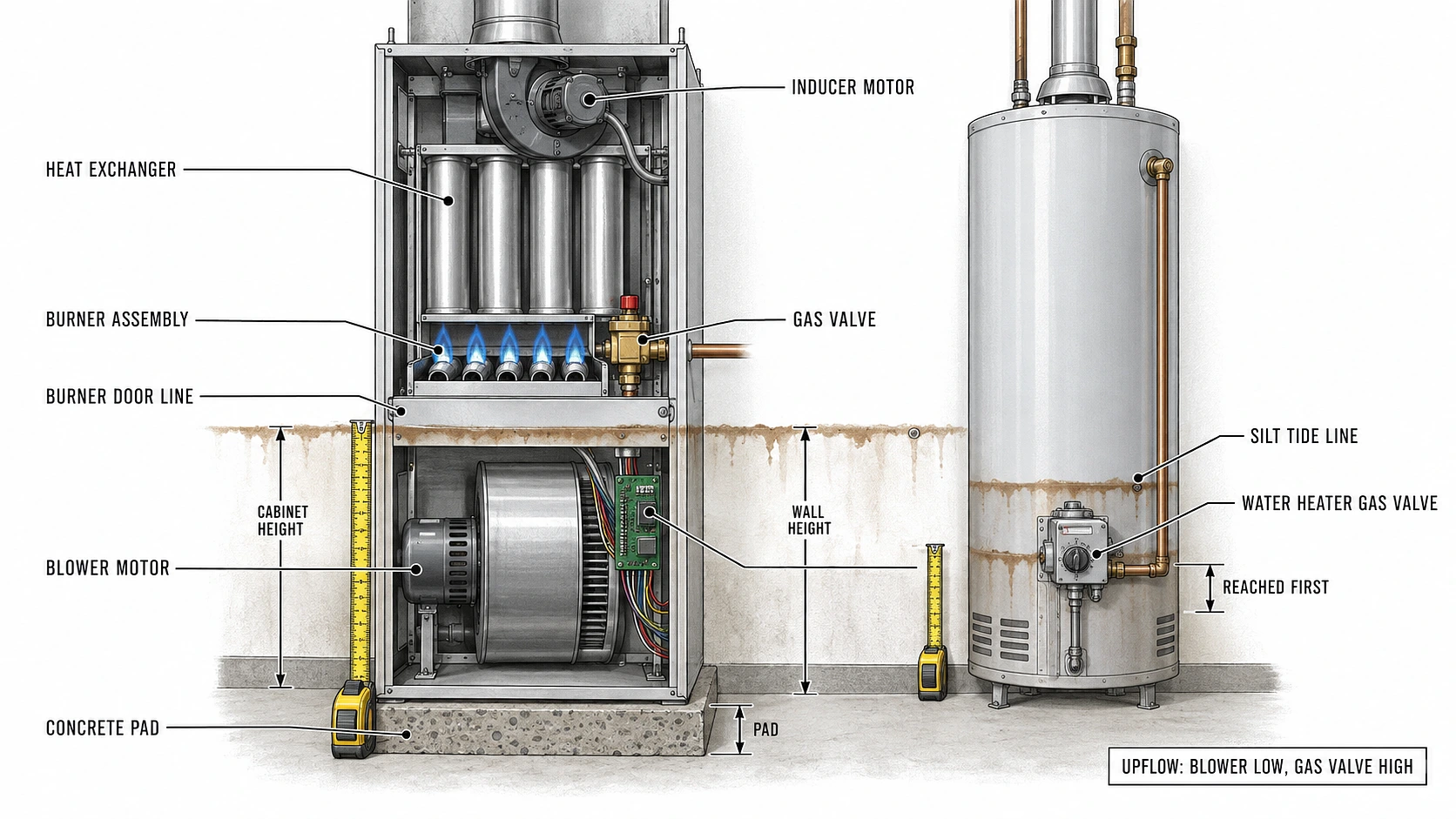
- On the water heater beside it. Its gas valve sits low on the tank, lower than anything on the furnace, so it is usually the first thing the water reached.
- On the electrical panel, if the water got anywhere near it.
The number on the furnace cabinet, in inches, is the one every phone call for the next 2 weeks is going to ask for, so write it on the cabinet in marker before the silt wipes off.
Image needed here for reader understanding: a basement furnace drawn front on with a brown silt line across the cabinet, a tape measure held against it, the blower door, burner door and gas valve labeled at their heights, and a water heater beside it with its own lower line.
Which Way The Furnace Is Built
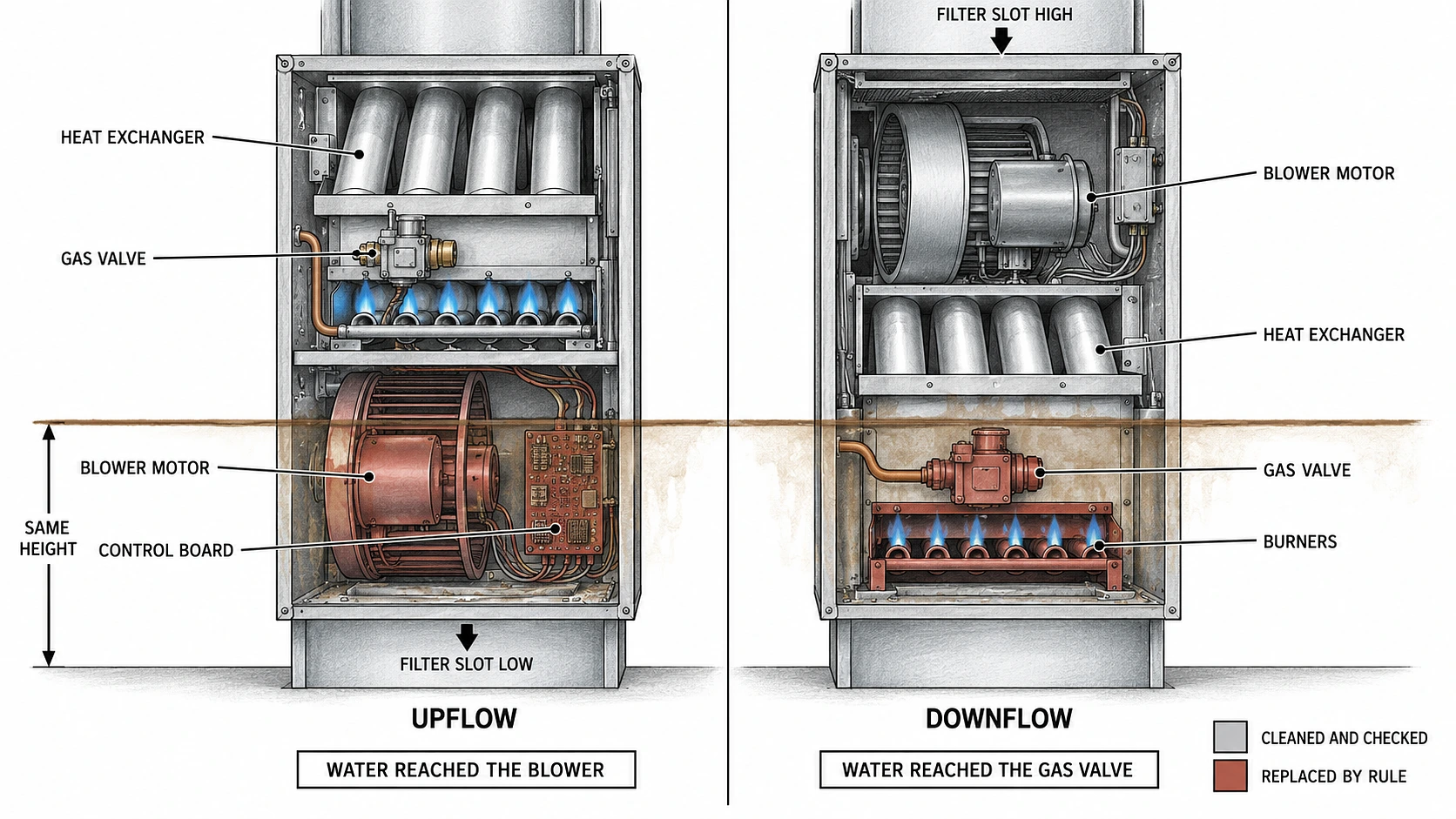
Most basement furnaces are upflow, and the flood guides never say so, which means the blower sits in the bottom compartment, pulling air in low and pushing it up through the burners and out the top into the ducts. So in an upflow furnace the blower motor and often the control board are the lowest electrical parts, and the gas valve and burners sit above them behind the upper door.
Look at where the filter slides in. A filter slot at the bottom of the cabinet, or in the return duct at the bottom, means upflow. A slot at the top means downflow, which turns the whole thing upside down, burners low and blower high, and is rarer in a basement. A horizontal unit lying on its side in a crawl space has everything at about the same height.
So 6 inches of water in an upflow furnace has reached the blower motor and possibly the board and has not touched the gas valve. The same 6 inches in a downflow furnace has reached the gas valve first. Two houses, the same tide mark, 2 different answers, and the reader who knows which furnace they have walks into the conversation ahead.
The 3 Heights And What Each One Means
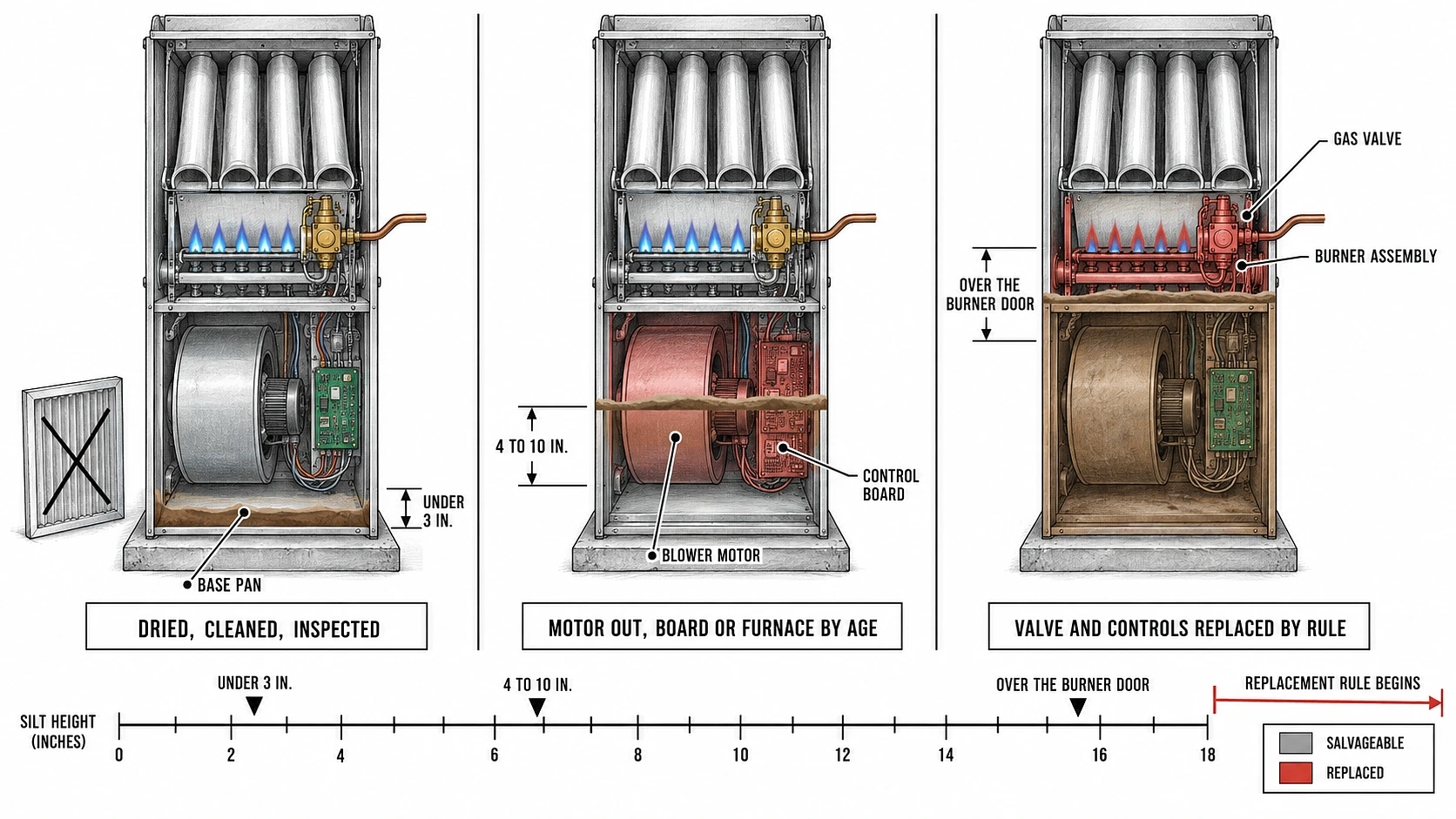
A Few Inches At The Base
Water that stayed under the blower door, 2 or 3 inches on the cabinet of an upflow furnace, has wet the base pan and the bottom of the cabinet and not much else. The furnace gets opened, dried, the base cleaned of silt, the bottom of the blower compartment checked for damp, and it is usually back in service after an inspection. The filter is thrown away whatever it looks like, since it has been sitting in flood air.
Up To The Blower
Once the mark reaches the blower compartment, roughly 4 to 10 inches on most upflow units, the motor has been in the water, and a motor that has been in silt is a motor with grit in its bearings and water in its windings. It may run. Running is not the test. The control board sits in the same compartment on a lot of furnaces, and a board that got wet is a board that will do odd things in January, so the blower motor is usually replaced and the board is replaced or the furnace is, depending on age.
Over The Gas Valve
At this height opinion stops. The US Consumer Product Safety Commission put the rule out after the 1997 floods and has never softened it:
Gas control valves on furnaces, water heaters, and other gas appliances that have been under water must be replaced. Gas control valves that have been under water cannot be salvaged; they must be replaced.
AHRI, the association of the companies that make the furnaces, says the same thing in its own words, that contractors must replace all valves and controls that have been in contact with flood water, because the corrosion starts inside the valve where no inspection can see it. The same rule covers the breakers and GFCIs in the panel if the water reached them. And for the water heater the rule is stricter again: flooded, replaced, gas or electric, whatever its age.
That is the sentence to read twice, because the furnace is going to look fine. A technician on the heating trade’s own forum, where they talk to each other and not to customers, put it this way after a flood season:
I’ve seen water damaged furnaces “dried out and cleaned” and then light on fire a few months later. Controls, wiring, gas valve must be replaced if flooded.
So over the gas valve there is no inspection that ends in “it is fine”. There is a valve replaced and the burners cleaned on a newer furnace, or there is a new furnace on an older one, and the age arithmetic is short. A valve, a board and a blower motor on a 15 year old furnace is most of the price of a new one, and the new one has not been under water.
| Tide mark on an upflow cabinet | What it reached | What happens to it |
| Under 3 inches | Base pan, cabinet bottom | Dried, cleaned, inspected, usually back on |
| Roughly 4 to 10 inches | Blower motor, often the control board | Motor replaced, board replaced or the furnace, by age |
| Over the burner door | Gas valve, burners, igniter, the controls | Valve and controls replaced by rule, or a new furnace |
| Any height on the water heater’s valve | Its gas valve and controls | The water heater is replaced |
The Furnace That Lights On The First Cold Night
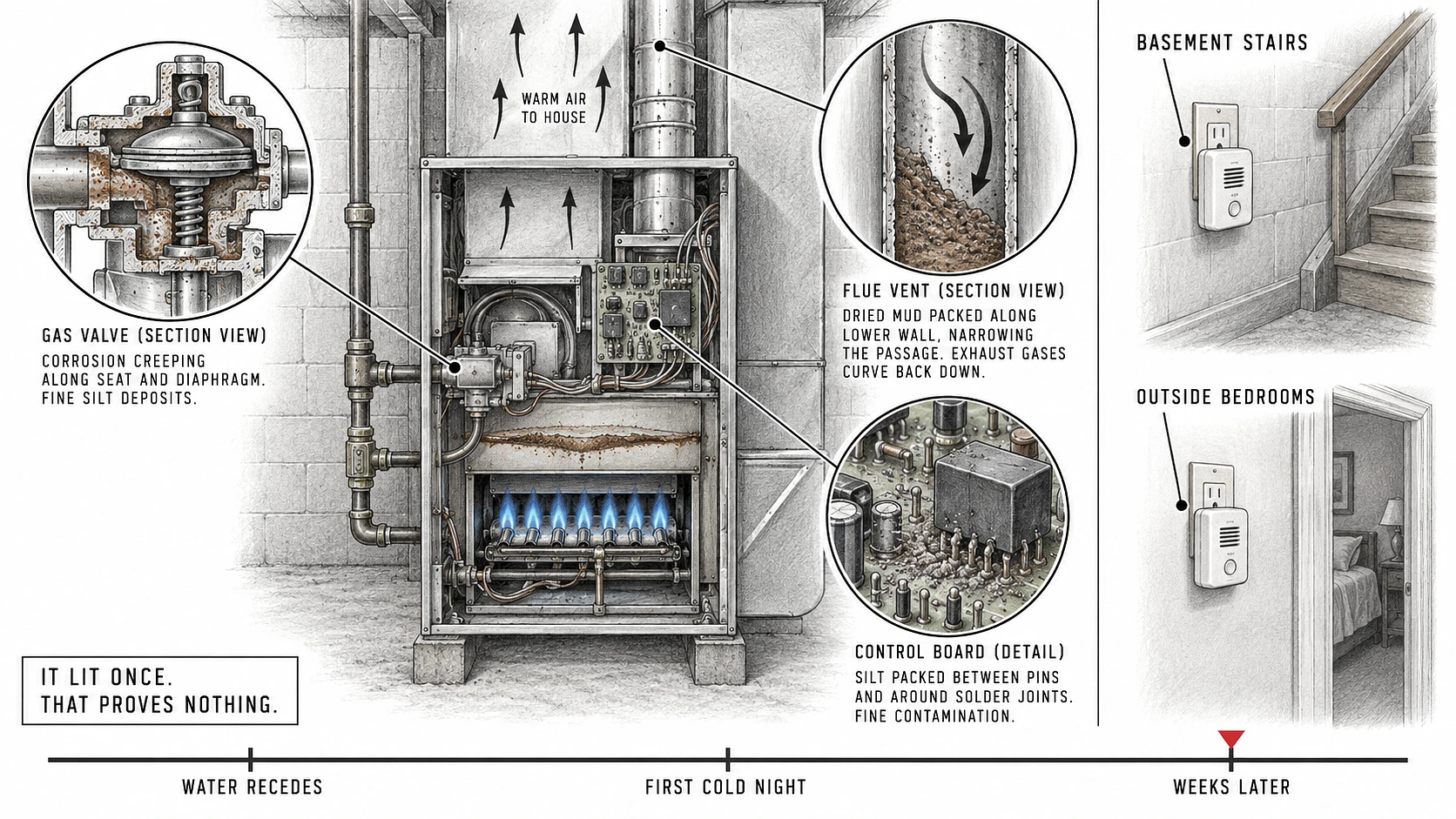
What makes this different from a flooded washing machine is the calendar. The water recedes in September, the basement dries out, and 3 weeks later there is a cold night and the thermostat goes up and the furnace lights, runs for an hour, and warms the house. Everyone relaxes. That furnace has told you nothing, because the corrosion the CPSC line is talking about takes weeks to close a valve or make it stick, and a control board with silt in it works right up until the morning it does not.
The failure a flooded furnace is heading for is not a cold house. It is a valve that does not shut, a burner that lights wrong, or a vent packed with mud sending the exhaust back into the basement, which is a carbon monoxide problem and the one reason the trade is as firm as it is. So the 1 purchase in this whole piece, before the heat goes back on, is a carbon monoxide alarm on the basement stairs and another outside the bedrooms, $25 each, plugged in the day the furnace is restarted.
And if the furnace lights before anyone has been to see it, because someone could not wait, it gets switched off at the breaker and the appointment gets kept. A furnace that lit once is still a furnace with a tide mark over the burner door.
The 2 Phone Calls, With The Number In Inches
The first call is the insurer, and what they want is the photos with the tape in them and the number on the wall, because a flood claim and a water damage claim are different things and the height, together with where the water came from, decides which one you have. A sump pump that failed is one policy line, a river is another, and a burst pipe is a third, and the adjuster is going to ask before anything else.
The second call is the heating company, and the company doing the furnace repair needs the height on the cabinet in inches before it sends anyone, because a 3 inch mark and a 14 inch mark are 2 different visits with 2 different vans. Say which way the furnace is built if you worked it out from the filter slot, say what the water heater’s mark is, and say whether the water was clean or came up through a drain, since silt and sewage change what gets cleaned against what gets thrown away. A company that asks for all of that on the phone is the one that has done this before.
What you do not do, between those 2 calls, is test it. The thermostat stays where it is, the breaker stays off, and the first person to touch the furnace is the one who arrives with the number already in their notebook.
 Decor & Improvement Accessories