

Home & Decor Blogs: DIY, Interior Design & Lifestyle Ideas
8 Ways to Make a Small Apartment Feel Twice as Big

You are not imagining the squeeze. New apartments really are shrinking, and RentCafe’s data puts the average new US apartment at 908 square feet, with renters in Seattle and Portland folding themselves into under 670. Studios alone have shed 54 square feet over the past decade while the rent kept climbing, so you are paying more for less, and that means every square foot you have got has to earn its keep or it is money on the floor.
Most of it comes down to something people miss entirely. The “my apartment feels tiny” problem is rarely about the square footage at all, it is about how the space gets used. The furniture that only ever does one job, the appliances eating floor they never earned, the little habits that pile up week after week. Sort those out and the exact same apartment suddenly has room to breathe.
Walls Are Free, So Use Them
Floor space is costing you money every single month, while your wall space just sits there doing absolutely nothing. That is backwards, and it is the easiest thing in the apartment to fix.
The quickest way to open up a small place is to lift your storage off the floor and put it on the walls, which sounds obvious enough that you would think everyone does it, and yet almost nobody actually does.
- Floating shelves above desks, above the washing machine, above doorways, anywhere between eye level and the ceiling that is currently blank.
- Tall narrow bookcases instead of wide ones that eat into your walking space.
- Hooks on walls for bags, coats, kitchen utensils, headphones, keys.
- Over-the-door organizers on the bathroom and closet doors.
Marie Kondo put it well in The Life-Changing Magic of Tidying Up, that storage should reduce the effort needed to put things away, not the effort needed to get them out. A hook is zero effort, and that is exactly why the keys actually end up on it instead of wherever they landed.
A set of floating shelves runs you maybe $30 to $50. A storage unit rental runs $100 and up every month. The math is not complicated. And the real payoff is not even the storage, it is the empty counter and clear floor you get back, because when the surfaces are clear a small apartment stops feeling like it is closing in on you.
The Storage You Already Have But Aren’t Using
Under the bed. Tops of wardrobes. Inside cabinet doors. The gap between the fridge and the wall. Above the toilet. These spots exist in basically every apartment, and most of them are collecting dust when they could be holding things.
- Flat under-bed containers for seasonal clothes, spare bedding and shoes, and bed risers to buy a few more inches of clearance if your frame sits low.
- Baskets on top of wardrobes and kitchen cabinets for the stuff you reach for a few times a year.
- Stick-on hooks or small wire racks inside cabinet doors for lids, spice jars and measuring cups.
- Slim rolling carts that slot into the narrow gaps beside the fridge or between furniture.
None of this needs a renovation or a call to your landlord. You are just using space that already belongs to you and has been going to waste.
One Thing In, One Thing Out
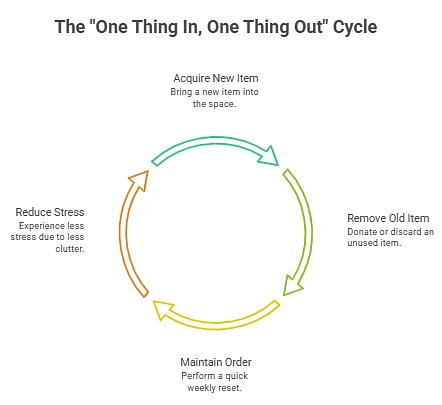
You can install all the clever storage in the world and it will not save you if you keep bringing things home without ever letting anything go.
Small apartments punish hoarding fast. One week of telling yourself you will deal with it later and the place already feels half its size, and there is real weight behind that feeling, not just annoyance. Researchers at UCLA’s Center on Everyday Lives of Families found that people who described their homes as cluttered tended to have unhealthier daily patterns of cortisol, the stress hormone, and part of why is that every object sitting out competes for your attention whether you are looking at it or not. In a big house the mess has somewhere to hide. In 500 square feet it is all in your eyeline, working on you.
The fix is boring and it works: every time something new comes in, something old goes out.
- New jacket, donate one you have not touched in a year.
- New kitchen gadget, the one it replaced leaves.
This is not a minimalist philosophy thing, it is just arithmetic, you have got X amount of space and if you only ever add without subtracting, X runs out eventually. Although the actual minimalists agree anyway, since The Minimalists have been closing their podcast for years with love people, use things, the opposite never works, and a small apartment is where that stops being a slogan and starts being actual floor space.
A five-minute weekly reset does more than you would expect, too. Sort the mail pile. Put things back where they live. Wipe down the surfaces that have been quietly collecting random objects since Monday. Tiny apartments do not forgive laziness the way bigger ones do, and you notice the mess the moment it starts because there is nowhere for it to hide.
Furniture That Does Two Jobs Minimum
Single-purpose furniture belongs in a house with rooms to spare. In a small apartment, every piece has to earn its spot, and the good ones earn it twice over.
| What You Buy | What You Get |
|---|---|
| Storage ottoman | Somewhere to sit, a coffee table, and blankets and shoes hidden inside |
| Sleeper sofa | Daily couch plus a guest bed that does not need its own room |
| Nesting side tables | Spread them out when you need them, stack them when you don’t |
| Wall-mounted fold-down desk | A workspace by day, flat against the wall by night |
| Folding chairs | Dinner-party seating that disappears into the closet afterwards |
Drop-leaf tables are massively underrated for tiny kitchens, small enough for everyday use and then opening right up when you have got people over, one piece of furniture doing two completely different jobs depending on the day.
A bigger idea sits underneath all this. The architects Woods + Dangaran, who design high-end LA homes, describe a room as something that should be set up to accept whatever you decide to make of it. In a mansion that means a space that can flip from gym to wellness room. In your apartment it means the exact same instinct on a budget, a sofa that becomes a bed and a desk that folds away, a room that changes its job when you need it to. Sofa beds have come a long way from the lumpy torture devices they used to be, so if you have got people visiting and no guest room, a decent sleeper is the difference between hosting them and telling them to book a hotel.
Your Appliances Are Hogging Space
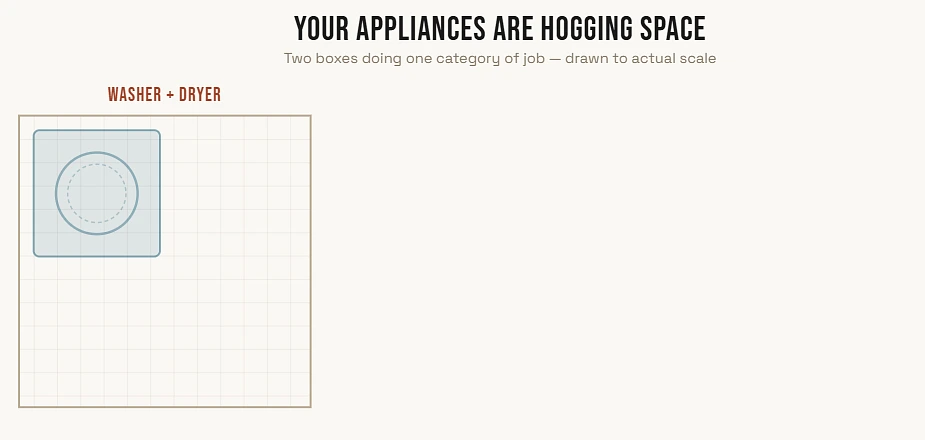
Two separate machines for washing and drying is a commitment most small apartments cannot afford, and not financially so much as physically, because that is a serious chunk of floor gone to two boxes doing one category of job.
A washer-dryer combo does both in a single unit, handling as much as 10 pounds of laundry in one wash-and-dry cycle at roughly half the footprint of running two appliances. A lot of the newer combos are ventless too, which kills the ductwork requirement and can free that laundry closet up for actual storage.
The storage industry quietly tells the whole story here.
Over 547 million square feet of self-storage has been built in the US since 2015, pushing the national total past 2 billion square feet, and people are renting rooms outside their own homes because their apartments cannot hold their stuff.
Shrinking your appliance footprint is one way to keep your belongings inside the place you are already paying for.
Francine Jay wrote in The Joy of Less that your home is a living space, not a storage space, and fair enough, agreed. But where does the genuinely seasonal stuff go? James Bennett, who works as principal for storage units saint-laurent at Bluebird Self Storage, says fall is when that question turns up at his counter, and Montreal renters especially, because Quebec law puts winter tires on every car from December through mid-March, so anyone who drives is stuck keeping a second set of wheels somewhere for eight months of the year. Tires, ski gear, the Christmas boxes, that is what a locker is for, he said. If you are paying to store furniture you forgot you own, cancel the unit and book a donation pickup instead.
Kitchen Gadgets That Only Do One Thing
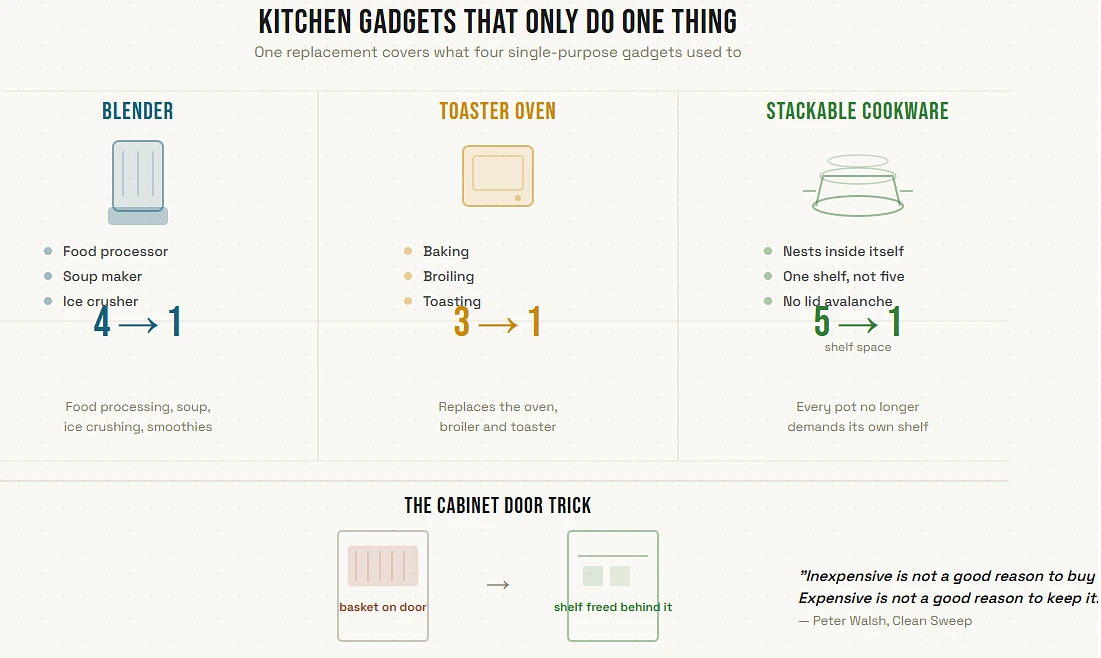
This one creeps up on everyone. A waffle maker. A bread machine. A standalone rice cooker. A panini press somebody gave you for Christmas three years ago. Each one seemed perfectly reasonable at the time, and now your kitchen counter looks like a Best Buy clearance shelf. Peter Walsh, the Clean Sweep organizer, said the only thing really worth saying about this whole category, that inexpensive is not a good reason to buy something, and expensive is not a good reason to keep something.
- A high-powered blender covers food processing, soup, ice crushing and smoothies, so that is four gadgets in one.
- A toaster oven bakes, broils and toasts, replacing three separate appliances.
- Stackable cookware nests inside itself instead of every pot demanding its own shelf.
Hang a small basket inside a cabinet door and you free up the whole shelf behind it, and suddenly there is room for the stuff you actually cook with instead of a jumbled pile of lids that avalanches onto the floor every time you open the door.
Making the Room Feel Bigger Than It Is
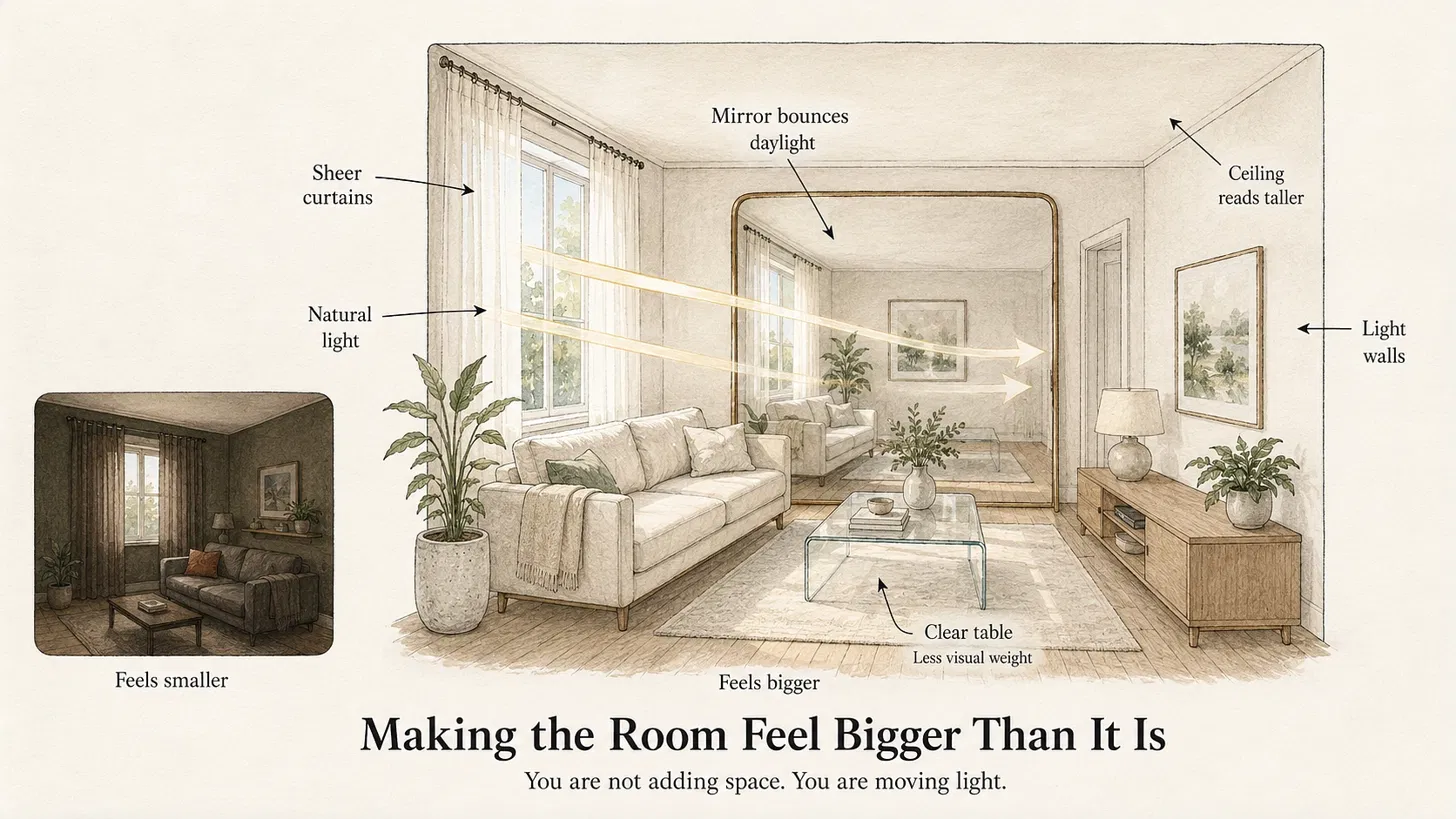
This is not really decorating advice, it is the same set of tricks a show apartment uses to fool your brain into reading a room as bigger than it is, and they work just as well in your place.
Mirrors placed across from a window bounce the daylight deeper into the room, and a full-length or floor-to-ceiling mirror on one wall can genuinely make a space feel close to twice its size. Swap heavy drapes for sheer curtains, because thick fabric makes the walls feel like they are pressing in. Glass or clear acrylic pieces, a coffee table say, take up their physical space without the visual weight, so the eye reads straight past them and the room stays open.
The connection to light and the world beyond the walls is the thing that makes a space feel alive, describing the pleasure of watching shadows walk across a floor over the course of a day. You cannot install a skylight in a rental, obviously. But the same principle is why the mirror and the sheer curtain matter so much, because in a small apartment you are not adding space, you are moving light around to make what you have got feel like more.
Wall color does more heavy lifting than people give it credit for. Whites, soft grays and light beige reflect the light and the room seems to expand, while dark colors close a room in visually, which makes them better as an accent or a single feature wall than as the coat of paint on everything. And painting the ceiling the same shade as the walls, or a touch lighter, erases that hard line where they meet and tricks the eye into reading the room as taller.
Get Rid of Paper and Physical Media
You do not realize how much room paper eats until you pile it all up in one place. Old bills stuffed in a kitchen drawer. Instruction manuals for appliances you bought four years ago. Magazines you swore you would read again. A folder of receipts from 2021. Gather it all together and you have got a whole shelf’s worth of stuff doing absolutely nothing but sitting in your apartment taking up space.
Scan the things that matter, the lease, the tax records, the insurance papers, and drop them into cloud storage, then switch every bank statement and utility bill over to digital if you have not already. That filing drawer turns back into empty, usable space almost overnight.
Books are the harder conversation, because people get attached, and understandably. But if you have read it and you are honestly never going to read it again, it is decoration at best and clutter at worst, and an e-reader holds thousands of them in something thinner than a single paperback. Same goes for the DVDs, the CDs, the old photo albums, because anything that already exists digitally does not also need to exist physically in a 320-square-foot apartment where every shelf counts.
This one does not cost you a cent. It costs one Saturday afternoon of sorting. And the amount of drawer, shelf and counter space you claw back from getting rid of things your phone can already pull up is honestly hard to believe until you have done it yourself.
Putting It All Together
Small-apartment living is never going to be effortless, but cramped and small are two different things. If you compare a 600-square-foot place that somebody has set up properly against a 900-square-foot one that nobody has, the smaller one will feel like the bigger home nearly every time, because what decides whether a space breathes is how it got arranged, not how many square feet the lease says you are paying for.
When your walls are carrying the storage and your furniture is pulling double shifts, when you have swapped two appliances for one and you let something leave every time something new arrives, all those small moves start compounding into a place that feels far larger than its footprint. And the whole lot of it costs you less than a single month of self-storage rent, while it actually solves the problem instead of just trucking it off to a locker across town.

 Decor & Improvement Accessories