

Home & Decor Blogs: DIY, Interior Design & Lifestyle Ideas
The Sump Pump Installed in a Bucket: A Viral Plumbing Call and What It Teaches

A plumbing crew in Nova Scotia posted a job walkthrough that did numbers online for a reason most of the comments got wrong. The basement was flooded. The pump was working fine.
The pump had been dropped into a plastic bucket instead of a proper sump basin, and the discharge pipe ran straight into the sanitary sewer. Both of those are wrong, both of them look completely normal to a homeowner glancing at the corner of the basement, and the family in that house believed they had flood protection right up until the water came over the floor. Which is the whole lesson, and it’s a lesson that keeps repeating, because a second video going around a while later showed a different house with a different failure that rhymes, an open lidless pit, debris fallen in over the years, the float switch jammed against the side, and the homeowner reaching down to plug the pump straight into the wall to force it to run while the water rose around his shoes.
Two houses. Two “working” pumps. Two flooded basements.
The Bucket Was the Problem, Not the Pump
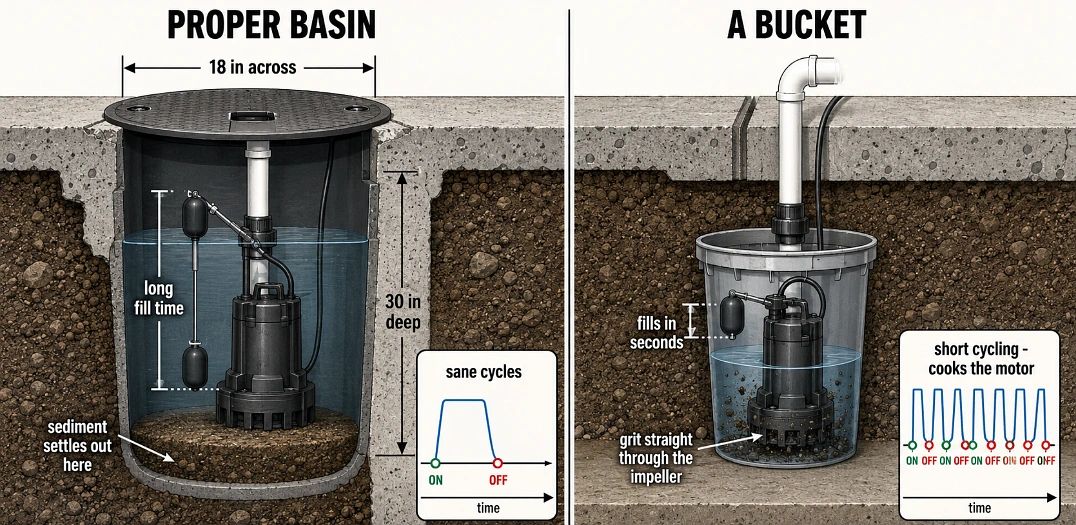
A sump basin isn’t just a hole for the pump to sit in, it’s sized so the pump runs in sane cycles.
Code generally wants that pit around 18 inches across and 30 inches deep because the volume decides how often the motor kicks on, and a bucket holds almost nothing, so the float rises within seconds of the water arriving and the pump starts, then empties it, then stops, then starts again. Short cycling is what plumbers call that and it cooks motors. A pump rated for years of service can burn out in a season doing it, and when it dies it dies quietly during the exact storm that filled the bucket in the first place. There’s also nowhere for the sediment to settle in a container that small, so grit goes straight through the impeller.
The bucket install probably saved somebody an hour of digging. It cost that family a basement.
Sending Sump Water Into the Sewer Is Against the Law
This is the part homeowners genuinely do not know, and I’d guess most of the people who watched that video still don’t.
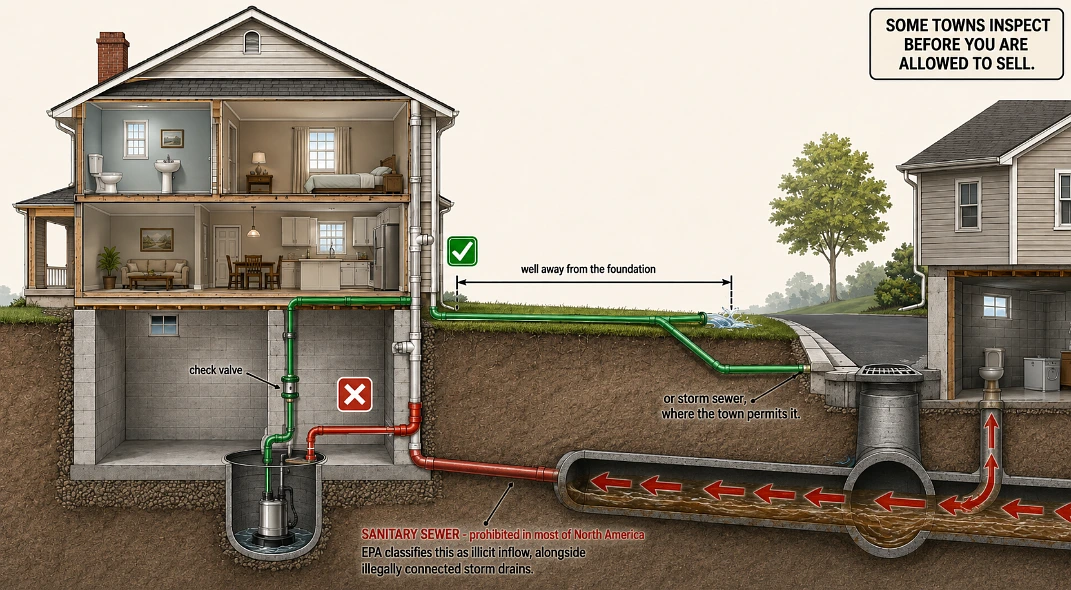
Sending sump water into the sanitary sewer is prohibited in most of North America. Not frowned upon, prohibited, because the sanitary system was sized for toilets and washing machines and not for groundwater, and when a whole street’s sump pumps pour into it during a storm the treatment plants overflow and sewage backs up into the lowest basements on the line. The EPA files these hookups alongside illegally connected storm drains. Danvers, Massachusetts fines $300 a day until it’s corrected. Plenty of municipalities inspect for them, and some make you prove compliance before you’re allowed to sell the house, which is a nasty surprise to find at closing.
Discharge belongs outside, into the yard, well away from the foundation, or into a storm sewer where the town permits it, with a check valve on the line.
The Five Things That Usually Break
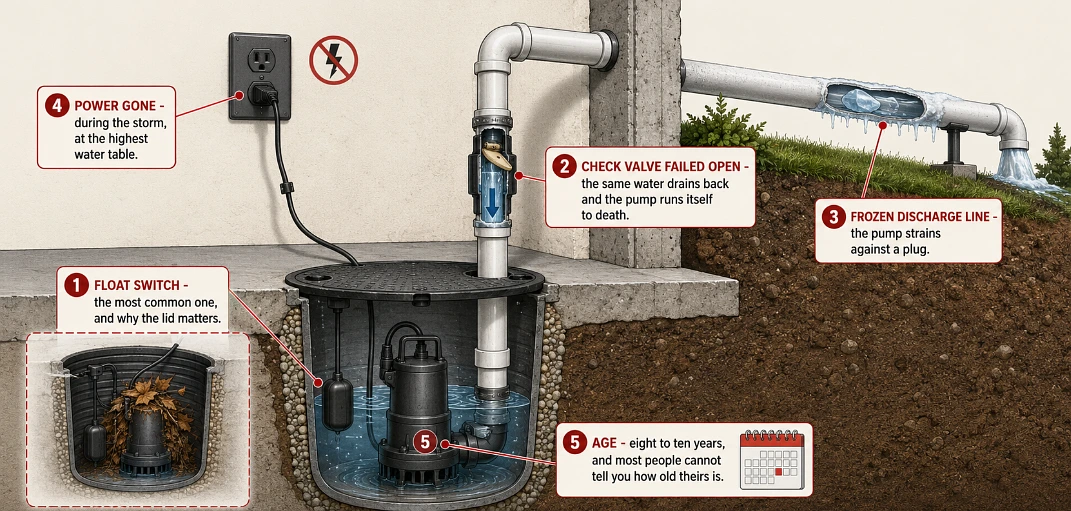
Almost no basement floods because the pump motor spontaneously died. It’s nearly always one of these:
- The float switch, stuck against the pit wall or pinned by debris that fell into an uncovered basin. This is the single most common one and it’s why the lid matters.
- The check valve, failed open, so every gallon the pump pushes up the pipe drains back down into the pit and the pump runs itself to death moving the same water.
- The discharge line frozen solid in January, which turns the pump into a machine straining against a plug of ice.
- The power, gone, in the storm, at the same moment the water table is highest, which is the failure no maintenance can fix.
- Age, quietly, because these things last eight to ten years and most people cannot tell you how old theirs is.
That last one deserves a sentence on its own. If you inherited the pump with the house, assume it’s older than you think.
How to Test Your Own Sump Pump in Ninety Seconds
Pour a bucket of water into the pit. That’s it, that’s the test.
The float should rise, the pump should start, the water should leave, and the pump should shut off by itself. Then go outside and confirm the water is coming out where you think it is, because that step is exactly what no one did in the Nova Scotia house. Do it in the spring and again in the autumn, and do it before you go away for a week. And while you’re down there, look for a lid on the pit, because the lid is what keeps the dust and the dropped screwdrivers and the general basement debris out of the float’s path.
If your test ends with a pump humming and no water leaving, or a pump that won’t stop, call a plumbing service company before the next storm rather than during it, because emergency rates at 2am for a flooded basement are their own kind of education.
What a Sump Pump Costs, and What a Flood Costs
Replacing a pump in an existing pit runs $400 to $1,000, and a full new system with a proper basin lands at $1,200 to $3,000.
Water damage restoration for a flooded basement runs $3,000 to $10,000. A battery backup, the thing that saves you when the power fails during the storm, adds a few hundred and needs its battery swapped every three to five years at fifty to a hundred and fifty dollars.
And here’s the one that gets people. Standard homeowners insurance does not cover water damage from sump pump failure. It’s an endorsement you have to add on purpose, water backup or sump overflow coverage, usually $50 to $150 a year, and without it the claim gets denied while you’re standing in four inches of water. The family in the video was dealing with that math after the fact.
The video ended with the crew rerouting the discharge outside and replacing the whole system properly. Which is a fine ending for a video and an expensive one for a homeowner, and the only reason any of it happened is that a pump in a bucket looks exactly like a pump in a basin from the top of the stairs.
 Decor & Improvement Accessories