

Home & Decor Blogs: DIY, Interior Design & Lifestyle Ideas
HVAC Systems in Georgetown, TX: What Actually Keeps Your House Livable and What Breaks First
Georgetown sits in that stretch of Central Texas where summer highs regularly hit 96 to 98°F — crossing 100°F in August isn’t an outlier, it’s the season. Then winter drops you into the mid to upper 30s, with cold snaps pushing below freezing a few times most years. Close to a seventy-degree swing across the calendar. The system runs nine or ten months in actual working conditions, not the mild 72°F weather the spec sheet was written for.
Texas residential customers average around 1,168 kWh of electricity per month — one of the highest figures in the country — with heating and cooling accounting for most of it, according to the U.S. Energy Information Administration’s 2022 state data. At roughly 12 to 14 cents per kWh depending on your retail plan, that’s $130 to $200 a month in a normal year. The number moves the moment the system is quietly compensating for a problem.
This isn’t a general primer on HVAC. Georgetown has specific conditions that wear specific things out faster than national averages suggest. What follows is what actually fails in this climate, what it costs, and what to look for before calling someone. The short version, if you read nothing else: the things that break first here are predictable — clogged condensate drains, dust-choked condensers, untested aux heat, and leaky ductwork — and most of them show up on your power bill before they ever show up as discomfort.
What Actually Keeps Your House Livable?
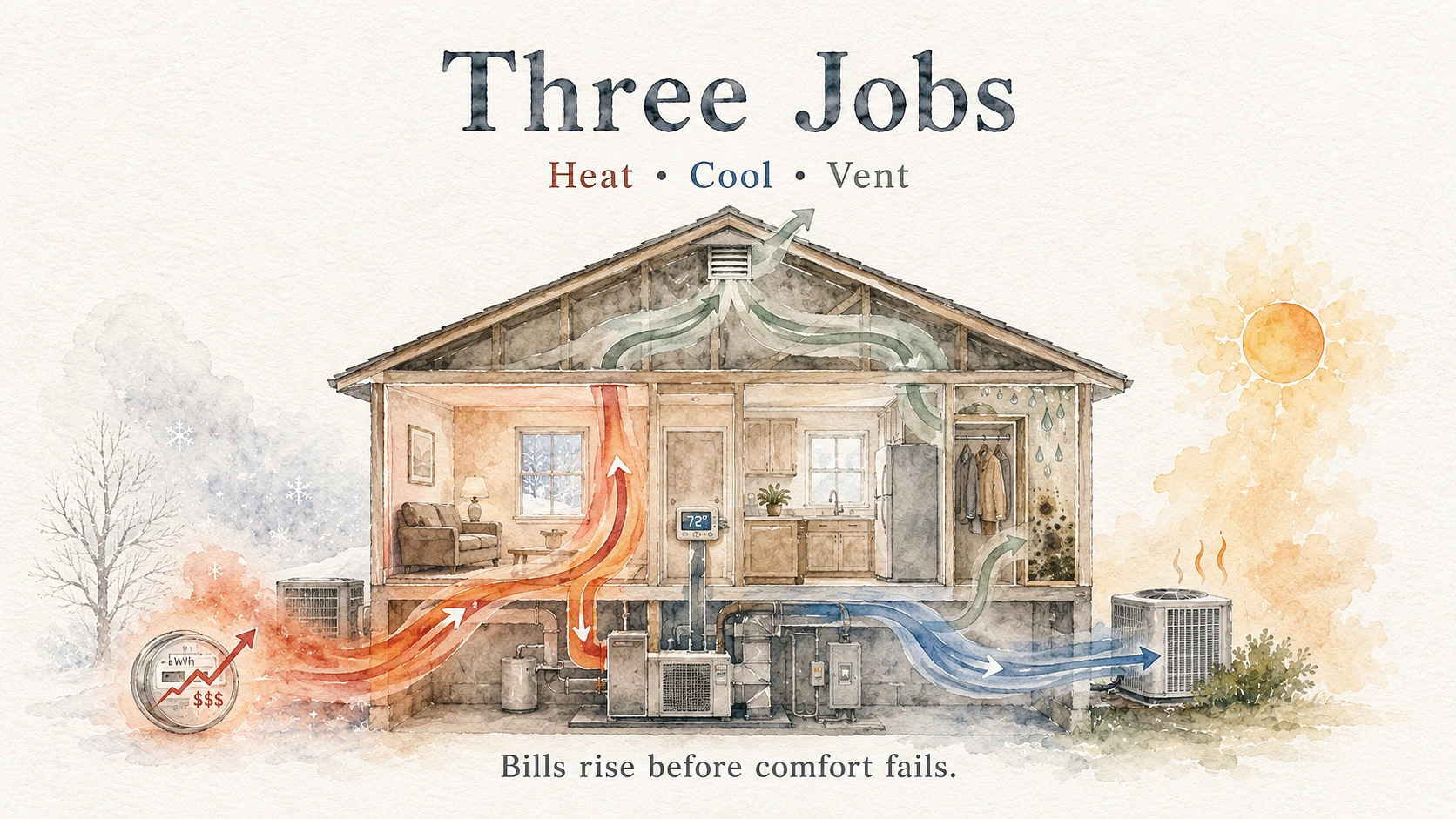
The system has three jobs running simultaneously — not two, not seasonal. When one falls behind, the others compensate. That’s why problems usually show up first as a higher electricity bill, not a comfort complaint.
In Georgetown, heating is provided by either a heat pump or a gas furnace. Although the heating season is shorter than the cooling season, the system pays for itself during those January cold blasts in the low 30s or lower. Heat pumps use supplemental electric resistance heating below a temperature threshold, typically approximately 35°F. Compared to the heat pump alone, that aux mode uses a lot more electricity. It appears prominently in your bill after running it for a few hours during a strong freeze.
Georgetown systems suffer greatly on the cooling side. The compressor pulls heat from interior air and rejects it outside through the condenser coil, cycling on and off during the day from about May to September. The condenser works harder when the outside air is hotter. You can determine whether the unit was the right size for the house on an August afternoon at 100°F.
Until a mold problem arises, ventilation is neglected. According to NOAA’s 1991–2020 climatic normals for the Austin–Round Rock region, Georgetown’s climate is in the humid subtropical zone, with outdoor relative humidity frequently exceeding 65% during the wetter months. Moisture gets trapped in the attic and walls of a home with inadequate ventilation. It could go unnoticed until you discover mold in a closet that backs up to an external wall or behind a cabinet.
What Breaks First — and Why Georgetown’s Climate Causes It?
Not just heat. Heat plus humidity — that combination is harder on HVAC than pure desert heat, and it’s worth understanding why.
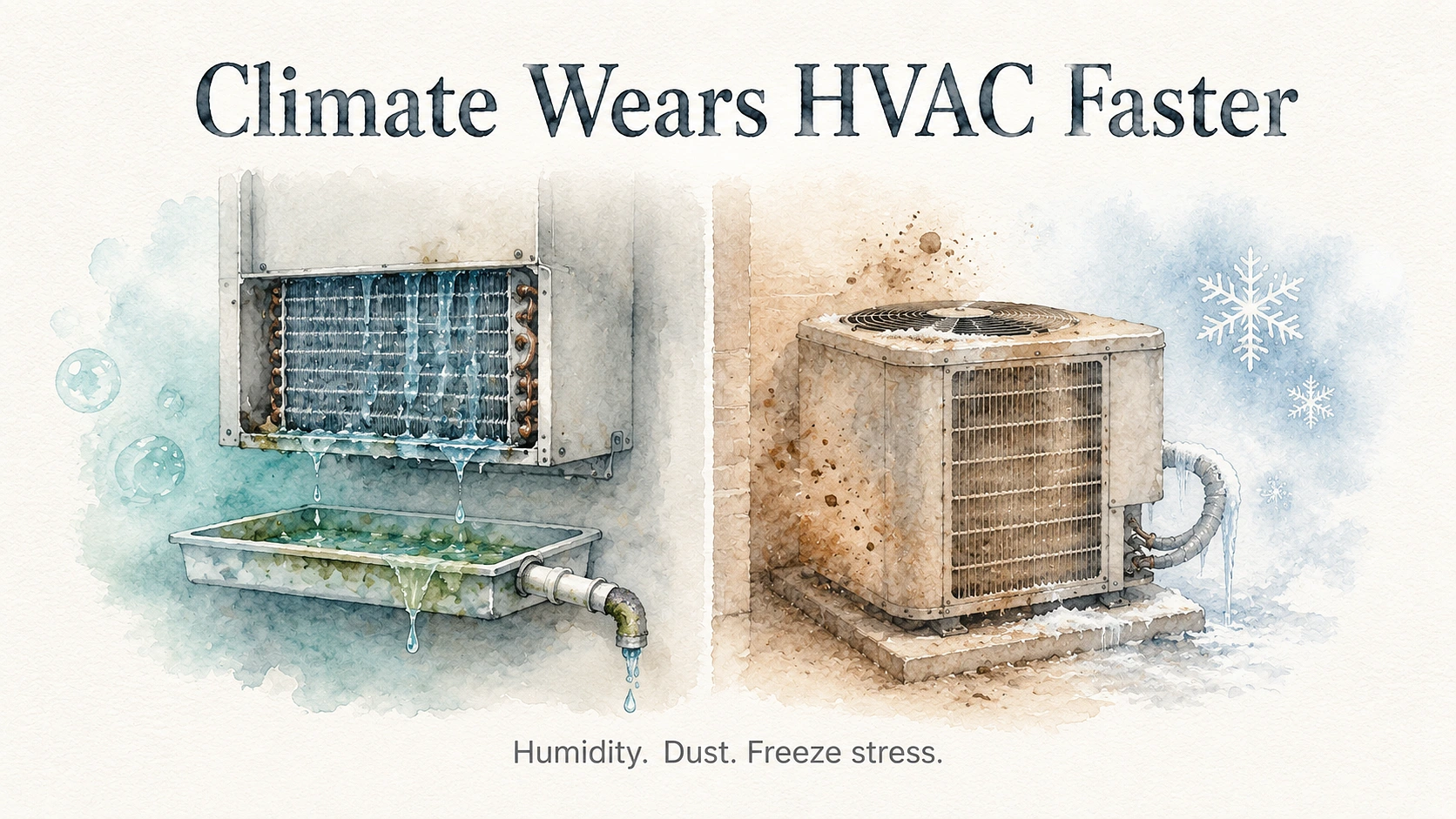
Dry heat is easier on equipment because the system only has to cool the air. Georgetown averages around 33 to 35 inches of rain a year, and relative humidity stays elevated through spring and early summer (NOAA 1991–2020 climate normals). That means the AC isn’t just cooling — it’s dehumidifying simultaneously, for months at a stretch. The evaporator coil stays wet. Algae grows in the drain pan and condensate line. The line clogs. Water backs up and the system shuts down on a safety float switch — or if there’s no float switch, it overflows the pan and damages the ceiling below the air handler.
A clogged condensate drain is one of the most common service calls in this area. Also one of the most preventable. A quarter cup of bleach into the condensate drain pan every couple of months kills the algae before it blocks anything. Takes thirty seconds.
The outdoor condenser unit takes different punishment. Georgetown gets dusty during dry stretches, and dust coats the condenser fins and cuts airflow. When airflow drops, the compressor runs longer cycles to hit the same cooling. Longer cycles mean faster wear on the compressor, which is the single most expensive component in the system — $1,500 to $2,500 for the part alone, before labor. At that price point, full system replacement often makes more financial sense than just swapping the compressor.
Then there’s the freeze problem. Georgetown isn’t Minnesota, but Winter Storm Uri in February 2021 showed the entire region what happens when residential HVAC meets temperatures it wasn’t designed for. Heat pumps struggled. Aux heat systems that were undersized or untested failed outright. If your heat pump’s emergency heat mode has never been tested, you’ll find out during the one storm that matters.
If You’re Replacing the System, Here’s What SEER2 Means
The Department of Energy updated its regional minimum efficiency standards for residential HVAC equipment, the Seasonal Energy Efficiency Ratio (SEER), effective January 1, 2023. Texas falls in the Southeast region. For split-system central air conditioners under 45,000 BTU cooling capacity, the minimum is now 14.3 SEER2. Larger units require 13.8 SEER2. This replaced the older SEER rating system, which tested under conditions that didn’t reflect real-world ductwork resistance — SEER2 uses 0.5 inches of water column static pressure, closer to what an installed system actually sees in the field.
The practical result: the cheapest legal unit you can install today is meaningfully more efficient than a ten or fifteen-year-old system. ENERGY STAR certification for central air conditioners starts at 15.2 SEER2. Variable-speed premium systems run 18 to 20+ SEER2.
Here’s how the three tiers actually stack up:
| Tier | SEER2 Range | Where it fits |
|---|---|---|
| Minimum legal (single-speed) | 14.3 SEER2 | Tight budget, lowest upfront cost |
| ENERGY STAR | 15.2 SEER2 and up | Mid-range, noticeable bill savings |
| Variable-speed premium | 18 to 20+ SEER2 | Long-run savings, best comfort |
Whether the premium efficiency justifies the upfront cost depends on hours of operation. In Georgetown, the system runs a lot. A variable-speed 18 SEER2 unit will use notably less electricity over a summer than a 14.3 SEER2 single-speed unit in the same house. Across fifteen years and five months of heavy cooling per year, that difference accumulates. The direction of the math isn’t really in doubt — the question is whether the upfront delta makes sense for your budget.
Variable speed also matters for a reason beyond the efficiency numbers. Georgetown has plenty of days in the 88 to 92°F range where a single-speed compressor runs at full blast, overshoots the setpoint, shuts off, then cycles back on. A variable-speed compressor holds temperature by running continuously at reduced capacity. More consistent temperatures, better dehumidification because air stays over the coil longer, less mechanical stress on the compressor. In a climate where compressor failure is the expensive failure, fewer cycles matter.
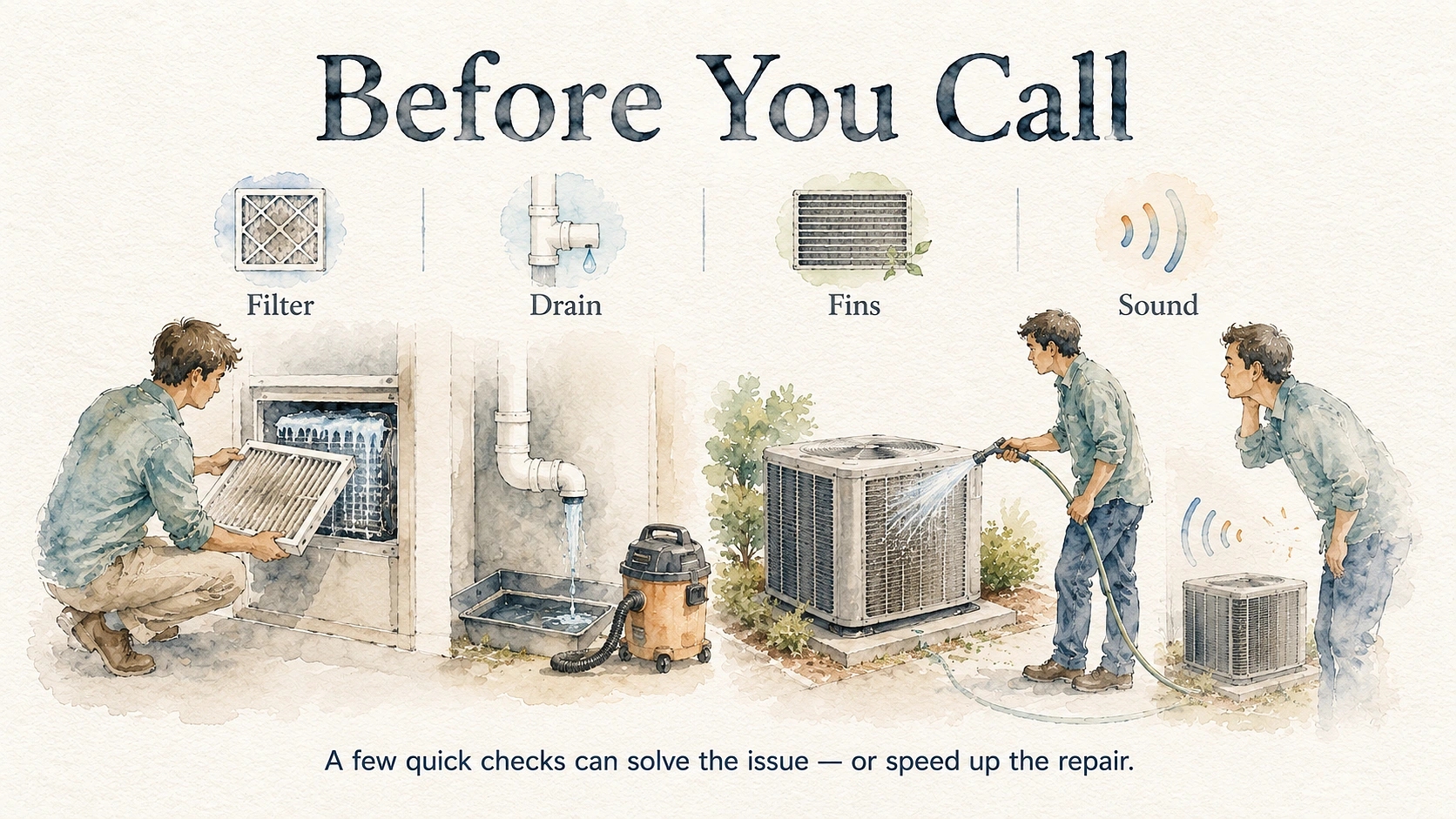
Check These Four Things Before You Call Anyone
There’s a short list of things worth going through before picking up the phone. Some fix the problem outright. The rest give the technician useful information that cuts time off the service call.
- Filter. A clogged filter restricts airflow enough to freeze the evaporator coil in summer. If the coil is iced over, you probably don’t have a refrigerant problem — you have a filter that needed replacing three months ago. In Georgetown, check it monthly from May through September. Pets or nearby construction? Check it every two weeks.
- Condensate drain. Find the PVC pipe coming out of the air handler — it should drip water outside during heavy cooling. Not dripping when the system is running? The line might be clogged. Standing water in the drain pan or staining below the air handler means it’s definitely blocked. A wet-dry vac on the outdoor end of the drain line often clears it in a few minutes.
- Condenser fins. Walk out and look at the outdoor unit. Fins packed with dust or cottonwood fluff mean the system is working harder than it needs to. Rinse it gently with a garden hose — not a pressure washer — from the inside out. Keep at least two feet of clearance around the unit on all sides.
- Sound. Short cycling — clicking on and off every few minutes — usually points to oversizing, low refrigerant, or a compressor problem. Grinding from the blower motor usually means bearings. Hissing near refrigerant lines suggests a leak. Write down what you heard before calling. It saves time.
Choosing a Contractor Who Actually Knows Georgetown
The contractor market here has grown with the city. Texas requires HVAC contractors to hold a license through the Texas Department of Licensing and Regulation, verifiable through the TDLR’s public license search tool. Beyond the state license, look for technicians who hold NATE certification — administered by North American Technician Excellence, a nonprofit that runs proctored competency exams specific to equipment type. Not a weekend seminar. An actual exam.
Local knowledge matters more than people usually factor in. Newer Georgetown subdivisions — Sun City, Cimarron Hills, and similar — have tight building envelopes that can create ventilation problems from being too sealed. Older homes closer to the square have different issues, where duct sealing and insulation upgrades often matter more than the equipment itself. A contractor who regularly works Georgetown knows which problems show up where.
Georgetown homeowners looking at installation, maintenance, and emergency repair have worked with local providers, including Quality Cooling Heating & Plumbing, who cover Georgetown and the surrounding Williamson County area. Getting multiple quotes is still worth doing — not because anyone is trying to overcharge, but because different contractors spec different equipment and different scopes. A real quote specifies the exact equipment model, SEER2 rating, what ductwork work is included, permit and inspection status, and separate warranty terms for parts and labor. A one-line number without those details isn’t a quote.
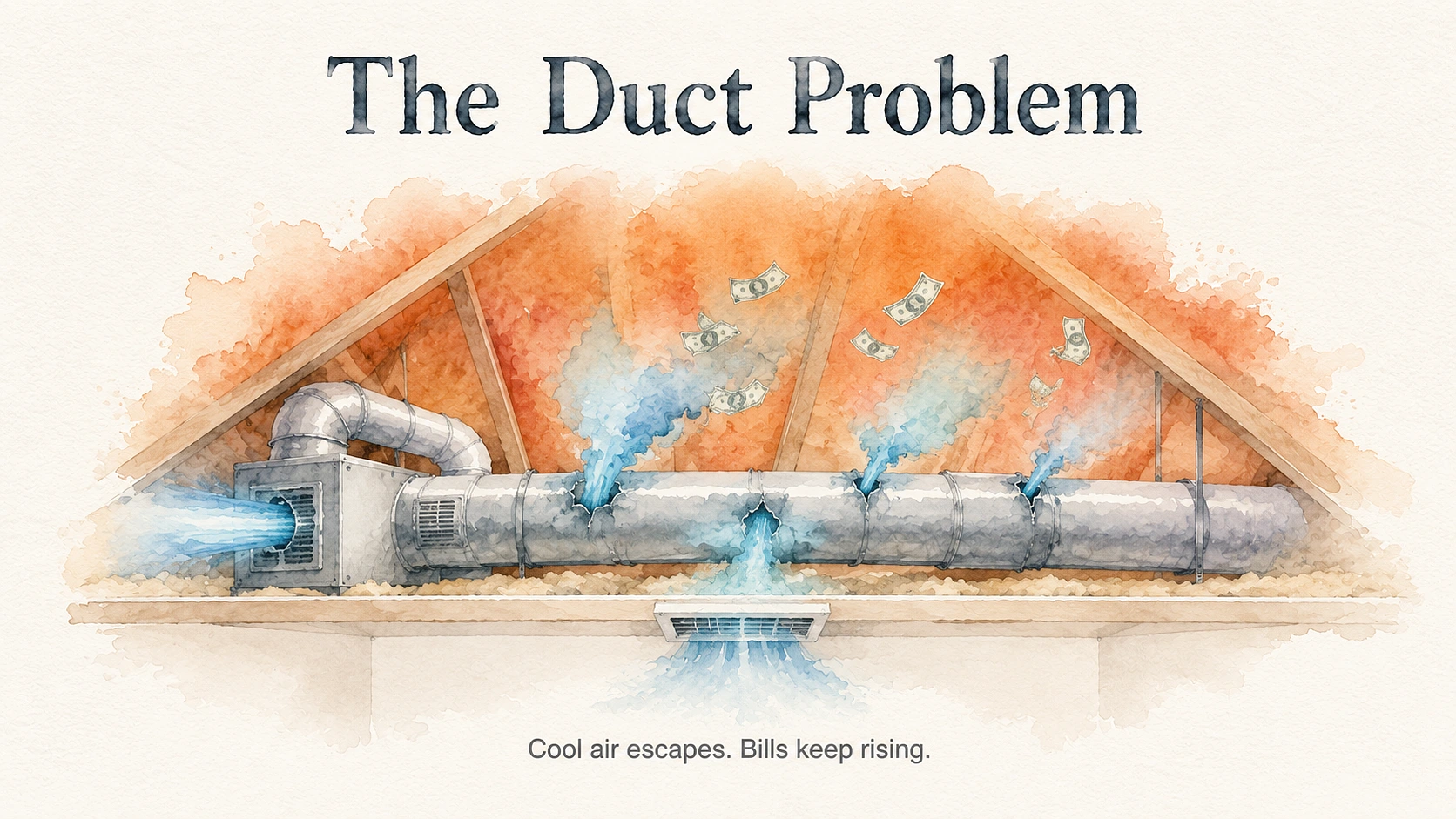
The Leaky Ducts Quietly Draining Your Bill
The DOE has published consistently that leaky ductwork wastes 20 to 30 percent of conditioned air in a typical home. In a Georgetown house paying $160 a month in summer cooling costs, that’s roughly $32 to $48 bleeding into the attic every month — doing nothing except making the attic slightly less hellish. Over a five-month cooling season, that’s $160 to $240 per year going nowhere useful.
Duct sealing isn’t cheap — $1,500 to $3,000 depending on duct volume and attic accessibility. But in a climate where the AC runs five months at meaningful load, the payback period is shorter than in milder regions. Some homeowners combine duct sealing with attic insulation and see 15 to 25 percent reductions in cooling bills. The difficulty is that sealed ducts are invisible. The only evidence they’re working is a lower number on your electricity bill three months later — which makes it a harder sell than a shiny new condenser sitting in the yard. That’s probably why duct problems are consistently underprioritized even when they’re the primary cost driver.
Replacing a system without fixing the ducts means the new unit is pushing conditioned air through the same leaky delivery system. It’ll cool the house, probably, but it won’t perform like the spec sheet suggested.
Your HVAC system is likely the most expensive thing in the house you never think about until something goes wrong. In Georgetown — heavy cooling from April through October, humidity fighting you through much of the spring, a February cold snap capable of exposing every weakness in your heating setup — a maintained system and a neglected one are separated by hundreds of dollars a year in electricity you didn’t need to spend, a compressor you might have kept running another few years, and mold behind the drywall nobody noticed until it was a much larger problem.
 Decor & Improvement Accessories