

Home & Decor Blogs: DIY, Interior Design & Lifestyle Ideas
Gas Furnace vs Heat Pump in Chicagoland: What Actually Costs Less to Run and What Breaks First
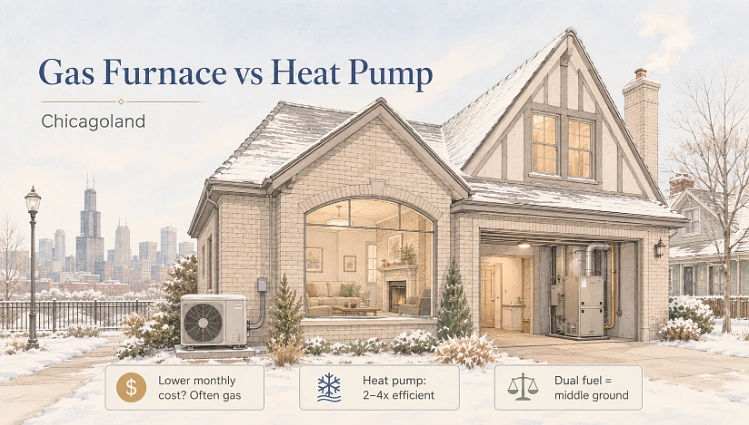
A gas furnace produces heat by burning fuel. A heat pump transfers heat that’s already in the outside air. That difference in how they work is why a heat pump can deliver two to four times more heating energy than the electricity it uses — a thermodynamic advantage no combustion system can match. But efficiency alone only tells you so much about which one is cheaper in your home, because the cost of gas versus the cost of electricity in your area changes the entire calculation.
Let’s get to the point of it before we get into the details:
- Gas furnace installation: $5,900 to $10,900, with the average price tag in Chicagoland around $8,400. Runs on natural gas. The most efficient is 96% AFUE — meaning 96 cents of every dollar in gas actually becomes heat, the rest goes up the flue.
- Heat pump installation: $7,000 to $14,000+, depending on whether you need a cold-climate inverter model and whether your electrical panel needs upgrading. Runs on electricity. Operates at 200 to 350% efficiency depending on outdoor temperature — for every dollar of electricity, you get two to three and a half dollars’ worth of heat.
- Federal tax credit status: The Section 25C credit (up to $2,000 for qualifying air-source heat pumps) applied to equipment installed on or before December 31, 2025. For new installations right now, that credit is no longer available. Illinois state or utility incentives may still exist — check current programs before assuming any rebate.
- The bottom line for Chicagoland specifically: Gas furnaces still win or tie on monthly operating cost for most homes in this region, thanks to low Nicor Gas supply charges and winters cold enough to push heat pump supplemental heating hard. The gap is narrower than it was five years ago, but the furnace still has the edge on pure monthly bills for a lot of south suburban and Northwest Indiana households.
Now the tricky part.
The Price of Gas vs Electricity in Chicagoland Right Now
There are a number of national averages quoted in these comparisons and they’re mostly useless for making a real decision. Recent EIA data puts the U.S. residential average around 17.5 to 19 cents per kWh for electricity and roughly $1.50 to $1.60 per therm for natural gas. But the numbers don’t apply to Chicagoland.
ComEd’s supply rate (the Price to Compare) is currently around 10.4 cents per kWh, but once you add delivery charges, taxes, and riders, the effective all-in rate lands somewhere between $0.15 and $0.18 per kWh depending on your plan and usage tier. Nicor Gas supply is minimal at the moment — around $0.36 per therm with no markup, passed straight through. The total effective rate, including delivery and riders, runs roughly $0.75 to $0.95 per therm depending on the billing period.
That ratio matters because it’s what decides which system is more economical to operate. Heat pumps win on running costs where electricity is cheap and gas is expensive — the Southeast, Pacific Northwest, and parts of Texas. Gas furnaces tend to prevail where gas is cheap and well-distributed, which includes much of the Midwest. Chicagoland falls squarely into that second category right now, with Nicor supply charges sitting historically low.
That said, this isn’t permanent. Gas prices have been unpredictable and could climb. Electricity rates in Illinois have stayed relatively flat by comparison. A heat pump installed today might not win on monthly bills this winter but could start winning in three or four years if gas prices shift upward. The math isn’t static even if the equipment is.
How the Heat Actually Feels Is Different, and Nobody Mentions This
This is the thing that catches people after installation.
Air leaving the furnace vents is heated to roughly 125 to 150°F. It’s hot, you feel it right away, the house warms up fast. That’s the “toasty” feeling people associate with winter heating. But it also dries the air out, which is why you end up with static electricity and cracked skin from December through March.
In actual use, the air from a heat pump runs at about 90 to 105°F. It’s warm, not hot. The system runs longer cycles at a lower output, holding temperature more consistently instead of blasting on and shutting off. The house stays at a steady 70°F instead of cycling between 68 and 73. More comfortable overall, but some people genuinely miss that blast of scorching air when they walk past a vent on a January morning.
Nobody talks about it before installation because it’s not a spec sheet item. It’s a comfort preference, and the only way to know which one suits you is to experience both — which is hard to do before you’ve spent eight to fourteen thousand dollars.
What Breaks First on a Gas Furnace and What It Costs
Gas furnaces are mechanically simpler than heat pumps — fewer moving parts, no reversing valve, no defrost cycle. But they burn fuel, and anything that burns fuel accumulates wear in specific places.
The heat exchanger is the expensive one. It’s a metal chamber where combustion happens, and over ten to fifteen years the metal fatigues from constant heating and cooling cycles. Cracks in the heat exchanger can leak carbon monoxide into your home’s air supply. That’s not a repair you delay. Replacement runs $1,500 to $3,500 for the part plus labor, and at that cost on an older unit most technicians will tell you to replace the whole furnace instead.
The igniter fails more often but costs less. Modern furnaces use a hot surface igniter — a small silicon carbide or silicon nitride element that glows red to light the gas. They’re fragile and they crack, usually after three to five years. The furnace clicks, tries to light, fails, tries again, and eventually locks out. Replacement is $150 to $300 including the service call.
The blower motor forces heated air through the ductwork. Standard PSC motors last eight to twelve years. Variable-speed ECM motors last longer but cost more to replace — $400 to $800 versus $200 to $400 for a PSC. You’ll hear the blower failing before it stops completely, usually as a grinding or squealing noise that gets worse over a few weeks.
The draft inducer motor pulls combustion gases through the heat exchanger and out the flue. When it fails the furnace won’t start at all, because the pressure switch can’t verify proper venting. Replacement runs $300 to $600.
Most of these failures happen on the coldest nights, because that’s when the system runs hardest, and Chicagoland doesn’t do mild winters — when it drops to single digits in January and the furnace is cycling nonstop, that’s when the igniter cracks or the draft inducer finally gives out. If your furnace quits at two in the morning during a polar vortex stretch, that’s when emergency furnace repair becomes the call you make — not a scheduled maintenance visit, not a quote request, an actual emergency where someone shows up and gets the heat back on before the pipes start freezing.
The maintenance that prevents most of these failures isn’t complicated. A clean filter every sixty to ninety days keeps airflow steady and stops the heat exchanger from overheating. An annual inspection catches igniter wear and heat exchanger cracks before they become middle-of-the-night emergencies. A technician checking the flame sensor takes thirty seconds and prevents the most common nuisance lockout. None of this is expensive. Most of it costs less than a single emergency call.
What Breaks First on a Heat Pump
Heat pumps are more complex because they’re two systems in one — heater and air conditioner in the same unit. More components means more potential failure points.
The reversing valve switches the system between heating and cooling mode. When it fails, the heat pump gets stuck in one mode — usually cooling, which means it blows cold air when it should be heating. Replacement runs $400 to $800 plus labor. Not the most common failure, but one of the more confusing ones, because the system appears to be running normally, just in the wrong direction.
The defrost cycle is a bigger deal in Chicagoland than in milder climates. In heating mode, the outdoor coil gets cold and moisture from the air freezes on it. The system periodically reverses itself briefly to melt that ice. If the defrost control board or sensor fails, ice builds up on the outdoor unit until airflow is completely blocked. You’ll see it — a solid block of ice encasing the outdoor unit. The system keeps running but produces almost no heat. In a climate where the outdoor unit is fighting single-digit temperatures for weeks at a stretch, defrost issues show up more often than national failure averages suggest.
Compressor failure is the big one. Same as an air conditioner — the compressor is the heart of the system and the most expensive single component. $1,500 to $2,500 for the part, $2,000 to $3,500 installed. On a unit older than ten years, compressor replacement usually triggers a full system replacement conversation, because the rest of the components are aging too.
Supplemental heat strips. In cold climates like Chicagoland, heat pumps use electric resistance heating as backup when outdoor temperatures drop below roughly 20 to 35°F depending on the model. These strips draw a lot of electricity — your bill spikes noticeably during cold snaps. If the heat pump’s outdoor unit fails and the system falls back to supplemental heat only, you might not notice a comfort difference for days, but you’ll absolutely notice the electricity bill. During a sustained cold stretch in January, supplemental heat running for a week can add $100 or more to your ComEd bill for that period alone.
The Five-Year Cost Comparison for Chicagoland Specifically
Upfront cost is one number. Running cost over five years is the number that determines which system was actually cheaper. And without the federal tax credit available for new installs right now, the heat pump’s upfront disadvantage is larger than most comparison articles written a year ago would have you believe.
Gas furnace scenario: $8,400 installed (Chicagoland average). Annual heating cost with Nicor gas at current effective rates: roughly $1,100 to $1,500 per year depending on home size, insulation, and how cold the winter runs. Over five years: $8,400 install plus $5,500 to $7,500 in gas bills. Total: roughly $13,900 to $15,900.
Heat pump scenario: $10,000 to $14,000 installed depending on model and whether panel upgrades are needed. No federal tax credit for new installs at the moment. Annual heating cost at ComEd rates: roughly $900 to $1,300 per year in a well-insulated home — but in a Chicagoland winter with sustained cold snaps pushing supplemental heat, that number can creep higher. Over five years: $10,000 to $14,000 install plus $4,500 to $6,500 in electricity. Total: roughly $14,500 to $20,500.
The heat pump does double duty as your air conditioner, which matters if you’re replacing both heating and cooling at the same time. A standalone AC unit runs $3,000 to $5,000 installed. If you were going to replace the furnace and the AC anyway, the heat pump’s effective upfront premium shrinks considerably — and in that scenario the five-year totals get much closer.
Where gas still wins clearly in this region: older homes with existing gas infrastructure, 100-amp electrical panels that would need expensive upgrades for a heat pump, and households where the heating load is heavy (poor insulation, large square footage, lots of single-digit days).
Where the heat pump starts to make sense even here: new construction where you’re buying both heating and cooling from scratch, well-insulated homes where supplemental heat rarely kicks in, homeowners planning to stay long-term who want to hedge against future gas price volatility, and anyone who values the even-temperature comfort of a heat pump over the blast-and-cycle pattern of a furnace.
The honest answer for most Chicagoland homes right now is that the gas furnace costs less on monthly bills, and the gap, while narrower than it used to be, hasn’t crossed over yet for the average house in this climate. That could change with gas prices, new state incentives, or the next generation of cold-climate heat pump models — but making a decision based on what might happen rather than what your Nicor bill says today is a gamble, not a calculation.
Dual Fuel: The Middle Ground Worth Knowing About
There’s a setup that splits the difference, and it doesn’t get discussed as often as it should. A dual fuel system pairs a heat pump with a gas furnace — the heat pump handles heating when outdoor temperatures are moderate (roughly above 35°F), and the system switches to the gas furnace automatically when it drops below that threshold.
The logic is simple: the heat pump is cheaper to operate when it’s efficient, and the gas furnace takes over when the heat pump would be leaning on expensive supplemental electric strips. You get the operating cost advantage of both systems in the temperature ranges where each one wins.
The tradeoff is upfront cost — you’re buying both pieces of equipment. Installation for a dual fuel setup runs $12,000 to $18,000 in the Chicago area. But if you’re already replacing a furnace and an AC unit at the same time, the incremental cost of going dual fuel instead of furnace-plus-standalone-AC is smaller than most people expect.
For Chicagoland specifically, where winters are genuinely cold but spring and fall are mild enough for a heat pump to run efficiently for months, dual fuel is probably the strongest long-term answer. It’s also the most complicated to install and configure correctly, which means finding a contractor who has done it before in this climate and knows where to set the switchover temperature matters more than the brand of equipment.
Heating and cooling account for roughly 40 to 50 percent of a typical home’s energy consumption, and in Chicagoland — where winter runs five solid months and summer humidity pushes the AC hard — that percentage can run even higher. The furnace-versus-heat-pump decision is one of the larger financial choices you’ll make about the house, and one of the few where the wrong answer costs you real money every single month for the next fifteen years. The spec sheets and efficiency ratings are useful, but they don’t tell you what your ComEd or Nicor bill will look like in January — your actual rates and your actual winter do. Start there.

 Decor & Improvement Accessories