

Home & Decor Blogs: DIY, Interior Design & Lifestyle Ideas
Bifold Doors From Foshan to Your Patio: What Actually Matters Beyond the Showroom Demo
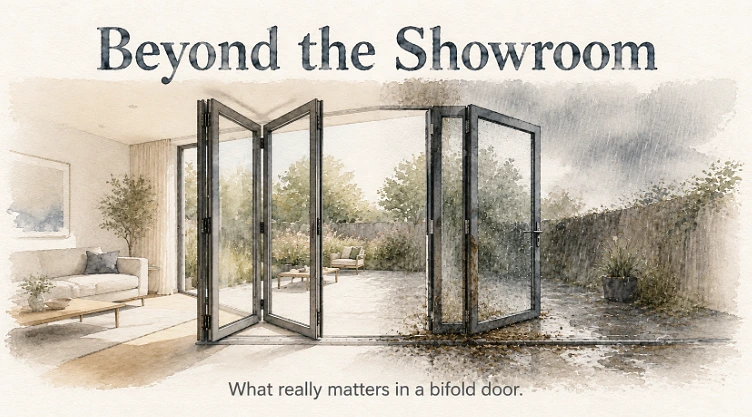
A bifold door is a multi-panel door system where panels fold against each other in pairs and stack to one or both sides of the opening, creating a wide unobstructed gap between two spaces — usually a living area and a patio, garden, or balcony. The panels run on a track, connected by hinges, and fold like an accordion when opened.
That part everyone knows. What most buyers don’t find out until after installation is that the material of the frame, the type of track system, and the number of panels you choose affect how the door performs three or four years down the line far more than how it looks on day one. A bifold door that opens smoothly in the showroom and one that opens smoothly after four winters of dirt in the track and thermal expansion in the frame are not always the same product — and increasingly, the systems that hold up best are coming out of specialist aluminium manufacturing hubs like Foshan, Guangdong, where the concentration of extrusion and fabrication expertise has made it the global centre for aluminium door and window production.
Aluminium vs Timber vs uPVC — Three Different Doors Pretending to Be the Same Thing
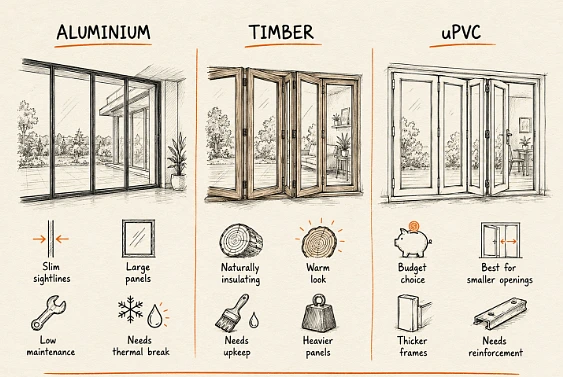
These get compared as if they’re just finish options. They are not. The frame material determines the thermal performance, the maximum panel size, the weight, the maintenance cycle, and how the door ages.
Aluminium is the most common choice and there are solid reasons for that. It’s strong enough to support large glass panels at narrow sightline widths — 120 to 160mm on standard systems, with premium slim configurations getting down to 95mm or even 30 to 50mm at the meeting stiles. More glass, less frame, which is the whole visual point. Aluminium doesn’t rot, doesn’t warp, and holds quality architectural powder-coat finishes for fifteen to twenty-five years in most climates without repainting, longer with proper pretreatment though coastal and high-UV environments may need earlier inspection.
The weakness is thermal conductivity. Aluminium alloys conduct heat roughly 800 to 1,200 times faster than uPVC — typical values sit around 150 to 200 W/m·K for aluminium versus 0.16 to 0.25 W/m·K for uPVC. Without a thermal break — a strip of insulating polyamide sandwiched between the inner and outer aluminium profiles — the frame becomes a cold bridge in winter or a heat bridge in hot climates. Condensation runs down the inside of the frame, pools on the sill, damages flooring. Any aluminium bifold worth buying has a thermal break. If the product spec does not mention one, ask directly, because cheaper systems skip it and you will not notice until the first cold month.
The good news is that modern thermally broken aluminium systems have caught up dramatically. With polyamide breaks, low-E coatings, argon-filled glazing, and warm-edge spacers, premium aluminium bifolds now achieve whole-door U-values between 0.8 and 1.4 W/m²K — some configurations hitting 0.87 W/m²K with triple glazing. That comfortably meets or exceeds UK Part L targets and comparable international standards, often while delivering slimmer profiles and better structural performance than uPVC equivalents. Foshan-manufactured systems from certified factories routinely hit these numbers because the extrusion and thermal-break insertion processes are done in-house on precision lines, not assembled from outsourced components.
Timber looks the warmest and has the best natural thermal performance — lower U-values than aluminium without needing a thermal break. But timber bifolds are heavier per panel, limit your maximum panel width, and need repainting or re-oiling every two to four years depending on exposure, longer in sheltered positions with modern finishes. Skip a maintenance cycle and the finish degrades, moisture gets into the grain, the timber swells unevenly, and the panels start binding in the track. In humid or termite-prone regions, additional treatment is not optional. Timber bifolds work beautifully in covered or semi-sheltered openings. Fully exposed south-facing wall with direct rain and sun? The maintenance commitment is real and ongoing.
uPVC is the budget option and it does the job in smaller openings — up to about three metres wide with three panels. Beyond that, uPVC frames need reinforcement, usually internal steel or aluminium sections, to support the glass weight without flexing. That adds cost and reduces the weight advantage. Sightlines on uPVC bifolds are the thickest of the three — 150 to 180mm or more is common — meaning more frame visible and less glass. For a bedroom or kitchen opening onto a small courtyard, perfectly fine. For a wide living room opening where the view is the point, uPVC starts to compromise the design.
Top-Hung vs Bottom-Rolling TrackTop-Hung vs Bottom-Rolling Track: One of These Causes Most Service Calls
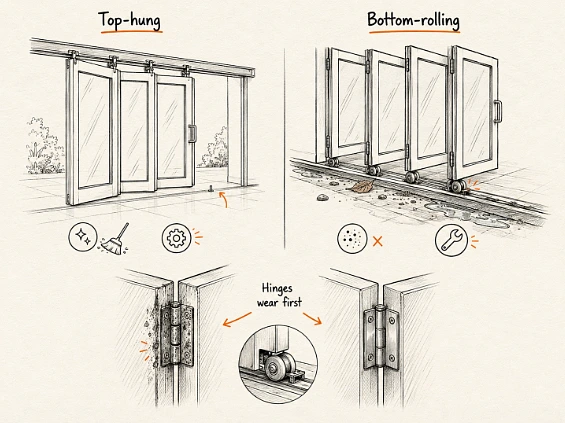
A folding door runs on a track. That track is either at the top, panels hanging from an overhead rail, or at the bottom, panels rolling on a floor-level rail. This choice matters more than most buyers realise because it determines what happens when dirt and leaves and grit and water get into the track. And they will.
- Bottom-rolling systems are more common and generally cheaper. Panels sit on carriages rolling along a floor track recessed into the threshold. The problem is that floor track — it collects debris constantly. Dust, sand, pet hair, small stones tracked in from outside. Over time that grinds against the rollers and the track surface and the door starts feeling gritty, then stiff, then it starts jumping off the track if a pebble wedges under the carriage. Regular cleaning fixes it but “regular” means weekly during seasons when doors are open often, not twice a year. Modern systems have improved this with sloped track profiles and brush seals that reduce debris buildup, but the fundamental issue remains — anything at floor level collects what the floor collects.
- Top-hung systems suspend the panels from an overhead rail. The floor track is either minimal, a small guide channel, or absent entirely, replaced by a floor-level guide pin. Less debris accumulation, smoother operation long-term, easier to clean the threshold. The trade-off is that the entire panel weight hangs from the header, so the lintel above the opening needs to be engineered for that specific load. In a new build the structural engineer specifies it from the start. In a retrofit where you’re cutting a new opening in an existing wall, the lintel upgrade adds cost and complexity.
- What actually fails in both systems: The hinges between panels take the most mechanical stress. Every open-close cycle flexes them. Cheap hinges with thin pivot pins wear out faster, and when they do the panels sag at the hinge point and the folding action becomes uneven. Stainless steel pivots and heavy-gauge hinge plates last significantly longer than zinc-plated mild steel, especially in coastal or high-humidity areas where corrosion accelerates. Quality hardware rated for 100,000+ cycles makes a measurable difference — and this is one area where asking the manufacturer about their specific hinge and roller specs tells you more about long-term performance than any brochure photo.
The Threshold Problem That Shows Up the First Time It Rains Sideways
Where the door meets the floor is the most vulnerable point in any bifold installation. Water, air, and dirt all try to enter through the threshold, and the design of that junction determines whether they succeed.
- Flush thresholds sit level with the interior and exterior floor. Clean look, step-free access, great for accessibility. But almost no physical barrier against wind-driven rain. In exposed locations or during heavy storms, water pushes across the track and onto the interior floor.
- Raised thresholds — even just 15 to 20mm above floor level — dramatically improve weather resistance but create a step. Some systems use a low-profile weatherbar sitting 5 to 10mm proud as a compromise, though the seal still depends on the quality of the brush strips or rubber gaskets along the bottom of each panel.
No bifold threshold is as weatherproof as a solid wall. Every bifold door, regardless of price, has more potential water ingress points than a sliding door or a hinged door simply because it has more joints, more moving panels, and more gaps where seals meet. Well-designed systems manage this with sloped drainage channels in the track and multiple seal lines — the better Foshan-manufactured systems, for example, are tested to 720 Pa water pressure resistance, which handles most real-world weather conditions — but in fully exposed positions with driving rain, proper external drainage design around the threshold is still critical.
When a Bifold Door Is the Wrong Choice
No door company’s website covers this, but it matters.
- Very wide openings over six metres with a premium view. Bifold panels stack to one side when open. On a six-metre opening with six panels, that stack is roughly 500 to 700mm deep depending on panel thickness — a visible block of folded glass and frame at one edge of your view. A lift-and-slide system puts panels behind each other instead of folding them, so the open section is genuinely clearer. If uninterrupted view is the whole point, lift-and-slide often delivers that better.
- High wind exposure. When open, bifold panels present flat surfaces to the wind. A sudden gust catches an open panel and stresses the hinge connections and the track carriage. Manufacturers rate their bifolds for specific wind loads when closed — tested systems handle up to 3,600 Pa — but open-position resistance is much lower. Coastal cliffs, elevated hillside homes, exposed rural properties — a sliding system that keeps panels within the frame at all times handles wind more predictably.
- Tight interior space near the opening. Folding door panels swing inward or outward as they fold. Inward-opening needs clear floor space for the panels to pass through. Furniture, kitchen counters, or fixtures close to the opening and the swing arc clashes. Outward-opening solves this but requires clear external space and exposes the folding mechanism to weather.
None of this means bifolds are wrong. It means they are a specific solution for a specific situation — wide openings in reasonably sheltered positions where the indoor-outdoor connection is used regularly and the stacking width of folded panels is acceptable. For that use case, nothing else does the job quite the same way.
Panel Count and Sizing: The Configuration That Fits Daily Life
- Standard panel widths run from about 600mm to 1,000mm, with premium aluminium systems going up to 1,200mm. Aluminium handles the widest panels because of its strength-to-weight ratio. Timber panels max out narrower due to weight. uPVC narrower still unless reinforced.
- Odd vs even panel counts change how the door opens. Even numbers — four, six — split evenly to both sides or stack entirely to one side. Odd numbers — three, five — allow a traffic door, one panel that opens independently like a normal hinged door for everyday use without folding the entire set. If you use the opening multiple times a day and don’t want to fold four or five panels just to step outside for a coffee, the traffic door configuration is worth specifying.
Weight per panel matters for how the door feels over time. A standard double-glazed aluminium panel at 900mm wide and 2,100mm tall weighs roughly 40 to 70kg depending on glass thickness and frame profile — triple glazing or larger panels run heavier. Across five or six panels that is 250 to 400+ kg running on the track. That kind of cumulative weight needs properly engineered hardware to feel effortless. The first panel always feels smooth in the showroom. It’s the fifth panel, three years into daily use, that tells you whether the carriages and the track and the hinges were specified for the actual load.
The showroom demo tells you how a bifold door looks. It does not tell you how it performs when the track has two winters of grit in it, or how the threshold handles a sideways rainstorm, or whether the hinges will still fold cleanly after ten thousand open-close cycles. Those answers live in the material spec, the track engineering, the hinge and roller quality, and the threshold drainage design — not in a brochure photo of an open-plan living room on a sunny day.

 Decor & Improvement Accessories