

Home & Decor Blogs: DIY, Interior Design & Lifestyle Ideas
What Breaks First in Ottawa Homes Built Before 1980 — and What It Costs to Fix

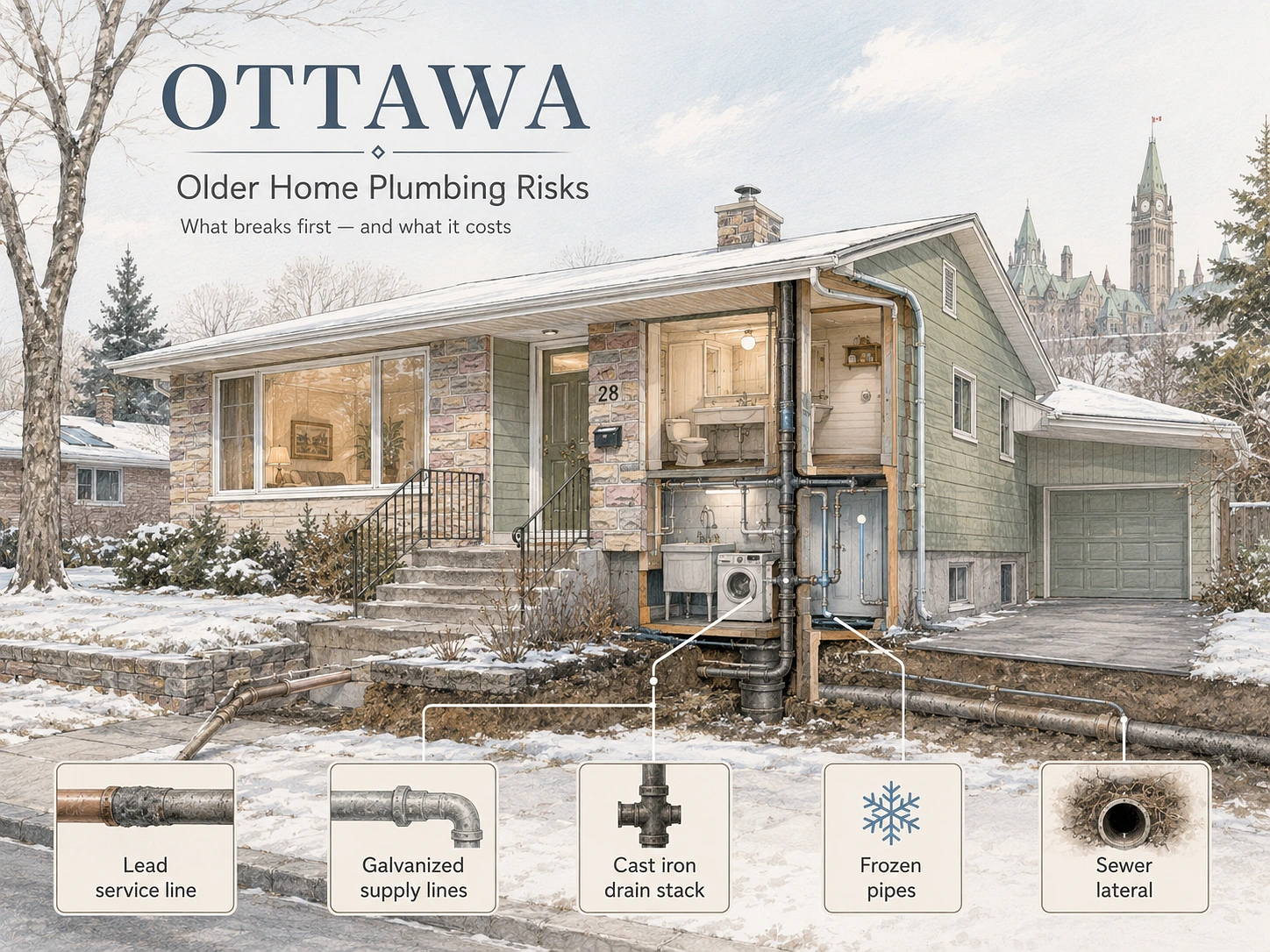
There are approximately 30,000 homes in Ottawa built with lead water service lines. Homes built prior to the late 1950s are the most likely to have them, but even properties built into the early 1960s can be connected to older watermains that carry the same risk. The City operates a Lead Pipe Replacement Program with rebates, and most homeowners in affected neighbourhoods are unaware it exists.
That’s one problem. There are four others hiding inside the walls of older Ottawa homes, each on its own timeline. Galvanized steel supply lines installed from the 1940s to the early 70s are reaching the end of their expected useful life. Close behind are the cast iron drain stacks of the same era. Copper supply lines with lead-soldered joints — common through the mid-1980s — are a health risk even when the pipe itself is fine. And every winter, Ottawa’s cold snaps of minus 25 to minus 30°C put all of it under stress that warmer cities never deal with.
This will make it easier to understand what each material does as it ages, how the failure looks from inside the house, and what replacement actually costs — so you can decide which problem to deal with first instead of waiting for one to announce itself.
Galvanized Steel Supply Lines: Built to Last 40 to 50 Years, and That Clock Has Already Ticked
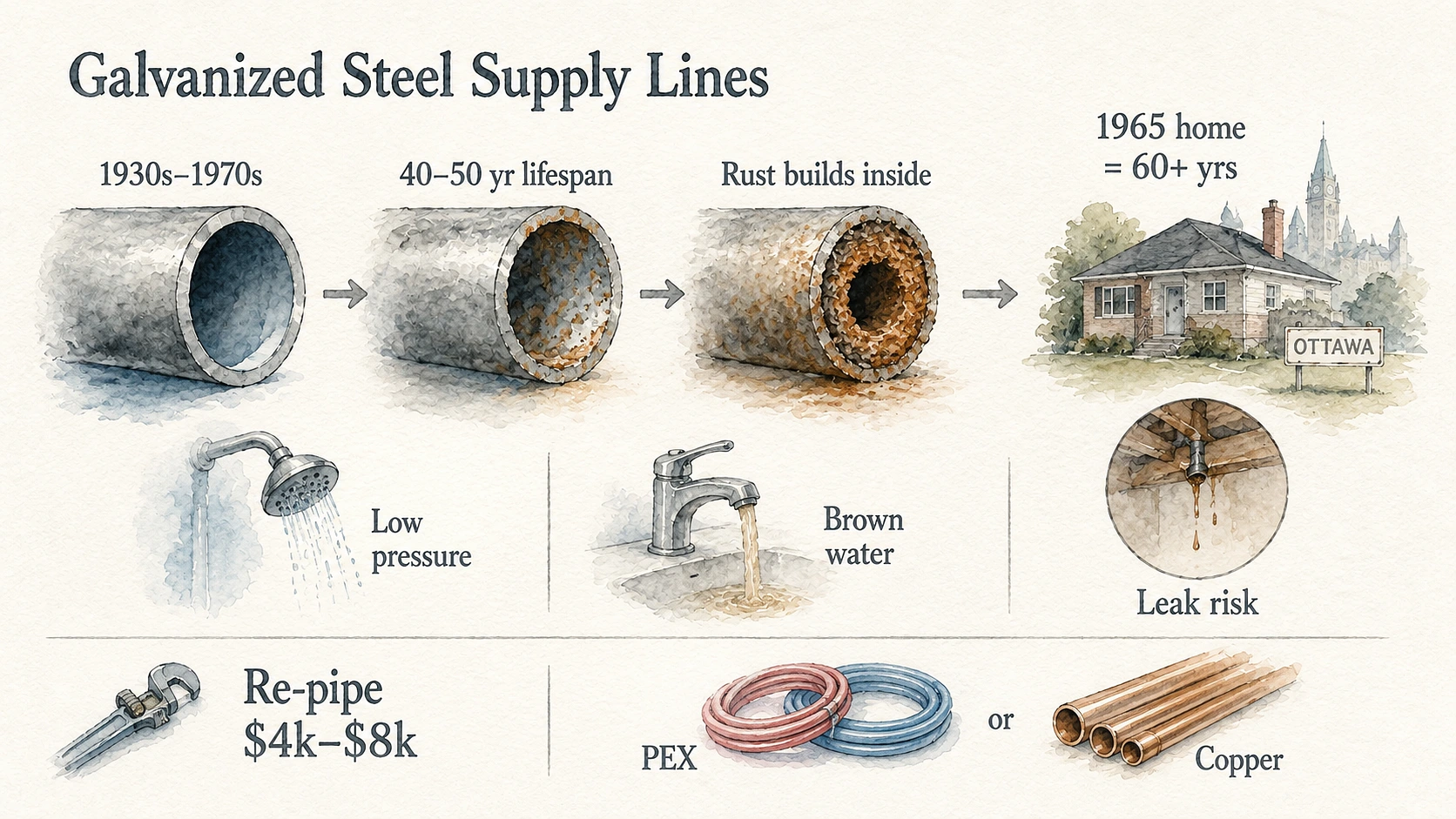
Most water supply pipe used in residential construction was galvanized steel from the 1930s to the early 1970s. The pipe is steel coated with zinc — the idea was to stop it from rusting. For a time it did. Then the zinc gradually wears away, and the steel underneath begins corroding from the inside out, building up rust and scale that eventually restricts water flow.
How you know it’s happening. The initial symptom is low water pressure, usually at the shower, where the flow demand is greater than at a sink tap. Most people point to the showerhead or the municipal supply. Then you notice the pressure dropping at several fixtures at the same time, and that’s the pipe narrowing internally across its full length, not just at one location.
The second sign is discoloured water. Brown or yellowish water when you first turn on a tap in the morning — that’s rust sitting in the pipe overnight and flushing through when flow starts. If it clears after running for a minute, the pipe is corroded but still functional. If it stays discoloured, the corrosion is deep enough that particles are breaking off continuously.
The timeline problem for Ottawa specifically: A house built in 1965 with galvanized supply lines is now over 60 years old. The pipe’s expected lifespan was 40 to 50 years. It’s not a question of whether it will fail, it’s whether it fails as a slow pressure decline you can plan around, or a sudden leak behind drywall that you discover when the ceiling below starts dripping.
What replacement costs. A full re-pipe of a typical Ottawa two-storey home — replacing galvanized with copper or PEX — runs $4,000 to $8,000, depending on the number of fixtures, how accessible the pipe runs are, and whether walls need opening. PEX is cheaper than copper and faster to install because the tubing wraps around corners rather than requiring soldered joints at every turn, though some homeowners prefer copper for longevity.
Cast Iron Drain Stacks: 50 to 70 Year Lifespan, and the 1960s Were a Long Time Ago
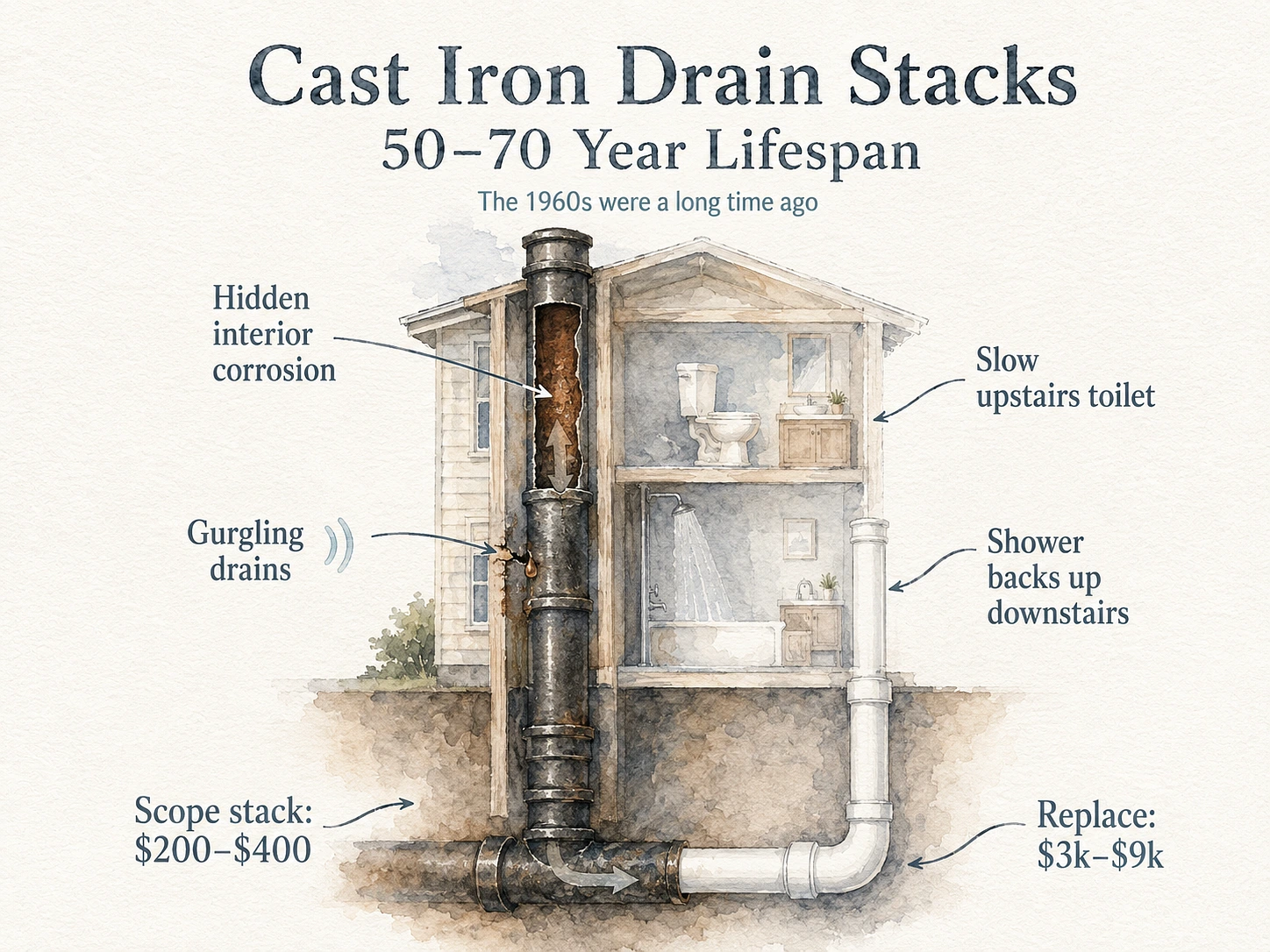
Cast iron was used for drain, waste, and vent pipes in most homes built before the mid-1970s. These are the large vertical pipes — the stacks — that carry wastewater from upper-floor bathrooms down to the main sewer line. In ideal conditions, cast iron can last 50 to 100 years, but waste lines corrode faster internally than supply lines because of what’s flowing through them — realistically, you’re looking at 50 to 70 years of effective service before problems show up. PVC and ABS plastic replaced cast iron for new construction starting in the mid-1970s, but the old cast iron is still sitting in tens of thousands of Ottawa homes that have never had a full plumbing renovation.
Cast iron corrodes differently than galvanized steel. It rusts from the inside, and you can’t see it happening because the pipe still looks solid from the outside until it isn’t. The corrosion roughens the interior of the pipe, which catches grease and debris and creates blockages that get worse over time. Eventually the pipe rusts through completely — a section cracks or a joint separates, and now you have sewage leaking inside a wall cavity.
What it sounds like before it fails. Gurgling drains. An upper-floor toilet that drains slowly even after you’ve cleared the trap and the branch line. Water backing up in a ground-floor shower when someone flushes upstairs. These are signs the vertical stack is partially blocked by internal corrosion, not that individual fixtures have isolated clogs.
What replacement costs. Replacing a main cast iron stack with PVC runs $3,000 to $9,000, depending on height, accessibility, and how many branch connections tie into it. Simpler jobs in unfinished basements with exposed stacks come in at the lower end, but in a finished Ottawa home where the stack runs through closed walls across two storeys, the labour and drywall restoration push costs toward the higher end. The pipe itself costs almost nothing — PVC is cheap — the real expense is the labour of cutting out heavy cast iron in a confined wall space, supporting the upper sections while you work, and tying the new PVC into existing connections at the top and bottom.
The one thing most homeowners get wrong here: they keep snaking individual drains year after year instead of scoping the stack itself. A camera inspection of the main stack costs $200 to $400 and tells you whether you’re dealing with a localized blockage or system-wide corrosion. If you’re calling a Plumber Ottawa for the third drain backup in two years, the stack inspection is worth more than another round of snaking.
Lead Service Pipes and Lead-Soldered Joints: Two Different Problems, Same Health Risk
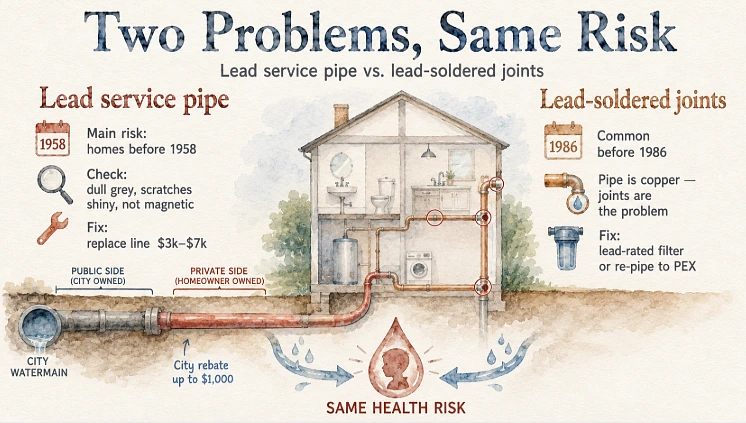
These are separate issues and they get confused constantly.
Lead service pipes are the underground pipe connecting your house to the city watermain. Ottawa homes built before 1958 are the primary risk group. The City’s water leaving the treatment plant is lead-free, but when that water sits inside a lead service pipe, trace amounts of lead dissolve into it. The City of Ottawa runs a Lead Pipe Replacement Program that provides rebates for replacing the homeowner’s portion of the lead service line — the section from the shutoff valve to the house. The city handles the public portion from the valve to the watermain.
How to check if you have one. Find the pipe where your water supply enters the basement. If it’s dull grey and you can scratch it with a coin to reveal a shiny silver surface underneath, that’s lead. Copper is a reddish-brown colour. Galvanized steel is grey but magnetic — lead is not.
Lead-soldered copper joints are the second problem, and they affect a wider range of homes. Copper supply pipes installed before the mid-1980s were commonly joined with lead-based solder. The pipe itself is fine, but lead leaches from the solder joints into the water, particularly in hot water lines and in water that’s been sitting in the pipe overnight. Canada’s National Plumbing Code banned lead solder for potable water systems in 1986, but homes plumbed before that ban still have it at every joint throughout the system.
Cost to address:
- Lead service pipe replacement (homeowner’s portion): $3,000 to $7,000, depending on length and excavation conditions. The City’s rebate covers up to $1,000 — roughly 20% of typical private-side costs — so check the program before paying full price out of pocket.
- Re-soldering copper joints throughout a home: generally not done. The practical fix is either a whole-house water filter rated for lead reduction or a full re-pipe to PEX, which eliminates the solder joints entirely.
Ottawa Winters and Frozen Pipes: The Problem That Hits Every Material
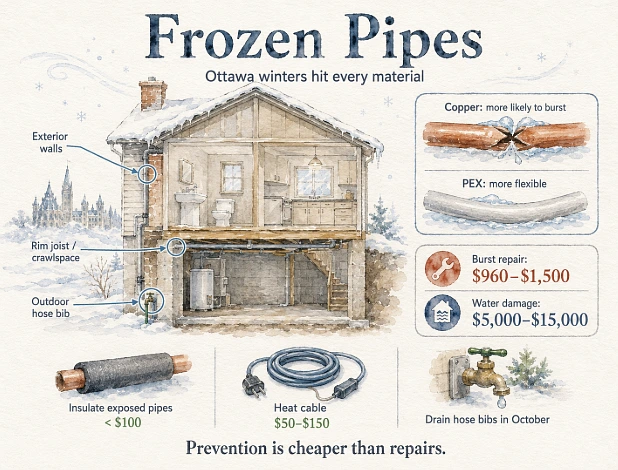
Ottawa is not a city where frozen pipes are an edge case. January average lows sit around minus 14 to minus 15°C, but cold snaps pushing minus 25 to minus 30°C hit several times most winters — and those extremes are when pipes actually burst. Every pipe material is vulnerable, but copper pipes are more likely to burst than PEX because copper is rigid — when ice expands inside it, the pipe splits. PEX has some flexibility and can absorb minor expansion without cracking, which is one reason it has become the default replacement material in cold-climate re-pipes.
Where pipes freeze in Ottawa homes:
- Supply lines running through exterior walls, especially on the north and west faces of the house where wind chill is worst.
- Pipes in unheated crawlspaces or unfinished basements near the rim joist — that gap where the foundation meets the framing is the coldest spot in most Ottawa homes.
- Outdoor hose bibs that weren’t shut off and drained before the first hard freeze. The ice forms at the bib and travels backward into the supply line inside the wall.
What a frozen pipe burst costs in Ottawa. Repair runs $960 to $1,500 for a straightforward burst where the plumber can access the pipe without major demolition. That number climbs fast if the burst happened inside a finished wall or ceiling and the water ran before anyone noticed — now you’re adding drywall repair, painting, and possibly mould remediation on top of the plumbing bill. A burst pipe that runs undetected for even a few hours can cause $5,000 to $15,000 in water damage.
Preventing it is cheaper than fixing it. Pipe insulation on exposed runs costs under $100 in materials and takes a Saturday afternoon. Heat cable on vulnerable sections adds another $50 to $150. Shutting off and draining outdoor hose bibs every October costs nothing. These aren’t complicated measures, but they have to actually be done before the first cold snap, not after the pipe has already frozen.
The Sewer Lateral: The Pipe You Cannot See and Probably Haven’t Thought About
The sewer lateral is the underground pipe running from your house to the municipal sewer main, usually under the front yard. In Ottawa homes built before the 1970s, this pipe is almost certainly clay or cast iron. Both materials have a 50 to 70 year lifespan underground, and both are vulnerable to root intrusion from mature trees — which Ottawa’s older neighbourhoods have in abundance.
Tree roots find their way into sewer laterals through tiny cracks or gaps at the joints between pipe sections. Once inside, the roots expand and create a growing blockage that catches grease, paper, and debris until the line backs up into the basement. You snake it, the backup clears, and six months later it’s back because the roots are still there growing through the same entry point.
How to actually diagnose it. A camera inspection — running a small waterproof camera through the sewer lateral from the cleanout inside the basement to the municipal connection. This shows you exactly where the roots are entering, whether the pipe has shifted or bellied (sagged), and whether the damage is localized to one joint or spread across the full length. Lister Plumbing runs these inspections routinely for homeowners buying older Ottawa properties, because a failing sewer lateral is a $5,000 to $15,000 repair that doesn’t show up on a standard home inspection — you have to specifically request a sewer scope.
Replacement options and what they cost:
- Trenchless pipe lining (cured-in-place): A resin-coated liner is pulled through the existing pipe and inflated, creating a new pipe inside the old one. $4,000 to $8,000. No excavation, no tearing up the front yard. Works when the pipe has cracks and root intrusion but hasn’t collapsed.
- Traditional excavation and replacement: Dig up the yard, remove the old clay or cast iron, lay new PVC. $8,000 to $15,000 depending on depth, length, and whether the city sidewalk or driveway sits on top of the run. Required when the pipe has collapsed, bellied severely, or shifted enough that a liner can’t follow the path.
Which Problem to Fix First
If you’re sitting in an Ottawa home built in the 1950s or 1960s, you could theoretically have all five of these issues at once — lead service pipe, galvanized supply lines, cast iron drain stack, lead-soldered copper joints, and an aging clay sewer lateral. Fixing everything at once would cost $20,000 to $40,000, and that’s not realistic for most homeowners.
Start with what affects health: the lead service pipe and lead-soldered joints. The City’s rebate program helps with the service pipe. A whole-house lead-rated filter handles the solder joints as an interim measure while you plan a re-pipe.
Then fix what causes catastrophic damage: the sewer lateral if you’re getting recurring backups, and pipe insulation for freeze prevention before your first Ottawa winter in the house. A basement flood from a backed-up sewer or a burst frozen pipe causes more financial damage in one event than years of low water pressure from corroded galvanized lines.
Then plan the big replacements: the galvanized re-pipe and cast iron stack replacement can be scheduled, quoted properly, and done during warmer months when plumbers aren’t buried in emergency freeze calls. Get three quotes, compare scope not just price, and make sure the quote specifies exact materials, permits, and warranty terms — a number without those details is not a quote.
 Decor & Improvement Accessories