

Home & Decor Blogs: DIY, Interior Design & Lifestyle Ideas
Summer Maintenance for Indiana Homes: Six Things That Actually Cost You Money if You Skip Them

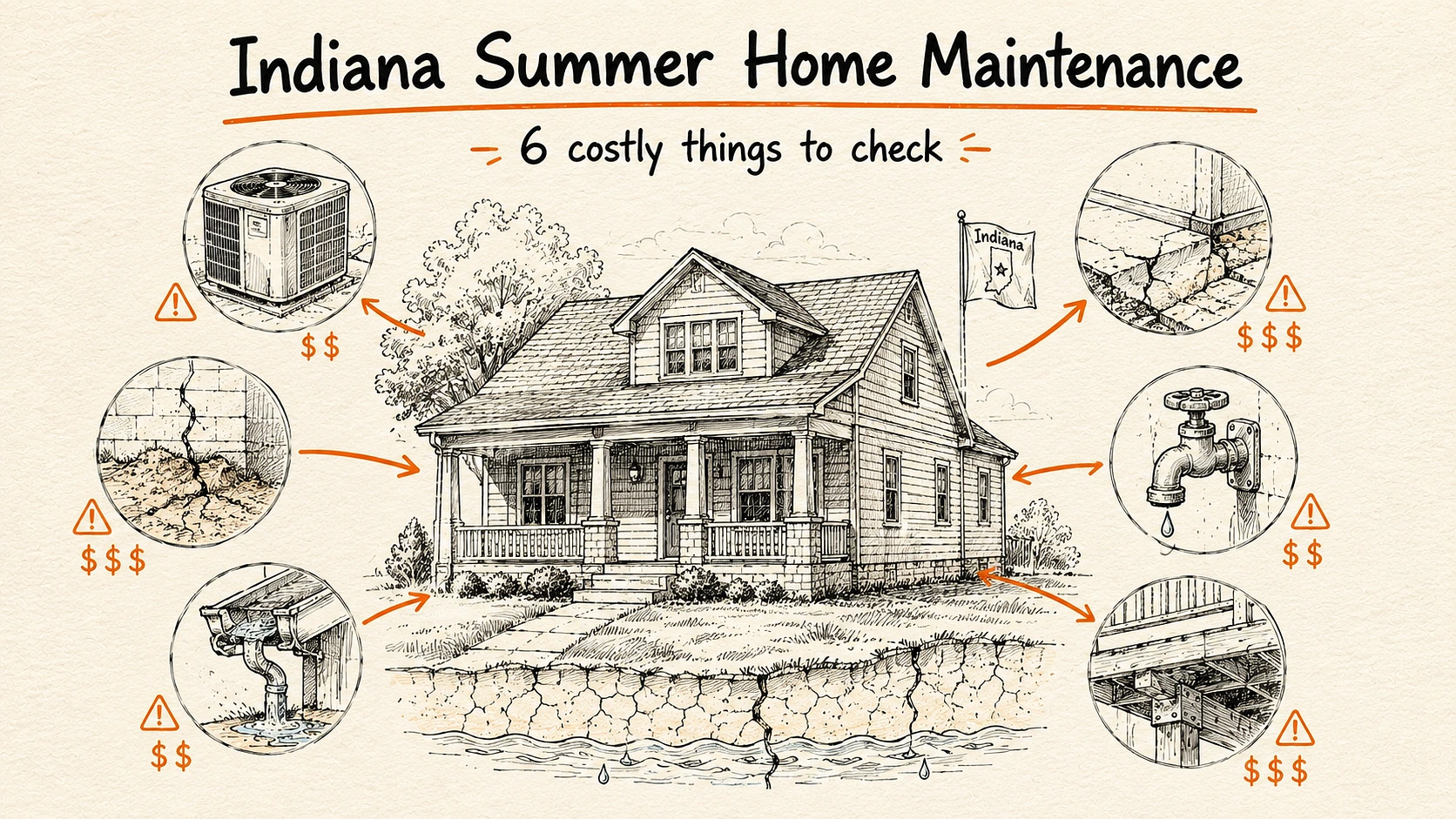
Most summer checklists tell you to clean your gutters and test your smoke detectors. Fine. But if you live in Indiana, the things that quietly run up repair bills have more to do with clay soil, Gulf humidity, and what last winter’s freeze-thaw cycles did to your foundation than whether you remembered to trim a bush.
Fremont and the rest of northeast Indiana sit in a climate that swings from the low teens in January to the low eighties in July, with humidity averaging around seventy percent through June and July. May and June typically deliver the heaviest rainfall, with monthly totals frequently reaching or exceeding four inches during active thunderstorm periods. That combination — heat, moisture, and soil that moves with the seasons — creates problems you will not find on a generic summer checklist written for the whole country.
Your AC Ran All Winter on Heat Mode. Now It’s Switching to Cooling — and Nobody Checked In Between
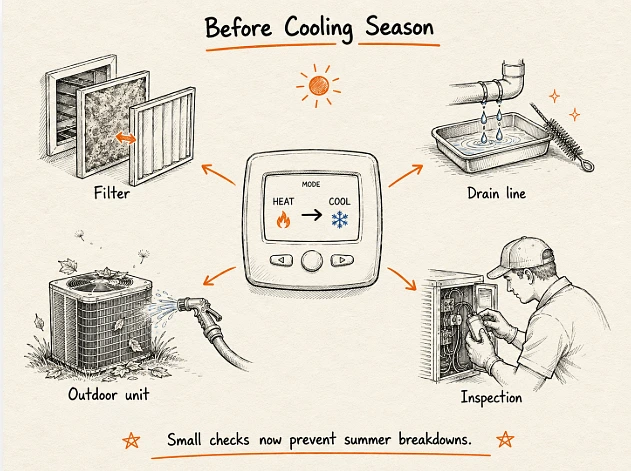
The system has been working since October. Heat pump or furnace through winter, then switch to cooling as temperatures rise through May. That is eight or nine months of continuous operation with no inspection, and the transition from heating to cooling is exactly when small problems turn into midsummer breakdowns.
What actually needs checking and why:
- The air filter. If you did not change it in March, it has five months of dust, pet hair, and furnace cycling caked into it. A clogged filter restricts airflow enough to freeze the evaporator coil in summer — and a frozen coil looks like a refrigerant problem when it’s actually a $4 filter that needed swapping.
- The condensate drain line. In cooling mode, the evaporator coil pulls moisture out of indoor air. That moisture drips into a pan and drains through a PVC line to the outside. Indiana’s humidity means that line handles a lot of water from May through September. Algae grows inside the line, blocks it, water backs up into the pan, and either the safety float switch kills the system or the pan overflows into your ceiling. A quarter cup of bleach in the drain pan every couple months stops this entirely.
- The outdoor condenser unit. It has been sitting there since last summer collecting cottonwood fluff, grass clippings, and whatever the mower kicked up. Packed fins cut airflow, the compressor runs longer cycles to hit the setpoint, and longer cycles wear the compressor faster. A garden hose rinse from the inside out — not a pressure washer — takes ten minutes.
If you are in the Fremont area and the system has not had a professional inspection since last year, T&T Plumbing, Heating, Air Conditioning & Geothermal handles the full seasonal check — refrigerant levels, electrical connections, coil condition, and the stuff you cannot get to without pulling panels. The difference between catching a failing capacitor in June and having the compressor die on an eighty-five degree Saturday in July is a $150 part versus a $1,500 to $2,500 emergency replacement.
Indiana’s Clay Soil Moves Every Summer — and Your Foundation Feels It
This one is not on any generic checklist and it probably should be.
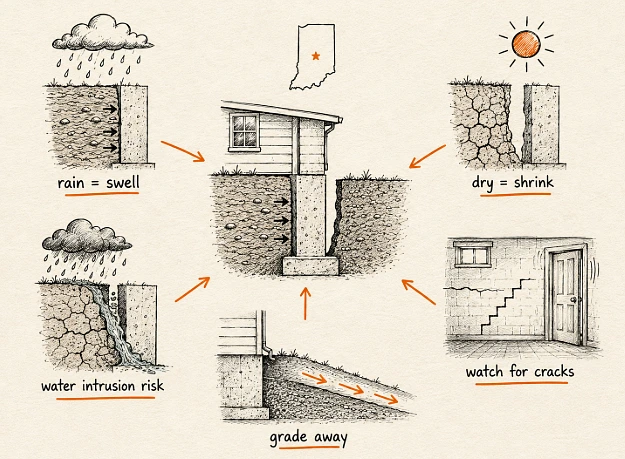
Much of Indiana sits on glacial till loaded with clay. Clay soil absorbs water and swells when it rains, then shrinks and cracks when it dries. That constant expansion and contraction cycle pushes against your foundation walls, pulls away during dry spells, and over years creates cracks that let water in. The cycle happens everywhere in the state, from Marion County down to the northeast corner around Steuben and DeKalb counties.
Summer is when the damage from this cycle becomes visible. After winter’s freeze-thaw and spring’s heavy rain, the soil has been through its most extreme movement of the year. Now in June and July the ground starts drying and shrinking, and the gaps that open between the soil and your foundation wall become pathways for the next heavy rain to pool directly against the concrete.
What to actually look for:
Walk the perimeter of your house after a dry week. If you see the soil pulling away from the foundation — a visible gap between the dirt and the concrete — that is the shrinkage phase. Not dangerous on its own, but it means the next heavy storm will dump water straight into that gap and directly against your wall.
Then go inside. Basement walls that show new horizontal cracks, stair-step cracks along mortar joints, or doors that suddenly stick in their frames — all of those can be clay soil pressure showing up. Not every crack is a crisis, but a new crack that was not there last summer is worth paying attention to.
The fix is boring but effective: make sure the ground around your foundation slopes away from the house, not toward it. Most of the time when water enters a basement in Indiana it is because the grading has settled over the years and now directs rainwater toward the wall instead of away from it. Regrading the soil around the foundation so it drops at least six inches over the first four feet from the house costs almost nothing and prevents problems that cost thousands.
Gutters in Indiana Aren’t a Cosmetic Problem — They’re Your Foundation’s First Line of Defense
Yes, every summer checklist says clean your gutters. But in Indiana specifically, gutters that overflow are directly connected to the clay soil foundation problem above. Water that pours over a clogged gutter lands right next to the foundation, saturates the clay, and increases hydrostatic pressure against the basement wall.
This is not a “maybe someday” issue. Indiana gets its heaviest rainfall in May and June — over four inches per month in the northeast part of the state. A single clogged downspout during a heavy summer storm can dump hundreds of gallons of water next to the foundation in an hour.
Two things matter more than just cleaning the gutters:
Where the downspouts terminate. If the downspout drops water right at the base of the house, it does not matter how clean the gutter is. Extend downspouts at least four to six feet away from the foundation. The cheap plastic extensions from the hardware store work fine.
Whether the splash zone has eroded. Check the ground directly below where the downspout discharges. If there is a depression worn into the soil, water is pooling there before it runs off. Fill it, grade it away from the house, and check it again after the next big rain.
The Freeze-Thaw Check: What Winter Did to Your Exterior That You Can Only See Now
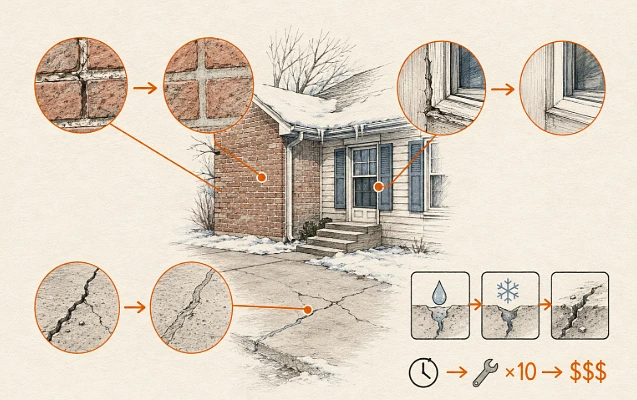
Winter in northeast Indiana means repeated freeze-thaw cycles — temperatures crossing the thirty-two degree line multiple times between November and March. Water gets into small cracks in concrete, brick, mortar, and caulking, freezes, expands, then thaws and leaves the crack wider than before. By summer, what started as a hairline crack in your driveway or a small gap in the mortar between bricks has opened up enough to let real water through.
Walk the outside of the house and look at:
- Mortar joints on brick facades. Crumbling or recessed mortar means the freeze-thaw cycle has been working on it. Repointing — scraping out the old mortar and packing in new — costs $5 to $15 per square foot if you catch it early. Letting it go means water gets behind the brick, damages the wall sheathing, and turns a $300 repointing job into a $3,000 moisture remediation project.
- Concrete walkways, stoops, and driveways. Cracks that were not there last fall probably opened over the winter. Filling them with a flexible concrete caulk now prevents water from getting back in and repeating the cycle next winter.
- Caulking around windows and door frames. If the caulk has pulled away from the frame or cracked, water is getting behind the siding when it rains. Recaulking a window takes fifteen minutes. Repairing the rot that happens when you skip it takes a day and costs ten times more.
Test Your Outdoor Plumbing Before You Need It
This one is quick. Indiana winters are hard enough on pipes that outdoor faucets, hose bibs, and irrigation lines can crack internally without showing any visible damage on the outside. The crack happened when water froze inside the pipe last January. You will not know until you turn the faucet on in June and either get low pressure, a spray from a split fitting, or worse — water running inside the wall behind the faucet where you cannot see it.
Turn on every outdoor faucet. Watch the connection point where the pipe comes through the wall. If the wall is getting wet around the pipe, or if the faucet dribbles when it should stream, there is likely a split in the pipe behind the siding. Catching it now means a plumber fixes a pipe. Catching it in August means a plumber fixes a pipe plus you are dealing with mould inside the wall cavity that has been quietly growing all summer.
Check the Deck — But Not for the Reasons You Think
Most checklists tell you to look for loose boards and protruding nails. Fair enough. But the actual structural risk on an Indiana deck is underneath, not on top.
Indiana’s humidity and summer rain mean the underside of deck boards stays damp longer than the top surface. The top dries in the sun. The bottom stays wet, especially if the deck is low to the ground with poor airflow underneath. Over years, that moisture difference causes the boards to cup — curving upward at the edges — and rots the joists before the walking surface looks bad.
Get under the deck or look between the boards from below. If the joists are soft, dark, or show white fungal growth along the grain, the structure is weakening regardless of how the surface looks. Replacing joists costs $200 to $600 per joist depending on access. Replacing a deck that collapses because nobody looked underneath costs ten to twenty times that.
Also check where the ledger board attaches to the house — that is the horizontal beam bolted to your exterior wall. If the flashing above it is missing or has pulled away, water runs down the wall and behind the ledger. That connection point is the number one structural failure point on residential decks nationwide, and Indiana’s rain and humidity accelerate the rot faster than drier climates.
 Decor & Improvement Accessories