

Home & Decor Blogs: DIY, Interior Design & Lifestyle Ideas
Summer Maintenance For Indiana Homes Starts With What The Winter Left Behind


Most of the damage an Indiana homeowner pays for in July was done months earlier, in January and in May, and the summer is only the season when it finally shows. The usual list of gutters and smoke alarms gets done every year and the house still ends up costing money, because that list follows the calendar on the fridge while the damage follows a different one.
This article runs on that different calendar, month by month, starting in the middle of winter.
January, When The Freeze Keeps Coming Back
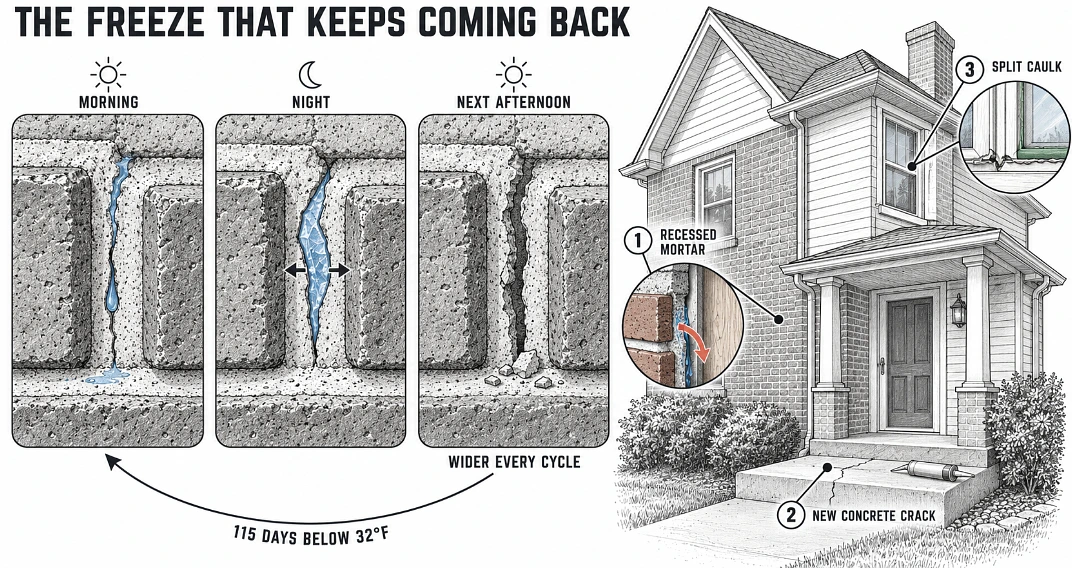
Northeast Indiana does not freeze once and stay frozen. If you look at the record for the Fort Wayne weather station you would see 115 days a year below 32°F, and plenty of those days warm back past freezing by the afternoon, so water that got into a small crack in the morning has frozen, pushed the crack open and melted out again by supper. Winter in northern Indiana goes on like that from November through March, and each round leaves the concrete, the brick, the mortar and the caulk a little more open than it found them.
The cracks open in January and only get noticed in June. The first slow walk around the house in early summer is where the winter repair list comes from.
On that walk, 3 places would be worth stopping at:
- Mortar on brick. Mortar that crumbles under a fingernail, or sits back behind the face of the brick, has been through the freeze. Repointing costs $5 to $15 a square foot while the damage is still small. Once water gets behind the brick and into the sheathing, the same $300 job could become a $3,000 moisture repair with the wall opened.
- Concrete walks, stoops and the driveway. Any crack that was not there last fall opened over the winter. Flexible concrete caulk pressed into it now will keep the water from getting back in for another round next year.
- Caulk around windows and doors. Where it has split or pulled off the frame, rain has been running in behind the siding since spring. About 15 minutes and a $6 tube for each window, against a day of rot repair that usually ends with the window coming out.
The Outdoor Faucet That Split Without Showing It
The hose bib on the back wall went through the same January. If any water was sitting in the pipe when the cold came, it froze and split the pipe from inside, and an outdoor faucet can do that without a single mark on the outside. Most people find out on the first warm day they hook up a hose, when the pressure is low, or a fitting sprays, or water starts running inside the wall where no one can see it.
Turn each outdoor faucet on and go look at the spot where the pipe comes through the wall. You would want to watch it for a minute or so. A damp patch spreading around the pipe, or a faucet dribbling when it ought to stream, means a split behind the siding, and in June that is a plumber and a length of pipe. If it waits until August, the plumber will also be opening a wall cavity that has had mold growing in it all summer.
May, When 3 Months Get A Third Of The Rain
Fort Wayne averages about 39.5 inches of rain a year and roughly 30% of it comes down between May and July, mostly as thunderstorms. Gutters are on every summer list in the country, but in Indiana the reason they matter is the ground right beside the house. Water that spills over a blocked gutter, or leaves a downspout at the base of the wall, goes straight into the clay next to the foundation, and 1 blocked downspout in 1 storm could put hundreds of gallons there inside an hour.
Cleaning the gutter is the part people remember. The downspout decides where the water goes, so 2 things on it need checking:
- Where it ends. A downspout that lets go at the foundation sends the water to the same place a blocked gutter would. An extension out to 4 to 6 feet from the house fixes it, and the plastic ones from the hardware store do the job even if they do not look like much.
- The ground under it. A worn hollow where the water lands means it is pooling and soaking in at that spot. Fill it, slope it away from the wall, and look again after the next heavy rain, since fresh fill usually sinks the first time it gets wet.
June, When The Clay Pulls Away From The Wall
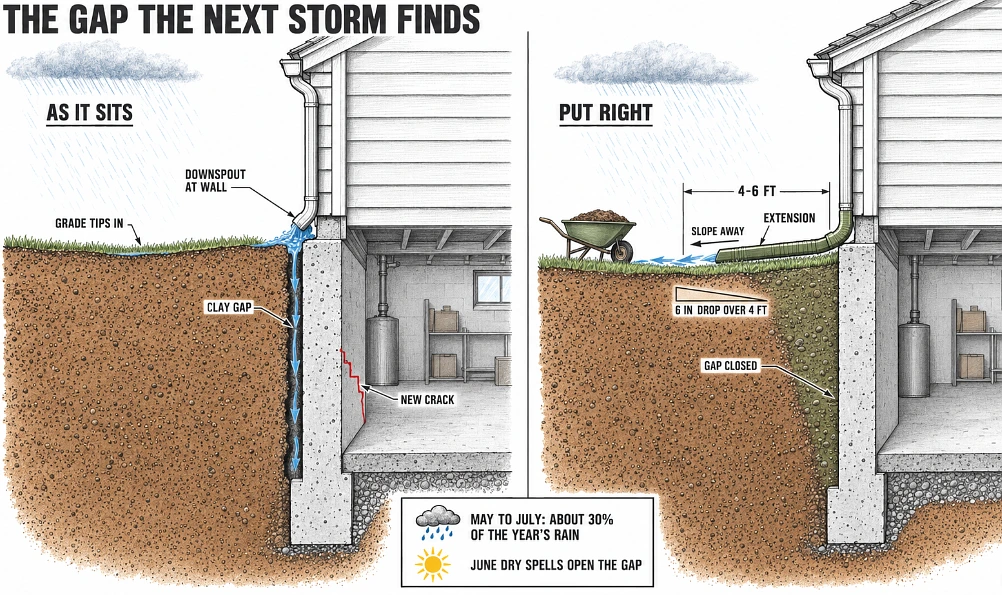
Much of Indiana sits on glacial clay that swells when it is wet and shrinks when it dries. After the May rain, the June dry spells pull it back from the foundation, and the gap it leaves will carry the next storm straight down to the basement wall.
You would not find this one on a national list at all, and in an Indiana house it is probably the most expensive item on this page. The movement happens every year from Marion County up to Steuben and DeKalb in the northeast corner, and over 20 or 30 years the push and pull opens cracks in foundations that were sound when they were poured. A gap along the wall in June is not damage on its own, the trouble is the 2 inch rain that comes after it and finds an open channel to the concrete, and if you walk around the house after a dry week and can see daylight between the dirt and the wall, that is the shrink, and then it is worth going down to the basement as well and looking for new horizontal cracks, stair step cracks running along the mortar of a block wall, or noticing whether a door upstairs has started sticking this year when it never did before, because any of those could be the clay pushing, and a crack that was not there last summer should be asked about even if it turns out to be nothing.
Grading fixes most of it. The ground should drop at least 6 inches over the first 4 feet going away from the house, and in a lot of Indiana basements that take water, the grading has settled over the years until it tips the rain back toward the wall. Putting that right would take a weekend, a wheelbarrow and a few yards of topsoil. The alternative people end up paying for is an interior drainage system at several thousand dollars.
July, When The AC Finally Gets Asked To Work
Of everything in the house, the air conditioner has gone longest without anyone looking at it. It started in October as a furnace or a heat pump, ran all winter, got switched over to cooling in May, and the first proper heat in July is the first time it has had to run hard, which is why HVAC schedules across the state fill up in the same week every year.
A homeowner can handle 3 parts of it in an afternoon.
The Filter
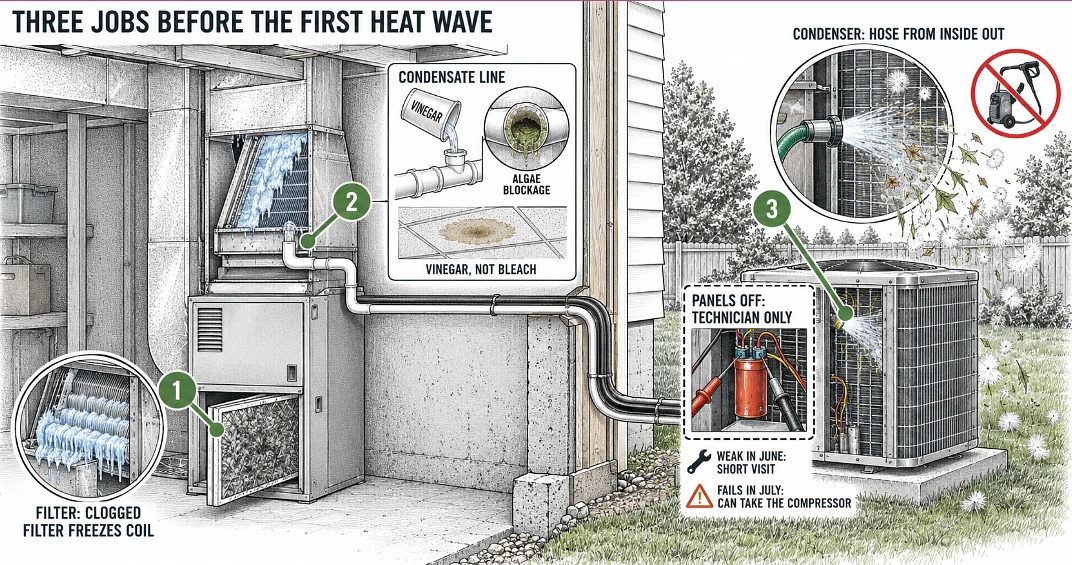
A filter last changed in March has been collecting dust, pet hair and furnace cycling for 5 months. Once it clogs far enough, the airflow drops enough for the indoor coil to freeze in cooling mode, and to most homeowners a frozen coil looks like a refrigerant leak. A $10 filter is often all it was.
The Condensate Line
In cooling mode the indoor coil pulls water out of the air, and an Indiana summer gives it a lot to pull. That water collects in a pan and drains out through a thin PVC line, and algae grows in the line until it blocks. Then either a float switch shuts the system off, or on a system without one, the pan overflows into whatever is under it, which in many houses is a finished basement ceiling. A cup of white vinegar down the line every couple of months keeps it open. Bleach gets recommended for this too, but it can corrode the aluminum in the coil and in some drain pans, so vinegar is the safer pick.
The Outdoor Unit
The condenser has been collecting cottonwood fluff and grass clippings since last summer. With the fins packed, the compressor has to run longer for the same cooling, and those long runs are what wear a compressor down. A garden hose sprayed from the inside out will clear it in about 10 minutes, while a pressure washer would fold the soft fins flat.
Past those 3, the work needs the panels off and a meter. Tyler owns T&T Plumbing, Heating, Air Conditioning & Geothermal in Fremont. When we asked him what the first cooling calls of the summer tend to be, he listed capacitors, dirty coils and blocked drains, the same short list his company has been seeing since 2 friends started it in the late 1970s. A capacitor reading weak in June might be a part in the $150 range and a short visit. Left to fail on a hot Saturday in July, it could take the compressor with it, and that would be a $1,500 to $2,500 job with a wait, since every technician in the area will be out on the same kind of call that weekend. His tune up covers the refrigerant charge, the electrical connections and the coil, none of which a homeowner should be opening up.
The Deck Joists Under The Cookout
July is also when the deck has the most people standing on it, and the part of a deck that fails is the part no one looks at. Summer rain and humidity keep the underside of each board damp long after the top has dried, and on a low deck with little air moving under it the wood might stay damp from one storm to the next. Over the years the boards cup and the joists rot from the top edge down while the surface still looks fine, and a fresh coat of stain every few years does nothing for the framing underneath.
Lie on the grass and look up between the boards with a flashlight, and push a screwdriver into a couple of joists. Wood that goes soft, looks dark along the grain or carries white fungal growth has been losing strength. One joist costs $200 to $600 to replace depending on how hard it is to reach, and a deck that gives way with people on it would cost 10 to 20 times that in carpentry alone.
The ledger board needs the closest look. It is the beam bolted to the house that the whole deck hangs from, and if the flashing above it is missing or has pulled away from the siding, rain runs down the wall and in behind it. Investigators going through deck collapses find the ledger connection has failed more often than any other part, so a slow pass along its top edge with a flashlight, checking for daylight where the flashing should be, is worth doing before the first cookout of the year.
What Each Problem Costs Found In June Against Found In August
| Problem | Found in June | Found in August |
|---|---|---|
| Recessed mortar on brick | $5 to $15 a square foot repointing | $3,000 moisture repair with the wall opened |
| Split hose bib | A plumber and a pipe | A plumber, a pipe, and mold in the wall cavity |
| Downspout dumping at the wall | A $10 extension | Part of a drainage bill |
| Grading tipped toward the house | A weekend and a few yards of topsoil | Interior drainage, several thousand dollars |
| AC capacitor reading weak | About $150 and a short visit | $1,500 to $2,500 compressor, with a wait |
| Soft deck joist or open ledger flashing | $200 to $600 a joist | 10 to 20 times that in carpentry |

 Decor & Improvement Accessories