

Home & Decor Blogs: DIY, Interior Design & Lifestyle Ideas
We Audited a £4,200 Fitted Wardrobe That Stopped Working in Three Months — Every Wrong Measurement Inside It

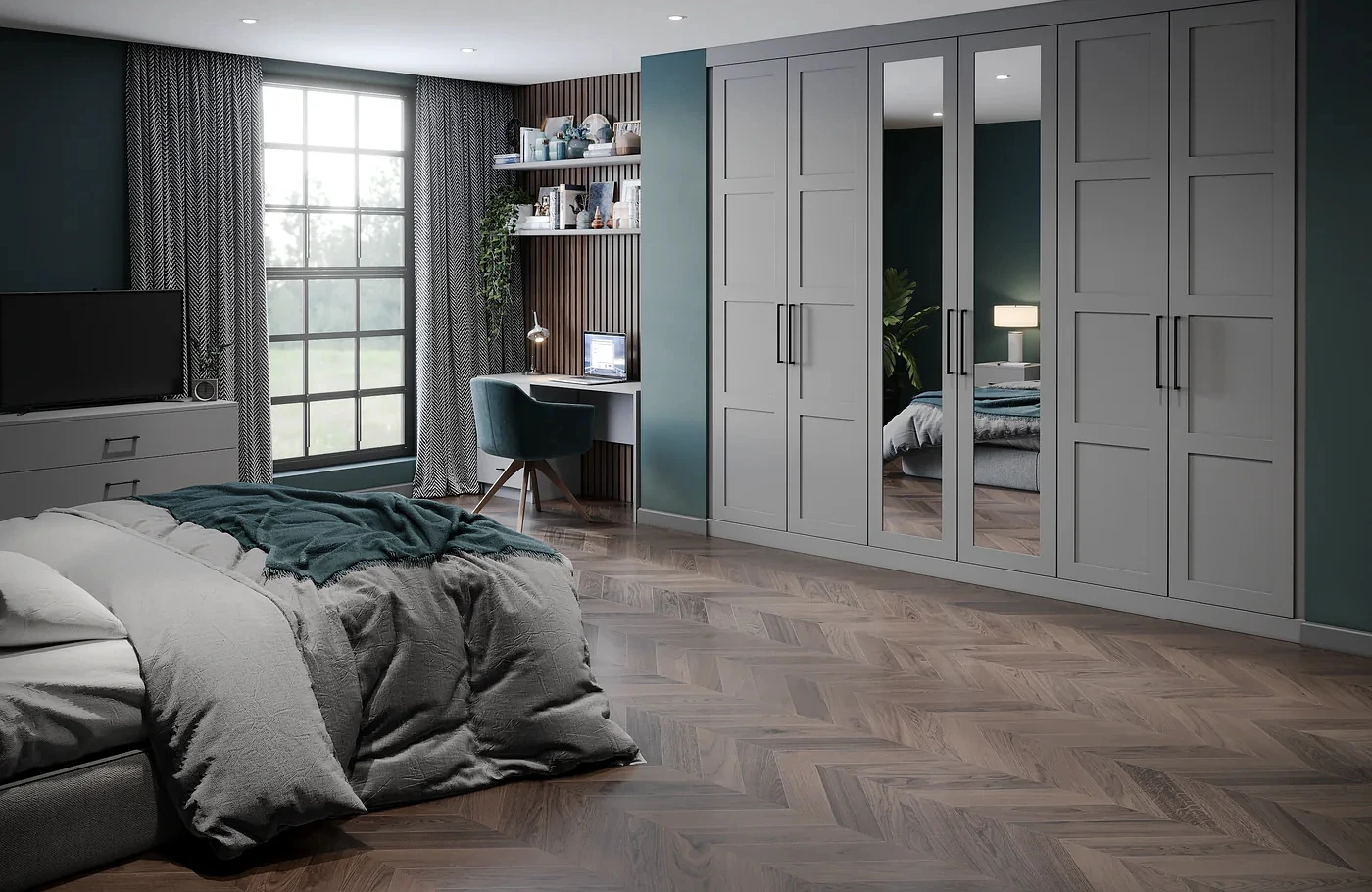
Floor-to-ceiling, matt cashmere finish, handleless doors, soft-close on everything. A couple in Surrey — mid-thirties, three-bedroom semi, sharing the wardrobe — said it photographed so well they nearly put it on Instagram.
By month three, there was a chair next to it piled with clothes. The build quality was fine. The carcasses were solid, the doors aligned. The internal layout was wrong in six measurable ways, and every one of them came from a showroom template applied without asking what was actually going on inside the fitted wardrobes.
Single Hanging Rail: ~30% of Vertical Space Wasted
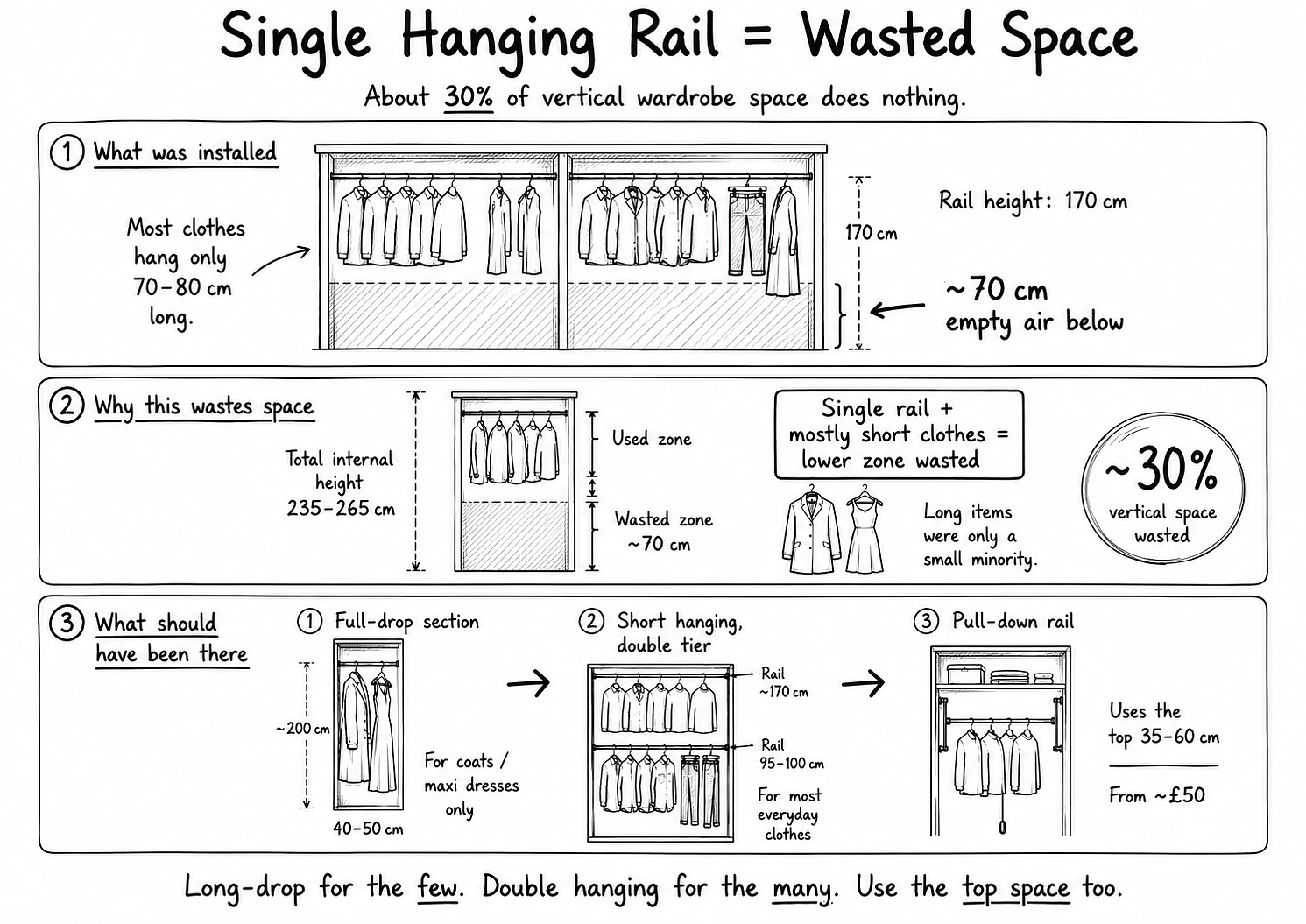
Both towers had one rail at 170cm from the floor — the standard single-rail height across most UK fitted wardrobes. Neither of them owns many full-length garments. His longest item was an overcoat at roughly 130cm hanging length from the hanger top to hem. Hers were two maxi dresses and a winter coat. Most other garments had a hanging length of 70 to 80cm, so hems finished around 90 to 100cm from the floor. That left roughly 70cm of empty air below per tower doing nothing.
Typical UK bedroom ceilings sit at 2.4 to 2.7m, so floor-to-ceiling carcasses usually finish around 2.35 to 2.65m internally. A single rail at 170cm wastes the entire lower zone unless a second rail or low-level storage fills it.
What should have been there:
- Full-drop section (high rail at ~200cm): 40 to 50cm wide only — enough for the handful of long items. Not the entire wardrobe width.
- Short hanging section (lower rail at 95 to 100cm): two usable tiers for shirts, blazers, folded trousers. Standard short-hanging height recommended by UK designers.
- Pull-down rail in the space above the top rail to ceiling (typically 35 to 60cm left): from ~£50 for 15kg capacity soft-close models. The designer never mentioned it. They didn’t know it existed.
60cm Deep Shelves: Clothes Disappearing Behind Stacks
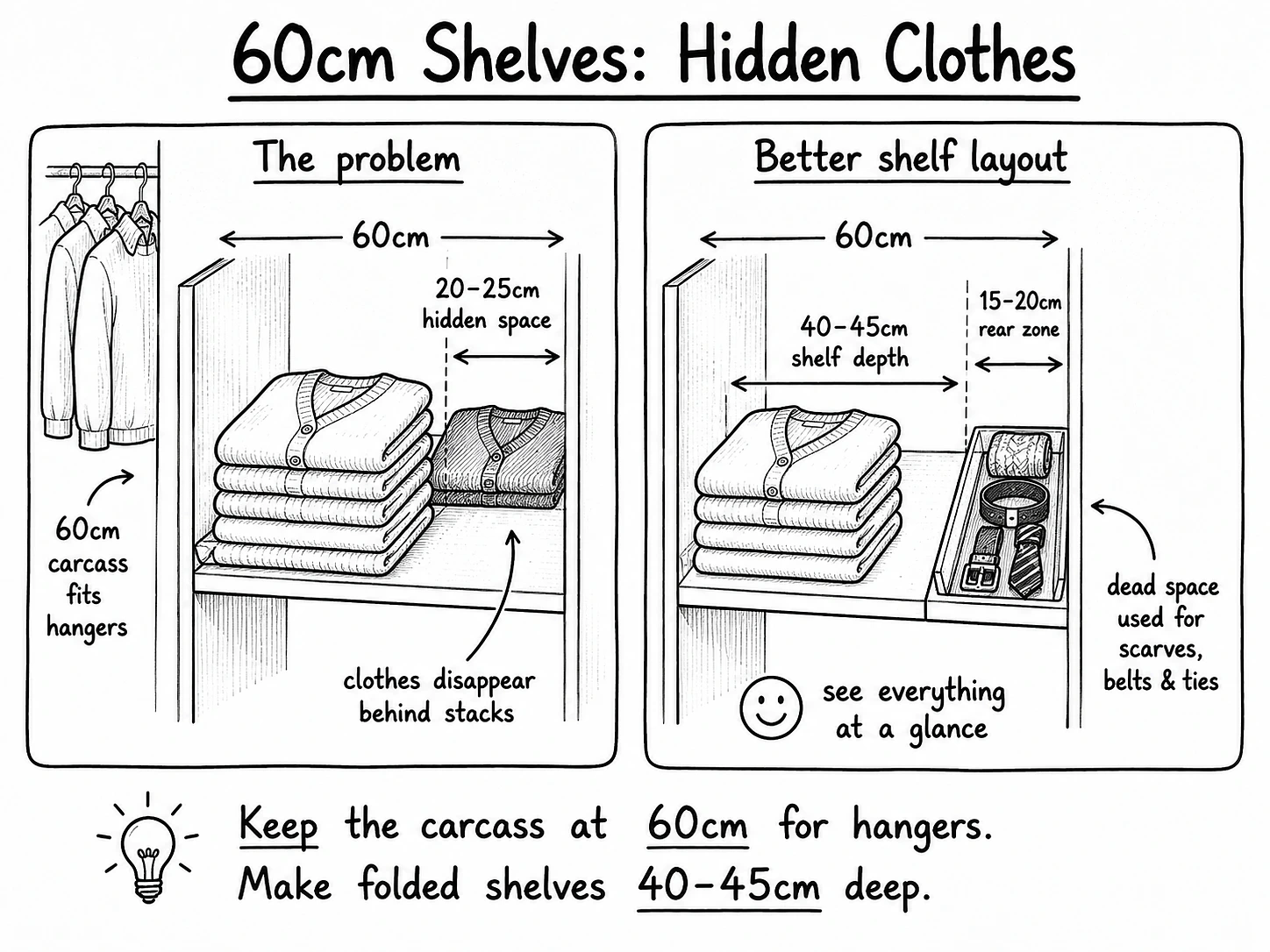
Shelves ran the full 60cm carcass depth — the UK standard because hangers need roughly 50 to 55cm clear depth plus door clearance. A folded jumper or chunky cardigan is realistically 30 to 35cm deep. That left 20 to 25cm of invisible space behind every stack. A cashmere cardigan she’d been looking for turned up wedged behind his work shirts, pressed flat against the back panel.
The fix is simple and costs nothing extra at the point of build:
- Folded clothing shelves: 40 to 45cm deep. See everything at a glance.
- Remaining 15 to 20cm behind the shelf: dead space, or a slim vertical section for scarves, belts, ties laid flat.
The carcass stays at 60cm for hangers. The shelves inside don’t have to match it. Just requires someone to think about it before cutting the boards.
Uniform 28cm Shelf Spacing: Wrong for Almost Everything
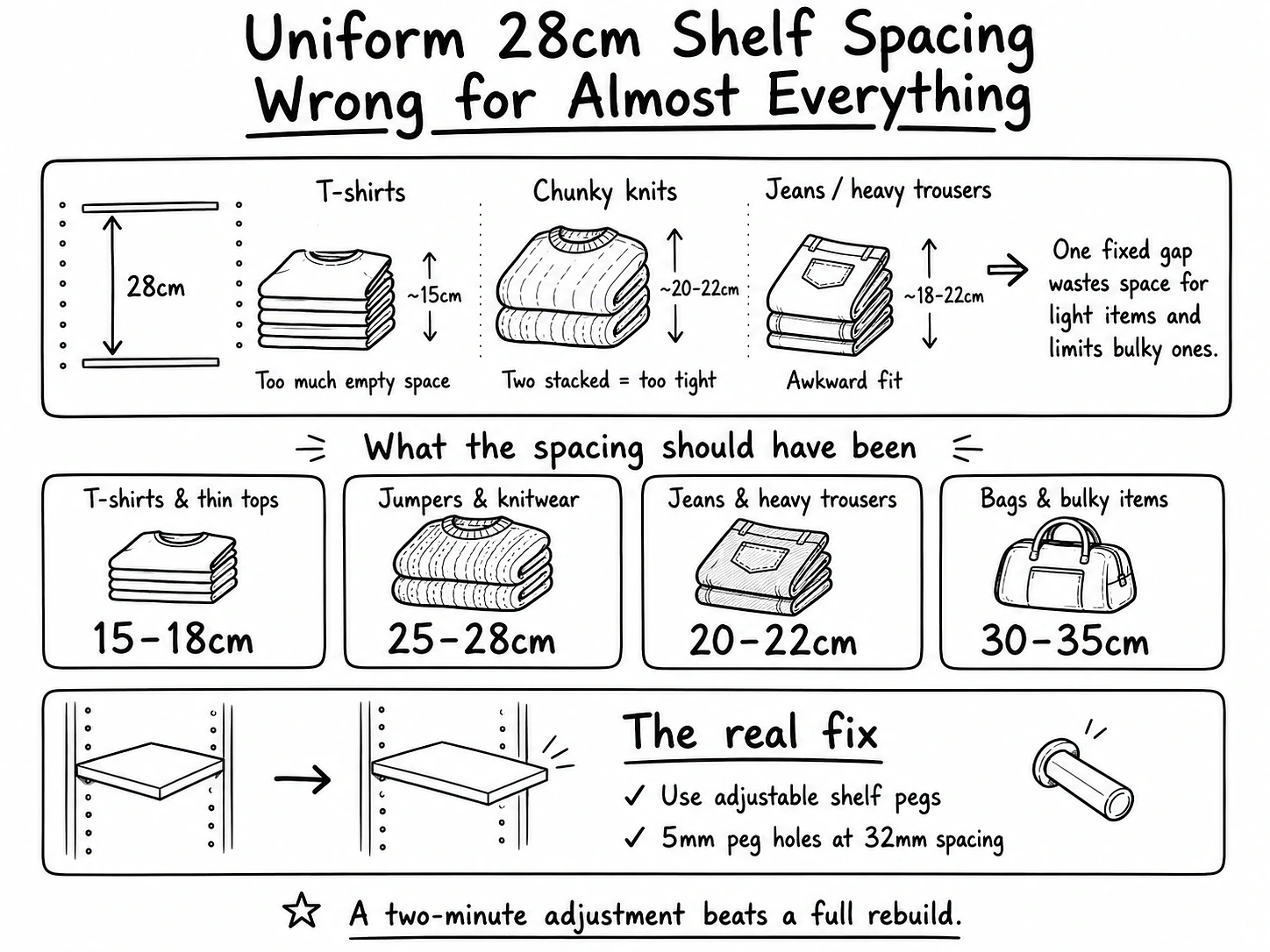
Every shelf in both towers spaced at 28cm. His t-shirts fold to about 10 to 12cm high — six in a stack reached roughly 15cm with 13cm of dead air above. Her chunky knits folded to about 20 to 22cm each and couldn’t stack two deep without compression that stretches the weave. Jeans and heavy trousers typically need 18 to 22cm per folded item — the uniform 28cm gap was too tall for light items and awkward for stacking heavier ones.
What the spacing should have been:
- T-shirts and thin tops: 15 to 18cm. Fits six to eight shirts, no wasted air.
- Jumpers and knitwear: 25 to 28cm. One chunky knit without cramming, or two thinner ones stacked comfortably.
- Jeans and heavy trousers: 20 to 22cm.
- Bags and bulky items: 30 to 35cm. At least one or two taller gaps somewhere.
The real fix: adjustable shelf pegs instead of fixed shelves. Drill 5mm peg holes at 32mm spacing up the carcass sides — standard European cabinet system. Repositioning a shelf becomes a two-minute job instead of a rebuild. Everyone rearranges within the first month. A fixed uniform gap is a compromise that suits almost no one perfectly.
One Drawer, Budget Runners — Three Problems at Once
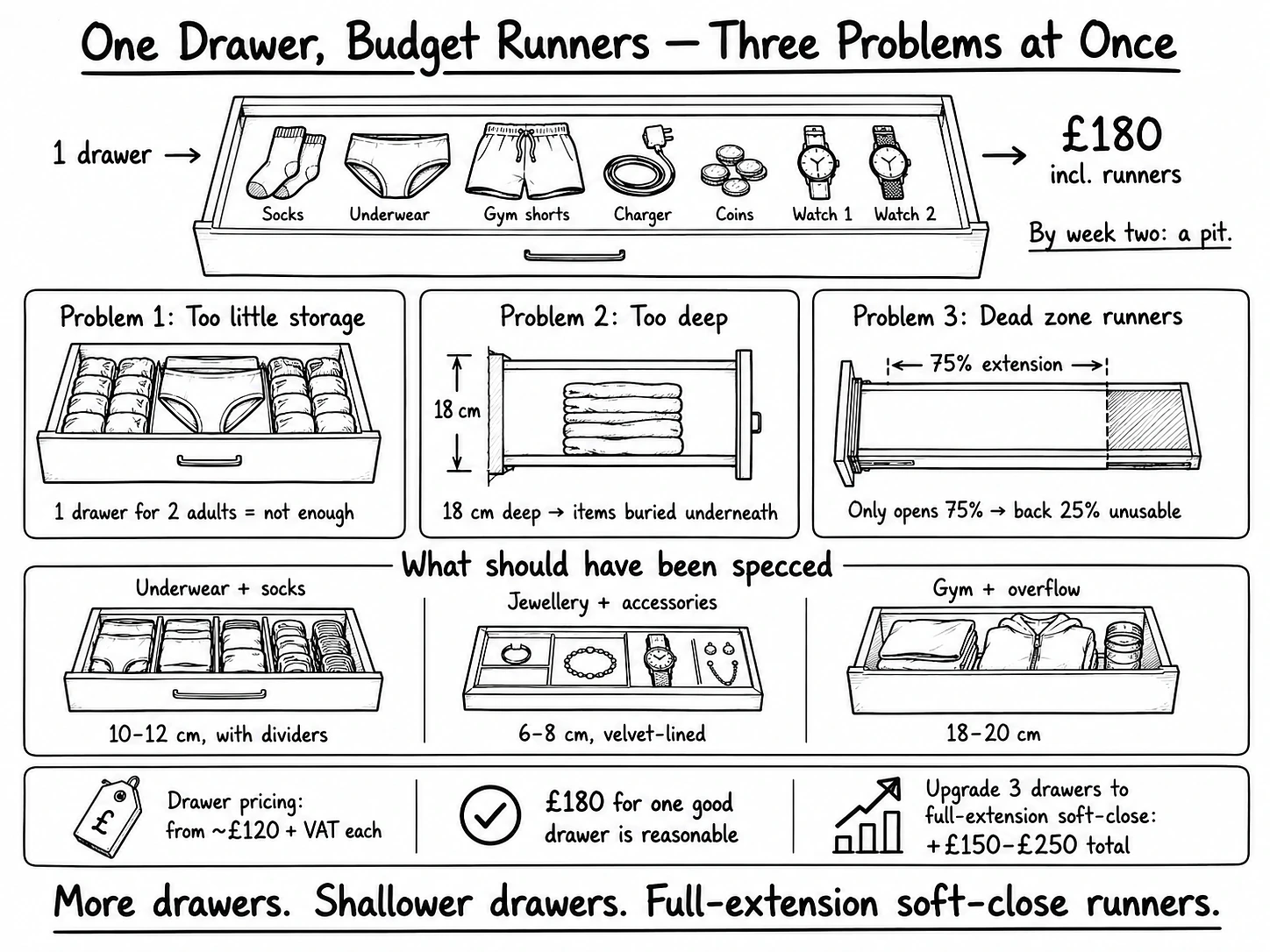
One internal drawer on his side. One. £180 including runners. It held socks, underwear, gym shorts, a charger, loose change, and two watches. By week two it was a pit.
Problem 1: One drawer for two adults is not enough. Underwear and socks alone fills it.
Problem 2: At 18cm deep, items layered and the bottom layer became archaeological.
Problem 3: 75% extension runners. The drawer only opened three-quarters of the way — back 25% was a dead zone from day one.
What should have been specced:
- Underwear and socks drawer: 10 to 12cm deep with dividers. Items stood on edge, every pair visible from above.
- Jewellery and accessories: 6 to 8cm deep, velvet-lined.
- Gym and overflow: 18 to 20cm deep.
Internal drawer pricing in fitted wardrobes typically starts from around £120 plus VAT each. The £180 paid here is reasonable for a well-finished unit — the problem wasn’t the price per drawer, it was only having one.
Full-extension soft-close runners on every drawer. Non-negotiable. Budget runners catch and jam after a year or two of daily use. Replacing a failed runner means pulling the drawer box and usually dismantling the shelf above it. The premium for upgrading three drawers to full-extension soft-close is realistically £150 to £250 total, depending on width and spec — money well spent upfront on a £4,200 build.
Angled Shoe Rack That Fits Four Pairs Out of Twenty
Pull-out angled rack, space for eight pairs, looked sharp in the render. In reality, it held her court shoes and his dress shoes. Trainers were too wide, ankle boots too tall, running shoes too bulky for the angle. Sixteen pairs ended up on the wardrobe floor in a pile.
What works instead:
- Adjustable flat shelves at 15 to 20cm spacing. Not photogenic. Significantly more functional.
- Width per pair: 20 to 23cm is the confirmed standard. Ten pairs = 200 to 230cm of linear shelf space across two or three shelves.
- Drip tray on the lowest shelf for wet shoes — especially on carpeted floors.
- Raise the bottom shelf 10 to 15cm on a plinth. Stops grit from dragging into the carpet, easier to see without bending to floor level.
Overbed Bridge That Made the Bedroom Feel Like a Cupboard
Bridging unit at 45cm deep, full width of the bed. On the render, it looked proportional. Lying in bed, it felt like a soffit bearing down. She described it as sleeping inside a cupboard.
What went wrong and what it should have been:
- Depth: 45cm was too much. At 35cm deep, still fits duvets and vacuum-packed seasonal clothes but barely registers visually from the bed.
- Clearance above headboard: 35cm gap — too close. Should be 45 to 50cm minimum so sitting up to read doesn’t put your head roughly 10cm from the cabinet base.
- Lighting: none installed. Back half of the shelf was pitch dark. A battery LED strip on a door-activated switch costs £10 to £20 and was never discussed during the design stage.
- What belongs up there: spare bedding, vacuum bags, travel holdalls. What doesn’t: anything accessed more than once a month, anything heavy, anything breakable.
They’d started putting shoes up there because the shoe rack below didn’t work — climbing onto the bed every morning for trainers. The bridge was solving a problem created by a different part of the wardrobe failing.
What Twenty Minutes of Measuring Clothes Would Have Changed
After auditing every section, the exercise that should have happened before a single board was cut took twenty minutes. Everything out of the wardrobe, onto the bed, sorted by category.
His longest garment: one overcoat at roughly 130cm. Hers: two maxis and a long coat. Full-drop section needed: 40 to 50cm wide, not four metres. Her knitwear stacked to about 22cm per item, his t-shirts to about 12cm, jeans at roughly 18cm — three different shelf spacings, not one uniform 28cm gap. Twenty-two pairs of shoes in rotation, eight too bulky for any angled rack. Three drawers minimum, not one.
The build cost would have been roughly the same — £4,200 is typical for a good-spec floor-to-ceiling run with premium finishes in the South East. The wardrobe would have still been working at month three instead of being lost to a bedroom chair.
 Decor & Improvement Accessories