

Home & Decor Blogs: DIY, Interior Design & Lifestyle Ideas
Pests That Come With the Building, Not the Mess: What Actually Causes Infestations


Most pest problems in homes are not caused by dirty kitchens. They are caused by gaps in the structure that let pests walk in regardless of how clean you keep the place.
Three things drive the majority of residential infestations:
- Entry points in the building envelope. Cracks in foundations, gaps around pipe penetrations, unsealed utility line entries, missing door sweeps, and damaged soffit vents. A mouse needs a gap the width of a pencil. A cockroach needs less than that.
- Moisture trapped where it should not be. Leaking subfloor plumbing, poor drainage against foundations, bathrooms without extraction fans, and condensation in wall cavities. Pests need water more urgently than food. Fix the moisture and you remove the reason most of them settled there.
- Shared building infrastructure. In apartments and townhouses, pests travel through plumbing risers, electrical conduit gaps, shared ceiling voids, and party wall penetrations. Your unit can be spotless and the infestation still comes from three doors down through a gap behind the kitchen sink pipe.
Cleaning your counters and sealing your cereal in containers is basic hygiene. It is not pest control. The difference matters because one costs you ten minutes a day and the other might cost you thousands in structural repair if it goes unnoticed long enough.
Which Pests Are Structural Problems and Which Ones Are Hygiene Problems?
Worth separating these because the response to each is completely different.
Structural pests (the building let them in):
- Termites. They do not care about your kitchen. They enter through soil contact with timber framing, through cracks in concrete slabs, through joints between brick and timber. A termite colony can eat through a structural beam for years before anyone notices. By the time you see the damage it is often extensive enough to require framing replacement.
- Rodents. Mice and rats follow warmth and shelter, not crumbs. They nest inside wall cavities, ceiling voids, and subfloor spaces. They enter through foundation gaps, damaged vents, unsealed pipe entries, and weep holes in brick. A clean kitchen with an unsealed subfloor vent will have mice. A messy kitchen with a sealed building envelope probably won’t.
- Subterranean insects. Silverfish, earwigs, certain ant species. They come up from the ground through cracks in the slab or gaps in the subfloor. Moisture underneath the house is what brings them in, not food on the counter.
Hygiene pests (your habits influence them):
- Cockroaches. Partly structural, partly hygiene. German cockroaches (small, light brown) are almost entirely food and moisture-driven. Oriental cockroaches (larger, dark) are moisture-driven and come up through drains and pipe gaps regardless of cleanliness.
- Pantry moths and weevils. These arrive in the food packaging itself, not from outside. They spread when dry goods are stored in open bags.
- Fruit flies. Purely a food waste issue. Remove the rotting fruit or drain residue and they disappear within days.
If your pest problem is termites, rodents, or subterranean insects, cleaning harder will not help. You need to find and close the entry point or fix the moisture source. Everything else is just managing symptoms.
What Does a Proper Pest Inspection Actually Check?
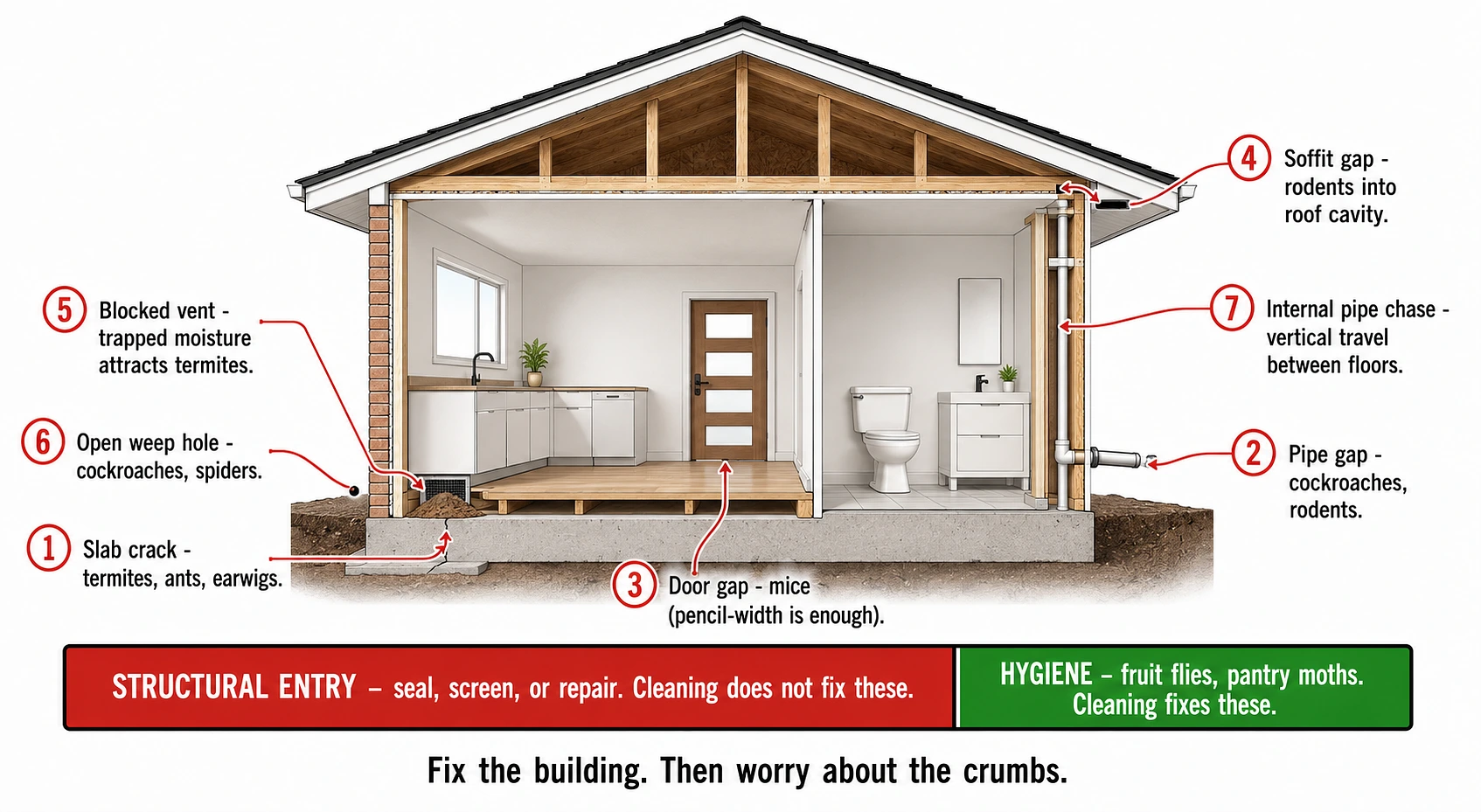
Not what most people think. A proper inspection is not someone walking through your kitchen looking for droppings. It is a structural assessment of how and where pests can enter the building.
Exterior check:
- Foundation perimeter for cracks, gaps, and soil bridging against timber framing.
- Weep holes in brickwork (are they screened or open).
- Pipe and cable penetrations through external walls (sealed or unsealed).
- Roof space entry points, damaged fascia boards, and gaps in soffit lining.
- Drainage and grading around the foundation. Water pooling against the base of the building is the single most common contributor to subterranean pest activity.
Subfloor check (if accessible):
- Timber framing condition, looking for termite leads (mud tubes), moisture damage, and fungal decay.
- Ventilation adequacy. Enclosed subfloors with blocked vents trap moisture, which attracts termites and other subterranean pests faster than almost any other condition.
- Plumbing leaks under the house that create standing moisture.
Interior check:
- Wall cavities around plumbing penetrations (kitchen, bathroom, laundry).
- Ceiling void access for rodent activity (droppings, gnaw marks, nesting material).
- Moisture readings in walls adjacent to wet areas.
For buyers looking at a property purchase, this kind of inspection happens before settlement. In Melbourne, where timber subfloors are common in older housing stock and termite risk varies significantly by suburb, a building and pest inspection in Melbourne combines the structural assessment with the pest assessment in a single report. You find out whether the house has active termite damage, moisture issues, or entry points before you commit to the purchase, not six months after when you discover the floor framing is compromised.
Why Apartments and Multi-Unit Buildings Are a Different Problem Entirely
You can do everything right in your own unit and still get pests from someone else’s. That is the reality of shared buildings and it changes how prevention works.
In a standalone house, you control the entire building envelope. Seal the gaps, fix the moisture, maintain the subfloor, and you have cut off the main entry paths. In an apartment building, the entry paths include shared plumbing stacks, electrical conduit running between units, party wall gaps at floor and ceiling level, garbage compactor rooms, basement storage cages, and common area connections that no individual tenant controls.
Rodents are the clearest example. In New York City, rats travel through sewer connections into basement plumbing, up through pipe chases between floors, and into individual units through gaps behind toilets and kitchen sinks that were never properly sealed during construction. A building from the 1920s with original plumbing has dozens of these pathways. Keeping your apartment clean changes nothing about the rat using a pipe chase four floors below you.
Bedbugs are the other multi-unit pest that defies individual effort. They travel through shared walls, through electrical outlet gaps, through cracks in baseboards. One infested unit in a building can spread to adjacent units within weeks through pathways that no amount of cleaning can close.
This is why multi-unit pest control works at the building level, not the unit level. An NYC pest control company working in apartment buildings typically inspects the entire structure, identifies the shared pathways, and treats the building as a connected system rather than individual apartments. The alternative, treating one unit at a time, usually means the pests just move to the next unit and come back once the treatment fades.
The Seasonal Pattern Most People Get Wrong
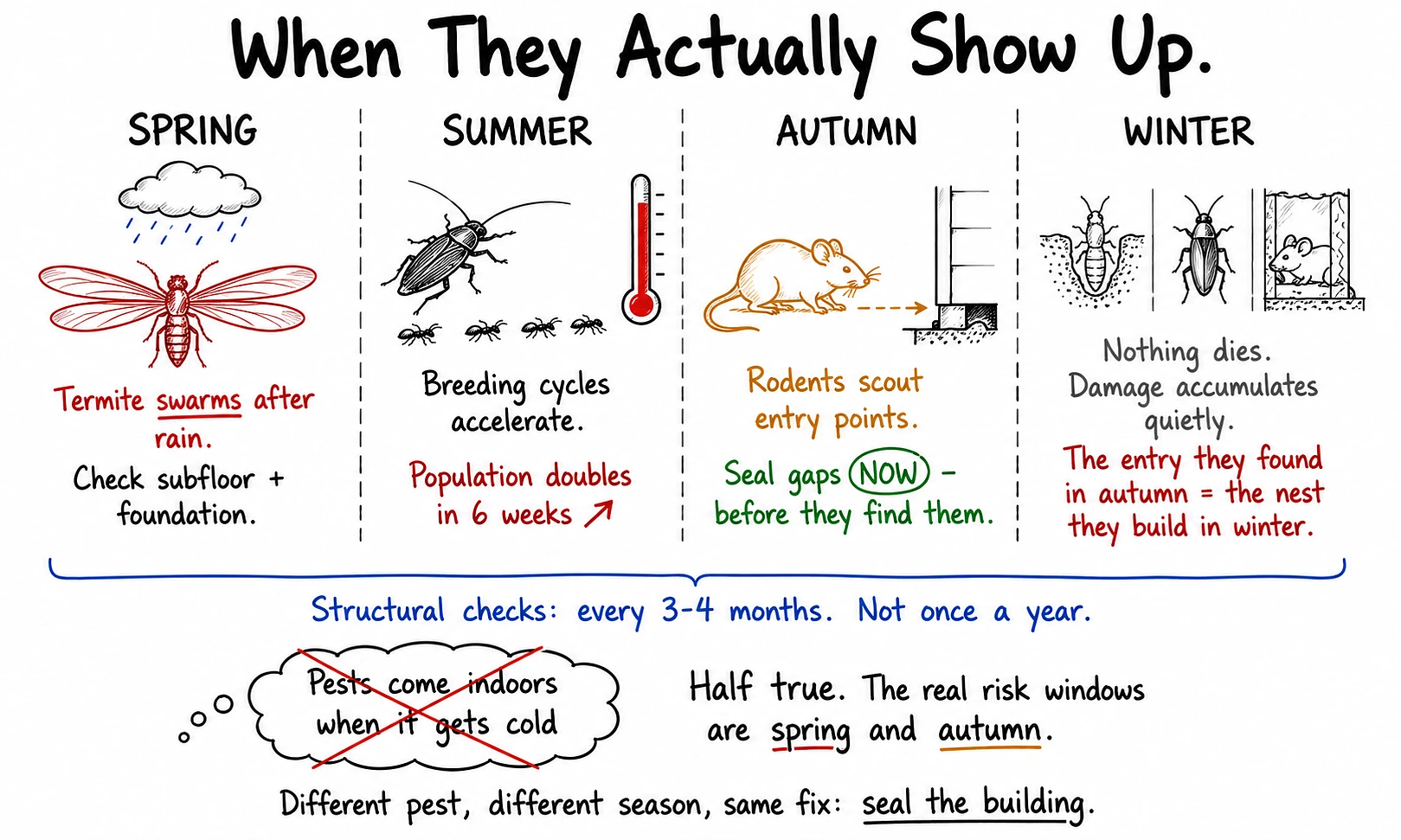
Common advice says pests come indoors when it gets cold. That is a half-truth that leads people to ignore the actual high-risk periods.
Spring is the real termite season. Reproductive termites swarm in spring, usually after rain. If you see small winged insects near windows or light fixtures between September and November (Southern Hemisphere) or March and May (Northern Hemisphere), that is a termite swarm and it means a mature colony is nearby. This is the time of year to check your subfloor and foundation perimeter, not winter.
Summer is peak cockroach and ant season. Heat accelerates breeding cycles. A German cockroach population can double in roughly six weeks during warm weather. An ant colony that was manageable in spring becomes a visible trail through your kitchen by mid-summer.
Autumn is when rodents scout entry points. Mice and rats start exploring buildings in autumn looking for winter shelter. The entry point they find in October is the one they use from November through March. Sealing gaps in autumn, before they find them, is more effective than trapping rodents all winter after they have already established routes.
Winter does not kill the problem. Termites remain active underground year-round. Cockroaches survive indoors regardless of outside temperature. Rodents that found entry in autumn are now nesting in your walls. Winter is when the damage accumulates quietly.
The mistake is treating pest prevention as a one-time annual task. The structural checks (foundation gaps, subfloor condition, pipe seals) need to be done once or twice a year. The moisture checks need to be done seasonally because what leaks in summer may be different from what pools in winter after heavy rain.
What to Check and When
Every three to four months:
- Walk the foundation perimeter. Look for new cracks, soil contact with timber, and blocked drainage.
- Check that subfloor vents are not blocked by debris or garden soil buildup.
- Inspect pipe penetrations through external walls. Reseal anything that has cracked or pulled away.
- Run bathroom and kitchen extraction fans and make sure they are actually venting outside, not into the ceiling cavity.
Once a year:
- Get into the roof space. Look for rodent droppings, gnaw marks on wiring, nesting material, and daylight coming through gaps in the eaves.
- If you have a subfloor, inspect timber framing for termite leads (mud tubes on stumps or bearers) and moisture damage.
- Check door sweeps and weather seals. Replace anything that has worn through or compressed flat.
Before buying a property:
- Get a combined building and pest inspection before settlement. Not after. Termite damage to structural framing can cost tens of thousands to repair, and it is not always visible during a casual walkthrough.
After heavy rain:
- Check for pooling water against the foundation. Redirect drainage if needed.
- Look for new moisture stains on interior walls near ground level or in subfloor areas.
The pattern here is simple. Most of what prevents serious pest problems is the same work that prevents moisture damage and structural decay. Seal the building, manage the water, check the hidden spaces. The pests that cleaning stops were never going to cause structural damage anyway. The ones that do cause damage are coming through the building itself.
 Decor & Improvement Accessories