

Home & Decor Blogs: DIY, Interior Design & Lifestyle Ideas
How Gutter Failure Damages Texas Foundations and Siding

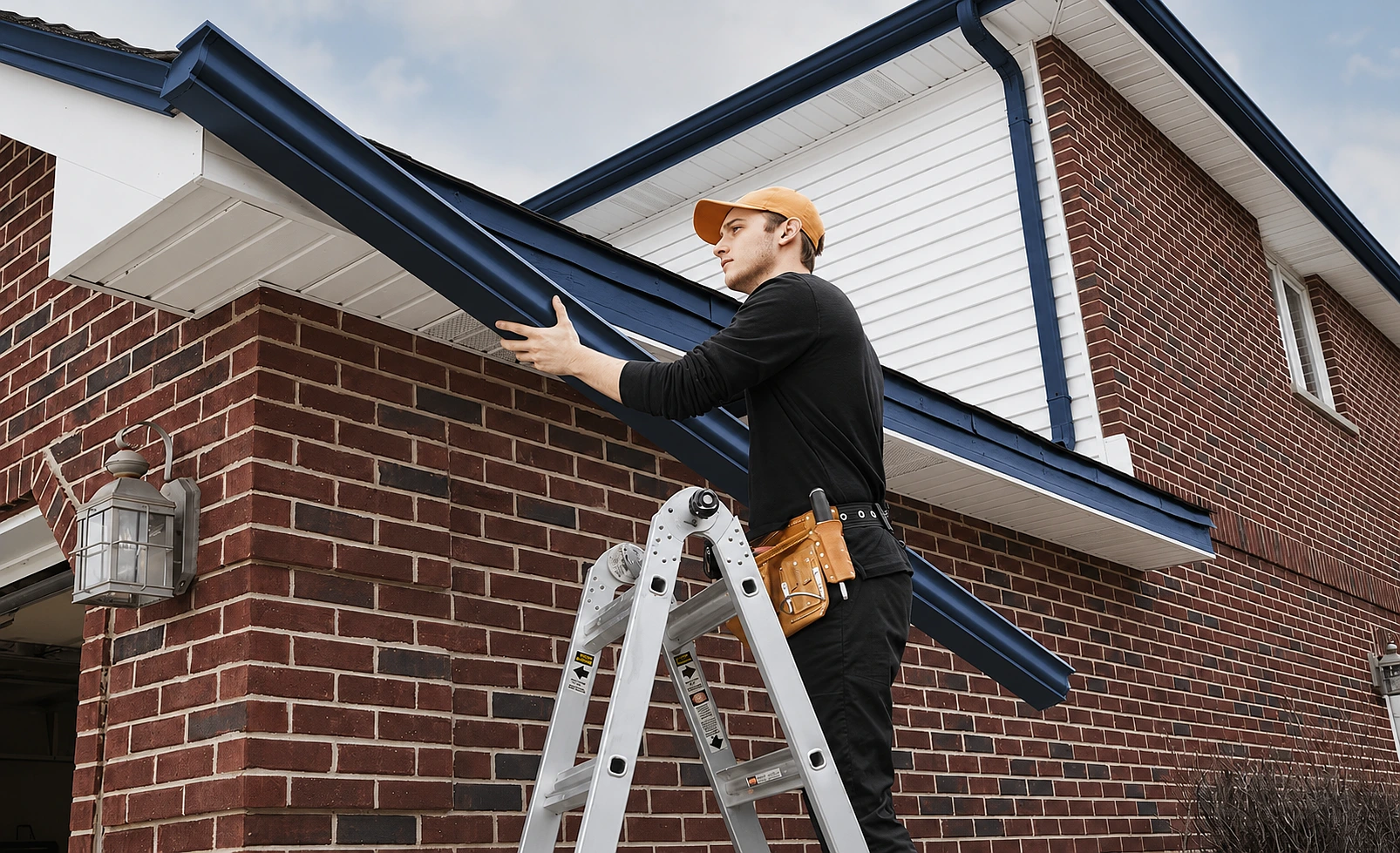
Rain hits the roof, runs down the slope, and reaches the edge. From that point forward, the gutter system is the only thing standing between the water and the house. In Texas, that matters more than it does in most places. The expansive clay soil under most of the state swells when wet and shrinks when dry, and the moisture swings are what cause the foundation movement that shows up as cracked drywall, sticking doors, and hairline slab fractures years later.
The gutter question isn’t really about the gutter. It’s about where the water ends up. A perfectly installed gutter that dumps water three feet from the slab in Central Texas clay is doing almost as much damage as no gutter at all. The system starts at the roof edge and only works when it ends far enough from the foundation to matter.
Here’s what happens at each stage of that water path.
Sizing the Gutter for Texas Rain
Design rainfall intensity for gutter sizing in most of Texas runs around 7 inches per hour for a 10-year return period event. That’s higher than most of the country. Texas rain doesn’t fall evenly. It comes in sudden bursts that overwhelm undersized gutters within minutes.
A 5-inch K-style gutter serves around 600 square feet of tributary roof area at that intensity, adjusted downward for steeper roof pitches. A 6:12 pitch drops that allowance to roughly 510 square feet per downspout, because a steeper roof delivers water to the gutter faster.
Most Texas homes have roof sections larger than that per downspout. Which means either the gutter itself is undersized for the volume it’s being asked to handle, or the number of downspouts is undersized for the roof area. The overflow that spills over the front edge during heavy rain is the visible symptom of a system that was sized for average rainfall rather than Texas peak rainfall.
Stepping up from 5-inch to 6-inch K-style gutters roughly doubles the tributary area a single run can handle. That’s the fix most existing homes need if the current system overflows during any thunderstorm.
Discharge Distance Is the Whole Game
Every gutter guide talks about downspout extensions. Most of them get the distance wrong.
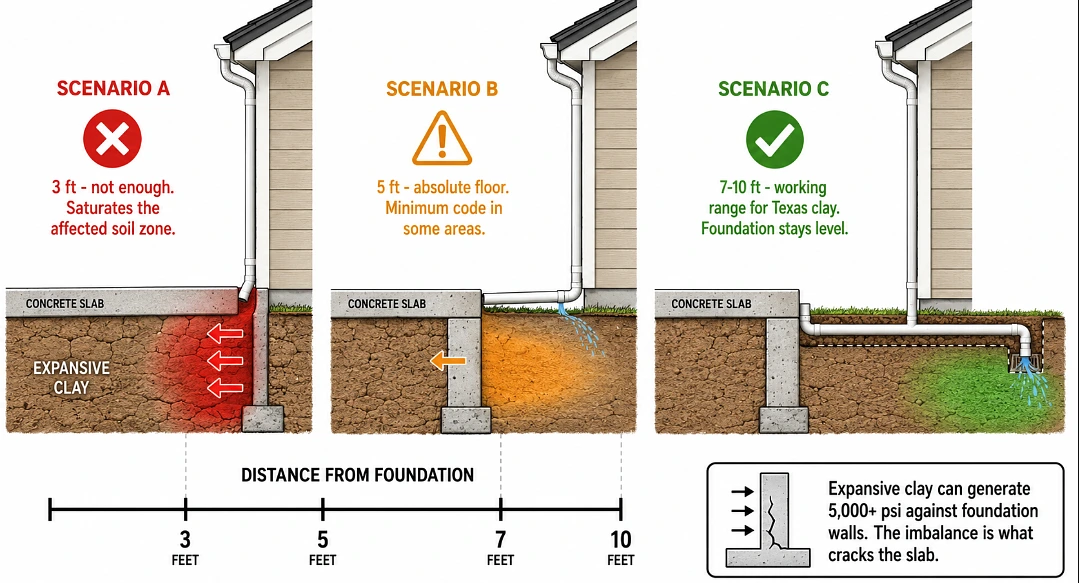
For Texas homes on clay soil, foundation engineers work with different numbers than the generic building code minimum. Five feet from the foundation is the absolute floor. Below that distance, the discharge saturates the soil directly against the slab, feeding the swell-shrink cycle that causes foundation movement.
Seven to ten feet is the working range for expansive clay areas, which covers most of Dallas-Fort Worth, Central Texas, and the Blackland Prairie soil belt. Ten feet is the minimum for underground catchment systems per EPA guidelines, because buried extensions carry water further before releasing.
Three feet, which shows up in some older code references, is not enough. Every foundation repair contractor working in Texas will tell you the same thing about that distance. It doesn’t clear the affected soil zone. Water discharged that close still saturates the clay under the foundation edge.
The reason this matters more in Texas than most places is that expansive clay under saturation can generate hydrostatic pressure against foundation walls of 5,000 psi or more. Concrete slabs are strong in compression. They are not built to withstand uneven lateral pressure from swelling soil on one side while the opposite side dries and shrinks. That differential movement is what cracks the slab. Not the pressure alone. The imbalance.
What This Does to Siding
Splashback from a downspout that dumps too close is what damages siding, and the pattern is different depending on the material.
Vinyl usually gets staining along the lower 12 to 18 inches with occasional mildew growth in shaded corners. Fiber cement holds up better but streaks along the bottom panels once soil splashes into the surface texture, and the streaks are hard to clean once they set in. Wood siding is where splashback gets serious. Water absorbed at the bottom edge of clapboards feeds rot from the bottom up, especially where paint has failed, and rebuilding rotted bottom courses jumps into structural repair territory fast.
Brick and masonry veneer is the one people don’t associate with gutter problems. The white mineral deposits that show up on brick near ground level, called efflorescence, are usually traced to persistent water reaching the base of the wall. That water is dissolving mineral salts as it moves through the mortar and depositing them on the surface as it dries. It’s a diagnostic sign, not just a cosmetic one.
The distance the water travels from the discharge point to the wall determines whether any of this happens at all. Eight feet out onto graded lawn produces almost no splashback. The same downspout at the corner releases water directly against the foundation with every storm.
What Specialists Look At on a Texas Property
Beyond the visible work of hanging gutters, Gutter installation specialists evaluating a Texas property look at conditions most homeowners don’t think about. Roof pitch and tributary area calculations. Existing grade around the foundation to see whether water discharged even eight feet out will actually flow away or pool against the slab. The number and placement of inside corners on the roofline, where water volume concentrates during heavy rain. Whether an underground drain tie-in makes more sense than surface extensions given the yard layout.
For narrow side yards, landscaped areas, or homes where surface extensions won’t work, buried PVC pipe carrying water 15 to 30 feet to a daylight outlet or pop-up emitter is the durable answer. It hides the extension and moves the discharge to a location that’s genuinely clear of the foundation zone.
The specification changes house by house. The generic “install gutters and downspouts” advice that shows up in every homeowner article misses that.
The Clay Cycle Most Homeowners Don’t See Coming
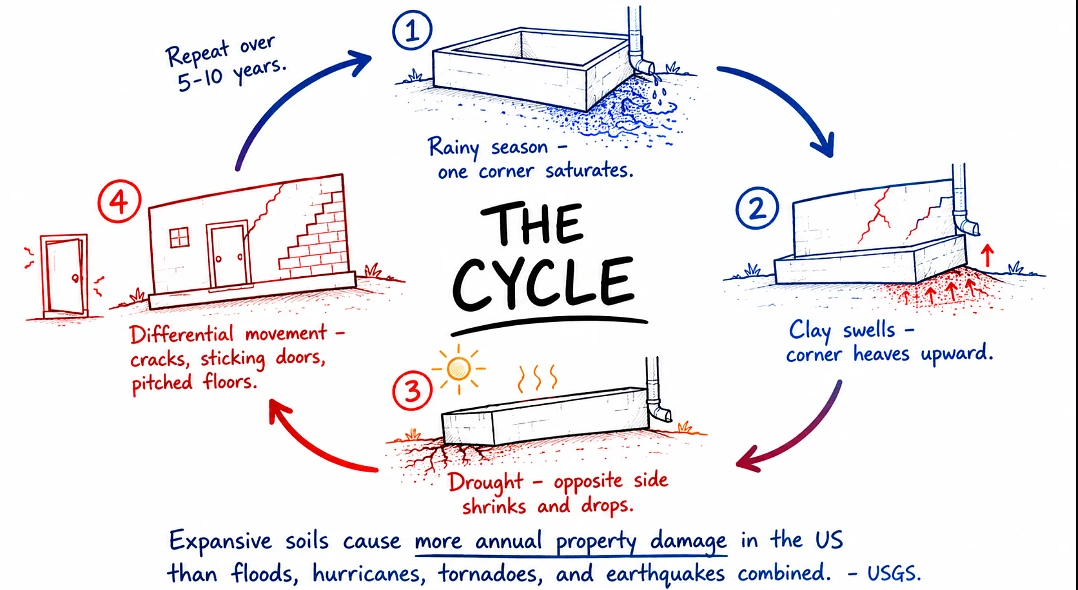
Texas foundation problems come from moisture imbalance, not moisture alone.
One rainy season saturates the soil at one corner of the house where a downspout dumps water. That corner heaves upward as the clay swells. The next summer, drought pulls moisture out of the soil under a different section of the foundation, and that section drops as the clay shrinks. Repeat this cycle over five or ten years and the differential movement is what produces the cracked drywall diagonal from doorframe corners, the doors that stick worse in July and February, the exterior brick cracks stepped along mortar joints, the floors you can feel pitching room to room.
None of that comes from the gutter directly. It comes from moisture concentration that gutter discharge either aggravates or prevents.
The U.S. Geological Survey estimates expansive soils cause more property damage annually in the United States than floods, hurricanes, tornadoes, and earthquakes combined. Most of that damage is happening in slow motion, one clay swell-shrink cycle at a time, in houses where the owners never thought their gutters were the problem.
The Diagnostic Walk
Walking the perimeter of the house during a heavy rainfall costs nothing and reveals almost everything. Water spilling over the front edge of the gutter means the gutter is undersized, clogged, or pitched wrong. Water splashing back onto siding at the discharge means the downspout is too short. Puddles within five feet of the foundation that persist after rain stops mean either the discharge is too close or the grade slopes toward the house. Efflorescence on brick near the base means water has been reaching that wall consistently for a while.
Any of these is fixable before it becomes a foundation problem. That’s the whole reason to look.
What Fixes Cost Versus What Foundation Repair Costs
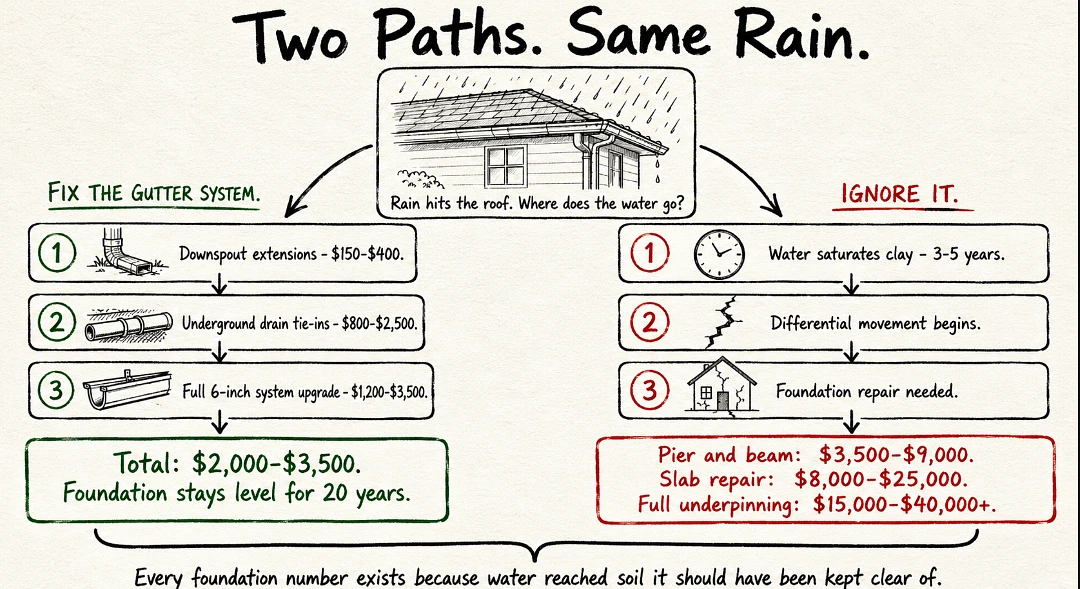
Downspout extensions installed during a standard service run $150 to $400. Underground drainage tie-ins that carry water clear of the foundation run $800 to $2,500. Replacing an undersized system with correctly sized 6-inch K-style seamless aluminum on an average Texas home runs $1,200 to $3,500 depending on linear footage and downspout count.
Foundation repair on a house where the water was allowed to do its work is a different conversation. Pier and beam adjustment on moderate movement runs $3,500 to $9,000. Slab repairs run $8,000 to $25,000. Full underpinning on significant movement runs $15,000 to $40,000 or beyond.
Every one of those foundation numbers exists because water reached soil it should have been kept clear of.
Rain hits the roof. Where the water ends up decides whether the house stays level for the next twenty years or starts moving inside of five. In Texas that’s not an abstraction. It’s the difference between a $2,000 gutter upgrade and a $20,000 foundation project, and the specifications that matter aren’t the ones most gutter articles bother to name.
 Decor & Improvement Accessories