

Home & Decor Blogs: DIY, Interior Design & Lifestyle Ideas
How to Compare Quartz Countertops Before You Buy

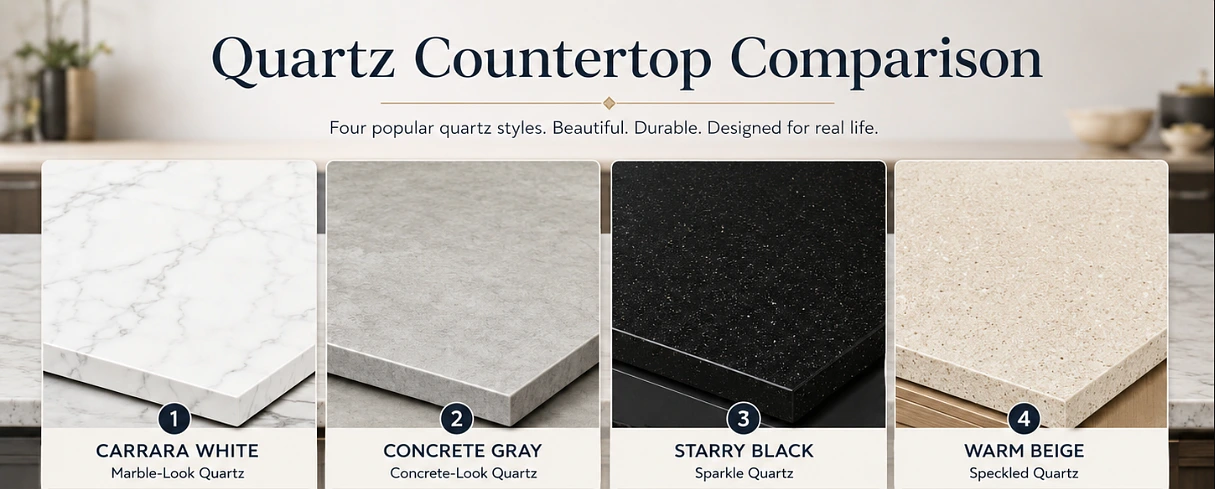
Two quartz slabs can look identical under showroom lights and behave completely differently in a kitchen, and the gap comes down to three things you can check before signing anything: the quartz to resin ratio, the warranty terms on paper, and how the slab was made rather than how it was photographed. Installed, quartz runs $50 to $150 per square foot with most kitchens landing between $70 and $100, so a bad pick is an expensive one to live with.
Ask the Quartz Percentage First
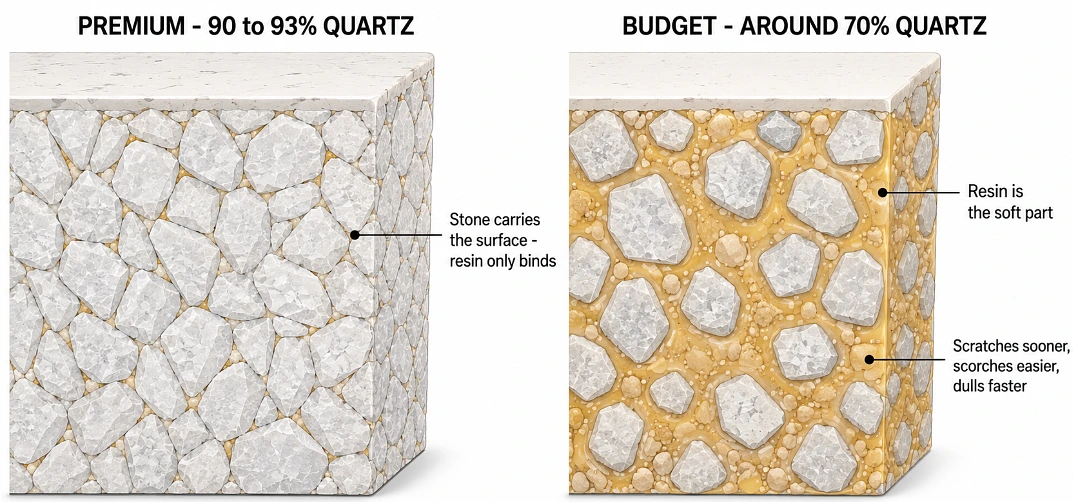
Engineered quartz is ground stone bound in resin, and the ratio is the quality. Premium slabs run about 90 to 93 percent quartz, meaning only 7 to 8 percent resin, while budget slabs slide toward 70 percent with the difference made up in resin and powder fillers. That matters because the resin is the soft part. More of it means a surface that scratches sooner, scorches easier, and dulls faster, which is why installers report that failures cluster in cheap unbranded slabs rather than in any particular color or pattern. The percentage rarely appears on the sticker, so ask for it directly, and treat a salesperson who cannot answer as an answer in itself. Grade tracks price honestly here, builder’s grade sits around $50 to $60 per square foot installed and first choice material at $80 to $100 and up.
Judge Full Slabs, Not Sample Chips
A 3 inch chip is a color swatch, not a preview. Quartz countertops come in a wide range of styles, solid whites through full Calacatta lookalikes, and the marble style patterns are exactly where small samples mislead, because veining has movement that only reads across a full slab of roughly 120 by 60 inches. Standing at the real slab, look along the vein edges in raking light. On a well made slab the veins sit crisply in the surface, on a cheap one the resin pools slightly around them and catches light like plastic. If your layout includes an island or a waterfall end, ask to see the two slabs that will sit next to each other, matched veining across a seam is a fabrication decision that happens before cutting, not after.
Where Quartz Is Honestly Weak
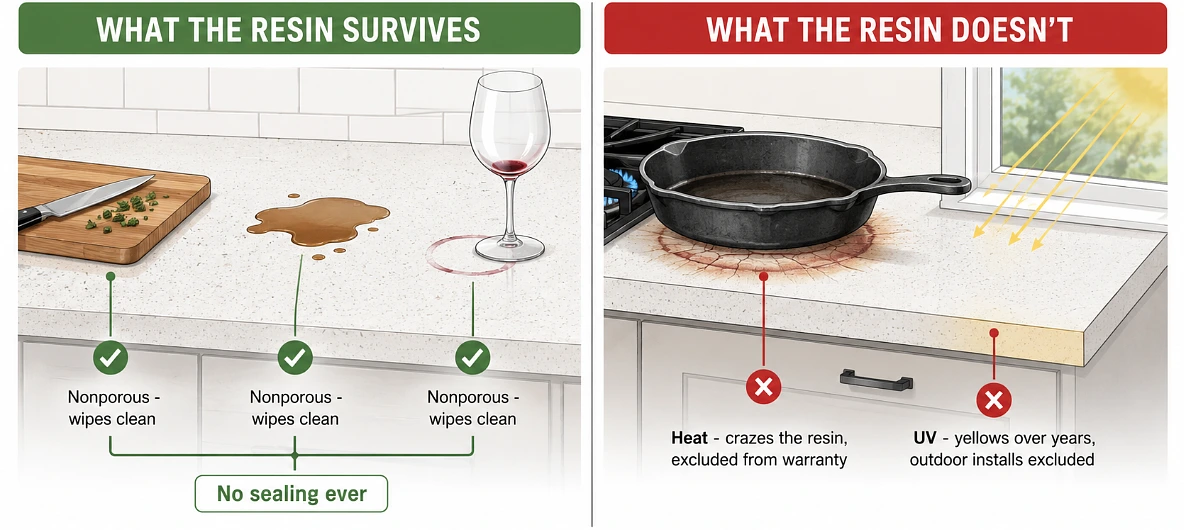
Then there’s the trade-off side of the material. The resin that makes quartz nonporous is still plastic, and a pan straight off the burner can scorch or craze it, which is why every brand’s care sheet says trivet and why heat damage sits in the warranty exclusions. Sunlight does the same damage slower, UV yellows the resin over the years, so quartz is the wrong material for outdoor kitchens and sunny window runs, and most manufacturers exclude outdoor installs from coverage outright. None of this is disqualifying for a normal kitchen. It’s just the reason the warranty document is worth reading before the slab is worth loving, because coverage length and exclusions differ far more between brands than the surfaces do.
What Quartz Costs Installed
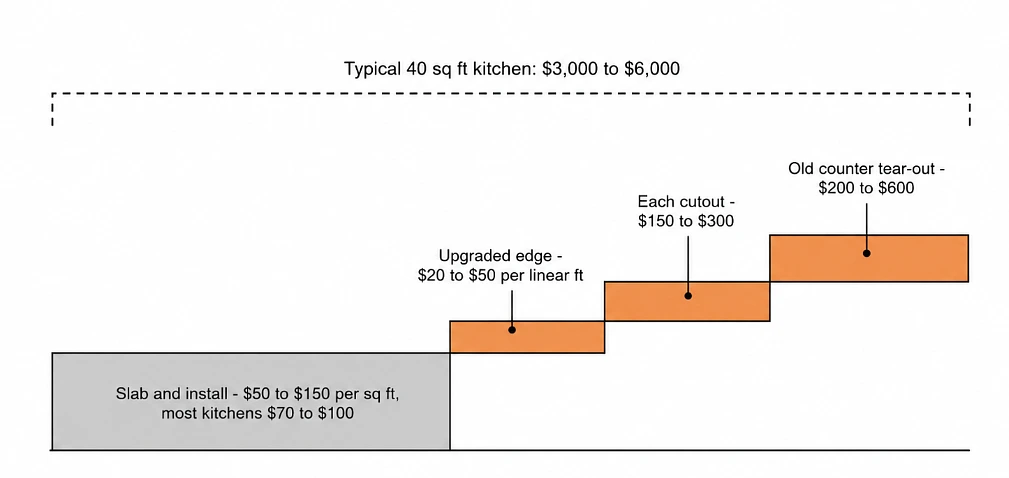
The ranges are consistent across the market:
- Installed quartz runs $50 to $150 per square foot, with most projects between $70 and $100.
- A typical 40 square foot kitchen totals $3,000 to $6,000 with fabrication and install included.
- Standard eased or beveled edges are free, while ogee, mitered, and waterfall edges add $20 to $50 per linear foot.
- Every sink or cooktop cutout adds $150 to $300.
- Tearing out the old countertop adds $200 to $600 if the fabricator handles it.
Thickness moves the number too. Kitchens mostly use 3 cm slabs, bathroom vanities get away with 2 cm, and quoting the thinner material with a laminated edge is one of the quieter ways a low bid gets low.
Comparing quartz countertops properly ends in a showroom with the actual slabs, not in a spreadsheet of per foot prices. Get the quartz percentage, the warranty, and the slab you saw written into the quote by name and lot. Fabricators respect buyers who do that, and the ones who resist it are telling you something worth hearing before the template appointment, not after.
 Decor & Improvement Accessories