

Home & Decor Blogs: DIY, Interior Design & Lifestyle Ideas
How to Compare Quartz Countertops Before You Buy

Somewhere in the middle of the Caesarstone lifetime warranty there is a list of things the warranty does not cover, and reading down it you get to flames or excessive heat, then extreme humidity, then uneven exposure to weather, and by the time you reach the bottom you have a fairly good picture of what an engineered quartz slab is afraid of. I went through that document and 2 others like it before writing this, since the countertop most people are choosing for a kitchen is being chosen off a 3 inch chip under a showroom spotlight, and 2 chips that look the same under that spotlight can be sitting on top of very different slabs.
Ask the Quartz Percentage First
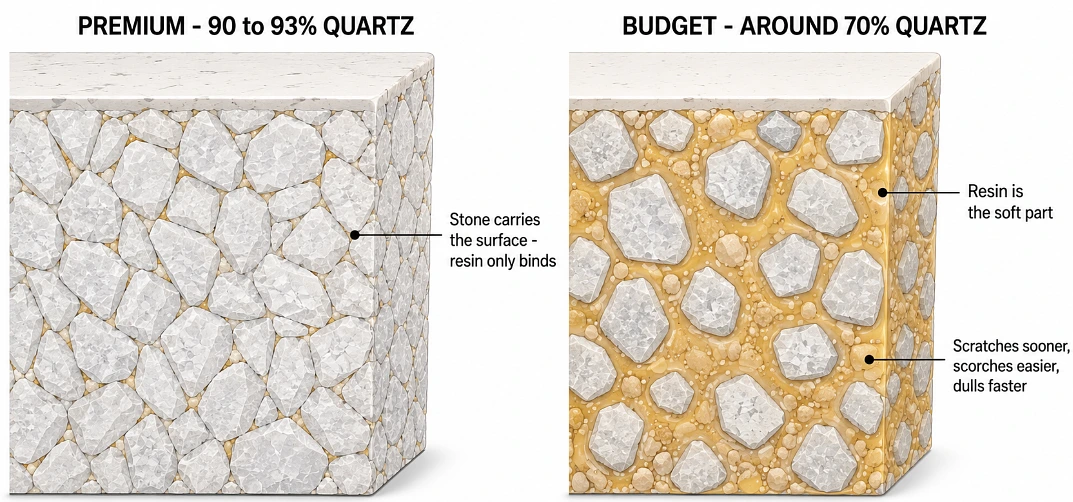
What is being sold as quartz is crushed stone that has been mixed with a resin and pressed into a slab, and how much of the slab is stone and how much is resin is the thing that decides how it is going to age. The good brands are putting in somewhere around 90 to 93 percent stone, which leaves the resin at 7 or 8 percent and doing nothing more than holding the grains together. The cheap slabs coming in by the container have drifted down toward 70 percent stone, and everything that was taken out has been replaced with more resin and some powdered filler to bulk it up.
Resin is a plastic, and plastic is the part a knife marks, the part a hot pan discolors, and the part that goes dull where the sponge has been going round the sink twice a day for 3 years, so a slab that is a third plastic is going to show all of that a good deal earlier than a slab that is a tenth plastic. You will not find the percentage printed on the sticker in the showroom, which is why it has to be asked for out loud. A salesperson who can give you the stone percentage without going to look it up is selling a slab from a maker who publishes it, and that on its own tells you which end of the range you are standing in. The price follows the grade closely enough to trust, with builder’s grade material installed for about $50 to $60 a square foot and first choice material starting around $80 to $100 and going up from there.
Judge Full Slabs, Not Sample Chips
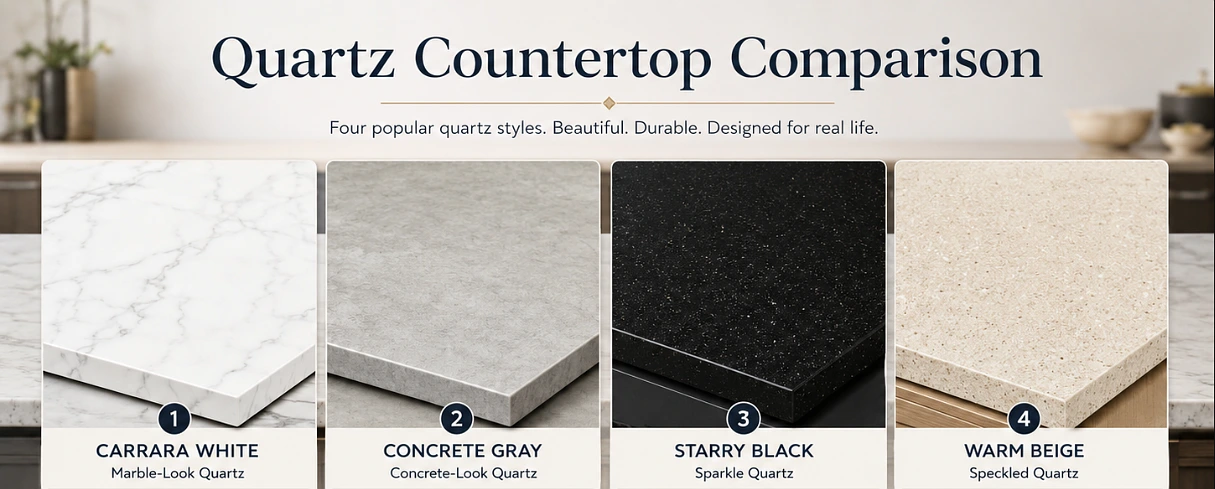
The chip in the sample rack is giving you the color and it is giving you nothing else, and for a plain white or a plain grey that may be enough. It is not enough for the marble patterns. Quartz countertops come in a wide range of styles now, and the Calacatta and Carrara lookalikes are the ones being bought most, and a vein in one of those has a direction and a spacing that only makes sense when you are looking at the whole slab, which is about 120 inches by 60. So the thing to do is go and stand at the slab that is going to be cut, with the light coming across the surface from a window or a raised lamp rather than straight down from the ceiling, and look along the edge of a vein, because on a properly made slab the vein is sitting flat and sharp in the surface, and on a poorly made one there is a faint pooling of resin either side of it that catches the light the way a plastic tray does.
Anyone with an island or a waterfall end has a second thing to check, which is the 2 slabs that are going to meet at the seam, side by side, before anything is cut, since a fabricator can only match the veining across a joint by choosing where to cut both pieces and that choice has to be made while both pieces are whole.
Where Quartz Is Weak
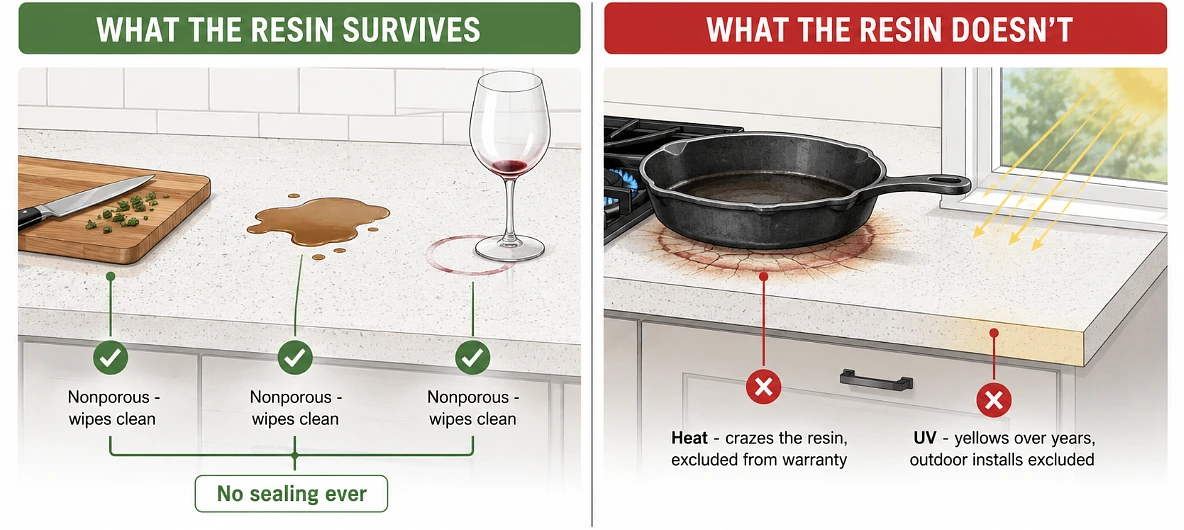
The same resin that stops wine and coffee soaking in is what a hot pan is landing on when it comes off the burner, and above roughly 300 degrees the resin is either scorching to a brown ring or crazing into a web of fine cracks, and the brand care sheets are unanimous about the trivet for that reason. Every warranty I looked at, the lifetime ones as much as the 10 year ones, has heat in the exclusions, so a scorch is coming out of your pocket whatever the slab cost. Sunlight is doing the same thing to the resin over a much longer time, turning it slowly yellow, which is why a run of quartz along a south facing window is going to be a different color from the rest of the kitchen in 5 or 6 years, and why outdoor kitchens are excluded from coverage by nearly every maker before you even get to the heat.
For an ordinary indoor kitchen with a trivet by the stove, none of that is a reason to choose something else. It is a reason to read the warranty before choosing the slab, because the length of coverage and the list of exclusions are where the brands genuinely differ from each other, far more than the surfaces do, and a 10 year limited and a lifetime limited are covering the same manufacturing faults for very different stretches of the kitchen’s life.
What Quartz Costs Installed
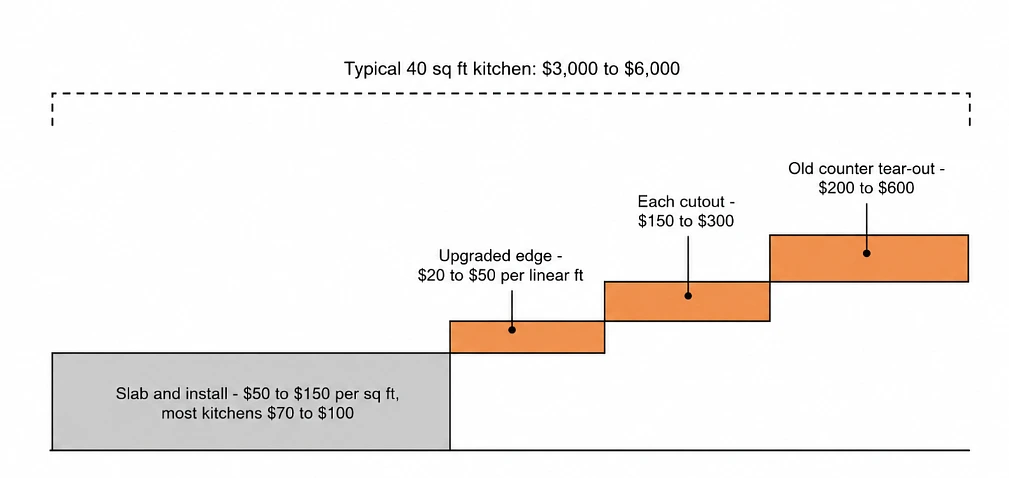
The prices being quoted across the country are close enough to each other that a quote well outside them needs an explanation:
- Quartz is going in at $50 to $150 a square foot, and most kitchens are landing somewhere between $70 and $100 of that.
- A 40 square foot kitchen, which is a typical L shape, is coming to $3,000 to $6,000 with the fabrication and the fitting in the number.
- An eased or a beveled edge is usually thrown in, and an ogee, a miter or a waterfall is adding $20 to $50 for every linear foot it runs.
- Each hole cut for a sink or a cooktop is another $150 to $300.
- Having the fabricator take the old top out adds $200 to $600 to the invoice.
Thickness is the other line to check, because a kitchen is normally getting a 3 cm slab, a bathroom vanity gets away with 2 cm, and one of the ways a surprisingly low bid has got that low is by quoting the 2 cm material with a strip glued along the front edge so that it reads as 3 cm from across the room.
One Kitchen, Two Quotes
Per foot prices only mean something once they have been added up for a real kitchen, so take one and price it twice. An L shaped run of 40 square feet with a sink and a cooktop to cut for, the old laminate coming out, and an eased edge on both quotes so the difference is the slab and not the trim. Quote A is a 70 percent slab from an unbranded importer, in 2 cm with a laminated front edge, and it carries a 10 year limited warranty. Quote B is a branded 92 percent slab in 3 cm with a lifetime limited warranty. Both are worked from the ranges above, taking the middle of each.
| Quote A, budget slab | Quote B, branded slab | |
|---|---|---|
| Stone in the slab | About 70 percent | 92 percent |
| Thickness | 2 cm, laminated edge | 3 cm |
| Warranty | 10 year limited | Lifetime limited |
| Slab and install, 40 sq ft | $55 x 40 = $2,200 | $90 x 40 = $3,600 |
| Sink and cooktop cutouts | $300 | $500 |
| Old top removed | $200 | $400 |
| Total | $2,700 | $4,500 |
The branded slab is $1,800 more on this kitchen. Heat is not part of what that buys, because a scorch is excluded under both warranties and a cast iron pan left down for a minute is marking either slab. Color is barely part of it, since the 2 whites are indistinguishable on the day of the install at arm’s length. The money is going into the extra 22 percent of stone, and where that shows is around the sink at about year 5, where the cheaper slab has usually developed a dull ring from the sponge and a grey line along the spot the chopping board sits, and the 92 percent slab has not. It is also going into a full 3 cm edge with no glued strip, which matters on the run beside the dishwasher where steam has been hitting the front edge every night, and into the longer warranty, which pays out on the things a factory can get wrong, a crack with no impact behind it, resin that pooled during the pour, a slab that arrived with a bow in it.
For a rental, or a house going on the market inside 3 years, take Quote A, and the 10 year warranty is covering the whole of your time in that kitchen. For a kitchen you expect to cook in for 15 years, the $1,800 is $120 a year, and the sink ring on the cheaper slab is arriving around year 5 and staying for the other 10.
Before the template appointment, and not after it, have the fabricator write 3 things into the quote: the stone percentage, the name of the warranty document that applies, and the lot number of the slab you stood in front of. Templating is the last point at which a different slab can be substituted without anyone noticing.
 Decor & Improvement Accessories