

Home & Decor Blogs: DIY, Interior Design & Lifestyle Ideas
Renovate or Knock Down and Rebuild? How to Tell Which One Your House Needs

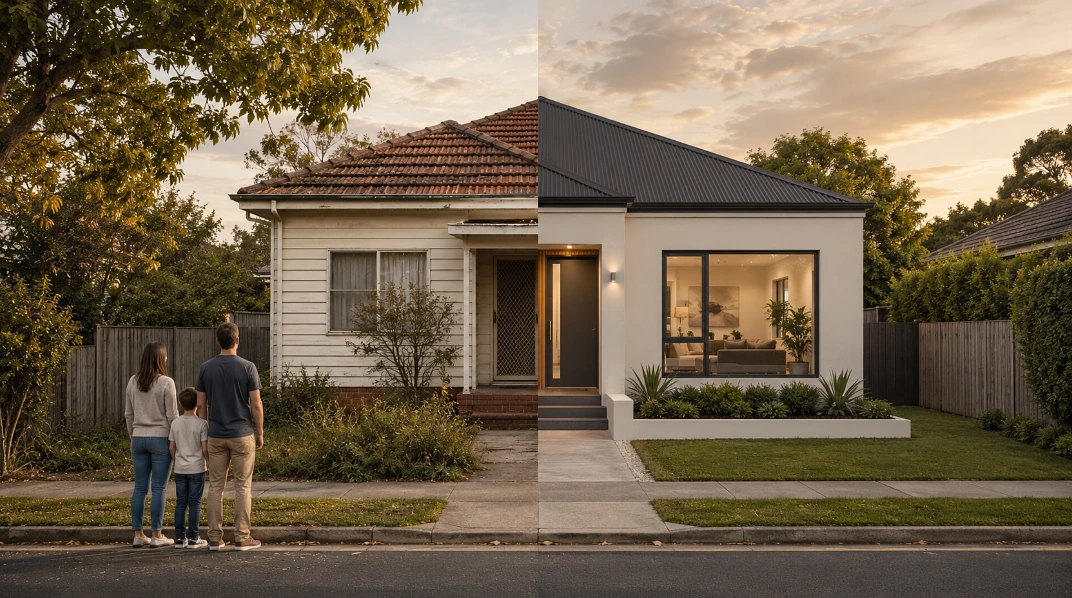
Most people come to this question the same way. They love where they live, the street, the block, the school run that finally works, but the house itself has stopped keeping up. The layout fights them. The good light is in the wrong rooms. The renovation wish list has quietly grown into something that looks less like a project and more like a rebuild.
So the real question isn’t “should we renovate?” It’s whether renovating is genuinely the cheaper, smarter move, or just the one that feels safer because it sounds smaller. As builders, we’ve watched plenty of families spend renovation money and still end up wishing they’d started fresh. Here’s how to tell the difference before you commit.
Renovation Costs Rise From the Parts You Can’t See
The trap with renovating an older home is that the budget is set by the things you can see, the kitchen, the bathroom, the extension, while the cost is driven by the things you can’t. Open up a house built before the 1980s and you routinely find wiring that no longer meets code, plumbing near the end of its life, stumps or footings that have moved, and framing that was never designed for the open plan layout everyone wants now. None of that is on the mood board. All of it has to be paid for. It’s why quantity surveyors tell renovators to carry a hidden issues allowance of around 20 percent on top of the quoted scope, and why that allowance so often gets spent.
Because these costs are hidden until the walls come off, they tend to arrive as a mid project variation, when you’ve already committed and can’t easily stop. A new build has hidden costs too, but they show up before you sign, in the soil report and the site assessment, where you can still plan around them. A renovation hides them until the demolition is half done. That timing difference is the single most underrated factor in this whole decision.
The Honest Test: Price the Renovation, Then Compare Per Square Metre
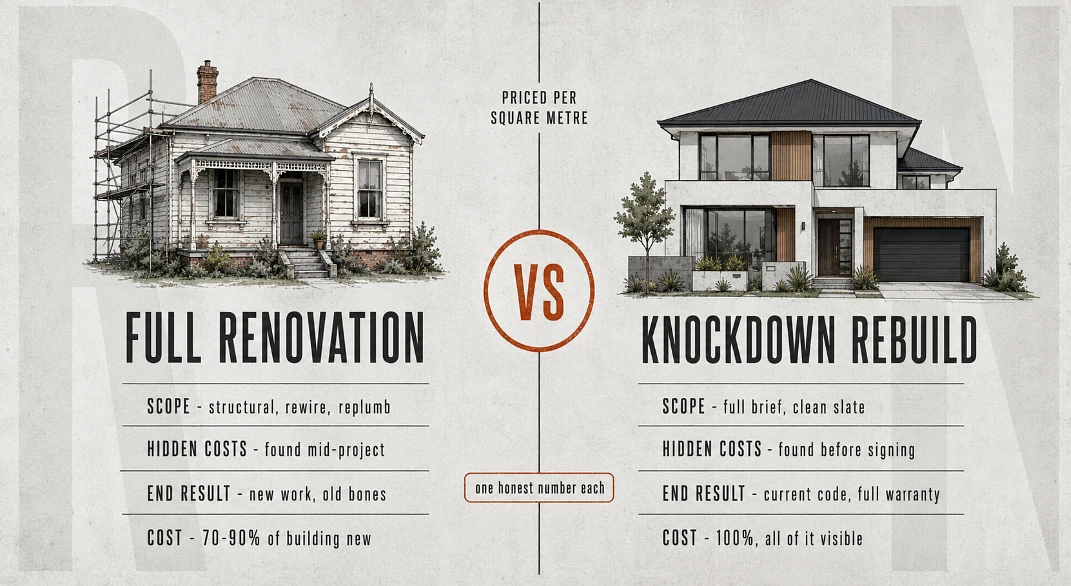
Here’s the exercise almost no one runs, and the one that settles most of these decisions. Take your full renovation scope, not the optimistic version, the real one, with the structural work, the rewiring, the replumbing and the “while we’re at it” items you already know you’ll add. Get it priced properly. Then divide that number by the floor area you’re improving, and compare it against building new.
The current Melbourne numbers make the comparison uncomfortable for a lot of renovations. Serious renovation work runs about $2,000 to $4,000 per square metre once structural changes are involved. A new build runs $2,100 to $3,900 per square metre for standard to mid range homes. Those ranges overlap. In our experience pricing both, a heavy renovation regularly lands at 70, 80, sometimes 90 percent of the cost of building new, and at the end of it you still have an old house. New wiring behind old walls. A modern kitchen bolted onto a floor plan from another era. You’ve spent most of the money and kept most of the compromises. When the renovation number gets that close to the rebuild number, the decision usually makes itself.
Renovating Wins When the Bones Are Good and the Changes Are Cosmetic
None of this means renovating is the wrong call. It’s often the right one, and cheaper by a wide margin, when three things are true. The structure is sound, with no significant movement, footings that are holding, and a roofline and frame you’re happy to keep. The layout basically works and you’re improving it, not reinventing it. And the house has character worth preserving, period features, a facade, a streetscape contribution that a new build can’t replicate.
If you’re refreshing kitchens and bathrooms, opening up one wall, or adding a modest extension to a home whose bones are genuinely good, renovation is very hard to beat. The mistake is assuming that logic scales. A cosmetic refresh and a full gut are not the same project, and the reasoning that fits one does not transfer to the other.
A Knockdown Rebuild Wins When You’re Fighting the House Itself
The rebuild case gets strong when your problems are structural, spatial, or both, when no amount of renovating gives you the home you want because the existing house is the constraint. You want a fundamentally different floor plan. The home has real structural issues, not cosmetic ones. You’re chasing energy performance that an old building envelope will never deliver no matter how much you spend insulating around it. Or you simply want the certainty of a new home, full warranty, current standards, nothing hiding behind the plaster.
Starting fresh also removes the compromise tax. Every renovation is a negotiation with a building that already exists, working around load bearing walls, existing service runs, and ceiling heights you’re stuck with. A rebuild answers to your brief and nothing else. The numbers are more knowable than most people expect, demolishing a standard Melbourne home runs $15,000 to $35,000, asbestos in pre 1990 homes adds $2,500 to $15,000, and complete projects land between $400,000 and $1.5 million depending on size and finish. We’ve broken down what a knockdown rebuild really costs, line by line, including the demolition and site costs, so the comparison starts from complete numbers rather than a headline figure.
Don’t Forget the Third Option: Just Moving
There’s a quieter option people skip past because they’re emotionally committed to staying: sell, and buy a home that already works. Sometimes that’s the sensible answer. But run the real cost before you assume it’s cheaper. Selling and buying carries transfer duty, agent commission, legal fees and moving costs, a combined bill that routinely runs into the tens of thousands before you’ve improved a single thing. And you’re trading a location you know for the compromises of someone else’s house, in a market where the home that ticks every box rarely comes up when you need it. If you don’t love where you live, moving is worth taking seriously. If you do love it, then moving means paying heavily to give up the one thing you were trying to keep.
How to Make the Call Without Regret
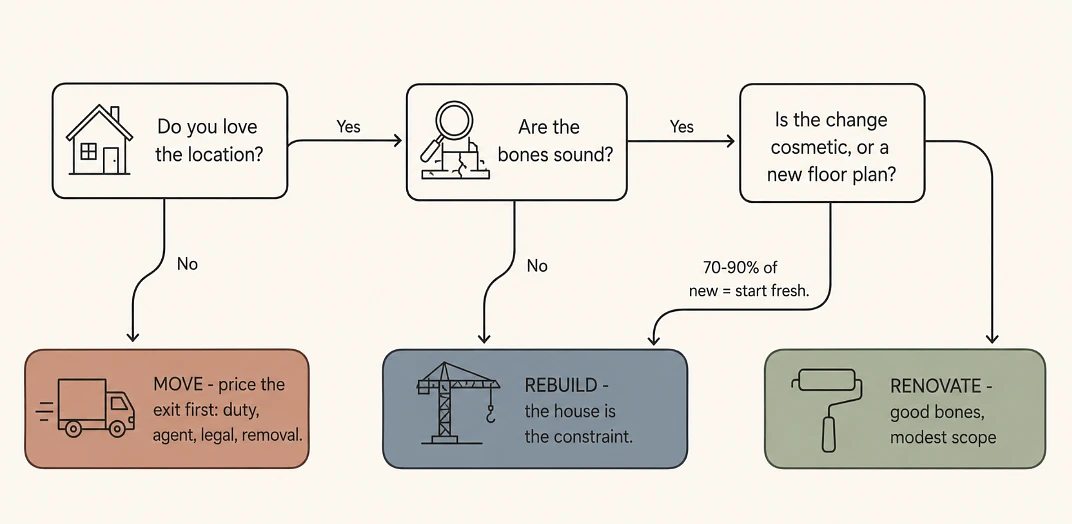
A few habits separate the people who look back happily from those who wish they’d chosen differently. Get an independent structural assessment before you decide anything, a builder or engineer walking the house will tell you in an afternoon whether the bones justify renovating. It’s the cheapest insurance in this whole process. Price the honest version of the renovation, not the hopeful one, because the “while we’re at it” items are not optional extras, they’re the real scope. And be ruthless about what you want from the finished home. If your list only works with a completely different floor plan, no renovation will get you there, and every dollar spent trying is a dollar spent on a compromise.
The families who regret this decision almost always made it the same way: they picked the option that sounded smaller, rather than the one the numbers and the structure pointed to. Do the comparison properly, and the house itself will usually tell you which one it needs.
Written by the team at Crowncon, a boutique custom home builder specialising in knockdown rebuilds across Melbourne’s southeast. Crowncon builds for families who want a quality home without the volume builder experience: honest numbers, no surprises, and the person who quotes your job being the person who runs it. You can see how they approach the process at Crowncon.
 Decor & Improvement Accessories