

Home & Decor Blogs: DIY, Interior Design & Lifestyle Ideas
Why Your Renovation Estimate Is Wrong Before the Work Even Starts

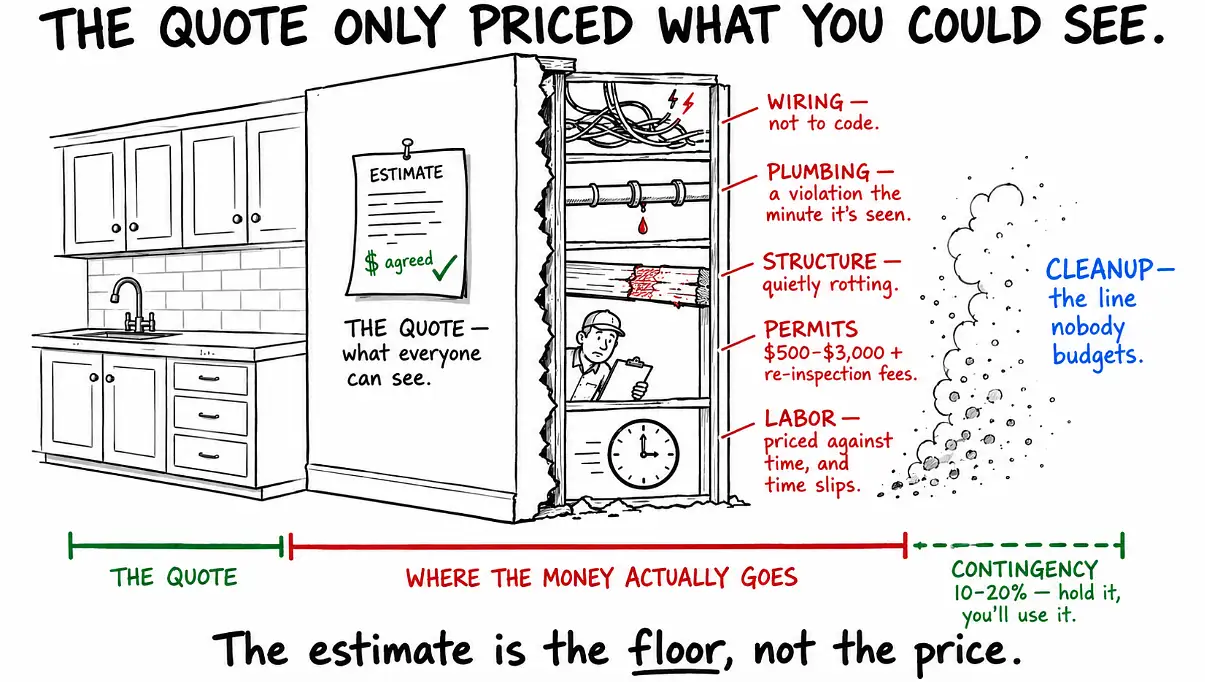
The quote is never the price. It’s the price of the work everyone can see.
You get the estimate, you read it over a few times, it feels solid, so you sign. Then somewhere around week three the number starts moving, and at the end you have a final bill that is thousands more than you agreed to pay. I did everything right, I got a proper estimate, so how am I this far over? This is a question that’s asked in half-finished kitchens all over the country, and the answer is almost never that someone cheated you. It’s that the quote priced what could be seen, and renovations spend their money on what couldn’t.
That gap isn’t bad luck either. It’s predictable, so once you know about it, you can budget for it instead of getting ambushed.
The Contingency line
Everyone’s heard the advice to save 10 to 20 percent for surprises. And everyone hears it, nods, and quietly ignores it, because when you’re already at the outer limits of affording the project, setting aside another fifteen percent for problems you can’t even name yet looks like an outlandish luxury.
It’s not. That might be the safest number in the whole budget, especially on an older home, because you’re going to use it. The only thing you don’t know is which surprise it pays for. Newer build, the 10% end of that’s defensible, fine. Older than a couple of decades, you want the top of that range, and honestly on a real gut job I’d rather see someone hold 20% and hand it back at the end than run out of road at week five with the walls already open.
What’s Behind the wall
Nobody quotes for this part, because nobody can. Until the wall comes open, everybody’s guessing.
I’ve budgeted the kitchen down to the tile. I have no idea what happens when they pull the cabinets off. That’s the honest position, and that’s where the money goes. Wiring that worked until the inspector saw it, and now has to come up to code before anything gets signed off.
The plumbing one is the one that gets me, honestly. A pipe can sit there doing its job for thirty years, bothering no one, and the minute it sees daylight it’s a violation with a four-figure price tag attached. Nothing about it changed overnight. What changed is that now someone official has looked at it
A bit of structure quietly rotting under a finish nobody had reason to pull back. None of it was visible when the estimate got written, so none of it was in the estimate.
You can see why the low quote is often the one that bites you. It might just be the one that hasn’t looked hard enough yet, or has priced the visible job cleanly and left the discoveries as change orders you’ll be signing later.
Permits
Permits are the cost people are most surprised by, partly because the number is real money and partly because it arrives once you’re already in. Most residential renovation permits run between $500 and $3,000, average building permit about $1,650, multi-trade jobs higher. The base fee isn’t where it gets you though, it’s the little fees piled on top of each other. Plan review, charged separately. Some local governments add impact fees for schools or roads. Re-inspection runs $100 to $500 each time work fails and has to be looked at again.
Pull a permit and an inspector shows up, and that’s often how the code problems behind the drywall get found in the first place. The permit cost and the surprise cost usually come due at the same time. It’s worth paying for a proper cost estimation service before you start or bid on anything, if only because it forces all of these conversations to happen early instead of at week three.
Labor
Labor is close to half the budget on most renovations and it’s the half most likely to slip, because labor is priced against time and renovations do not adhere to a schedule. Every surprise behind the wall is more hours, every hold-up waiting on an inspection is more days, and a project that runs long can catch a material price change partway through as well.
When one quote comes in noticeably under the others, this is usually where the difference is buried. Somebody priced the labor tight to win the job, and the hours that got trimmed off the quote don’t disappear, they just show up later as the overage.
The Cleanup, Which Nobody Budgets
This one gets left off almost every estimate, right at the end when you’re tired of thinking about money.
A real renovation kicks up a bonkers amount of debris and dust, the drywall dust especially, the stuff that works its way into every surface, every vent, every track, and doesn’t come out with a broom and a Saturday afternoon. My theory is it gets skipped simply because it comes last, and by the end of a renovation everyone’s brain is fried and the budget spreadsheet hasn’t been opened in two weeks.
And in a busy market it gets worse, because the cleaning crews are booked out the same way the builders are. If your area is in the middle of a construction run, get the cleanup people on the calendar before the project wraps, not after, or you’ll find yourself moving boxes into what is still basically a job site, except now it has nice new countertops.
Cleanup is real work, it costs real money, and if it’s not a line in your budget it becomes a surprise at the worst possible moment.
Getting The Knowable Stuff On Paper
You can’t make the surprises disappear. What you can do is drag them into the light before you sign, rather than one change order after another later on.
That’s the case for a proper itemized estimate over a rough number scrawled on the back of a business card. A line-by-line estimate from a service like PRO Estimating Services forces everything specific, materials, labor broken out honestly, permits accounted for, the contingency named as its own figure instead of a vague “things might come up.” It can’t tell you whether the wire behind that wall is bad, nothing can. What it does is get the knowable costs out of the fog and turn the unknowable ones into something you’ve explicitly set money aside for.
Stop treating the estimate as the price and start treating it as the floor. That number is your minimum spend, not your maximum, and the people who make it through a renovation without a meltdown had that fact in their heads from day one.
One piece of advice worth more than most budgeting apps: be there on demolition day. Not to supervise, just to see the wall come open with your own eyes, because that’s the moment the real project reveals itself, and the sooner you know what’s actually behind there, the sooner you can make calm decisions instead of panicked ones over the phone three days later.
 Decor & Improvement Accessories