

Home & Decor Blogs: DIY, Interior Design & Lifestyle Ideas
How to Make a Home Safer and More Comfortable for an Aging Veteran

The money and the modifications come from 2 different VA programs. Mixing them up is the most common mistake families make
Most families start with the grab bars, and that is the wrong place to start.
Grab bars are fine, but they are usually put in after somebody has already fallen, and by then the house has a different problem. The changes that keep an older person steady are mostly about heights, clearances and light, and when they are done well they do not look like medical equipment at all.
So this is about a house that somebody is going to keep living in, and it should keep looking like one. For a veteran that matters more than it does for most people, because he spent his working life being the one who helped, and a grab bar on the wall is the house telling him that he is now the one being helped. The changes that keep him steady should look like decisions about a nice house, which is what they are.
One more thing about the person this house is for. A veteran’s eyes open at the first sound. He has been on alert for most of his life, and that does not stop when the uniform comes off, so a small noise at 3 in the morning is enough to cost the old man the rest of his night. A few of the changes below are about that, and nothing else.
The Numbers That Do the Real Work
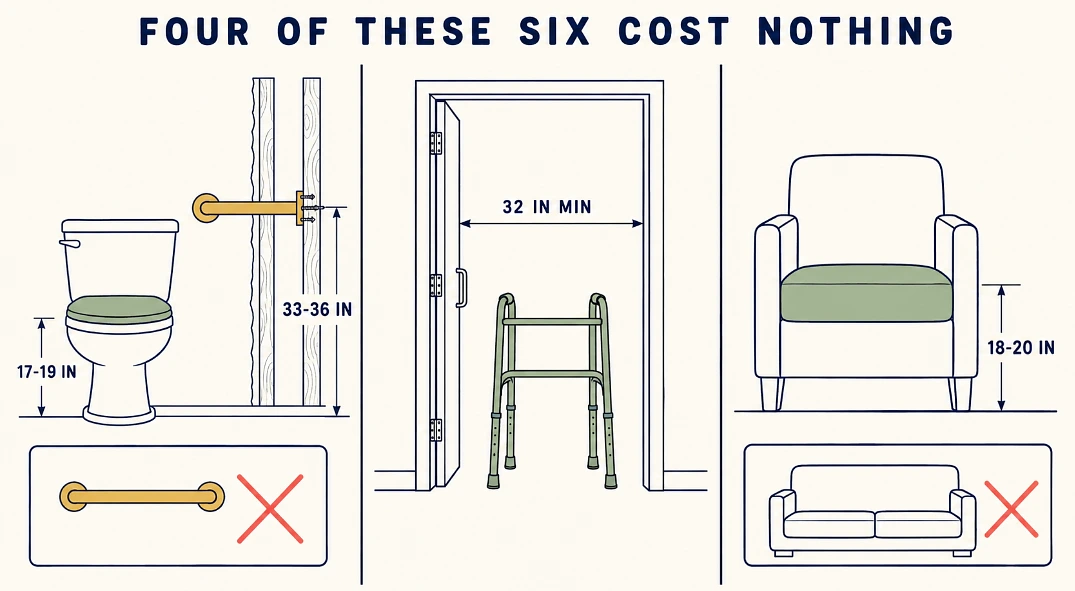
Most of the safety in a house comes down to a handful of measurements, and you can check every one of them this afternoon with a tape measure.
| What | Target | Why it matters |
|---|---|---|
| Chair and sofa seat height | 18 to 20 inches | Below 17 and standing up becomes hard work |
| Toilet height | 17 to 19 inches | Comfort height seats, the easiest bathroom change there is |
| Grab bar height | 33 to 36 inches | Fixed into studs or blocking, never into drywall (sheetrock) alone |
| Clear doorway width | 32 inches minimum, 36 better | The number that decides whether a walker fits |
| Clearance around a dining table | 36 inches | Enough to stand up and turn without shuffling |
| Walkway through a room | 30 to 36 inches | The route to the bathroom at night is the one that counts |
Four of the 6 things in that table cost nothing, because they are about where you put things and not what you buy.
Chairs You Can Get Out Of
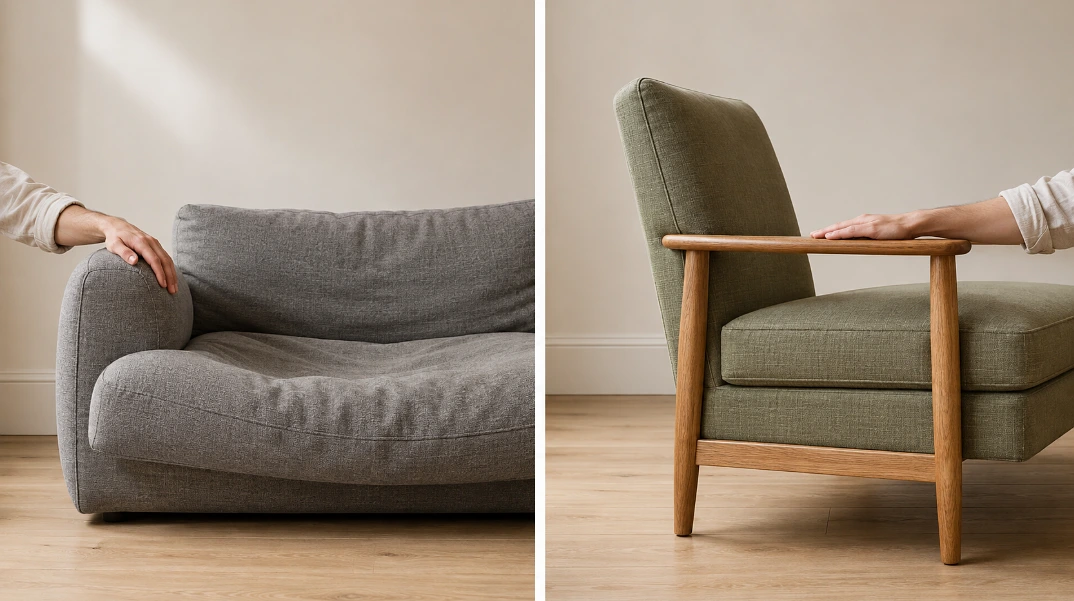
The chair matters more than almost anything else in the room, because sitting down and standing up is the movement that happens 20 times a day.
You can start with the seat height. Feet flat on the floor, knees roughly level with the hips, and a seat at 18 to 20 inches, and not the low, deep sofa that everybody sinks into and then needs a hand to get out of.
Firm cushions will serve you better than soft ones. A soft seat feels nice for the first minute and then you are stuck in it, and getting out again means pushing on the arms of the chair, which is exactly why the arms matter.
What to look for in the arms
Full length arms that reach forward to the front of the seat, so there is something under the hand at the moment of pushing up. Arms that stop halfway along the seat are no use for this.
Solid wood or metal frames and not anything that flexes, since a chair that gives a little under a push is a chair that is not helping.
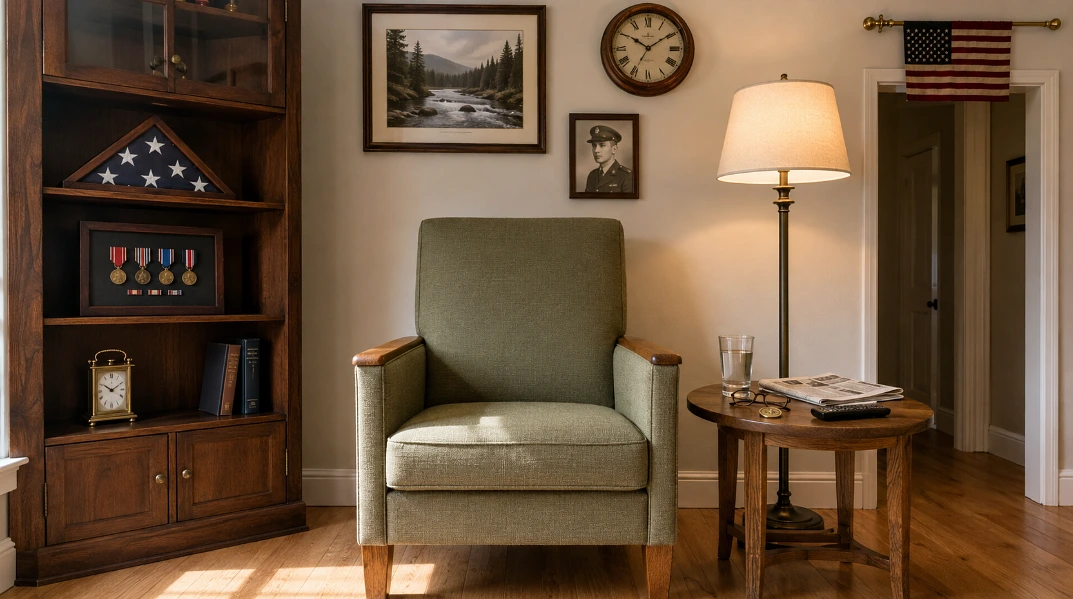
The core thing that matters is where the chair faces and how high it is kept, and anyone who has lived with a veteran knows the first part already, because he will always want to see the door. If the chair has its back to the room he will sit in it for 5 minutes and get up again, however good the seat is, so put the good chair where he can see the door and the window at the same time, and that is where you will find him most days.
Then put a side table within reach on the strong side, and a floor lamp beside it with a warm bulb. Phone, water, glasses, remote, all reachable without standing. A lot of falls in a living room start with somebody getting up for something small.
Floors, Which Cause More Falls Than Stairs Do
Loose rugs cause most of the trouble, and they are also the thing people least want to give up.
- Throw rugs in the hallway and by the front door really should come out altogether, and taping them down is only half a fix. No one likes hearing that, and it is still the right advice.
- Any rug you decide to keep will need a non slip backing or double sided tape underneath it, and you will have to check it every few months, because the tape gives up long before the rug does.
- Go for a low pile that lies flat, because anything that bunches up at the edge will trip somebody on a bad night sooner or later.
- Bathroom and kitchen mats want suction backing, and they want replacing when the suction stops gripping.
- Worn carpet edges and lifting vinyl seams get fixed the week you notice them.
Hard floors are easy to keep clean and they can be slippery when wet, and you cannot have the one without the other. Where a floor is being replaced anyway, a matte finish tile or a textured luxury vinyl grips far better than anything polished.
A hard floor adds a sound as well, and it is one a light sleeper hears from 2 rooms away. A dining chair dragged back on tile or on wood makes that long scrape every time somebody sits down or gets up, and in a house where one person is dozing in the afternoon and another is clearing the table, that scrape is going to wake him every time. Felt pads under every chair leg cost a few dollars for the whole set and stop it, and they want checking every few months, because they wear through and the scrape comes back.
Light, and Why Older Eyes Need More of It
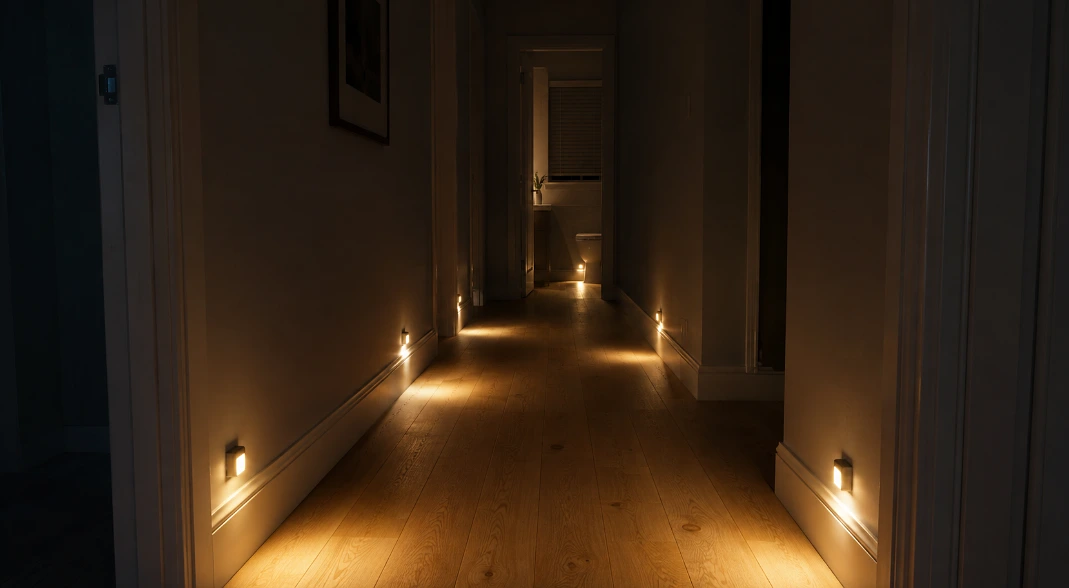
Somewhere around 60, the eye needs a lot more light to see the same detail, and most houses are lit for whoever chose the fittings 20 years ago.
Layer it. Ceiling light for the room, lamps for the corners, and something at every point where the floor changes level or direction.
The nighttime route from bed to bathroom is the one to solve properly. Plug in motion sensor lights along the baseboard, low down, so the path lights itself without anybody hunting for a switch at 3 in the morning. That is about a $20 fix for the most dangerous walk in the house.
With a veteran there is one more thing to check before you buy the lights, and it is the noise they make. A man who served sleeps lightly, and a motion light that clicks when it comes on, or a night light that hums all night on the landing, will have him awake 3 or 4 times before morning. This is what turned up while we were reading on it:
- The Department of Veterans Affairs followed more than 5,500 veterans for 7 years, and 57% of them had insomnia. For adults in general the figure is about 30%.
- Older veterans in a separate study said their sleep trouble began during service and has stayed with them for decades.
Hmm, so that is the reason he is up at every creak, and it is not going to change now. So buy the lights that come on without a sound and go off without one, and put them low, where they light the floor and not his eyes.
Warm bulbs, 2700K to 3000K, and enough of them. Glare is a problem of its own, so shades and diffusers and not bare bulbs.
Storage That Stops the Reaching and Bending
Everything used daily belongs between hip and shoulder height. That is the rule, and most of the fixes come from it.
The heavy pans that live in a low cupboard, the good glasses on the top shelf, the medications in a bathroom cabinet that needs a stretch, all of that gets moved into the band where nothing needs a stool or a knee on the floor.
Levers instead of round doorknobs, which is about a $15 swap per door and makes a big difference to arthritic hands. The levers earn their place twice over here. A round knob fights an arthritic hand, and a man who has slept badly for 40 years has less patience for a door in the morning than he once had, which the same sleep research lists plainly as one of the costs of insomnia. A handle that opens on the first try is a small thing that stops a bad start to the day.
A small rolling cart on wheels earns its place too, especially in a house where meals travel between rooms.
Two Different VA Programs, and They Do Not Do the Same Thing
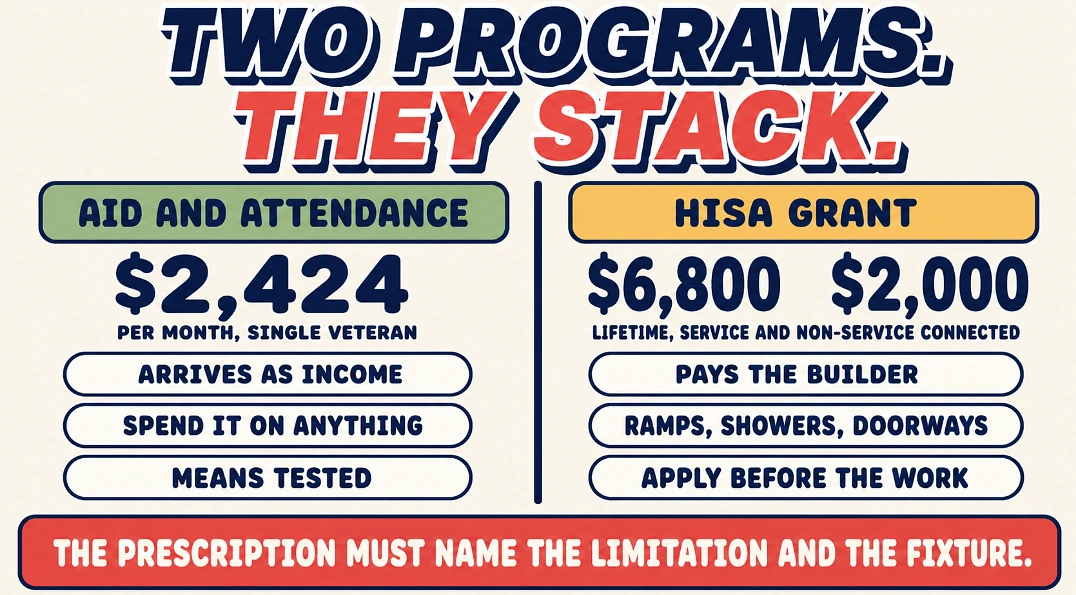
Before anybody spends money, the 2 benefits need separating, because they get talked about as if they were 1 thing.
Aid and Attendance is a monthly addition to a VA pension for veterans who need help with daily things like bathing, dressing, getting in and out of a chair or using the toilet, or who cannot leave the house.
In 2026 that runs up to about $2,431 a month for a single veteran, and yes, that is every month.
It arrives as income, so it can pay for care, or for the modifications in this article, or for anything else, and the veteran decides. To qualify he will need:
- 90 days of active duty, with at least 1 of those days during a recognized wartime period.
- An honorable discharge.
- Income and assets under the limit, because it is means tested.
HISA, which stands for Home Improvements and Structural Alterations, is the one that pays for the building work itself:
- Up to $6,800 over a lifetime for a service-connected disability.
- Up to $2,000 for one that is not service-connected.
- It covers ramps, roll in showers, widened doorways and grab bars, the heavy end of the list in this article.
These 2 can be easily claimed together, and families in Florida looking at Aid and Attendance Florida often qualify for both and then apply for neither, mostly because the paperwork looks worse than it is.
One thing gets HISA applications rejected more than any other. The doctor’s prescription has to be specific about the functional limitation and the modification that solves it, so a note saying “needs bathroom modifications” gets rejected while a note naming the condition, the risk and the required fixture does not.
The VA decides all of this, not the contractor and not this article, so take the numbers above as a guide and get the eligibility confirmed before planning around them.
What This Costs and What to Do First
Do it in this order and the money goes where the risk is. Free first. Move the furniture for clearances, clear the night route, shift daily items into the reachable band, take up the hallway rugs, put the good chair where he can see the door.
Then the small money, which is under a couple of hundred dollars all in. Silent motion lights, lever handles, non slip mats, felt pads for the chairs, warmer bulbs, a raised toilet seat.
Then the real spend, which is grab bars fixed properly into blocking, a chair with the right seat height, and eventually the bathroom itself. That last tier is what HISA exists for, and apply before the work starts and not after, since the grant does not pay back what you already spent. None of this needs to look like a care home. A good chair is a good chair, a well lit hallway is a nice hallway, and the only person who needs to know why any of it was chosen is the one living there.

 Decor & Improvement Accessories