

Home & Decor Blogs: DIY, Interior Design & Lifestyle Ideas
7 Warning Signs Your Home May Have Roots In The Sewer Line

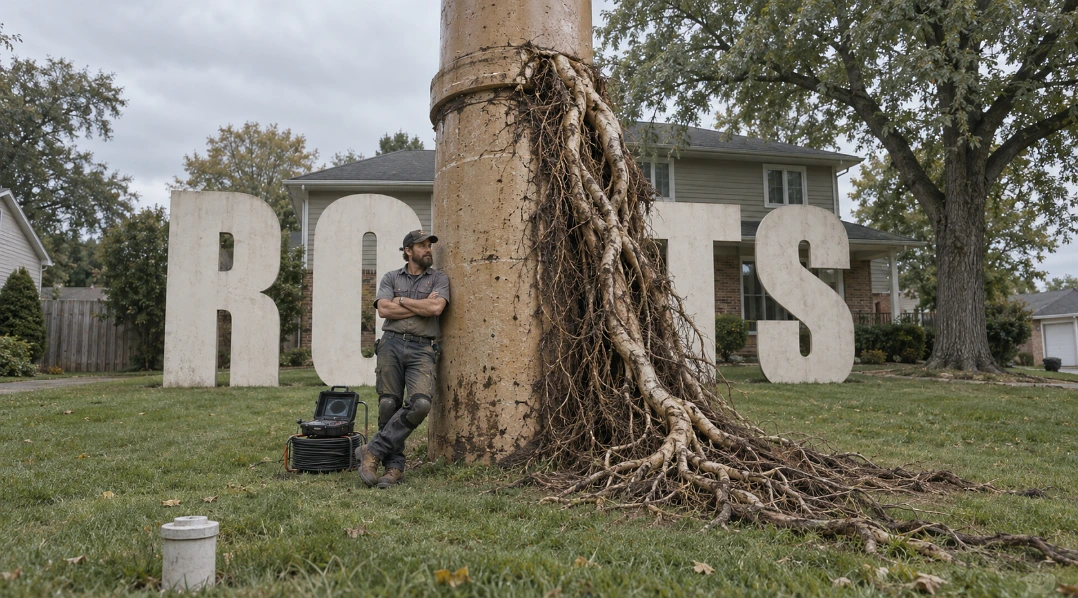
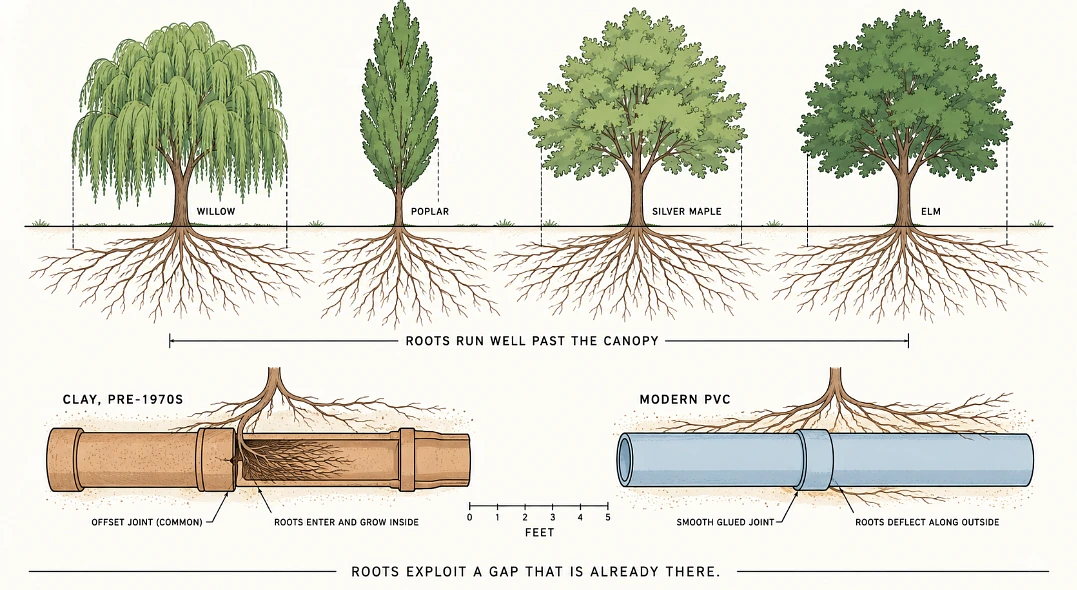
A tree root usually gets into a sewer pipe through a gap that is already there, a joint that has shifted, a hairline crack, an old connection that no longer seals. The gap leaks moisture and nutrients into the soil around it, roots grow toward that, and once one hair thin root is through it thickens season after season until it is filling the pipe like a bottle brush. Established roots can also press on a pipe and make existing cracking worse, though roots breaking an otherwise sound pipe is far less common than roots exploiting one that has already failed.
One thing to be clear about before the list. These symptoms can indicate a problem in the building sewer, but none of them confirms tree roots on its own. Grease, debris, an offset joint, a sagging section, corrosion and some venting faults all produce overlapping symptoms. Root intrusion gets confirmed by clearing the line and looking inside it with a sewer camera, not by reading the signs from the kitchen. Minor intrusion often produces no symptoms at all, so the absence of these signs does not mean the line is clear, and their presence does not tell you how far it has gone.
1. Slow Drains In More Than One Room
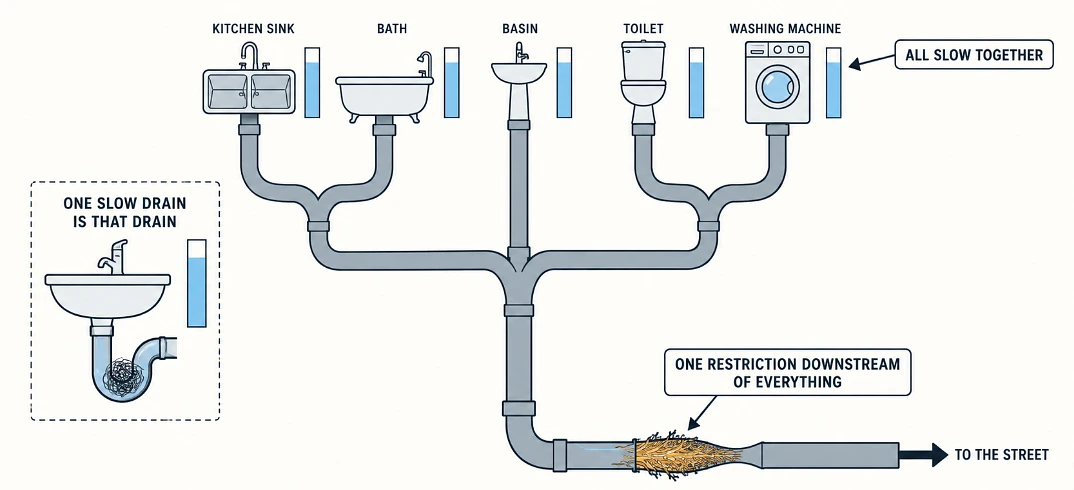
One slow drain points at that fixture. Several slow drains point downstream of all of them, at a shared branch, a stack or the main sewer.
Hair in a bathroom sink or grease in a kitchen trap is local, and the water runs fine once it gets past the blockage, because everything after it is clear. When the restriction sits further down, every fixture feeding into that section is pushing through the same narrowed pipe, so they slow together.
It usually shows up in sequence rather than all at once. Somebody notices the kitchen sink taking its time in March. By April the bath is holding water for a minute after the plug comes out. In May the downstairs basin joins in, and by then a homeowner has been through 2 bottles of drain cleaner wondering why none of it is sticking.
You do not need to test for this, and deliberately loading the system is the wrong move if a partial blockage is possible. Watch what happens during ordinary use instead, so which fixtures drag and whether one of them reacts when another is running. If several are affected, cut water use and get the line looked at, and that is the point where Expert Sewer Cleaning Services become the sensible call rather than another trip to the hardware store.
2. A Smell Coming Up Through The Drains

Every fixture has a trap holding a liquid seal, and that seal is what stands between your kitchen and the sewer gas. Codes generally set the seal depth between 2 and 4 inches.
Break it and the gas comes up. Rotten eggs, sulphur, or plain sewage.
Several things can cause it. A trap dries out in a spare room that gets used twice a year. A vent gets blocked, often by a nest or leaves at the roof, so pressure cannot equalise the way the system needs it to. A blockage downstream lets gas build behind it. Damaged pipework, a failed toilet seal or a poor vent layout can do it too, and odour alone will not tell you which of those you have.
Start with the cheap check, and keep it narrow. Go round the fixtures that hardly get used, so the spare bathroom, a basement sink, a floor drain, and run water into each one for half a minute to refill a trap that may simply have evaporated. Give it a day. If the smell is still there afterwards, it needs a proper diagnosis rather than another guess.
3. Gurgling When You Run Something Else
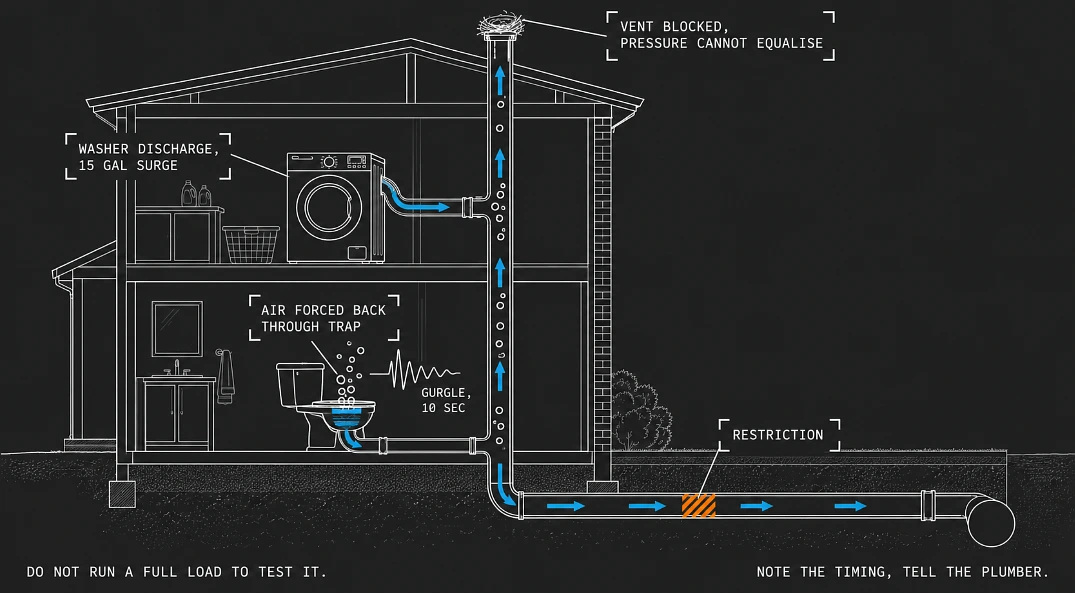
Gurgling means air is being pushed through water somewhere it should not be, and that usually comes down to a restriction in the pipe or a venting problem.
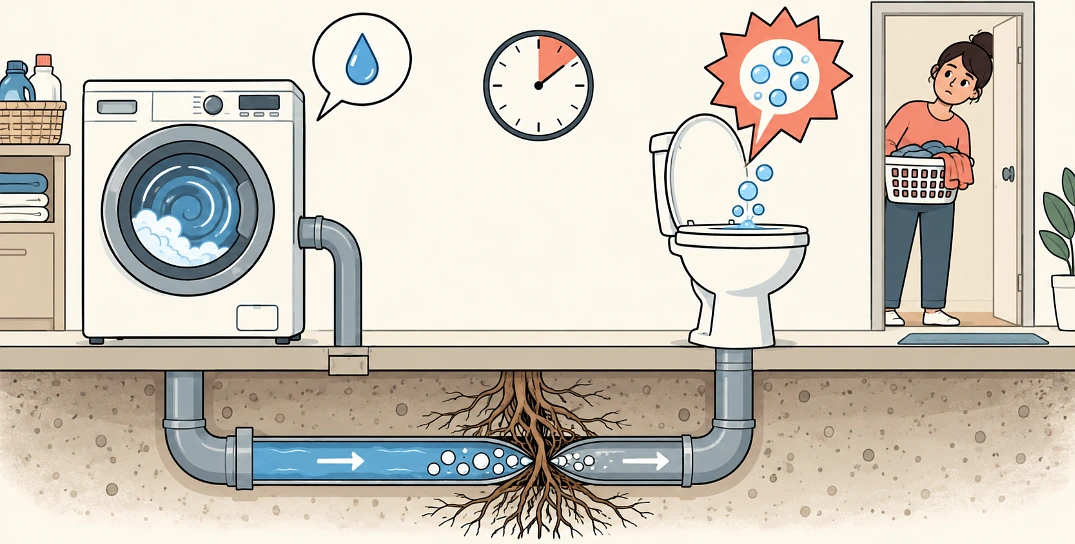
The pattern is what makes it worth noticing. You flush upstairs and the downstairs shower burps. You start the washing machine and a nearby toilet bubbles for 10 seconds. Those fixtures are talking to each other somewhere downstream, though not necessarily as far down as the main sewer, since they may share a branch drain or a stack well before that.
It is also the sign most likely to be ignored, because gurgling does not stop anybody using anything. The house still works. It just makes a noise doing it, and people get used to noises.
Resist the urge to force it into the open. Running a full load specifically to see whether the drain gurgles means deliberately dumping a large volume into a system you suspect is restricted, and that is how a slow drain becomes a backup. Note when it happens during normal use and tell the plumber, since the timing is genuinely useful information.
4. Water Coming Back Up Somewhere Low
Wastewater comes out at the lowest available fixture upstream of the blockage, which in a house with a basement is often the floor drain or the basement shower.
Where exactly it appears depends on the plumbing layout and where the blockage sits, but the principle holds, and it is why the damage tends to be worse than the blockage deserves. The lowest room in the house is usually the one with the boiler, the boxes, and a carpet that was never meant to get wet.
The moment you see it, stop using water. All of it. No dishwasher, no laundry, keep everyone out of the shower, do not flush toilets, because every gallon going down adds to whatever is already coming back up. People do the opposite instinctively, running the tap to see if it clears, and it does not clear, it just arrives faster.
Keep people and pets away from it as well. Sewage carries bacteria and other pathogens, so it is not a mop and carry on situation, and anything contaminated that cannot be properly cleaned, disinfected and dried is generally not worth keeping.
Then call somebody. A household plunger is the right tool for a clogged toilet and it is not going to reach a blockage deep in the sewer line, so there is little point working at it.
5. Several Fixtures Clogging At Once
One blocked toilet is a toilet. Every toilet in the house refusing to flush properly on the same weekend points at the line they share.
The repeat is what makes it worth investigating. A plunger will often get a toilet moving again for a day or 2, because you are clearing enough space for water to squeeze past, and then it collects again and you are back where you started. Plunging the same toilet 3 weekends running might still be the toilet or the branch behind it, but once other fixtures start misbehaving in the same period, the shared line is worth ruling out.
House age changes the odds, and so does what is growing in the garden. Older American properties may have clay, cast iron, concrete or Orangeburg lines depending on the region and when they were built, and some cities carried on laying clay far later than others. Clay is the one roots exploit most readily, because it goes in as short sections with a joint every few feet and older joints were never watertight.
Willow, poplar, silver maple and elm turn up most often in the lists of offenders, though they are not the only species that cause it. Distance is not much comfort either, since root systems spread well past the canopy, so a tree some way from the house is not automatically out of range.
If the house is that age and the line has never been looked at, a camera inspection runs $125 to $500 with a cleanout and $175 to $750 without one, on current US estimates. Worth knowing that a camera works best once the line has been cleared, because a pipe still full of wastewater hides the very thing you are paying to see.
6. A Green Patch In The Lawn That Has No Reason To Be There
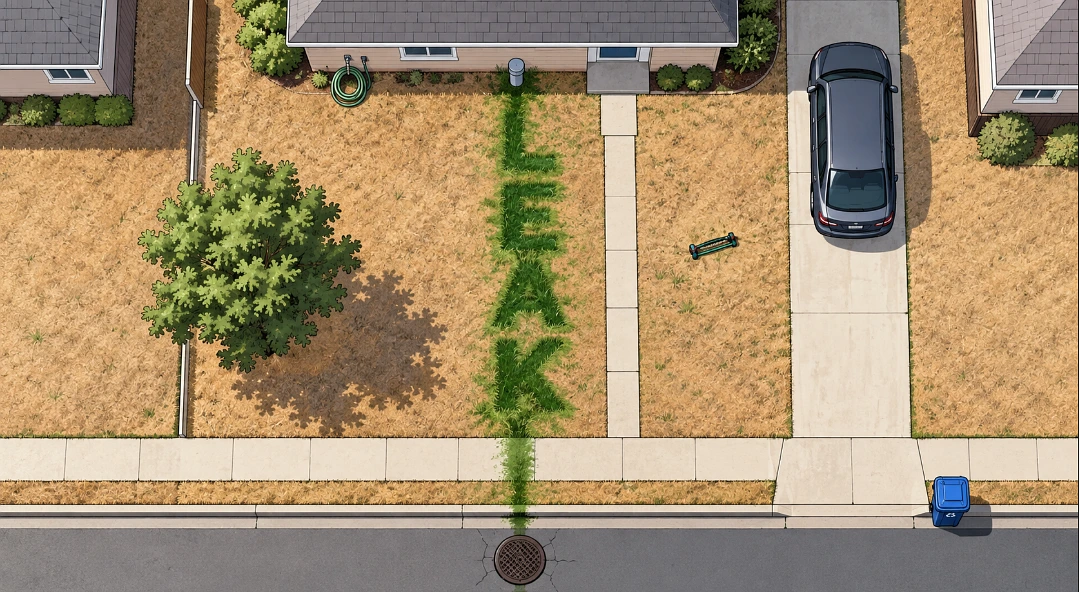
Grass over a leaking sewer line can grow better than the grass around it, because the leak is effectively feeding it, and the same leak is often what drew roots in to begin with.
It looks like good news. A strip that is darker, thicker and taller than everything else, sometimes running from the house toward the street. That said, it proves nothing on its own, since irrigation, a broken downspout, drainage patterns and plain variation in the soil all produce similar patches.
The better companion sign is ground that stays soft in dry weather, or a patch that sinks slightly underfoot. Sinking may mean soil is washing into or around a damaged pipe, and over time that kind of void can grow into something more serious.
Walk the run of your lateral in a dry spell, which means from the house toward the street or the alley. Dry weather is what makes this visible, since everything is green in April. In August the leak may be the only thing being watered.
7. Repairs That Keep Coming Back
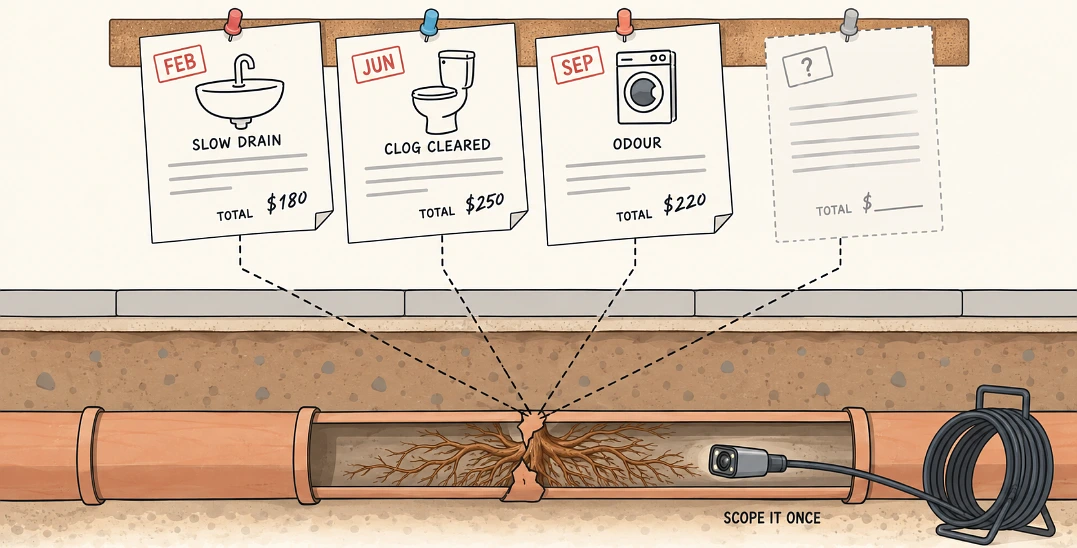
If you have had a plumber out 3 times in a year for 3 different fixtures, it is worth asking whether they share a cause.
A deteriorating sewer line generates symptoms all over the house, and each one looks unrelated from a distance. A slow basin in February. A toilet clogging in June. A smell in the laundry in September. Three separate call outs, 3 separate invoices, and not one of them looks at the pipe underneath.
That pattern does not confirm anything by itself, but it justifies scoping the line once rather than paying to treat symptoms one at a time.
One correction worth making, since it gets repeated everywhere. A leaking sewer lateral does not add to your water bill. The meter counts water coming into the house, and wastewater has already passed through it, so a gravity sewer leak creates no extra metered consumption. A jump in usage usually points at heavier use or a supply side leak instead, which is a different pipe and a different job. Sewer charges themselves vary, and some utilities calculate them from metered water use.
What This Costs Against What It Prevents
On 2026 US market estimates, snaking a main line runs $200 to $500, hydro jetting runs $600 to $1,400, and a camera inspection runs $125 to $500 with a cleanout. Those ranges move a lot by region and job, and some national trackers quote camera inspections considerably higher, so treat them as a starting point rather than a quote.
Full sewer line replacement is commonly quoted anywhere from $3,000 to $25,000, depending on length, depth, access and what sits on top of the run. A driveway or a mature tree in the way is what pushes a job toward the top of that.
Two things worth understanding before booking anything. Cutting or jetting roots clears the obstruction, it does not repair the opening the roots came through, so if a cracked joint or deteriorated section is still there, the intrusion can come back and a structural fix, a liner or a replacement may end up being the real answer. And hydro jetting is not right for every old pipe, since high pressure equipment can do further damage to a line that is already fragile.
Find Out Where Your Pipe Ends And The City’s Begins
Responsibility for a sewer lateral varies by city and utility. In some places the property owner is responsible all the way to the connection with the public main, including the section under a sidewalk or street. Elsewhere the utility takes on part of the lateral. There is no national rule that splits it at the property line, whatever anyone tells you.
Check your utility’s sewer lateral map or its published rules before authorising any repair, and call and ask while you do not have a problem. It takes 10 minutes and it tells you which side of the line you are paying for.
Find your cleanout while you are at it. It is a capped pipe, usually 4 inches across, sticking out of the ground near the house or sometimes set into a basement floor. Knowing where it is saves a plumber time, and time is what you are paying for. A house with no accessible cleanout costs more to inspect for exactly that reason.
 Decor & Improvement Accessories