

Home & Decor Blogs: DIY, Interior Design & Lifestyle Ideas
Signs Your Heat Pump Needs Professional Care Before Winter
- Most first winter heat pump calls turn out to be furnace habits and not faults, starting with a hand held over a vent expecting furnace air.
- The 4 faults that are real, a screech, a hiss, ice that will not clear and a unit that keeps starting and stopping, make themselves heard.
- 20 minutes on a mild evening with the thermostat shows which of the 2 you have got.
The first cold week of the year is when a heat pump company’s phone starts ringing. A good share of those calls end with a technician standing in a warm house, explaining that nothing has gone wrong.
That is not the owner’s fault. Most people running a heat pump through a first winter had spent the previous 20 years with a gas furnace, and a furnace teaches habits that a heat pump makes you pay for, either on the electricity bill or in the belief that the machine is dying. The habits come first here, in the order the calls come in, and the faults after them.
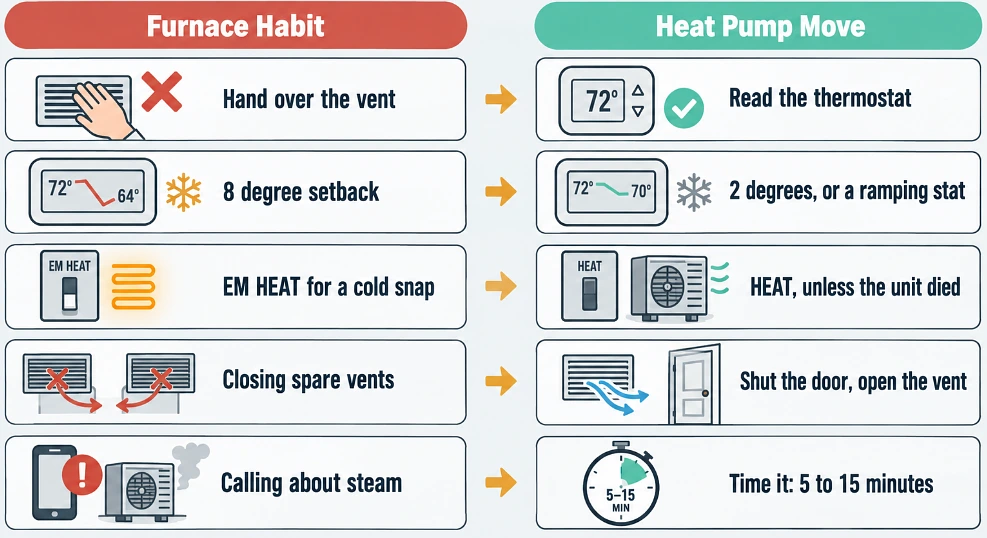
| Furnace habit | What it does on a heat pump | Do this instead |
| Hand over the vent to check the heat | Reports cool air from a vent that is 25 degrees above the room | Check the thermostat |
| 8 degree setback at night | Switches on the electric backup strips every morning | 2 degrees, or a heat pump thermostat that ramps |
| EM HEAT for a cold snap | Turns the heat pump off and heats the house on strips alone | HEAT, always, unless the outdoor unit has died |
| Closing spare room vents | Raises duct pressure and strains the compressor | Shut the door, leave the vent |
| Calling about steam and a whoosh | Reports a normal defrost cycle as a breakdown | Time it, 5 to 15 minutes is normal |
The Hand Over The Vent
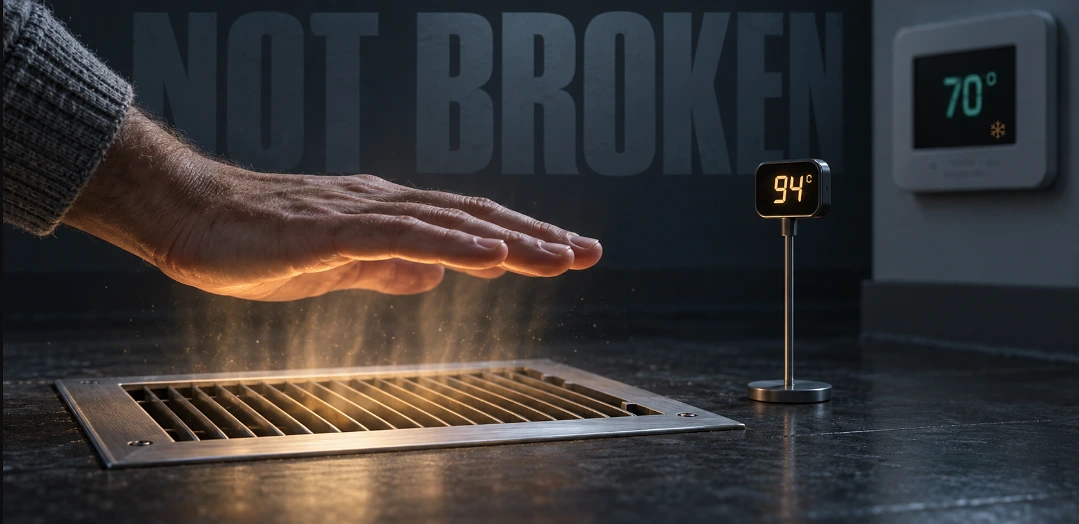
A furnace throws air out of the registers at somewhere between 120 and 140 degrees. After 20 years of that, a hand has learned what heat feels like. A heat pump moves heat rather than making it, so the air it sends up has been warmed to around 90 to 100 degrees, warmer than the room and cooler than a palm, and the palm reports cool air from a vent that has been pushing out air 25 degrees above the room the whole time.
Is the air supposed to feel that cool?
Yes. The house gets to 70 over a longer, gentler run, and the thermostat, had anyone looked at it, would have been holding 70 the whole time the hand was out.
If the thermostat is holding its number and the house is comfortable, the lukewarm vent is the heat pump working the way it was built to work.
Turning It Down At Night
This habit costs the most, and furnace owners were proudest of it. Down to 62 at bedtime, up to 70 at 6 in the morning, and on a furnace that had been true. On a heat pump the 8 degree jump at 6 in the morning asks the outdoor unit for more than it can deliver quickly, so the thermostat gets the electric backup strips going to close the gap, and the strips, which are a coil of resistance wire in the air handler, make heat at roughly 3 times the electricity of the heat pump on a mild morning. The Department of Energy’s thermostat page has said so for years:
When a heat pump is in its heating mode, setting back its thermostat can cause the unit to operate inefficiently, thereby canceling out any savings achieved by lowering the temperature setting.
The thermostat gives it away. A small AUX or AUX HEAT light, on many models a little orange snowflake, comes on whenever the strips are running, and if that light has been on for an hour every morning since the cold started, the January bill will arrive as a shock and the heat pump will get the blame for a thermostat habit.
So is the thermostat left at 70 all night?
Not quite:
- 2 degrees of setback rather than 8.
- A thermostat built for heat pumps, which ramps the temperature up so slowly the strips never wake.
- Setting back on the mild nights rather than the cold ones, because a cold night is when the outdoor unit needs every degree of head start it can get.
That EM HEAT Switch
Every heat pump thermostat has a position marked EM HEAT or EMERGENCY, and a surprising number of owners flip it on the first cold morning because it sounds like the strong setting. It does the opposite. Emergency heat shuts the heat pump off altogether and runs the house on the strips alone, at the 3 times cost, all day and all night, and it was put there for the morning the outdoor unit has died and someone is on the way to fix it. Left on for a week it will have added more to the bill than the repair it was covering for.
If it is on now, it goes back to HEAT. Should the house then go cold, that is a real call.
Vents In The Spare Room
Shutting the registers in the guest room and the office to push heat where the family is never worked on the furnace either. It does a heat pump more harm. The ducts had been sized with every vent open, so closing a third of them raises the pressure in the whole system, makes the blower fight to move air that has nowhere to go, and has the outdoor unit running longer cycles under more strain for the same result.
A heat pump lives on airflow in a way a furnace never did, since it is moving a smaller amount of warmth through a larger volume of air. The spare room vent stays open. The spare room door can be shut.
The Whoosh And The Steam
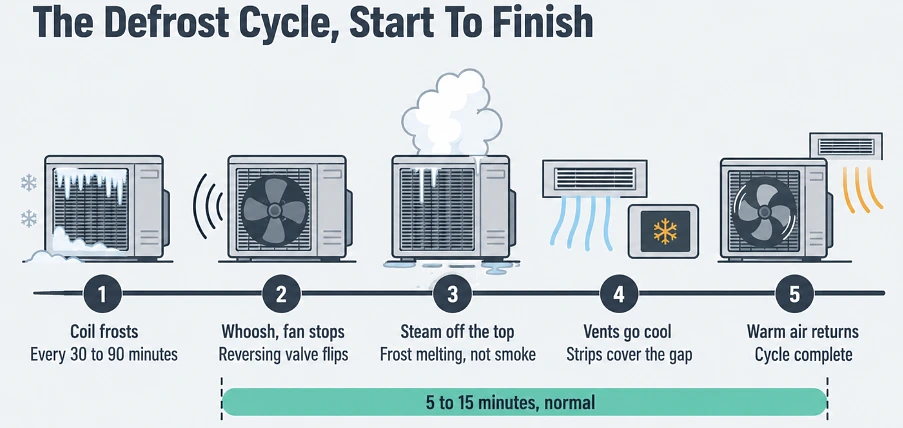
Once it is near freezing and damp, the outdoor coil frosts over, and every 30 to 90 minutes the unit will stop and melt it. From the kitchen window that looks like a breakdown, and it produces more panicked calls than anything else on this page:
- A loud whoosh, or a long sigh, from the outdoor unit, which is the reversing valve flipping the refrigerant round.
- The outdoor fan stops while the compressor keeps going.
- A plume of white steam off the top of the unit as the frost melts, and it looks like smoke.
- The indoor vents go cool for 5 to 15 minutes, and the strips come on to cover it, so the snowflake flickers.
- A second whoosh, the fan restarts, warm air comes back.
That is the defrost cycle. It has been generating “it is smoking and blowing cold air” calls every winter since heat pumps went into houses, and none of them needed a truck.
A defrost that runs past 15 minutes, or one that starts again the moment it finishes, or a unit that never defrosts at all and slowly turns into a block of ice, belongs in the next section.
The 4 Sounds And Sights That Mean A Repair
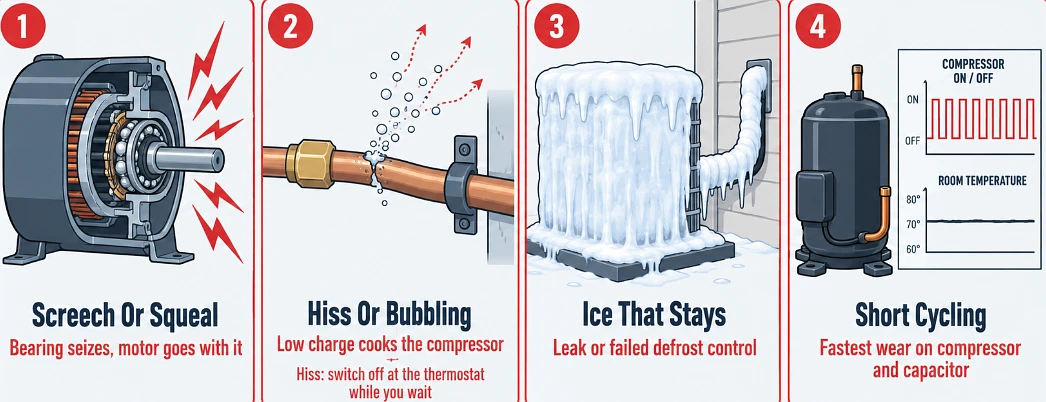
After the 5 habits, the real faults are easy to pick out, because none of them keeps quiet.
- A screech or a squeal while the outdoor fan runs is a motor bearing going, and the motor stays cheap to replace right up until the bearing seizes and takes the motor with it.
- A hiss or a bubbling that does not stop when a defrost ends is refrigerant getting out. Low refrigerant freezes the indoor coil solid and, given long enough, cooks the compressor.
- Ice on the refrigerant lines into the house, or an outdoor coil so buried the fins have vanished and no defrost is clearing it, points to that same leak or to a failed defrost control.
- Starting and stopping every few minutes without the house warming, which the trade calls short cycling, wears the compressor and its start capacitor faster than anything else here. The cause is usually a thermostat, a blocked coil or low charge, and every one of those costs less in the fall than in the first cold snap.
Any of the 4 is the moment to book heat pump repair before the first freeze rather than during it. A bearing or a capacitor that would have been a same day part in October becomes a 3 day wait once every technician in the area is out on the same roads for the same reason. If it is the hiss, the system gets switched off at the thermostat while you wait, since a compressor that has been run on low refrigerant is the repair that turns into a replacement.
A 20 Minute Test On A Mild Evening
None of the 4 faults waits for winter to exist. They wait for winter to be noticed. So the heat pump can be made to prove itself on the next mild evening, while a repair is still an ordinary appointment, and the whole test is the thermostat and a watch.
- Switch from cool to heat and set it 2 degrees above the room. Within a minute the outdoor unit should have started, and within 5 the air at the nearest register should be warmer than the room, lukewarm by hand.
- If the air were still cool after 10 minutes, the reversing valve would be stuck on the cooling side, which is the one fault a whole summer of air conditioning could never have shown.
- Push it to 4 degrees above the room and watch the thermostat. The snowflake should come on within a few minutes and the registers should get noticeably hotter, which proves the strips work.
- Set it back down and watch the snowflake go off.
- Go outside once. Clear the leaves off the coil and check the fins are not crushed, because half the airflow trouble in the section above started as a pile of leaves.
A dead strip is the fault no one finds until the first hard freeze, when the house sits at 60 and the outdoor unit runs all night trying to close a gap it cannot close alone. Finding it in a 20 minute test in the fall is what turns that night into an appointment.
One caveat. A heat pump in a truly cold place, the kind that sees weeks below 20 degrees, will run its strips more than any thermostat habit can prevent, and an owner there should expect a higher winter bill than the brochure implied. Everywhere milder than that, the habits above are most of the bill and most of the calls.
 Decor & Improvement Accessories