

Home & Decor Blogs: DIY, Interior Design & Lifestyle Ideas
That Clicking Sound When Your AC Starts: What It Means
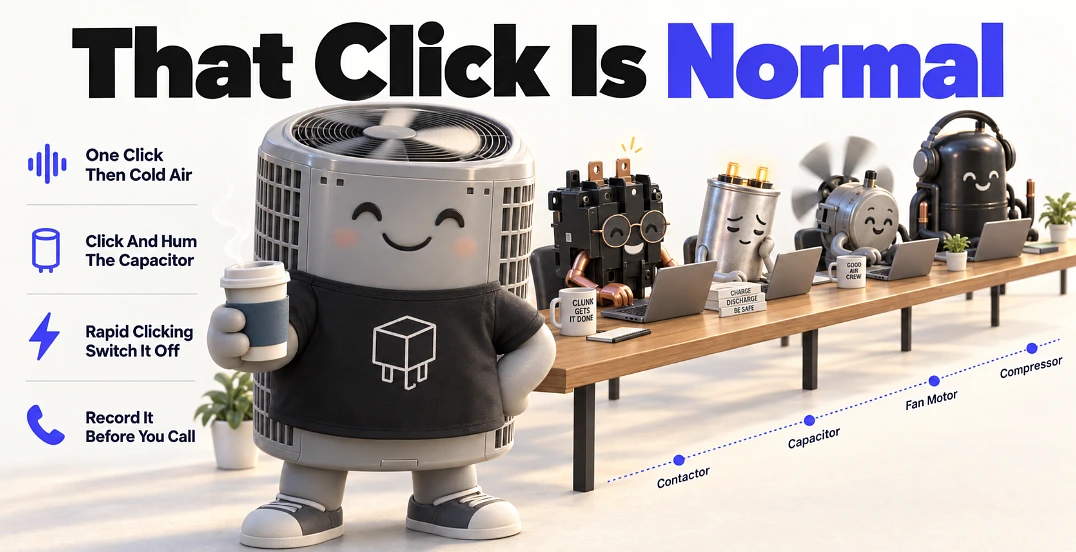
It is the middle of September and most of the country is about to say goodbye to cooling for the year. The afternoons are still warm enough that the AC kicks on around 2, and by dinner there is a breeze through the open window doing the same job for free, and that is the week people start hearing the click. Same click it made all summer, but now the house is quiet enough to notice it, and there is a small worry that comes with it, that the unit is going into the off season with something wrong. So is it a problem or is it the unit doing its job? Most of the time the second one, and the 3 or 4 times it is the first one, the click itself is not the thing that is broken. What is broken is whatever happens in the 2 seconds after it.
Is the Click Itself the Problem?
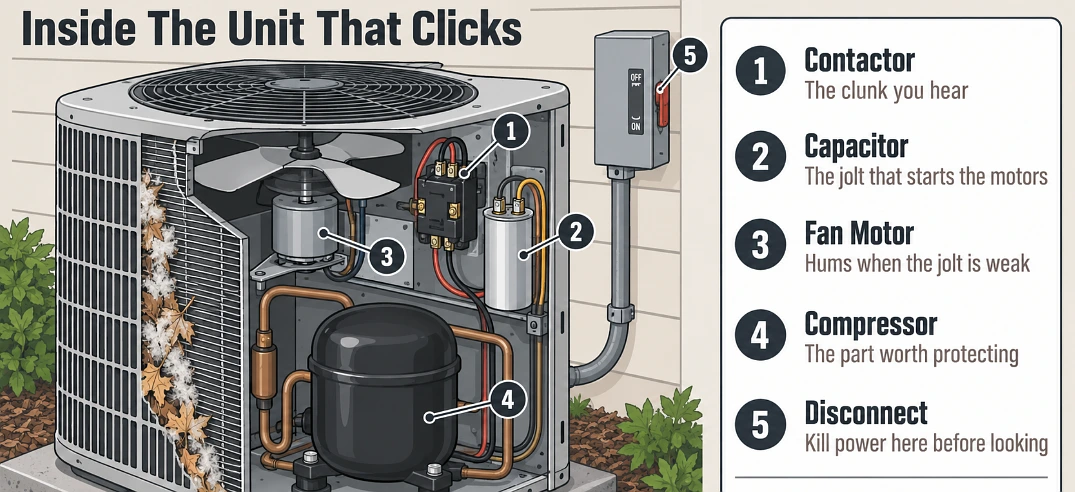
No, and this is the part that saves people a service call. The click is the contactor, a heavy relay inside the outdoor unit, pulling in to send power to the compressor and the fan, and it clicks every single time the system starts and every time it stops. Think of it as a light switch that a magnet flips instead of your finger. When the thermostat asks for cooling, 24 volts go out to the condenser, the magnet pulls the switch closed, clunk, and 240 volts hit the motors. That clunk is the sound. It is loud because the switch is big, and it has been happening 20 or 30 times a day since May.
So a single click at start, a single click at stop, and a soft one now and then when the system changes what it is doing, none of that is a symptom. What you listen for is what comes after the click.
Most People Think It Is the Thermostat. Is It?
Almost never, and the way to know is where the sound is. A thermostat click is a tiny relay inside the box on your wall, a soft tick you only hear standing next to it. The click people are worried about is outside, at the condenser, and it is a clunk you can hear through a closed window. If the sound is on the wall, it is the thermostat doing its job. If it is outside, the thermostat is the last thing on the list, and the only thermostat problem that shows up as outdoor clicking is a bad setting or a loose wire making the system start and stop too often, which is its own question further down.
What Does Reddit Say It Is Most of the Time?
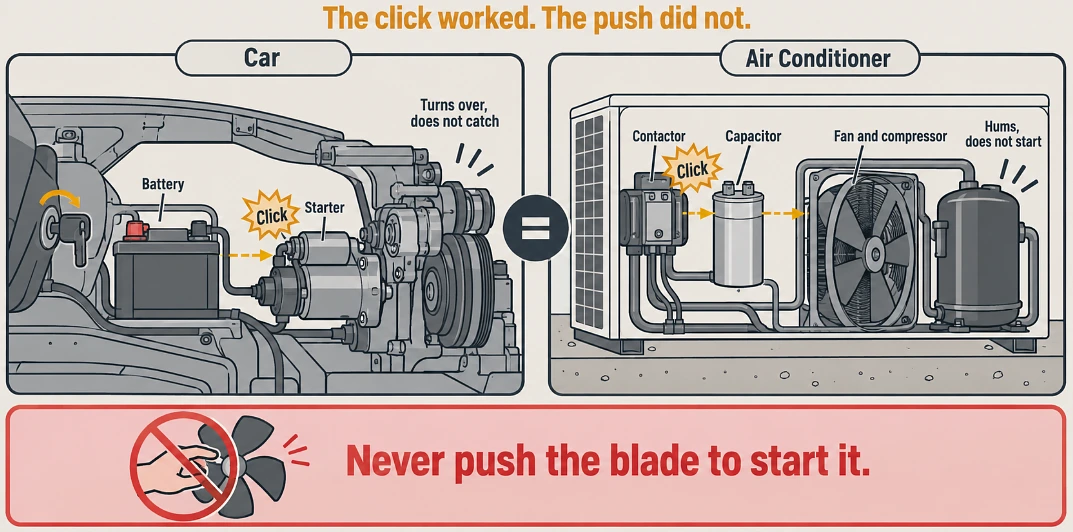
Go through any HVAC thread where someone posts “clicks but won’t start” and the first 5 replies are the same word. Capacitor. The pattern is click, then a hum for a few seconds, then nothing, then a minute later it tries again, and every tech on the thread is saying the same thing, the contactor did its job and the motor could not get moving.
The layman version is a car with a weak battery. You turn the key, you hear the starter click, the engine gives you a half hearted grunt, and nothing catches. The click was fine. The battery could not deliver the push. In an AC the capacitor is that push, it stores a jolt of energy and hands it to the compressor and the fan motor at the moment they need to start turning, and when it weakens with age they hum and strain and never get going. It is a $20 to $60 part, it is the most common failure on a residential AC, it is 20 minutes for a tech, and it is the first thing they check for exactly that reason.
The forum tell that everyone mentions: if the outdoor fan is sitting still and humming, and it starts spinning when someone gives the blade a push with a stick, that is a capacitor. Do not do that. A fan blade at full speed does not care what a stick is, and the capacitor next to it holds a charge after the power is off. Knowing the trick is useful only because it tells you why the tech is going to open that panel first.
What If It Clicks Over and Over?
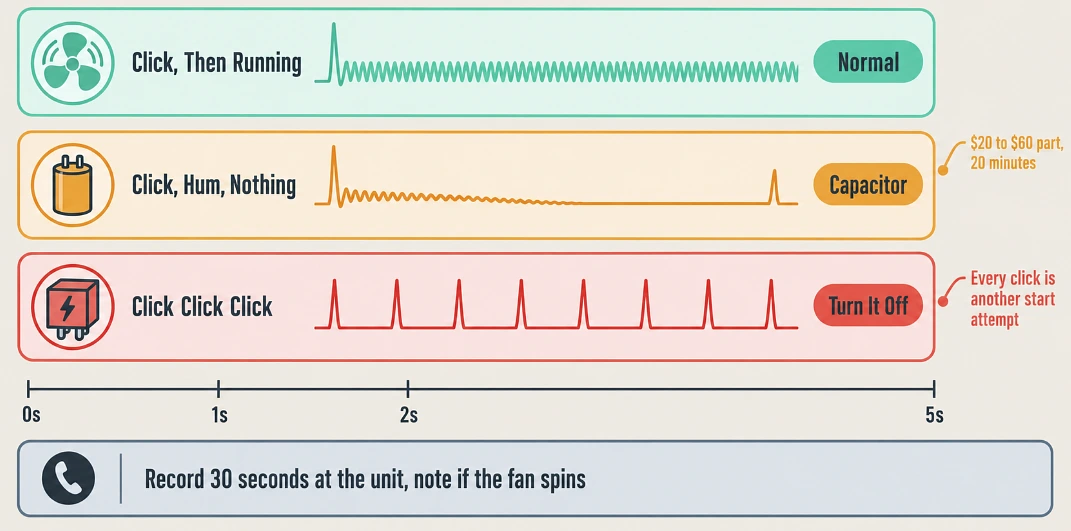
This is the one to take seriously. Click click click, quick, like a relay stuttering, or a click every few seconds while nothing cools, is the contactor chattering, and it means the 24 volt signal telling it to close is weak or flickering. Causes run from a control board or thermostat wiring problem to low voltage at the panel, and a tech has to trace it. What you can do today is shut the system off at the thermostat and leave it off, because every one of those clicks is another start attempt hitting a compressor that never got going, and a compressor being kicked every few seconds is heating up. The uncomfortable afternoon is cheaper than the compressor.
The same goes for clicking paired with the system starting and stopping every few minutes, which is short cycling. Occasionally that is only a thermostat set badly or sitting in a sunny spot. More often it is the unit failing to start, tripping on its own protection, and trying again, and that loop is the one that turns a capacitor job into a compressor job if it runs for a weekend.
What Can I Safely Do Myself Today?
Four things, and none of them involve opening the unit while it has power.
- Record the click on your phone, 30 seconds, standing at the condenser, and note whether the fan spins after it. Send that to whoever is coming. It tells a tech more than a description ever does, and it is the difference between them bringing the right part and making 2 trips.
- Check the breaker and the disconnect box on the wall next to the unit. Flip the breaker fully off and on again. A breaker that has half tripped will let the contactor click and starve the motors.
- Kill the power at the disconnect, then look for what is in the fan. Sticks, leaves, and in this valley the cottonwood fluff that packs into the fins every June.
- If the click comes with a hum and no start, or comes over and over, turn the system off at the thermostat and leave it off until someone looks at it.
And 1 thing not to do, which the forums still hand out: hitting the compressor with a hammer to free it. That advice is 40 years old, it was bad then, and on a modern scroll compressor it is a new unit.
When Does a Click Mean the Unit Is Done?
When the capacitor is new and the click, hum, nothing loop is still happening. At that point the motor itself is what cannot start, and if it is the fan motor that is a few hundred dollars and an afternoon, and if it is the compressor the conversation changes. A compressor that hums, pulls high amps and never turns has a locked rotor, and on a unit past 12 to 15 years the repair quote is usually within shouting distance of a replacement. A tech can tell you which of those you have in the first 10 minutes with a meter, and there is no honest way to tell from the sound alone, which is why the recording matters more than any guess.
| What you hear at the condenser | What it usually is | What to do today |
| 1 click, fan spins, cold air | Normal, the contactor closing | Nothing |
| Click, hum, nothing, tries again later | Capacitor, the most common failure there is | Turn it off, record it, call |
| Click, fan does not spin, compressor runs | Fan side of the capacitor or the fan motor | Turn it off so the compressor does not overheat |
| Rapid click click click | Contactor chatter, low voltage or control wiring | Turn it off, leave it off |
| Click with a rattle or a scrape | Something in the fan | Power off at the disconnect, look, clear what is outside the grille |
| Click, starts, stops within minutes, repeats | Short cycling, thermostat or a failing start | Check the thermostat first, then call |
The click is going to be there next May as well, on the first warm day, and if the unit hums and catches and blows cold, you have heard the whole story. It is the 2 seconds after that you are listening to.
 Decor & Improvement Accessories