

Home & Decor Blogs: DIY, Interior Design & Lifestyle Ideas
The Black Streaks On Your Roof Are Alive, And The Roof Came With Their Food


If you stand across the street from a 10 year old house with asphalt shingles and look up at the roof, you will see them. Somewhere on it, usually the side that gets the least sun, there will be dark streaks running downhill from near the ridge toward the gutter, wider at the bottom than the top because the rain carries them down. Most people read them as dirt, or soot from a chimney, or the roof getting old. They are none of those things. They are a colony of something living, and it has been living there for years, and it is eating the roof.
We went looking for what it is and how it gets removed, and part of what we found is something the shingle makers do not talk about much.
What Is Growing On The Shingles
The organism is called Gloeocapsa magma, and it is a cyanobacterium, which is the family of things that used to be called blue green algae before anyone knew they were bacteria. It travels on the wind as spores, it lands on roofs across most of the country, and it does 1 thing a moss or a lichen does not. It builds itself a dark outer sheath to shield its cells from ultraviolet light, and that sheath is black, and it is what you are seeing from the street.
It is not sitting on the roof the way a stain does. It is a colony spreading down the roof, with water and gravity pulling it toward the gutter, which is why the streak is always wider at the bottom. Moss and lichen come later, on top of it, once the colony has held moisture against the shingle long enough for them to get a foothold.
Why Shingle Makers Put Limestone In The Roof
An asphalt shingle is a fiberglass mat soaked in asphalt with a filler mixed in for weight and stiffness, and the filler is crushed limestone, because limestone is cheap and heavy and there is a lot of it. Gloeocapsa magma eats limestone. Not the asphalt, not the granules, the calcium carbonate filler that makes up a good share of the shingle by weight.
So the roof arrived with the tenant’s food already in it. The same manufacturers now sell algae resistant shingles with copper coated granules mixed into the surface, which the organism cannot tolerate, and they sell them at a premium. And the same manufacturers void the warranty on the old shingles if you clean the tenant off them with the wrong tool. That is not a conspiracy, it is a material choice made 60 years ago for weight and cost, but keep it in mind the next time a roofer tells you the streaks are your problem and not the shingle’s.
Read Your Own Roof From The Street
Steve is from the pressure washing services in Olive Branch, and he shared this idea with us as well, so this is how he reads a roof from the street, and it takes less than a minute from the sidewalk.
- Start with the north facing slope, and the east if the house has one. That is where the morning damp sits longest and where the colony starts, and a roof with streaks on that side only is an early one.
- Look at how dark the streaks are. The sheath thickens as the colony ages, so a faint grey shadow is a colony a year or 2 old and a hard black stripe has been there for 5 or more.
- Look for green on top of the black. Moss and lichen only arrive once the streaks have been holding water for a few seasons, so green means the streaks have been there long enough for moss to settle on them.
- Look under the gutter line for a clean strip. Where a metal gutter or a run of copper flashing sits above a slope, the rain carries metal ions down and the shingles below it stay clean, and that clean stripe is what a zinc strip does across the whole roof.

Done that way, a roof tells you its own history before anyone climbs it, and it also tells you which side to have cleaned first.
What A Pressure Washer Does To A Shingle
This is the part that costs people a roof. A rented pressure washer puts out somewhere between 1,300 and 3,000 psi, and an asphalt shingle is a mat of granules glued into asphalt that has been baking in the sun for a decade. Point that wand at it and 3 things happen, and the colony is not one of them.
The granules come off in a stripe behind the wand, and the granules are the shingle’s only protection against sunlight, so a stripped patch ages years in a summer. Water gets driven up under the tabs and finds the nails. And the colony, which is 2 millimeters of bacteria in a sheath built to survive weather, is barely touched, because it was built to survive rain and this is rain with more force behind it.
The manufacturers know this, which is why the cleaning clause is in the warranty. GAF and CertainTeed both put it in plain terms: pressure washing the shingles ends the coverage, and cleaning by the method the Asphalt Roofing Manufacturers Association sets out is allowed and in some cases expected. A roof cleaned with a pressure washer is a roof with a shorter life and no warranty, and the streaks are still there.
Soft Washing Is A Chemistry Job
Soft washing is the ARMA method, and the pressure in it is the pressure of a garden hose, 50 to a few hundred psi at most. The work is being done by the solution, which kills the colony at the cell, and the water is only there to carry it on and rinse it off.
The Mix
- Sodium hypochlorite, which is the active part of household bleach, at a working strength of about 3 to 6 percent once diluted. Pool grade at 12 percent cut 1 to 3 with water lands in that range.
- A surfactant, a foaming agent that makes the solution cling to a 30 degree slope instead of running straight off it into the gutter.
- Applied with a pump sprayer on a cloudy day or in the evening, since sun dries it before it has done anything.
The Dwell And The Rinse
The mix needs 10 to 20 minutes on the roof to work, and that is the dwell. Then a rinse from the ridge down at hose pressure, because rinsing uphill pushes water under the tabs the same way the pressure washer did. The streaks go grey within the hour and disappear over the next few rains as the dead colony lets go of the shingle. Moss takes longer, 3 or 4 months, because it dies where it stands and has to weather off.
The plants under the gutters are the part a Saturday job forgets. Bleach running off a roof lands on the hydrangeas, so a crew that knows the work pre wets everything under the eaves, keeps a hose running on the beds through the dwell, and rinses the plants again after. If the hedge under the gutter is brown a week later, the plants were not wetted first.
The Argument About Bleach
The trade does not fully agree with itself here and it is fair to say so. Most of it uses sodium hypochlorite because it kills the colony reliably and cheaply and ARMA accepts it. A smaller group of roofers, especially in the humid states, argues that bleach corrodes metal flashing and gutters over repeated treatments and is hard on landscaping, and they use proprietary algaecides or zinc and copper sulfate solutions instead, which are gentler and slower. Both sides are talking about the same organism and neither is using pressure. If a company quotes you for a roof clean, which chemistry they use and what they do about the plants are the 2 questions that tell you whether they have thought about it.
Why It Comes Back In 4 Years
The spores are on the wind every day, so a cleaned roof still has the same limestone in it, and the colony starts again. A soft wash holds for about 3 to 5 years on a shaded slope and longer on a sunny one. The thing that changes that number is metal.
A strip of zinc or copper along the ridge, screwed under the cap shingles so a few inches show, sheds ions every time it rains and those ions wash down the slope and poison the colony before it can establish. It is the clean stripe under the flashing, done on purpose, across the whole roof. It holds for 5 to 10 years and it works best on a roof that was cleaned this month or laid this year. The other route is to wait for the reroof and choose the algae resistant shingle with the copper granules built in, which puts the copper in at the factory instead of on the ridge.
Over the life of a roof the arithmetic looks like this:
| Route | Treatments over 25 years | What it costs you in trips up a ladder |
| Do nothing | 0 | A darker, hotter, shorter lived roof and green on top by year 10 |
| Soft wash when it shows | 5 or 6 | A crew every 4 years |
| Soft wash once, then zinc strips | 2 or 3 | A crew, a strip, and 1 more visit around year 12 |
| Algae resistant shingles at the reroof | 0 or 1 | A higher shingle bill once |
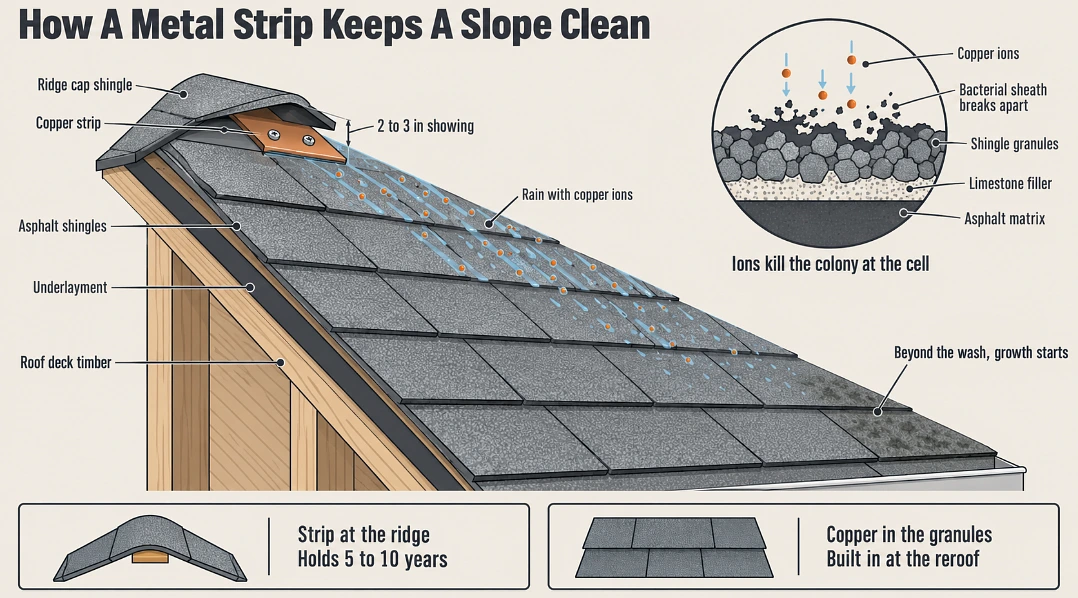
Which route is right depends on how old the roof is now. A roof at year 3 gets strips and is left alone. A roof at year 18 with black on both slopes gets 1 soft wash to get it to the reroof and the copper granules at the reroof, and money put into strips at year 18 is money spent on shingles that are 6 years from being replaced.
 Decor & Improvement Accessories