

Home & Decor Blogs: DIY, Interior Design & Lifestyle Ideas
HVAC Warranty Registration Deadlines by Brand — Trane, Carrier, Lennox, Rheem + Reasons Explained


Most articles on this subject warn you about what is coming. Skip a filter, let someone unqualified near the refrigerant lines, and one day the coverage disappears.
For most homeowners it has already happened, years ago, in a week when the system was brand new and running perfectly and you had done nothing wrong at all.
HVAC Warranty Claims Get Denied for These 5 Reasons
Here is the short version of everything that quietly takes your coverage away, so you know what you are looking at before the detail:
- You never registered it. The ten years you were sold has been five years since the day it went in, and nothing told you.
- Your installer got something wrong. Wrong charge, wrong size, bad ductwork, mismatched units. The manufacturer will not pay for somebody else’s mistake.
- You cannot prove the maintenance happened. Saying a technician came out every spring is worth nothing without dated invoices.
- Somebody opened the sealed system who should not have. Filters are yours. Refrigerant lines are not.
- You bought the house and the warranty stayed behind. Coverage follows the original owner, not the building.
Somewhere between fifteen and twenty-five percent of denied HVAC claims trace back to the first one on that list.
You Have Sixty Days To Register It. Some Brands Give You Ninety.
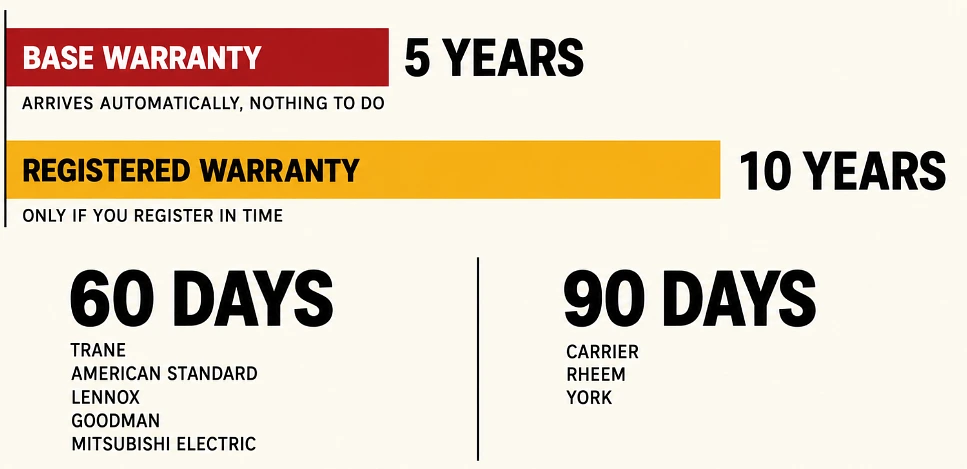
Every major manufacturer sells two warranties and you only ever hear about one of them.
There is a base warranty, which arrives automatically, and it is usually five years on parts. Then there is a registered warranty, usually ten years on parts, and you get it only if the equipment is registered inside a set window after installation.
The windows, brand by brand:
- 60 days: Trane, American Standard, Lennox, Goodman, Mitsubishi Electric
- 90 days: Carrier, Rheem, York
Miss it and the coverage drops back to the base term. No letter arrives. No flag appears anywhere. It was an offer with an expiry date and the date went past while you were getting used to a new thermostat.
One thing worth knowing about that clock. It runs from the installation date rather than the manufacture date, which is usually in your favor since equipment often sits in a warehouse for months. The catch is that you have to be able to prove the install date, and without paperwork the manufacturer will fall back on manufacture date plus a grace period. Keep the installer’s invoice.
Alex Determan of Apex heating and cooling specialists raises something homeowners rarely think to ask about:
“Ask whoever installed it whether they registered it, and ask them to send you the confirmation. Plenty of shops handle it in the office the same week as part of the paperwork. Plenty of others leave it to the technician to do from the truck, and that is where it quietly gets forgotten. Either way it is your ten years and not theirs, so it is worth the phone call.”
That difference between an office doing it and a technician remembering to do it from a van is why two shops doing identical quality work end up with completely different registration rates.
If your system went in within the last couple of months, check today. Most manufacturers let you look it up by entering the serial number from the data plate. If nothing comes back, you have your answer, and there may still be time.
What Missing That Window Costs You
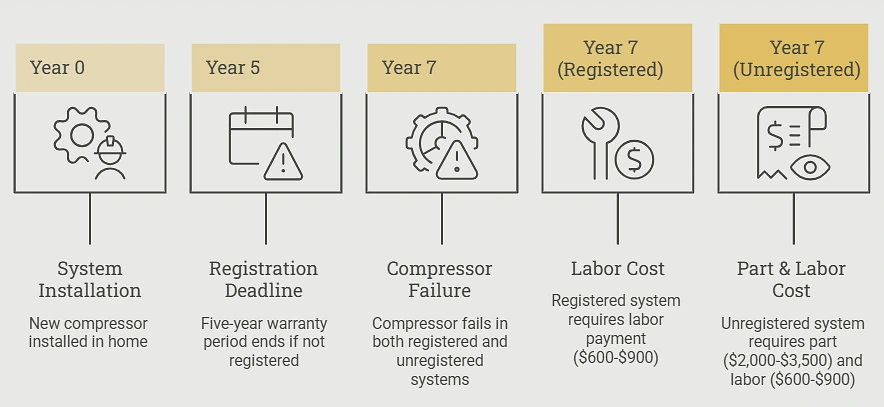
Percentages do not land the way money does, so take a compressor failing in year seven. Nothing unusual about that, it is simply how equipment ages.
If the system was registered, the part is covered. You pay the labor, somewhere around $600 to $900, and you are annoyed for an afternoon.
If it was not registered, the five-year term ran out two years ago. The compressor is $2,000 to $3,500 and the labor is still $600 to $900.
Same failure. Same house. Roughly two thousand dollars apart, decided by a form that takes five minutes and costs nothing.
The Warranty Pays For Parts. You Pay For The Labor.
This is the one that surprises people while they are standing in a hallway with a technician who has just finished diagnosing something.
Manufacturer warranties cover parts. That is the entire scope. Diagnosing the fault, pulling the failed component out, fitting the new one, recharging refrigerant, getting a van to your house, none of that has ever been included.
Labor coverage lives somewhere else, in your installer’s workmanship warranty, and those usually run one to two years. Once that closes, the hours are yours.
So a ten-year parts warranty in year eight means the control board turns up free and the four hours to fit it do not.
What you can still be billed for on a claim that is fully approved:
- The diagnostic fee
- Technician labor to remove and replace
- Refrigerant, which is its own line and is not cheap
- Trip or service call charges
Extended labor plans are sold at installation, which is genuinely the right moment to think about one, because buying labor coverage in year three is either impossible or expensive.
Why Claims Actually Get Refused
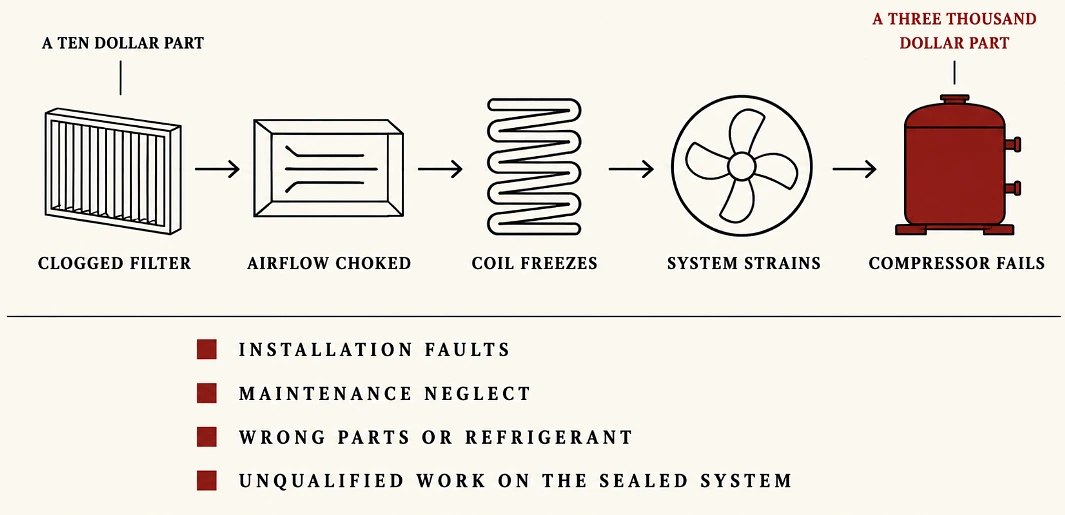
All the usual warranty advice comes down to one principle, so it belongs in one place. Manufacturers cover defects in their own equipment. They do not cover what happened to that equipment afterwards.
Installation faults are the biggest category after registration, and they are the most unfair, because they are entirely outside your control. Wrong refrigerant charge, a system sized wrong for the house, poor ductwork, bad drainage, an outdoor unit paired with an indoor coil that was never rated to run with it. A manufacturer will decline that claim, and you are then in a conversation with your installer rather than with the manufacturer.
Maintenance neglect means the failure came from dirt rather than from a defect. A clogged filter chokes the airflow, the system strains against it, the evaporator coil freezes over, and the compressor pays for all of it eventually. That chain starts with a ten dollar filter and finishes with a three thousand dollar part, and a manufacturer’s inspection reads that chain easily.
Wrong parts and wrong refrigerant, including recycled or contaminated refrigerant, and thermostats or controls the manufacturer never certified with that equipment.
Unqualified work on the sealed system. Changing your filter is expected of you. Opening refrigerant lines, rewiring connections, swapping a control board without credentials, all of that moves the fault onto you.
Underneath every one of these sits the same practical problem. You are the one who has to prove it. A verbal account of annual servicing is worth nothing at all. Dated invoices naming the work carried out are worth everything, and the time to start keeping them is long before you need them.
If You Buy Or Sell The House
Warranties belong to the person who bought the equipment rather than to the building, which catches out two groups of people who are not thinking about HVAC at the time.
Most manufacturers allow one transfer to a new owner. It usually needs an application and a fee, commonly $25 to $100, filed within 60 to 90 days of closing. Trane and American Standard charge $99.
Some do not allow it at any price. Lennox Elite and Merit series warranties are not transferable, while their Signature tier is, so two houses on the same street running Lennox equipment can be in completely different positions.
And this part cannot be fixed later. If the original owner never registered the system, you cannot register it after buying the house. The base term just keeps counting down from the installation date regardless of who is living there.
Buying? Ask for the HVAC paperwork during due diligence, the way you would ask about the roof. Model and serial numbers, the installation invoice, the registration confirmation. Then file the transfer promptly after closing.
Selling? A registered, transferable warranty is a fair thing to put in front of a buyer. Leave the folder in the kitchen drawer.
Keep These Papers Somewhere You Will Find Them
All of this comes down to one dull habit, which is having the paperwork in five years when you have forgotten every word of this article.
- Installation invoice, with the date clearly on it
- Model and serial numbers for both the indoor and outdoor units
- Registration confirmation from the manufacturer
- Every maintenance invoice, dated, saying what was actually done
- Repair paperwork, including which parts went in
- The workmanship warranty terms from your installer
Read the warranty document once while everything is working. It is dull. It is considerably less dull than reading it for the first time on the morning the compressor dies, looking for the paragraph that decides whether this is your bill or theirs.
The people who get paid out are not luckier than anyone else. They filled in a registration form during a week when there was no reason on earth to be thinking about it.
 Decor & Improvement Accessories