

Home & Decor Blogs: DIY, Interior Design & Lifestyle Ideas
uPVC vs Aluminium Windows: Forget the Brochure, Here’s What a Monsoon Actually Does to Each

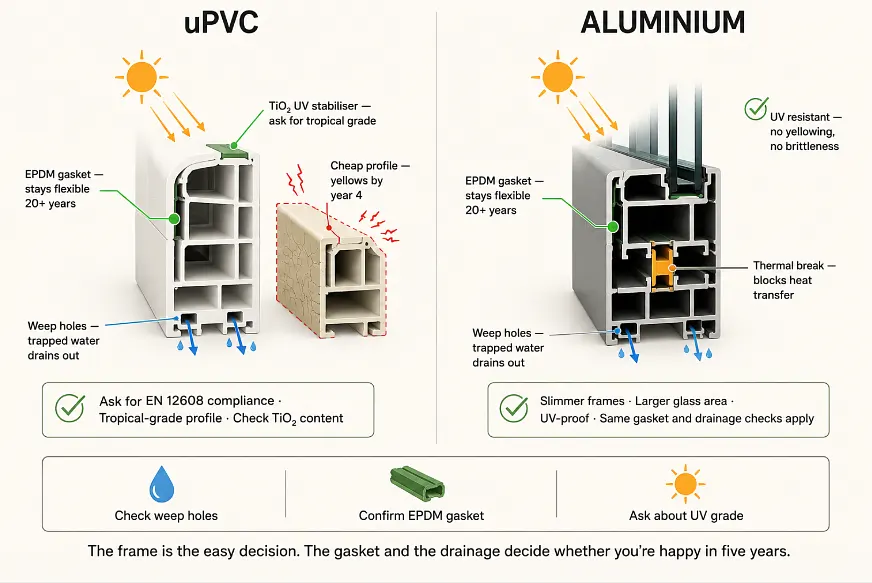
Don’t waste three weeks going around the showrooms. Nearly every comparison you read compares uPVC with aluminium on the wrong things — the price, the “look,” the slim frame. None of that is what fails you. What fails you is one wet July, and the two materials break in very different ways. One tends to yellow and go brittle in the sun. The other leaks in wet weather, and for a reason that has nothing to do with the metal and everything to do with a part most buyers don’t bother to look at.
When it comes to uPVC windows vs aluminum windows, the brochure won’t be of much help, because it’s the actual monsoon that decides the fate of each.
OK, here’s the real version, the one you can actually use when you’re sitting across from a salesperson.
The Sun Is uPVC’s Enemy. The Rain Is the Installer’s.
It’s all in one line, and it’s worth a pause, because it puts the whole decision in a different light.
Water isn’t actually uPVC’s greatest drawback. It’s moisture resistant, it doesn’t rust or rot. The issue with it is UV light. In the very strong, direct sun many homes face, cheap-grade uPVC can yellow and become brittle over the years as UV breaks down the polymer. Whether or not it happens comes down to one ingredient you can’t see.
UV has no effect on aluminium. It won’t yellow, won’t go brittle in the sun, which is a strong point in its favour for a sun-baked elevation. The part people don’t tell you about is when water comes in during a downpour — that’s rarely the aluminium. It’s the gasket and the drainage. Correct those and an aluminium window won’t get wet in the direst monsoon you can throw at it.
Two different problems. Two checks to make. Let’s take them one at a time.
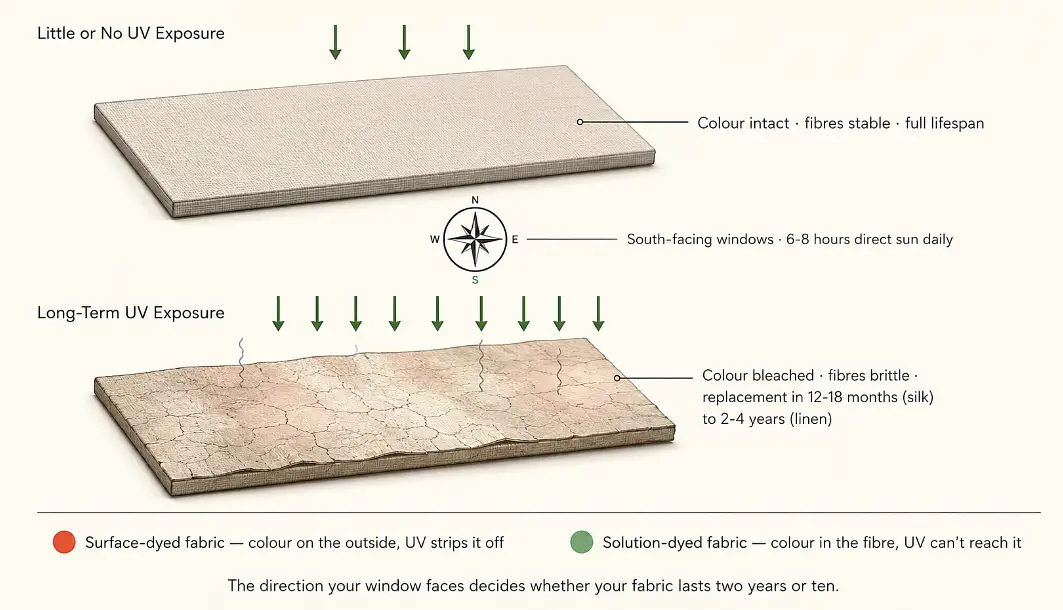
How to Tell If a uPVC Frame Will Survive the Sun
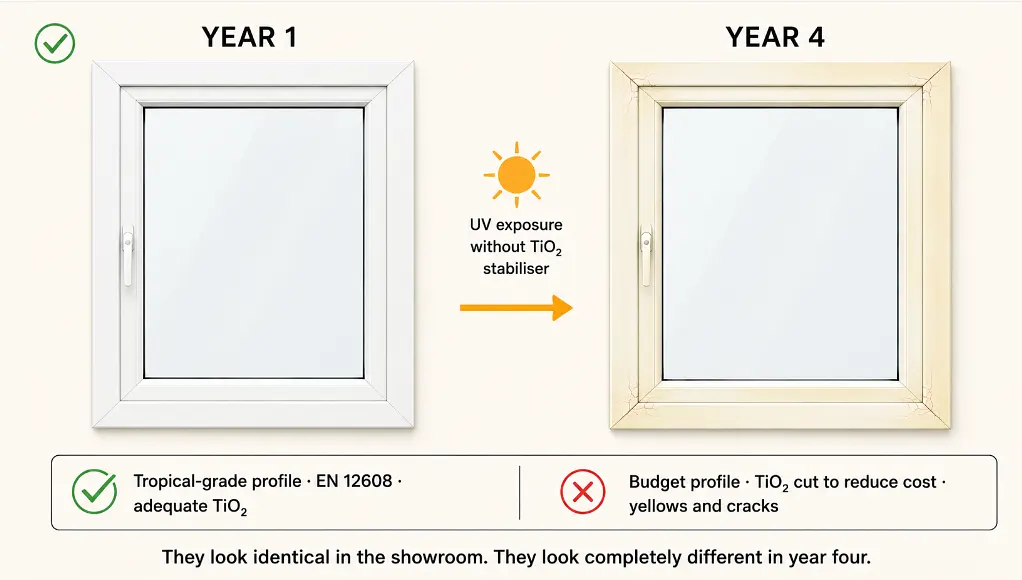
Titanium dioxide, TiO2, is the component in the profile that keeps uPVC from yellowing. It’s the UV blocker. Good profiles have enough of it. Cheap ones quietly cut it, and you can’t tell the difference from a totally new white frame in a showroom. They look similar on day one. They look completely different in year four.
So as not to be blind, you ask for the standard:
- Inquire about the profile’s compliance with EN 12608 (or an equivalent international standard). It’s the spec used to gauge uPVC profile quality, and if someone’s selling the real deal, they’ll know the answer off the top of their head. A vague answer is your answer.
- Request “tropical grade” or a UV-stabilised profile. These are designed with increased TiO2 for the sun. It’s a true product category, not a sales line.
- Watch out for a price that seems extremely cheap. The lowest-priced uPVC quote on the table has most likely saved its money in the TiO2 — the one thing you’ll regret in a few years.
In the sun, uPVC will be fine if the supplier can quote the standard and provide a tropical-grade profile. If not, stroll.
How to Tell If Any Window Will Survive the Rain
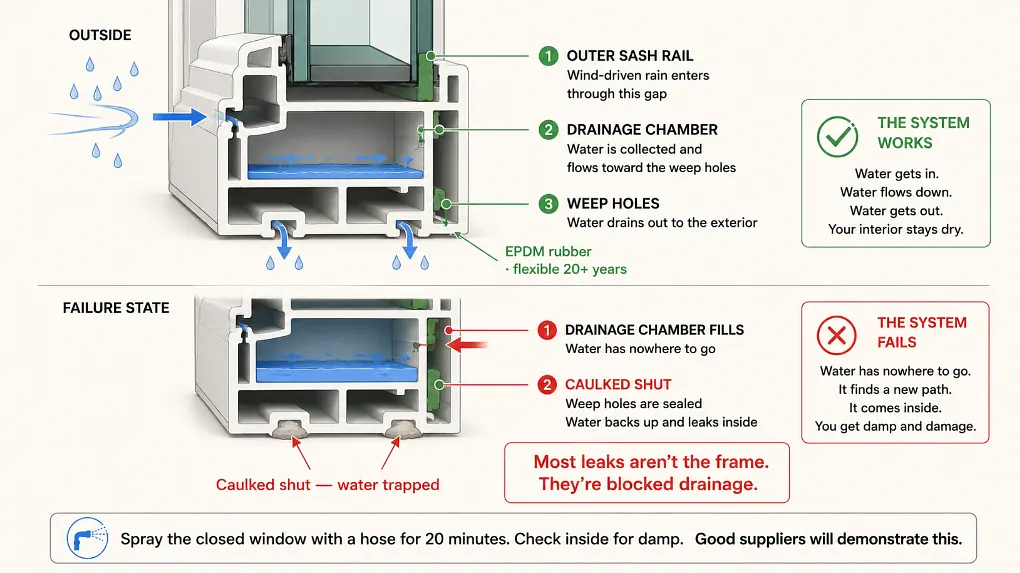
This is the part that matters most, and it applies to both materials, since a poorly-installed uPVC window leaks just as easily as a poorly-installed aluminium one. A window doesn’t keep water out by being completely tight. It keeps water out by letting the little bit that gets in drain back out. That’s the thing people don’t know.
Ideally, a good aluminum windows and doors have a drainage system in the frame — a small chamber that catches water that’s leaked past the outer seal, and weep holes, small slots at the bottom that let it drain back out. Built correctly, wind-driven monsoon rain gets trapped and sent back out. If they’re not there, or they get clogged, or someone caulks over them trying to “fix” a leak, that water has to go somewhere, and it’s going down your wall.
And the one thing you can physically do that’s the most helpful:
- Check for the weep holes. Small slots at the bottom of the outer frame. Add a little water to the bottom track; it should run out of them within seconds. No holes, or water that pools, is a red flag.
- Ask what the gasket is made of, and listen for “EPDM.” This is the rubber seal that encircles the sash. EPDM stays flexible for 20 years or more. The lower-cost PVC rubber many windows use hardens and shrinks within two or three years, and a hard gasket is a gasket that lets water and air through. This one change is the difference between a window that seals for decades and one that fails before your loan is paid off.
- Run the hose test before monsoon. Spray the closed window from various directions for fifteen, twenty minutes and check inside for any damp. Good suppliers will be happy to show you the drainage. The ones who get cagey are telling you something.
Notice that none of these three checks relates to whether the frame is plastic or metal. It’s not the material — it’s the water performance of the gasket and the drainage. A salesperson who’s only concerned with the frame is skipping the part that actually decides whether your sill stays dry.
So Which One Should You Actually Pick
Once you get past the sales pitch, it shakes out like this.
Where the concern is a hot west- or south-facing elevation getting direct sun all day, aluminium has the easier life with UV, and a thermally-broken aluminium system handles the heat without the frame degrading. It also comes with larger glass and leaner frames, if that’s the look you’re after.
Where the concern is heat coming through the window into the room, uPVC has some inherent insulating properties, though good thermal-break aluminium blocks most of that gap. And tropical-grade uPVC — the kind with the proper TiO2 — holds up against the sun just as well, so if you’re buying the certified profile, don’t be scared off it on UV alone.
But on the one question everyone really wants answered — which one survives the monsoon — the straight answer is that either one survives, or neither does, depending entirely on the gasket and the drainage. That’s not a fence-sit. It’s the actual finding. The smartest thing you can do isn’t to pick a material and relax, it’s to pick whichever material suits your climate and your look, and then refuse to sign until you’ve checked the EPDM gasket and the weep holes.
For your sun, get the material right. For your rain, get the drainage right. The frame is the easy decision. It’s the unseen parts that decide whether you’re happy in five years.
 Decor & Improvement Accessories