

Home & Decor Blogs: DIY, Interior Design & Lifestyle Ideas
Choosing a Modern TV Stand With Storage That Actually Fits Your Equipment
Modern concept depends on culture, each culture may have a different idea of it, but consider it on a global scale for a second. Every family and every household has its own idea of what a TV lounge is even supposed to look like, and none of them are wrong exactly, they just come from a completely different starting point.
A stand built for a minimalist flat in Copenhagen is not built for a joint family living room where three generations argue over the remote every evening, and that is the whole reason a piece of furniture this ordinary is actually harder to get right than people expect going in.
Architectural Digest’s own producer on Open Door, Lisa Romagnoli, was asked once what an average person could actually copy from these celebrity home tours. Her answer was not a rug, not a lighting trick. A Frame TV, she said, or a hidden projector. Two ways of making a television disappear from a room that is supposedly being shown to you exactly as it really is. Interior designers say something close to the same thing from their own side of the industry, that a television sitting there in plain sight is one of their more consistent pet peeves, a black rectangle that nothing else in a curated room ever quite agrees with.
Most homes are not hiding a television behind a motorized painting though. Most homes just need one piece of furniture to actually do its job.
Have You Ever Opened the Cabinet and Not Been Able to Explain the Cables Inside It?

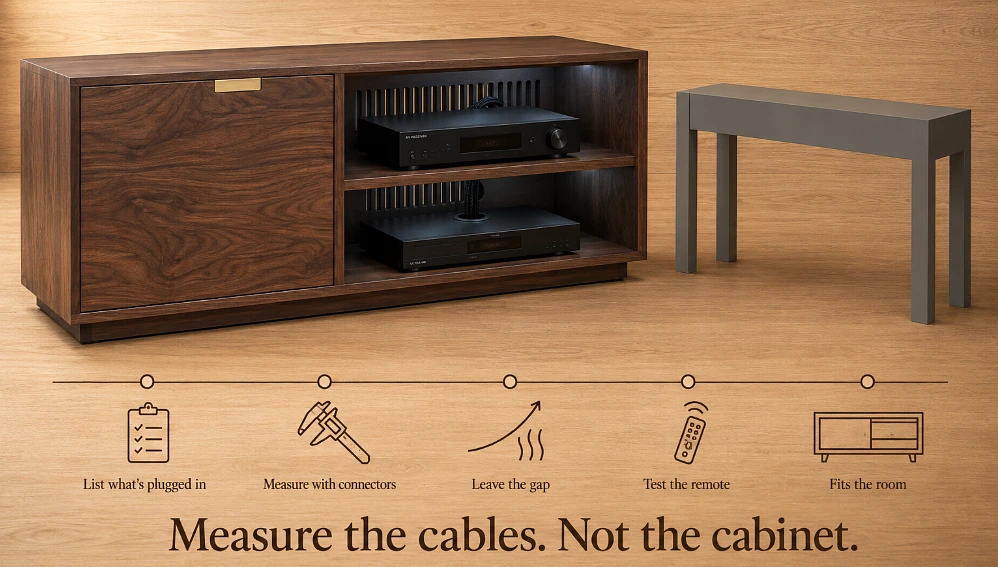
If the back of your current setup looks like something only a technician should be trusted to touch, storage planning has to start with what is actually plugged in, not the finish on the doors.
List it out first. The television. The receiver. The games console. Any streaming box. The router, if it lives down there too. Sound equipment. Then the smaller things people always forget until they are searching for them, controllers, headphones, the manuals nobody reads and nobody throws away either.
- Daily items get the nearest opening
- Rare items can sit further back
- Measure with the plugs and connectors already attached, never the bare device on its own, because a receiver’s listed depth on the box almost never accounts for what actually sticks out the back once it is wired in

A well chosen modern TV stand with storage should genuinely disappear into the room the way the best ones on television always seem to. Minus the hidden projector budget, obviously.
The Heat Question – Ask Before Until Something Starts Smelling Warm

A receiver left running for hours generates real heat. So does an amplifier. So, eventually, does a games console someone forgot to turn off.
A solid door with no thought given to airflow just traps all of that inside. Leave the ventilation gap the manufacturer actually specifies and resist the very real urge to fill that empty looking space with a spare controller or a stack of discs, because that gap is there so air can move through it properly.
Solid Doors Look Better and Do This One Thing Badly
Here is the part almost nobody thinks about until a remote stops working for no obvious reason. Solid cabinet doors hide the electronics beautifully, and they can block an infrared signal completely while they do it, so a remote that worked fine on the shop floor goes dead the moment the door swings shut at home.
Glass doors, slats, open shelving, a small IR repeater tucked inside, any of these can fix it depending on which devices are actually in there. Test it after everything is installed though. Before every cable gets tidied away and secured for good.
What Happens When the Console Outlives the Setup It Was Bought For?

A console that fits today’s equipment can still fail the room around it, because width and balance are really about the wall and the sofa, never about the screen size on its own.
Tape the outline of the screen and the stand together on the actual wall before buying anything. A piece that looks balanced in a showroom photo can crowd a corner or block a doorway once it is standing in your actual room, and that only shows up once it is already delivered.
View it from where you actually sit too, not from the doorway.
Most People Are Still Figuring This Out As They Buy It, and That Is Fine
If you genuinely do not know yet what you need, that puts you in the same position as most people buying one of these.
The shortest useful test: open every door and drawer during one completely ordinary week, the way the room actually gets used. Notice what still ends up sitting on top instead of tucked away where it belongs. A remote left out constantly is usually asking for a nearer drawer, not another organiser to lose it in.
Small adjustments like that are far easier in the first few weeks than after the household’s habits have already settled around whatever storage happened to be there first, right or wrong.

 Decor & Improvement Accessories