

Home & Decor Blogs: DIY, Interior Design & Lifestyle Ideas
Designing from the Ground Up: When to Tear Down an Aging Deck for a Modern Upgrade

The deck at the back of your house is 17 years old this spring, it has been stained more times than you can count, and you have not thought about it as a structure once in all that time, because a deck is something you stand on and not something you look at. That changes on the first warm Saturday in April when a board moves under a chair leg.
The Board That Felt Soft Under The Chair
You fetch a flathead screwdriver, because that is what everyone reaches for, and you push it into the post next to the soft board. It goes in. Not a scratch, a quarter inch and more with barely any resistance, and that is rot in the post, which is a different animal from rot in a board. A board you swap for $40. A post that takes a screwdriver has lost its capacity, and sanding and staining is doing nothing for it because the stain is on the outside and the problem is inside.
Under The Deck With A Flashlight
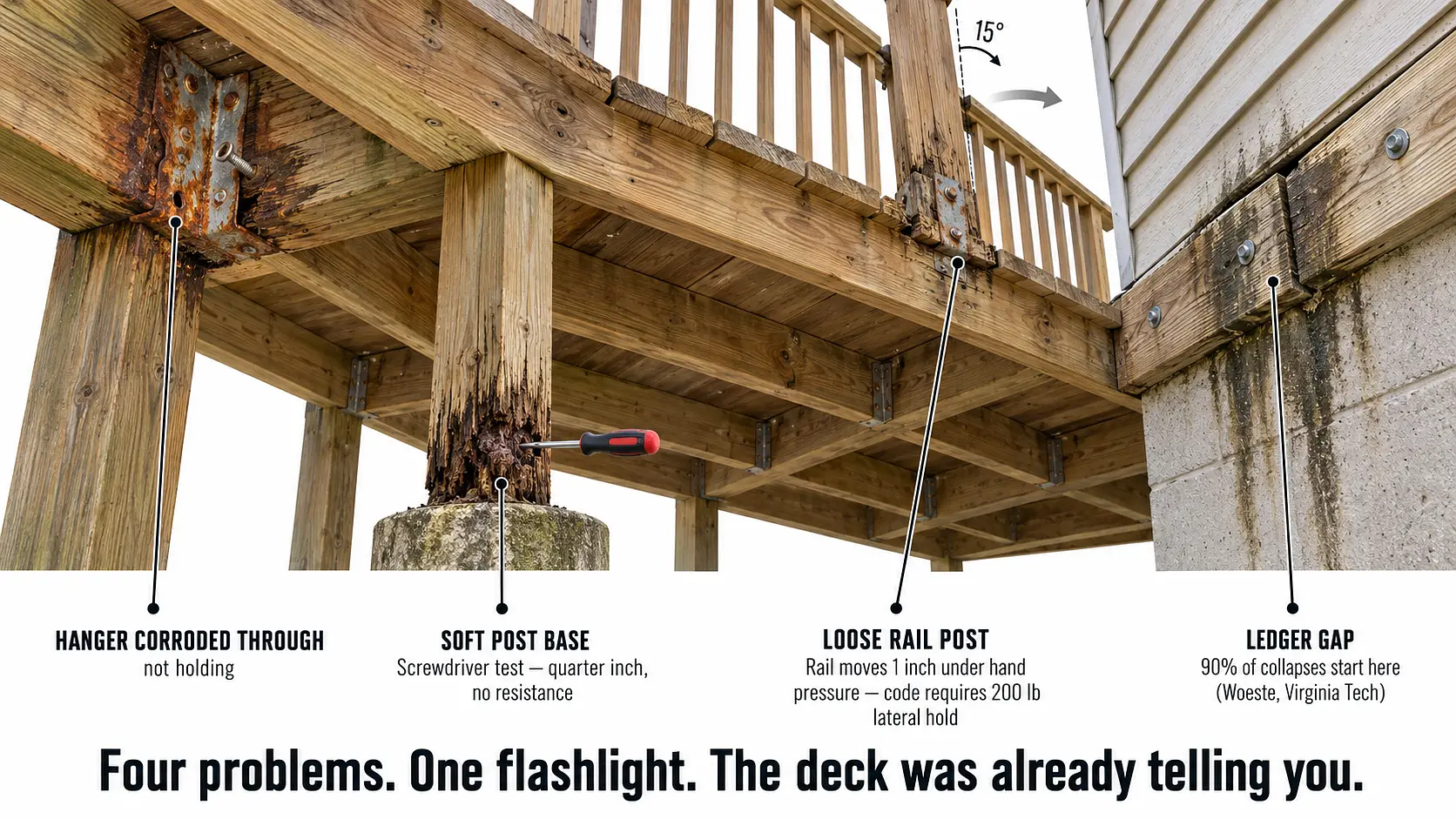
So now you are under the deck on your back, since you are there anyway, and in the order you can reach them this is what turns up:
- Joist hangers flaking away in your hand, and bolt holes that have opened up because the metal corroded and the wood around it kept swelling. Surface rust on its own is only decoration, this is hardware that stopped doing its job a while back.
- 3 or 4 bad hangers is a couple of hours and $20 to $40 in parts. Every connector under there looking the same is the frame being held up by rust.
- Rail post bases gone soft right at the bottom where the water sits and never dries. When you climb out and lean into the rail sideways, hard, the way someone stumbling with a drink at a barbecue would, it moves more than an inch. Code is asking that rail to hold about 200 pounds sideways.
- A gap between the ledger and the house wall you can slide a finger into, with water staining down the joint.
The Gap At The Ledger
The ledger is the long board bolted to the house that the whole deck is hanging off, and that evening you look it up, because a gap there feels worse than the rest, and it is. Frank Woeste at Virginia Tech has been studying deck collapses since 2002 and his number is that about 90% of them are the ledger letting go from the house, most of them nailed on instead of bolted, and his load tests are the reason the code now has a bolting schedule and flashing rules for that joint at all. The post could have been a repair. With the ledger gone the deck is coming down and going back up bolted and flashed, whatever else gets decided.
Adding Up What This Deck Has Cost
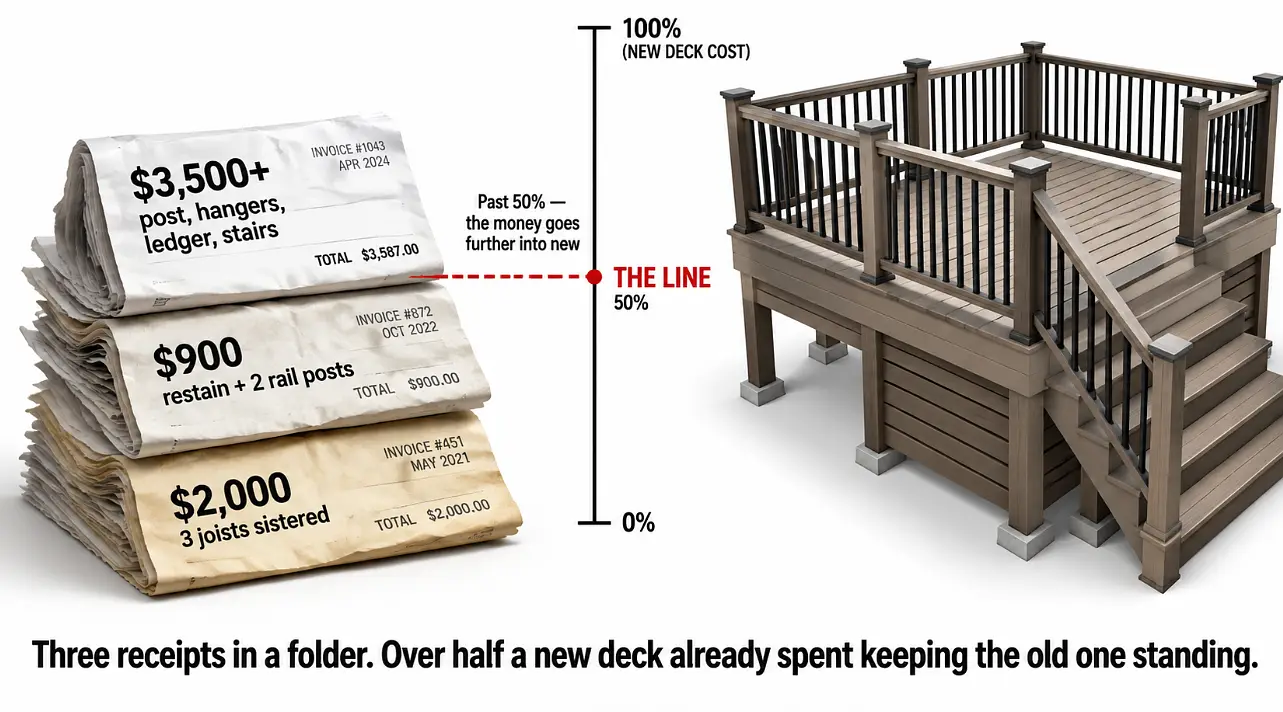
Kitchen table, a pen, the folder of receipts:
- 2 years ago, $2,000 sistering 3 joists.
- Last year, a restain and 2 railing posts, about $900.
- This year, the soft post, the hangers and the ledger, and the stairs are due whatever happens.
Surface work, boards, railings, a restain, is running $570 to $2,500 depending on how bad it is, structural work is starting around $500 a joist and passing $5,000 once several frame members are in, and the ledger is structural.
There is an old British sitcom joke about a road sweeper who has had the same broom for 20 years, 17 new heads and 14 new handles, and somewhere around the third receipt it occurs to you that this deck is that broom. New joists, new posts, new rail, new stairs, and still called the old deck.
The first time you add it up you forget the stairs and it comes to about a third of a new deck, which feels survivable. The second time, with the stairs and the ledger in, it is over half. And that is the line: once the repairs already paid for plus the ones you know are coming in the next 2 or 3 years reach roughly half the cost of replacing the whole thing, the money is going further into a new deck than into keeping this one standing. A full replacement with demolition and new composite is running $8,000 to $20,000 for most residential decks, and a pressure treated deck that has been looked after is reaching that line at 15 to 20 years, one that has not at closer to 10. Yours is 17.
The Teardown Quote
Demolition is priced by the square foot, $5 to $15 depending on the size and how the deck was built, so the quote is coming in around these numbers:
- A 300 square foot ground level deck is coming out and getting hauled away for $1,500 to $3,000.
- An elevated deck, or one on concrete piers, is going up to $4,500 because of the weight and the work of detaching everything properly.
- The permit is $100 to $500 and most municipalities want one.
You think about doing it yourself over a weekend, and for a small ground level platform that works fine. Yours is 4 feet up, it has wiring in it for the step lights, and it is lag bolted into the house framing, and pulling the wrong board in the wrong order on a deck like that is bringing a section down in a way you did not plan and taking a piece of the house wall with it where the ledger was. The crew that does deck demolition around York is quoting a flat rate with haul away and disposal inside it, which is the number you want, because a flat rate means no guessing at dumpster days or trips, and they are pulling that ledger off without tearing the siding or the rim joist behind it.
Wood Or Composite This Time, And Why It Depends On How Long You Are Staying
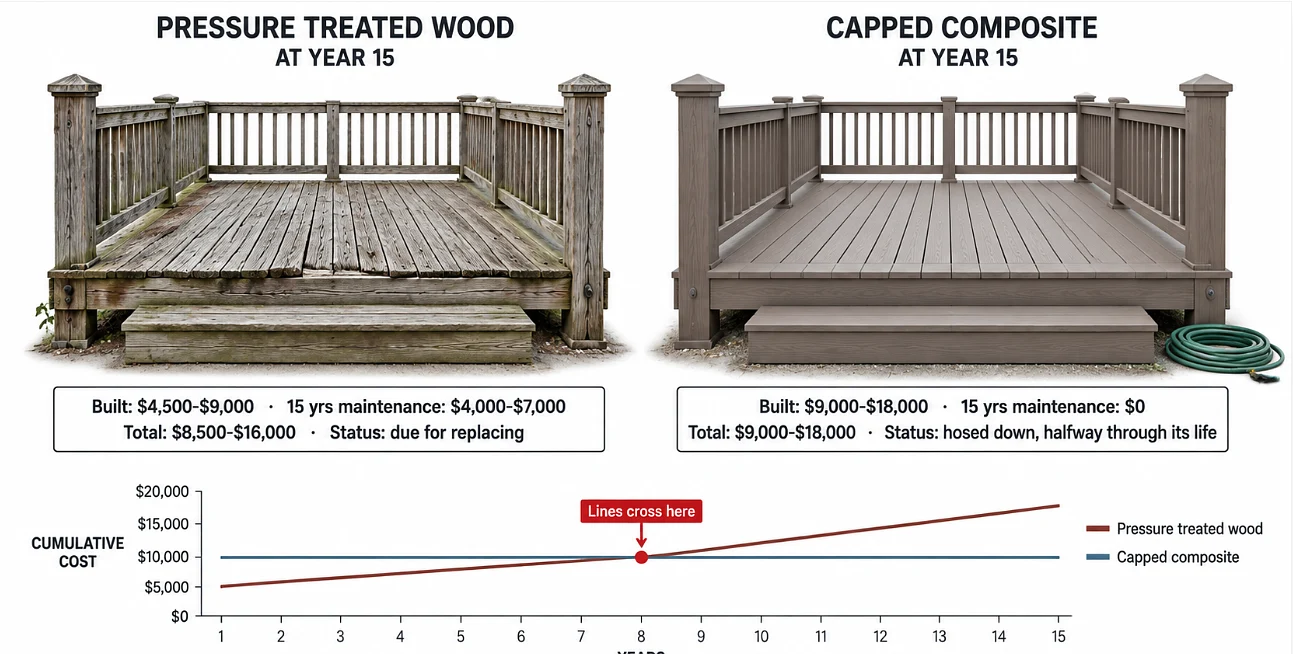
This is the argument at the table, and it deserves a proper hearing, because the sticker price is lying a little in both directions. Pressure treated lumber is the cheap way in, $2 to $5 a linear foot for boards and $4,500 to $9,000 for a finished 300 square foot deck with rails and framing, and on day 1 it looks great. The boards are starting to split and cup after 8 to 12 years whatever you do, and staining or sealing every 1 to 2 years is $300 to $1,000 a round depending on whose Saturday it is. Composite is $30 to $60 a square foot, so the same deck is $9,000 to $18,000, and it is not rotting or splintering and never getting stained, a hose and dish soap a few times a year is the whole plan.
The 15 Year Money
| Pressure treated wood | Capped composite | |
|---|---|---|
| Deck built, 300 sq ft with rails | $4,500 to $9,000 | $9,000 to $18,000 |
| Stain, sealer and the odd board, 15 years | $4,000 to $7,000 | $0 |
| Total at year 15 | $8,500 to $16,000 | $9,000 to $18,000 |
| Condition at year 15 | Split, cupped, due for replacing | Hosed down |
Look at the bottom 2 rows together. The totals are nearly touching, and 1 of the 2 decks is finished at year 15 while the other is halfway through its life. The lines are crossing around year 7 or 8, which is the point where wood has spent its head start, so it depends on how long you are staying and nothing else. Selling inside 5 years, go wood, someone else is inheriting the staining. Staying 10 years or more, composite is winning on total cost nearly every time, and I would not argue with anyone picking it for the house they plan to grow old in.
The Neighbor’s Faded Composite
Then someone at the table brings up the neighbor 3 doors down, whose composite went grey and streaky in 3 summers, and that is a fair objection with a real history. From 2004 a run of composite makers faced class actions over boards that faded and grew mold, and those were the uncapped boards from 10 or 15 years ago, and the capped boards with a polymer shell came after that, resisting UV and running noticeably cooler underfoot. A dark capped board in full afternoon sun is still warm, and the neighbor’s deck was the old product.
Shade And Lighting For The New Deck
Last August no one sat out there after noon, and the reason was not the deck, it was the sun. A deck in full afternoon sun from May through September is empty from lunch on, and railing styles and board colors, which is what the replacement guides spend their pages on, are not changing that. A pergola or a shade sail over part of the new one is, and a basic pergola over a section is $1,500 to $4,000, which feels optional in April and does not in August.
While the framing is being drawn, 2 more things go in that are hard to add later:
- A single step down of 6 to 8 inches splitting the deck into 2 levels, which separates the eating end from the lounging end without a wall or a divider, and is only $500 to $1,000 in extra frame.
- Lighting inside the frame, LED step lights in the risers and post cap lights on the rail, $300 to $800 in materials, wired while the frame is open, because retrofitting the same lights into a finished deck is 2 to 3 times the cost with an electrician working around finished surfaces.
The wiring is the thing you were under the old deck looking at in April, so this time it is going in properly. The new deck is full by the second weekend in June, which Woeste’s count says is the month decks fall, and this one is bolted to the house.

 Decor & Improvement Accessories