

Home & Decor Blogs: DIY, Interior Design & Lifestyle Ideas
How Do You Keep Your Home Comfortable During the Hottest Months of the Year?

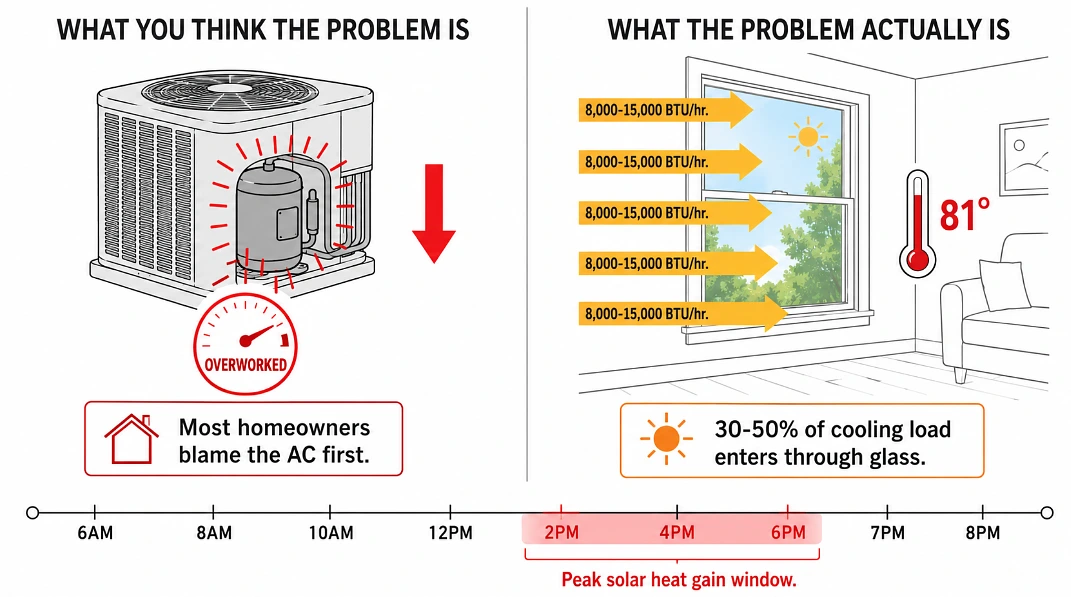
The AC is running. The thermostat is set at seventy-two. And the west-facing living room is still eighty-one degrees at four in the afternoon.
Most homeowners assume this means their air conditioner is undersized, aging, or broken. Sometimes it is. But before you spend money replacing equipment or upgrading capacity, there’s a question worth answering: how much heat is your house pulling in through its windows every afternoon, and is your AC actually the problem or is it just losing a fight it shouldn’t be forced to have?
This is the single most misunderstood cooling issue in residential homes, and it’s the reason so many summer comfort strategies fail. Everyone talks about blocking heat before it enters, in one line, and then moves on. The one line is right. What’s missing is the explanation of why it matters more than every other cooling tip combined.
Why Windows Are the Weakest Link in a Cooling System
An insulated wall slows heat down. Layers of drywall, insulation, sheathing, and siding force heat to transfer slowly through multiple materials before it reaches the interior. It works well enough that most homeowners never think about walls as a heat source.
A window doesn’t slow heat. It lets it walk right through.
Solar radiation passes through glass the same way visible light does, hits every surface inside the room, and immediately converts to heat that radiates back into the space. That heated interior air is what your thermostat reads. That’s what your AC compressor is trying to fight. And it can’t win, because the sun doesn’t stop shining just because you set the thermostat lower.
Solar heat gain through untreated windows accounts for 30 to 50 percent of a home’s total cooling load, according to residential HVAC calculation standards. Half of what your air conditioner is doing all summer is compensating for heat that’s entering through glass you’re not doing anything about.
On a sunny day, a single south-facing window can add 8,000 to 15,000 BTUs per hour of heat load to the room it’s in. That’s the equivalent of running a 14,000 BTU space heater in the living room while trying to cool the same room with the AC. The two systems are fighting each other. The sun wins every afternoon.
Which Windows Are Actually Causing the Problem
Not every window is the same. This is where most cooling advice gets vague and stops being useful.
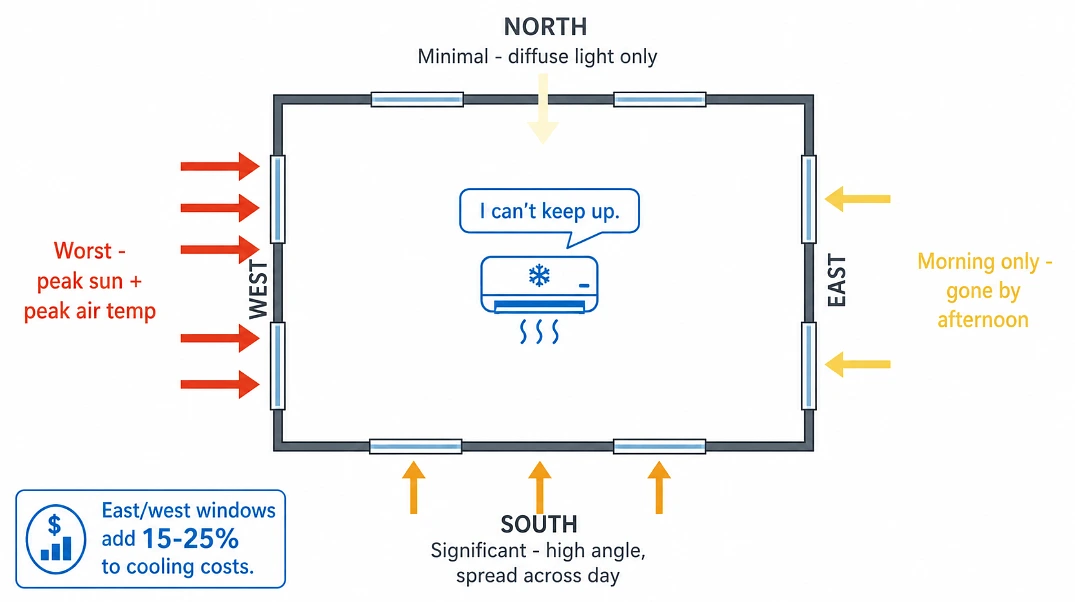
West-facing windows are the worst offenders in the northern hemisphere. They receive direct sunlight during mid to late afternoon, which is the same time outdoor air temperatures are peaking. Solar radiation is stacking on top of already-peak ambient heat. That combination is why west-facing rooms consistently drive the peak cooling load in a home, regardless of what climate zone you’re in.
East-facing windows are the next problem, but only in the morning. By late afternoon they’re contributing nothing to the cooling load, which is why east-facing rooms feel manageable by dinner even in hot weather.
South-facing windows get direct sun through most of the day but at a higher angle in summer, which means less intense heat gain per square foot than west-facing glass. They’re still a significant heat source, just distributed across a longer period rather than concentrated in the afternoon.
North-facing windows contribute the least to cooling load. They receive diffuse radiation only. If a north-facing room in your house is uncomfortably warm, the problem probably isn’t the windows.
Windows facing east or west can increase cooling costs by 15 to 25 percent in warmer regions compared to homes with the same window area but different orientation. That’s not the AC’s fault. That’s the geometry of the sun.
The Difference Between Interior and Exterior Heat Blocking
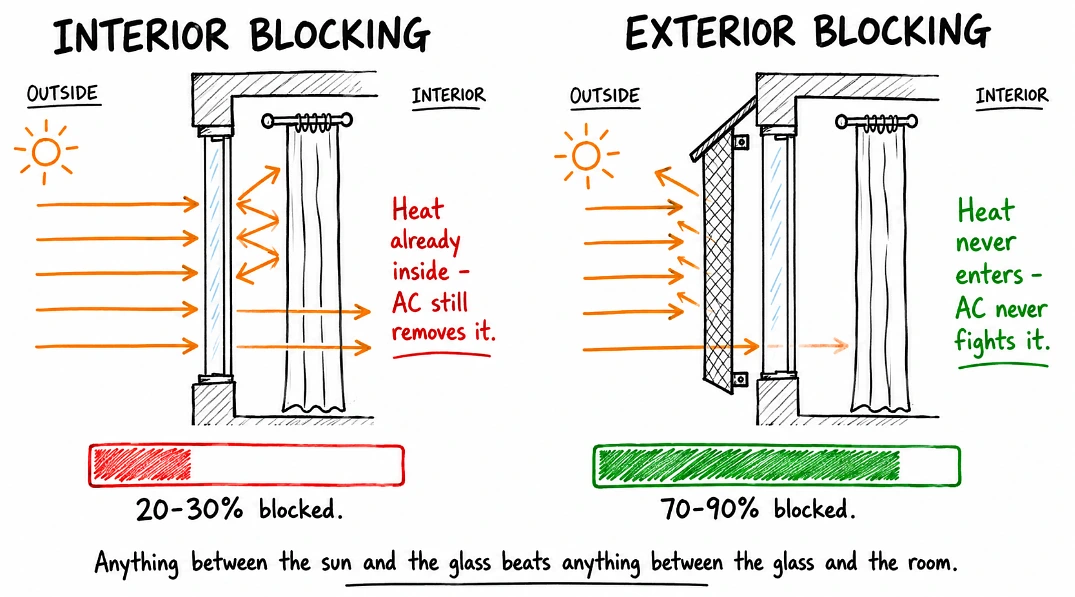
This is where the standard advice, “close your curtains,” starts to break down.
Closing an interior curtain or blind after the sun has already passed through the glass does something, but not what most people think. The solar energy has already entered the room. It hit the glass, passed through, and became heat inside the space. The curtain is now trapping some of that heat between itself and the window instead of letting it distribute across the room, but the heat is already inside your building envelope. Your AC still has to remove it.
Exterior shading is a different equation entirely. If you can block the sun before it reaches the glass, the heat never enters the home in the first place. Your AC never has to remove it because it was never there.
The effectiveness gap between these two approaches is huge:
- Interior curtains and blinds: Reduce solar heat gain by roughly 20 to 30 percent
- Reflective window films (interior): Reduce solar heat gain by 40 to 60 percent
- Solar screens (interior or exterior): Block 70 to 90 percent of heat
- Exterior awnings: Block 65 to 75 percent of heat
- Mature shade trees on west and south sides: Block 70 to 90 percent once established
The pattern is consistent. Anything you can put between the sun and the glass does more than anything you put between the glass and the room. Exterior beats interior almost every time.
What This Actually Means for Your AC System
Here’s the part that most homeowners never connect. If half your cooling load is solar heat gain, and you’re not doing anything to reduce that heat gain, you are asking your air conditioner to compensate for the sun. It’s a fight the AC will lose or barely win, and it will pay for that fight in efficiency and lifespan.
A cooling system running long, hard cycles all summer is a system that ages fast. Compressors, fan motors, and capacitors all degrade faster under sustained heavy use. The system that should last fifteen years starts failing at ten. The system that should run twenty percent of the summer runs forty percent.
I’ve seen homeowners spend money on air conditioner repair for systems that weren’t actually broken. They were just being asked to do a job no residential AC was engineered to do alone: cool a house while three thousand watts of solar heat pour in through the windows every afternoon. The repair fixes the immediate symptom. It doesn’t fix the underlying problem, and the same symptom comes back a year later.
The order that works is straightforward. Address the mechanical side of the AC first, filters, refrigerant levels, condenser coil cleaning, all the standard maintenance that keeps the system operating at peak efficiency. Then address the thermal side of the equation by reducing solar heat gain at the windows themselves. Those two things done together do more for summer comfort than any single upgrade to either one alone.
What Practical Heat Blocking Looks Like
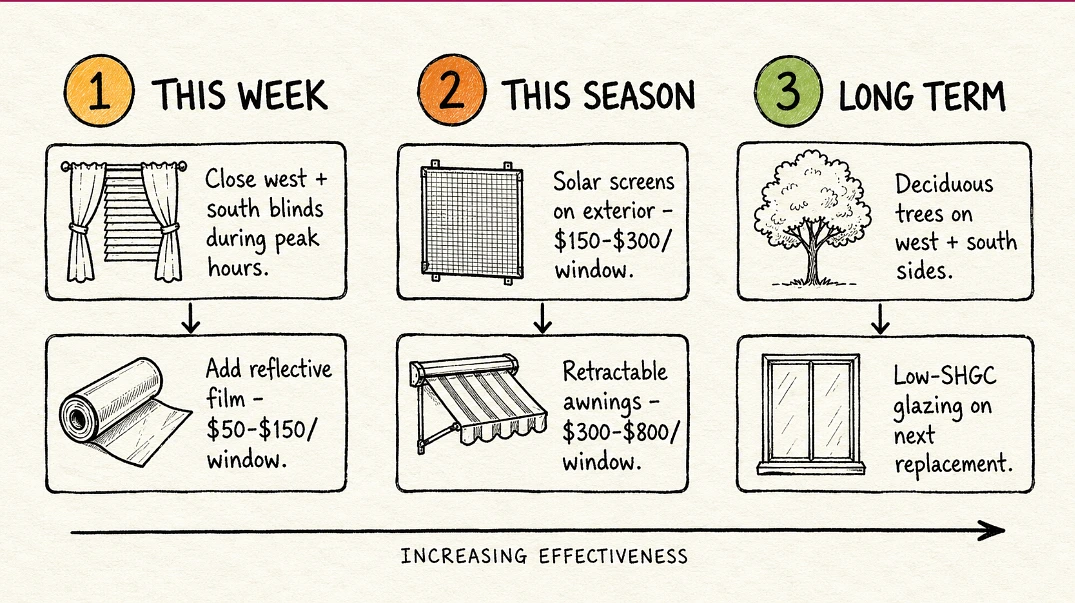
The question homeowners actually want answered is: what do I do this week that will make a difference this summer?
Immediate, low cost:
- Close blinds and curtains on west and south windows during peak sun hours. It’s not a great solution but it’s better than nothing.
- Add reflective film to the worst offenders, west-facing living rooms and bedrooms first. Modern film is nearly invisible and costs $50 to $150 per window for DIY or $150 to $300 installed. Blocks 70 to 90 percent of solar heat.
Medium term:
- Solar screens on the exterior of west and south windows. These sit outside the glass and block heat before it enters. $150 to $300 per window installed.
- Retractable awnings above west-facing windows. $300 to $800 per window. Blocks 65 to 75 percent of heat during peak hours, retracts in winter to let solar heat in when you want it.
Long term:
- Deciduous trees on the west and south sides of the property. Once established, they block 70 to 90 percent of heat in summer and drop their leaves in winter to let sun through when you need it. The one shading strategy that adapts seasonally without any effort from you.
- Window replacement with low-SHGC glazing during any renovation. Windows with a Solar Heat Gain Coefficient below 0.30 block roughly 70 percent of solar heat while still letting visible light through. Not worth doing just for cooling, but if you’re replacing windows anyway, spec them correctly.
Why This One Change Matters More Than the Rest
The reason this is the tip worth spending an entire article on, rather than covering ten cooling tips at surface level, is that it addresses the largest single variable in residential summer comfort. Ceiling fans help, but they’re moving air, not reducing heat load. Humidity control helps, but it’s addressing a different sensation of discomfort. Cooler bedding helps you sleep, but it doesn’t fix the room during the day.
Solar heat gain through untreated glass is the underlying condition that makes every other cooling strategy feel like it isn’t quite working. Fix that, and the AC starts winning the fight it was actually designed to fight. Everything else, the fan speeds, the thermostat settings, the humidity levels, starts behaving the way it’s supposed to.
Your air conditioner was engineered to remove a certain amount of heat from a certain volume of air. It was not engineered to fight the sun through unshaded west-facing windows for six hours every afternoon. Give it a chance to do the job it was built for and summer comfort stops being the constant battle it feels like now.
 Decor & Improvement Accessories