
Home & Decor Blogs: DIY, Interior Design & Lifestyle Ideas
What Actually Makes a Roof Anchor Point Safe in Australian Conditions

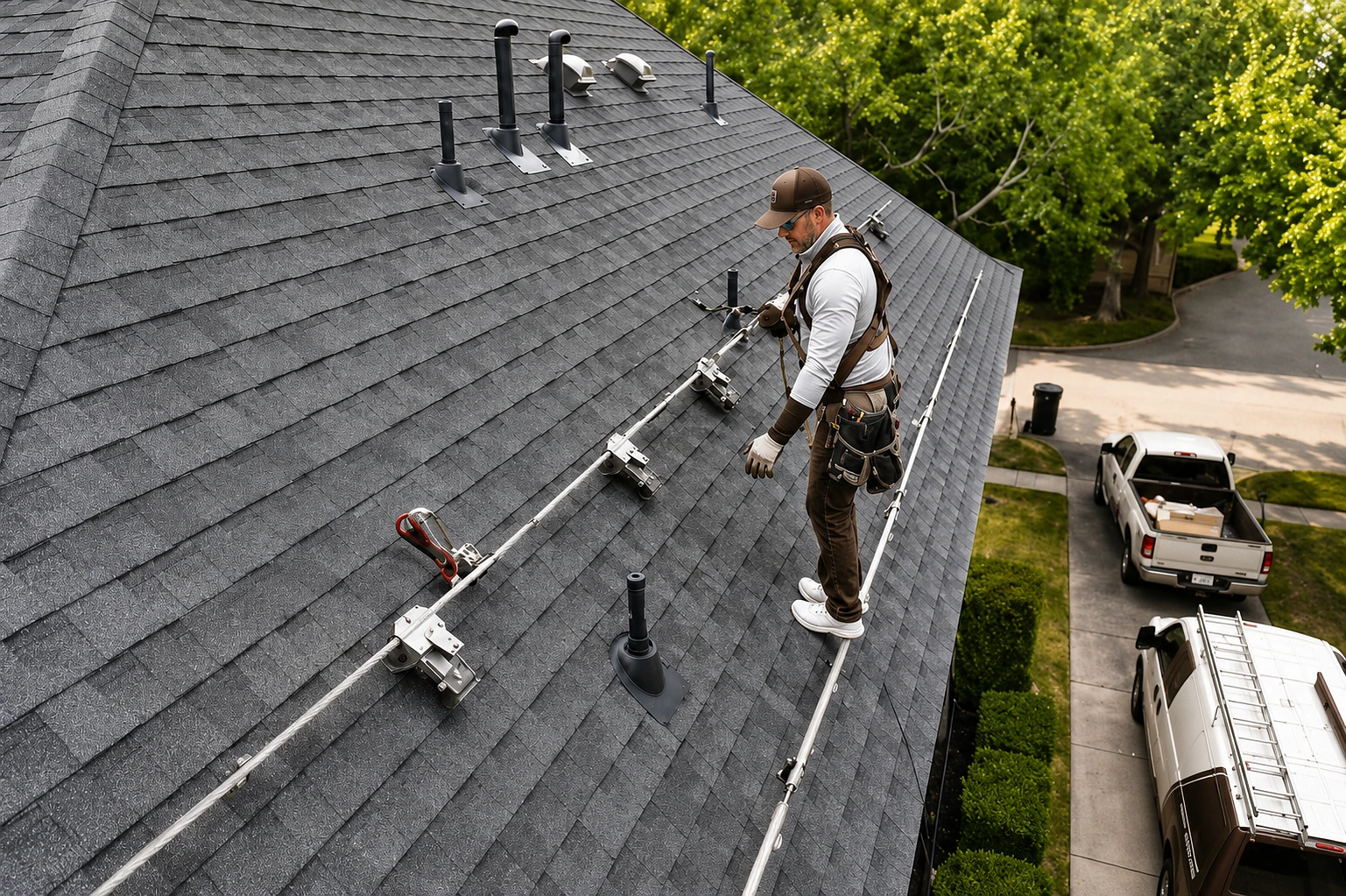
A certified anchor point does not mean a safe anchor point. This is the assumption that gets facility managers, strata committees, and PCBUs in trouble every year, and it’s the assumption most content on this topic never bothers to correct.
An anchor that passed dynamic testing in a lab five years ago, installed on a roof it was never rated for, fixed with the wrong fasteners into corroded purlins, inspected once and forgotten about, is a certified anchor. It’s also the kind of anchor that fails during a fall arrest incident. The certification is the first requirement, not the last one.
The features that actually determine whether an anchor keeps a worker alive during a fall have less to do with premium marketing language and more to do with load ratings that match the application, substrate compatibility, and inspection regimes that don’t lapse. Here’s what genuinely matters, drawn from the current Australian standards framework and the anchor failures that happen when people ignore it.
Load Rating Matched to the Actual Use Case
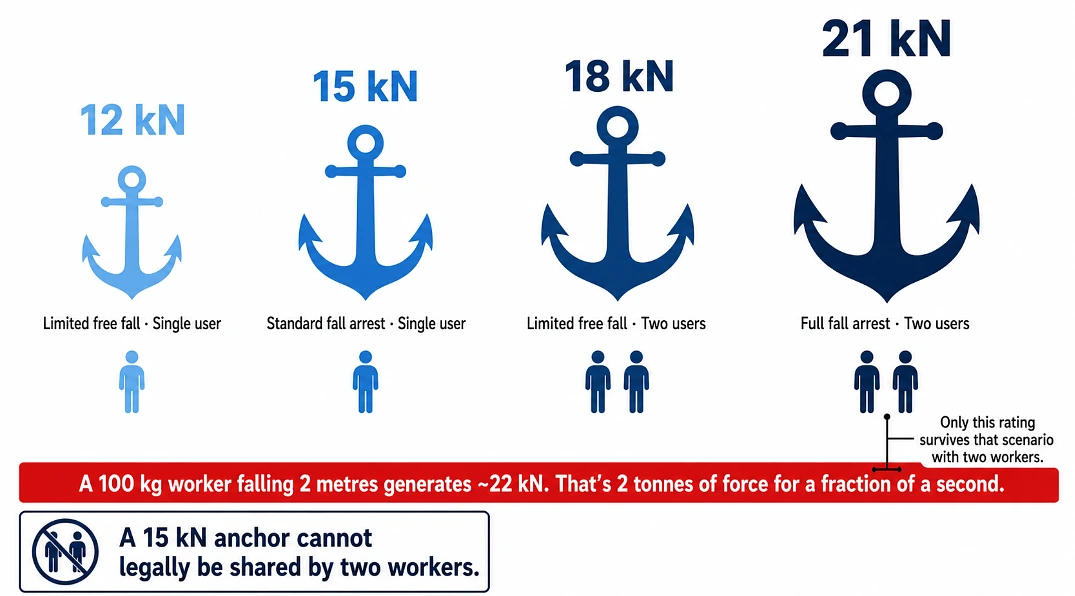
The reason AS 5532 was updated in 2025 is that the industry needed clearer separation between anchor classes. The previous single benchmark of 15 kN for one person and 21 kN for two-person use was too blunt for the range of real installations. The current standard defines four discrete rating levels, each with distinct proof load requirements and displacement tolerances:
- 12 kN — Limited free fall, single user
- 15 kN — Standard fall arrest, single user
- 18 kN — Limited free fall, two users
- 21 kN — Full fall arrest, two users
The number matters because a 100 kg worker dropped through 2 metres generates roughly. That’s the equivalent of the anchor point holding up a 2 tonne vehicle for a fraction of a second. An anchor rated for the wrong scenario doesn’t just underperform. It fails.
The other reason this matters is that a single 15 kN anchor cannot legally be used by two workers simultaneously, regardless of what the salesperson said when it was installed. If the site’s activity has changed and two workers are now clipping onto a shared anchor point that was originally certified for one, the compliance has already broken before anyone has fallen.
Substrate Compatibility, Not Just Certification
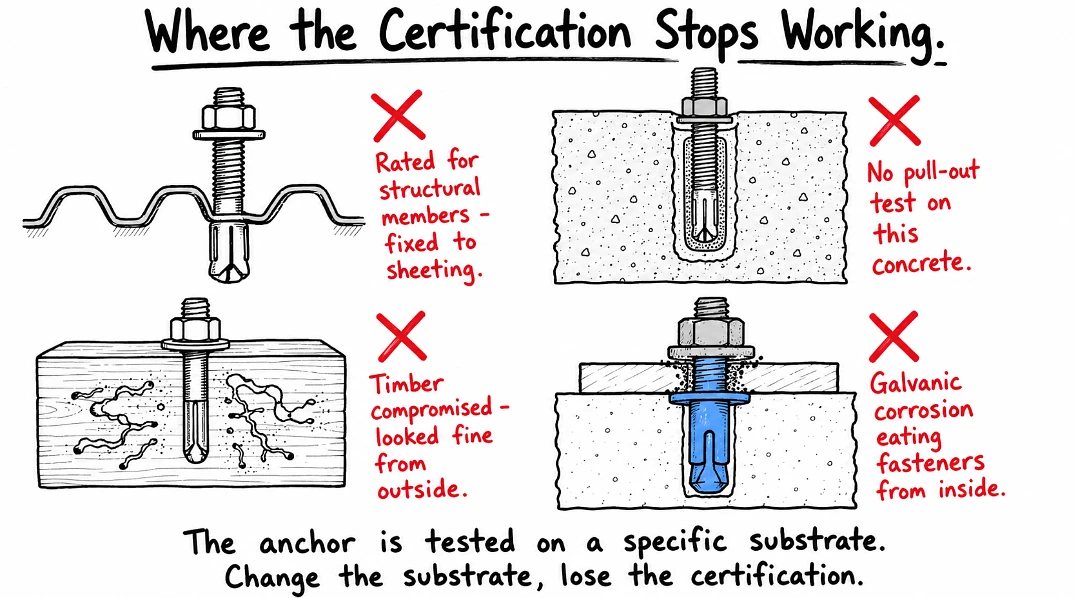
An anchor tested to AS 5532 was tested on a specific representative substrate. The certification applies to that substrate. Fix the same anchor to a roof structure it was not tested for, and the certification effectively no longer applies to the installation, even if the anchor itself is genuinely compliant.
This is the failure mode that keeps showing up in real incident reports:
- Top-fixed anchors into thin roof sheeting rated for structural members
- Chemical anchors installed into concrete without pull-out testing
- Timber-mounted anchors into purlins that were fine ten years ago and are now compromised by moisture or termite damage
- Steel purlin fixings using fasteners the anchor manufacturer never specified
The updated AS 5532:2025 requires anchor testing on the substrate type the anchor is designed for. The Working At Heights Association has been explicit about this: the anchor performance is inseparable from the fixing method and the structure it’s fixed to. Ignoring that is how you end up with a certificate that means nothing when the anchor is pulled during a fall.
Energy Absorption That Actually Limits Peak Load
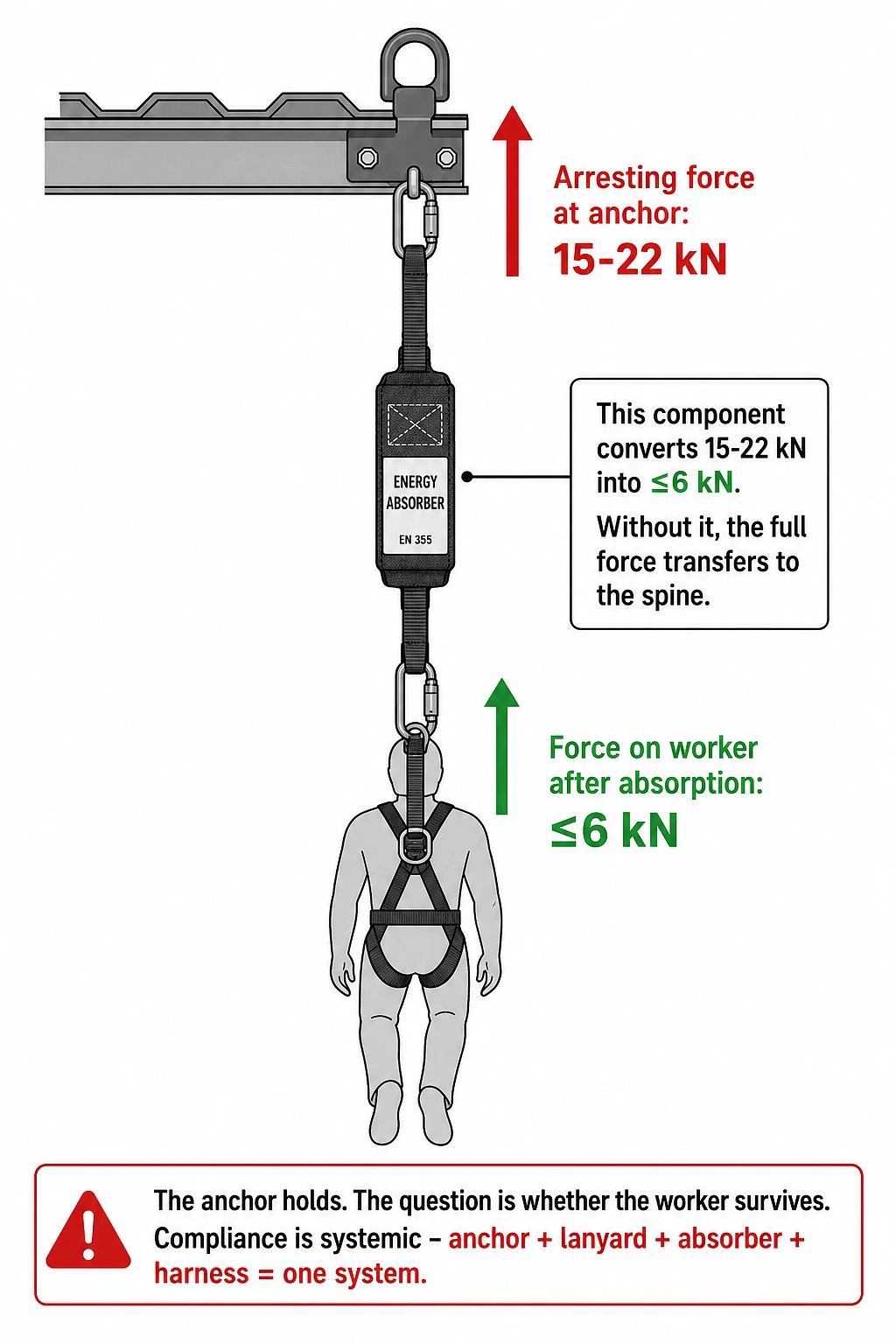
The AS/NZS 1891 suite requires that fall arrest systems limit the peak load transmitted to the worker’s harness to 6 kN. Not the anchor rating. The load on the human body during arrest. The difference between those two numbers is where energy absorption lives.
Without a shock absorber in the lanyard system, the full arresting force transfers through the harness into the worker’s spine. A 15 kN or 22 kN peak load without absorption is a broken back at best. The energy absorber is what converts that force into a controlled deceleration that keeps the peak at 6 kN or below.
This is why anchor point selection cannot be separated from lanyard selection. An excellent anchor paired with a rigid lanyard defeats the entire purpose of the fall arrest system. The anchor holds, the worker doesn’t survive. Compliance in this framework is systemic. The anchor, the lanyard, the harness, and the connection hardware are one system, not four independent components.
Corrosion Behaviour in Australian Coastal and Industrial Environments
Corrosion isn’t just a maintenance annoyance. It’s the single most common reason anchors fail their annual inspection in coastal Australia. Salt air, high UV exposure, and industrial pollutants degrade stainless steel and galvanised finishes at rates the original manufacturer data doesn’t always reflect.
The specification that matters:
- 316 grade stainless steel for coastal and marine environments
- 304 grade stainless acceptable inland but not near salt exposure
- Hot-dipped galvanised rated for the specific environmental category, with recoating intervals documented
- Fastener metallurgy matched to the anchor body to prevent galvanic corrosion
The failure mode that gets missed most often: the anchor body looks fine because it’s the correct grade, but the fasteners holding it to the structure were substituted during installation for something cheaper. Galvanic corrosion between dissimilar metals eats the fasteners from the inside. The visual inspection passes. The fastener snaps during a fall.
Anchors in corrosive environments need inspection intervals shorter than the 12-month baseline. Six months is standard for coastal installations. Three months isn’t excessive for genuinely aggressive environments like coastal industrial sites.
Inspection and Documentation That Doesn’t Lapse
An anchor system is only as compliant as its most recent inspection record. Missing documentation is functionally the same as no compliance at all when SafeWork inspectors arrive after an incident.
The current framework requires:
- Annual inspection at minimum, more frequent in corrosive or high-use environments
- Load testing of chemical and friction anchors per AS/NZS 1891.4
- Documentation of the compliance statement, batch number, and installation records
- Asset register with condition history for every anchor point on site
The bit that catches organisations out: legacy anchors installed under AS/NZS 5532:2013 aren’t automatically obsolete under the 2025 revision, but their documentation looks different from current records. When auditing an anchor system that has been in service for a decade, the facility manager needs to understand which edition of the standard was current at each inspection and what documentation requirements applied then. Historical certificates that only recorded “pass” against a 12 kN load without the additional data fields the 2025 standard requires are still valid for their respective periods, but they’ll look incomplete against current audit requirements.
A safety roof anchors supplier who can produce complete documentation trails, batch numbers, and substrate-specific test data is doing the job the standard actually requires. One who supplies the anchor with a generic compliance sticker and no application-specific data is passing the compliance obligation back to the site owner, whether the site owner realises it or not.
Design Layout That Prevents Swing Falls and Pendulum Effects
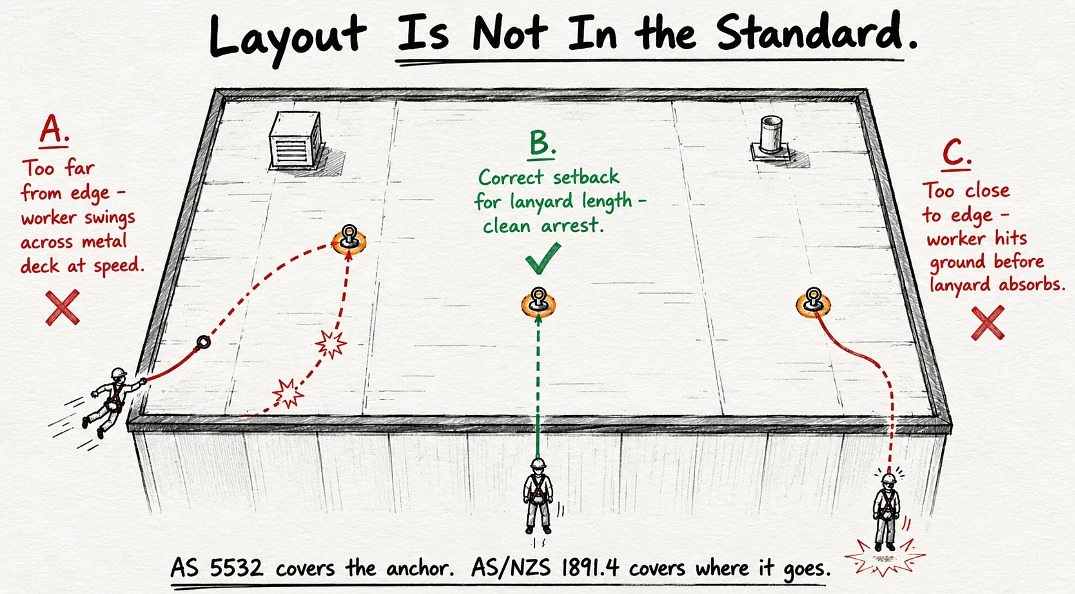
This is the feature that AS 5532 explicitly excludes from its scope, which is why so many anchor systems fail in real use despite being compliant on paper. The standard covers the manufacture of individual anchor points. It does not cover the layout of anchor points across a roof.
An anchor installed too far from the edge causes a worker who falls to swing across the roof surface before the lanyard takes up. That swing across a metal deck at speed causes lacerations, impacts, and secondary injuries that a properly positioned anchor would have prevented. An anchor installed too close to the edge means the worker hits the ground or the level below before the lanyard has absorbed the fall.
The layout question includes:
- Setback distance from the roof edge appropriate for the lanyard length
- Anchor spacing across the working area to prevent long lateral movements
- Rescue access planning for retrieving a suspended worker within the safe timeframe
- Compatibility between anchor eyelet dimensions and the lanyard’s snap hook
None of this is in the anchor’s box when it arrives. All of it is in the installer’s competence and the designer’s plan. This is why AS/NZS 1891.4:2025, the companion standard to AS 5532, is where the layout requirements live. The two documents work together. Neither one alone gets you a safe system.
The industry has spent a decade dealing with the confusion between what a certified anchor is and what a safe roof access system is. The certification tells you the manufactured component met the specified test. The safe system requires that component to be matched to the substrate, installed correctly, connected to compatible energy-absorbing equipment, positioned to prevent secondary hazards, inspected on the appropriate schedule, and documented in a way that survives an audit. Every one of those is a decision made by the facility, not by the anchor manufacturer.
The anchor is the piece of steel. The safety is everything the site does with it.
 Decor & Improvement Accessories