

Home & Decor Blogs: DIY, Interior Design & Lifestyle Ideas
How Top Agents Build Referral Pipelines That Actually Produce Listings

Referrals and repeat clients account for 41% of the average agent’s business, according to NAR’s 2025 Member Profile. That percentage rises to 42% from repeat business alone and 28% from recommendations for agents with sixteen or more years of experience. In contrast, agents who had been in the business for less than two years reported virtually no referral or repeat business.
That gap tells you everything. Referral pipelines are not a nice-to-have, they are the single biggest differentiator between agents earning seventy-eight thousand a year and agents earning eight thousand. And the pipeline does not appear on its own — it is built through specific habits that most agents either skip or do inconsistently.
66% of Sellers Already Choose Agents Through Referrals or Past Experience
According to NAR’s 2025 Profile of Home Buyers and Sellers, two thirds of sellers got their agent by either returning to an agent they had previously hired or through a recommendation from a friend or acquaintance. 43% of buyers choose their realtor on the advice of a friend, neighbor, or family member.
Those numbers mean the majority of transactions are decided before the agent even knows they’re being considered. Someone mentions your name at a dinner party, a colleague asks “do you know a good agent,” a neighbour sees your board go up and calls you directly. That conversation is where most listings originate — not from a Facebook ad, not from a letterbox drop, not from a cold call.
The agents who win those conversations are not necessarily the best negotiators or the most experienced. They’re the ones who stayed present in people’s minds between transactions, and that’s a seven to ten year gap for most homeowners.
The Referral Happens During the Campaign, Not After Settlement
Most agents treat referrals as something you ask for at the end. The reality is that clients form their opinion about recommending you during the transaction itself, usually within the first two or three weeks.
What shapes that opinion is not your sales result. It’s the operational experience — were updates consistent, were problems handled calmly, did the client feel informed or did they have to chase you for information. A seller who gets a weekly campaign summary without asking for it, who receives buyer feedback within hours of an inspection not days later, who gets an honest conversation about pricing when the market shifts mid-campaign — that seller talks about you to other people before the property even sells.
The agents who generate the most referrals usually systemise three things early:
- Vendor update cadence. Not “I’ll call when there’s news” but a fixed schedule — every Tuesday and Friday, or every Monday morning, regardless of whether anything significant happened. Silence during a campaign is what kills trust. Even a two-minute call saying “no new enquiry this week but here’s what I’m adjusting in the marketing” does more for your referral pipeline than a thousand-dollar ad spend.
- Buyer feedback turnaround. After an inspection, the buyer’s agent usually has feedback within twenty-four hours. The listing agents who pass that feedback to their vendor the same day build a reputation for transparency. The ones who batch it up and deliver it days later, or filter out the negative comments, get described as “hard to deal with” — and that description travels.
- Post-settlement contact within 30 days. Not a generic “congratulations on your sale” card. An actual call asking how the move went, whether the conveyancer sorted everything cleanly, whether they need a recommendation for a tradie. That call costs nothing and it’s the moment most agents disappear entirely.

Staying Visible Between Transactions Without Being Annoying
Here is the problem most agents run into — they know they should stay in touch with past clients but they don’t know what to say, so they either send generic newsletters that nobody reads or they go completely quiet for years and then suddenly reappear when they want a listing.
Both approaches fail. The newsletter fails because it’s impersonal and usually just recycled market stats the client could find themselves. The silence fails because by the time you resurface, the client has already spoken to two other agents.
What works is useful, low-frequency contact that positions you as someone who pays attention to their area. Not weekly emails — nobody wants that from their real estate agent. More like quarterly touchpoints that actually contain something worth reading.
This is where having a proper Real Estate Marketing strategy matters, and not the kind where you post inspirational quotes on Instagram. The agents who retain past clients between transactions are the ones sending hyper-local content — a planning application that affects the street, a comparable sale result with context about what it means for local values, a renovation trend that’s adding value in the area. Content that makes the recipient think “my agent actually knows what’s happening around here” rather than “my agent is trying to remind me they exist.”
Some agents do this through a CRM with scheduled touchpoints. Others do it manually with a spreadsheet and calendar reminders. The tool matters less than the consistency. A basic CRM runs twenty to fifty dollars a month. A spreadsheet is free. The agents who earn 41% of their business from referrals and repeat clients are not using some secret technology — they’re using discipline.
Treating Buyers Like Future Sellers Changes Everything
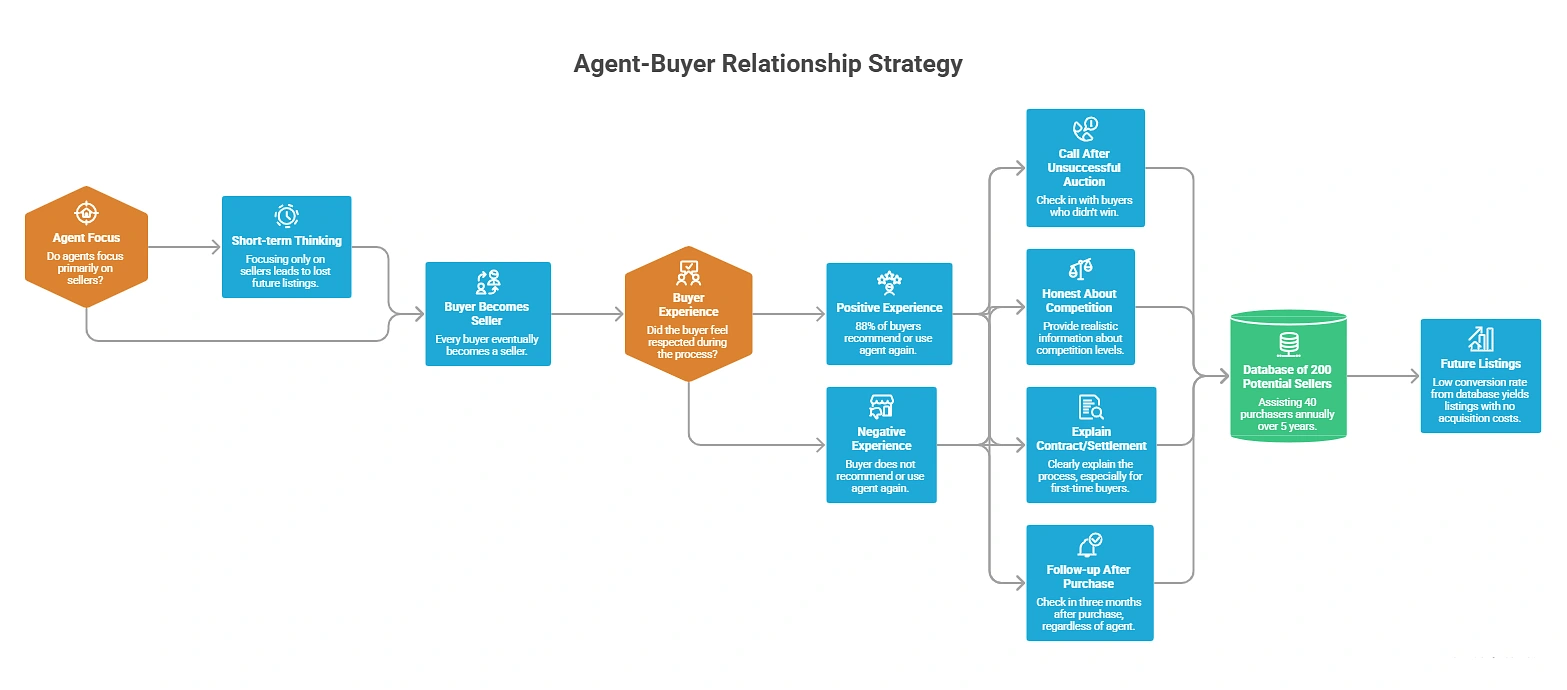
A lot of agents — particularly in markets where the vendor pays the commission — focus almost entirely on sellers and treat buyers as secondary. That’s short-term thinking that costs you listings three, five, seven years from now.
Every buyer eventually becomes a seller. And the buyer who missed out on a property but felt respected during the process remembers that. NAR’s data shows that 88% of buyers said they would recommend their agent or use them again. That number only holds if the experience justified it.
What “treating buyers well” actually looks like in practice is not complicated:
- Calling after an unsuccessful auction to check in, not just moving on to the next open home.
- Being honest about competition levels instead of inflating interest to create pressure.
- Explaining the contract and settlement process clearly, especially for first-time buyers who are overwhelmed and won’t admit it.
- Following up three months after they purchase — even if they purchased through another agent — to see how they’re settling in. That follow-up is unexpected enough that people mention it to others.
This has simple math. Over the course of five years, an agent who assists forty purchasers annually and maintains contact with each one creates a database that eventually includes two hundred individuals who will sell. From that category, even a low conversion rate results in several listings annually with no acquisition costs.
What a Referral System Actually Looks Like Week to Week
In real estate coaching, the term “system” is frequently used, but it is rarely given a useful definition. This is a breakdown of the real tasks that make up an effective referral system for a small team or a single agent.
Daily (5 minutes): Check your CRM for any past-client birthdays, settlement anniversaries, or scheduled follow-ups due today. Send a quick personal message — text is fine, it doesn’t need to be a handwritten card every time.
Weekly (20 minutes): Review any new sales results in your core suburbs. If a result is relevant to a past client — similar property type, same street, comparable price bracket — send them a brief note with the result and a one-line comment on what it means for their property’s value. This is not a market report, it’s a personalised data point.
Monthly (1 hour): Write or share one piece of genuinely useful local content to your database. Planning updates, infrastructure changes, school catchment shifts, council rate changes, and development applications. Whatever is actually happening in the area that a property owner would care about.
Quarterly (2 hours): Call your top twenty past clients. Not an email, not a text — an actual phone call. Ask how things are going, whether they’ve done any work on the property, whether they’re thinking about anything in the next year or two. Most will say no. Some will say “actually, funny you called because we’ve been talking about…” Those conversations are where listings come from.
Annually: Review your full database. Who have you lost touch with? Who referred someone to you that you never properly thanked? Who moved interstate and might need a referral to an agent in their new city? That annual review usually surfaces two or three opportunities that would have otherwise disappeared.
The total weekly time commitment is under an hour. The agents who say they don’t have time for this are usually spending that same hour on prospecting activities that convert at a fraction of the rate.
Eighty percent of sellers interview only one agent before listing with them. One. If you are that one agent — the one whose name came up in the conversation before the seller even started looking — you have already won the listing before you walk through the door. Being the loudest agent in the suburb does not create referral pipelines. They are developed by being the person that people think of when the topic is posed, and that memory is formed by dozens of little exchanges over many years rather than by a single noteworthy sales outcome that disappears from discussion in less than a month.
 Decor & Improvement Accessories