

Home & Decor Blogs: DIY, Interior Design & Lifestyle Ideas
Setting Up a Home Office That Can Actually Carry a Long Writing Project
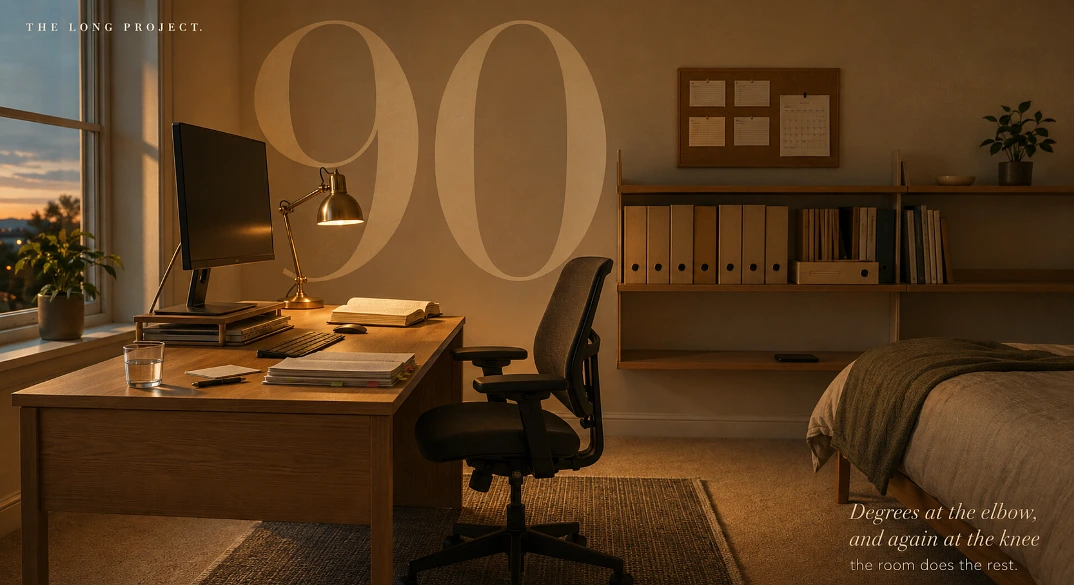
A desk and a laptop will get you through an afternoon. They won’t get you through the three months of a dissertation, or a long research project that keeps sprawling out past whatever you’d planned for it. That kind of work is asking something different from the room, it needs somewhere that’s guarding your attention, keeping the fatigue off, and holding a genuinely messy pile of material in some order you can actually work from.
And most people are setting the room up backward, buying the furniture first and then wondering why they still can’t settle into it.
Start From How You Actually Work, Not From a Furniture List
Before anything gets bought, watch yourself for a few normal working days.
Where are you losing the time. What’s breaking your concentration, and when. Which tools are you reaching for over and over, and which books and folders and screens are actually in play on a given day versus the ones just taking up the desk.
A long academic project is rarely the only thing you’re carrying, either. It’s competing with teaching, a job, a family, other deadlines all pulling at the same hours, and when that pressure builds the room has to help you get real value out of each hour you do manage to protect rather than fighting you for it. So the design brief isn’t “what does a nice office look like,” it’s “what does my specific working day keep tripping over.” That’s the thing that points your money at what’ll actually help instead of at decoration.
Pick a Spot Your Brain Learns to Associate With Work
A whole separate room is lovely if you’ve got one, but it isn’t the deciding factor. A quiet corner, a spare bedroom, a landing, an unused stretch of dining room, any of them turns productive once you’ve chosen it properly.
What you’re after is somewhere with low household traffic and a bit of distance from the telly, the kitchen noise, the casual chat. A door you can close is a bonus, not a requirement.
And here’s the part worth taking seriously, because it’s doing quiet work in the background. Sit in the same spot for the same task often enough and your brain starts filing the surroundings alongside the work, so just sitting down there begins tipping you toward focus before you’ve opened a single file. That association takes weeks to build and it only builds if the spot stays consistent, which is the actual argument against working wherever you happen to land that day.
One thing on distance from the bed specifically. At nine at night, deep in a hard reading session, a pillow that’s two feet away is going to win that argument more often than it loses it, and anyone who’s tried to work propped against their own headboard already knows exactly how that ends.
Build the Workstation Around Your Body Before You Spend on Looks
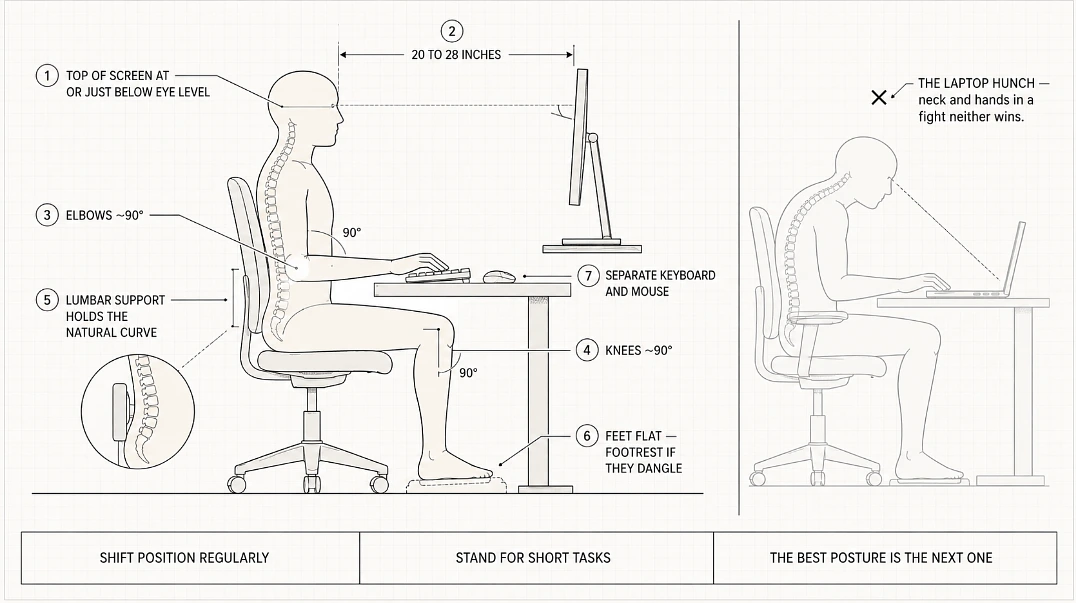
Long sessions are what punish a bad setup. The neck, the shoulders, the wrists, the lower back, they all start complaining somewhere around hour two if the geometry’s wrong, and cheap matching furniture does nothing for you if the heights are off.
The targets themselves are well established and worth getting right:
- A chair set so your feet are flat on the floor and your knees are somewhere near ninety degrees, with lumbar support that actually holds your lower back’s natural curve
- Elbows bending around ninety degrees when your hands are resting on the keyboard, shoulders relaxed rather than creeping up toward your ears
- The monitor about an arm’s length away, roughly twenty to twenty-eight inches, with the top of the screen sitting at or just below your eye level so your neck stays neutral instead of craning forward
- A separate keyboard and mouse the moment you’re working off a laptop for hours, because a laptop forces your neck and your hands into a fight neither wins
- A footrest if the chair’s right for the desk but leaves your feet dangling
None of that has to be expensive, and the bigger point underneath it is movement. The best posture is the next one. Shift position regularly, stand for the short tasks, and don’t lock yourself motionless in one shape for three hours, because even a perfect setup can’t save you from sitting dead still.
Get the Lighting Timing Right, Not Just the Brightness
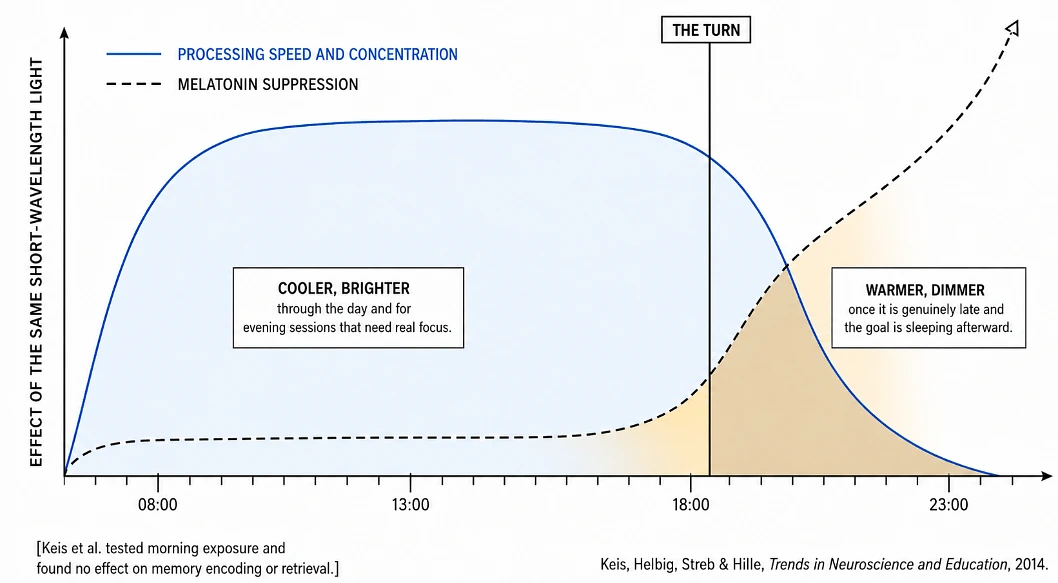
Most lighting advice stops at “get a bright lamp,” and that’s only half the story, sometimes the wrong half depending on the hour.
There’s a real study behind this. Keis and colleagues, published in Trends in Neuroscience and Education, put high school students under blue-enriched white light against standard classroom lighting and found the blue-enriched group processing information faster and concentrating better. Good news for daytime work. The catch is that the same short-wavelength light is suppressing melatonin, which is exactly what you don’t want late at night, so the bulb that’s sharpening you like a second coffee at four in the afternoon is quietly keeping you wired and awake at eleven.
Which turns into a simple rule in practice.
Cooler, brighter light through the day and for evening sessions that need real focus, then a warmer, dimmer lamp once it’s genuinely late and the goal is shifting toward being able to sleep afterward. Put the desk near a window if you can, but turn the screen sideways to it rather than facing the glass head-on, or you’re trading one glare problem for another. And set the lamp on the opposite side from your writing hand so your own hand isn’t throwing a shadow across the page.
Keep the Research From Turning Into an Avalanche
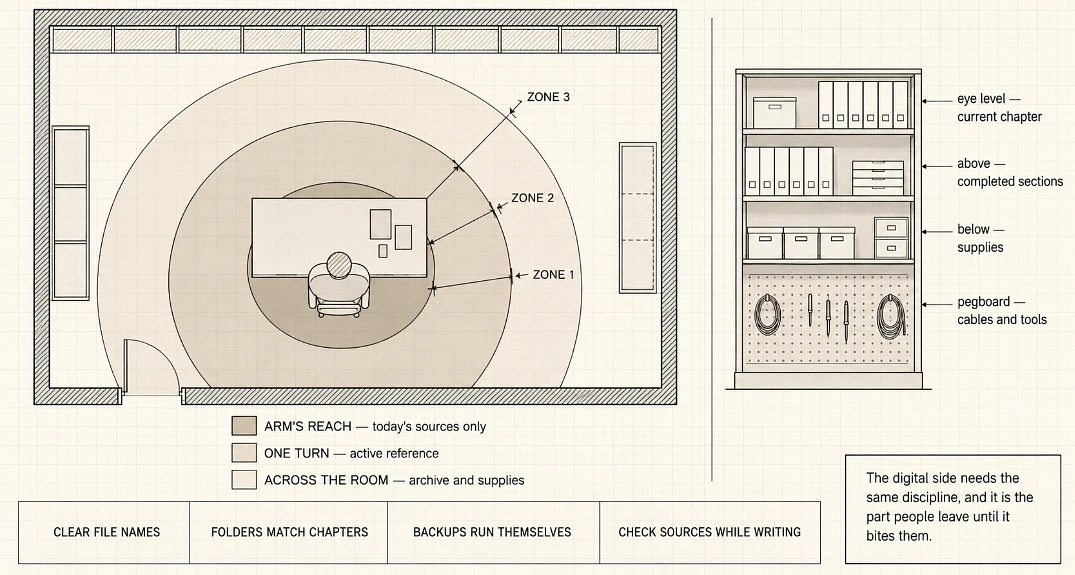
A long project generates an absurd amount of stuff. Books, printouts, notes, drafts, cables, reference folders, and with no system in place the one thing you need vanishes exactly when you need it.
Work in zones rather than piles. Current sources within arm’s reach of the desk, the archived material somewhere further back, supplies in one consistent place you don’t have to hunt through. Go vertical where you can, wall shelves and pegboards and magazine files hold a lot without eating the surface you actually work on.
The digital side needs the same discipline, and it’s the part people leave until it bites them. Clear file names, a folder structure that matches your chapters and your sources, and backups running on their own so a crash is an annoyance and not a catastrophe.
This is also where the checking stage lives, and it’s worth thinking about before you’re up against a deadline rather than after. I mentioned this to Antony M, one of the people over at PapersOwl, half expecting him to talk up the polished final read, and he went the other way entirely, that the students who get caught out are almost always the ones who leave the source-checking to the last night, when they’re too tired to spot where their own paraphrasing has drifted too close to something they read weeks ago and half forgot they’d read. Running your draft through a checker while you’re still in the writing, not the panic, is the version of that habit that actually saves you, because it catches the accidental overlaps while there’s still time to reword them properly.
Draw a Line Around the Space When You Stop
If the room’s also where you sleep and switch off, the work has to be able to end, or it bleeds into everything.
A rug under the desk and chair, a pinboard marking the zone, a different desk mat, even a narrow shelf standing between the bed and the desk, any of it gives the working area an edge instead of letting it dissolve into the rest of the room. Skip that and a bedroom-plus-study-corner slowly becomes one undifferentiated space where the laundry’s climbing onto the desk and the desk is climbing onto the bed.
So close it properly at the end of each session. Save what you need, put the supplies away, jot down the first small step for tomorrow so you’re not starting cold, and let the desk go quiet for the night.
The Room Doesn’t Need to Be Bigger, It Needs the Right Pieces
None of this is about square footage or about spending a lot, which is really the point of bothering to write it down.
Good light timed to the hour, a setup that isn’t wrecking your back, a storage system that keeps today’s work findable, and a clear boundary between working and not, those four things beat an expensive styled office that’s missing even one of them. Start with whichever one feels most broken in your room right now, fix that properly, and once it’s actually stuck, move on to the next. The work stays hard regardless. The room, at least, doesn’t have to make it harder.
A natural angle is to connect acoustic panels with reducing distractions and controlling background noise in a bedroom/study workspace. The best placement is in the paragraph about the room needing the right pieces, where it can function as an additional practical improvement rather than sounding promotional.

 Decor & Improvement Accessories