

Home & Decor Blogs: DIY, Interior Design & Lifestyle Ideas
Local Law 97 Reached Rent-Regulated Buildings in January, and the Clock Is Already Running
Rent-regulated buildings came under Local Law 97 on January 1, 2026. That much is on the Department of Buildings’ covered buildings list in plain text.
What an owner needs from that sentence, before anything else:
- The first compliance report is due May 1, 2027.
- That report gets built from 2026 utility data. This winter’s gas bills are already in it.
- The law covers most buildings over 25,000 sq ft, and the emissions caps tighten hard in 2030.
- Going over the cap costs real money, per ton, per year.
Now, a fair question. The deadline is May 2027. Why should anyone care in 2026?
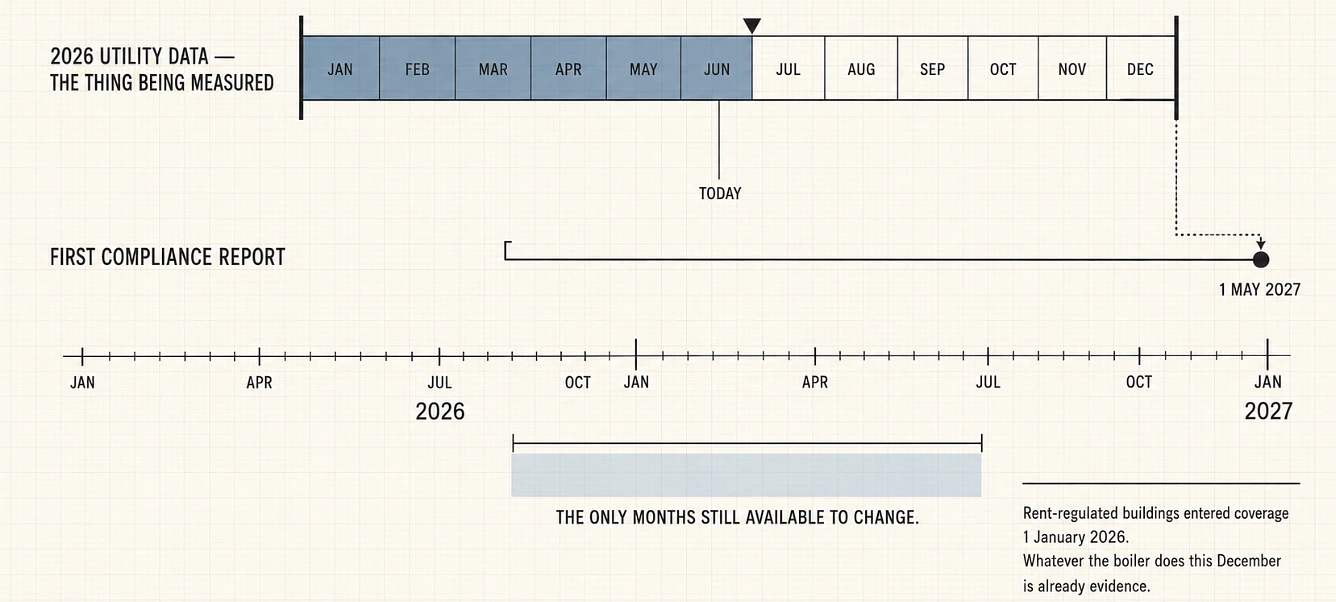
Because of the second bullet. Sit with it a moment. The report is not a form you fill out in spring 2027, it is a record of what the building consumed in 2026, and 2026 is half over. Whatever the boiler does this December is already evidence. An owner who starts thinking about this next year will be filing a report about a building it is too late to improve.
That timing quirk is the whole reason this article exists.
What the first scoreboard showed in April
The city published its first round of compliance data in April 2026, The Real Deal ran the analysis, and the table is short enough to read whole:
| Category | Compliance rate |
| Offices and hotels | 95% |
| Multifamily residential | 94% |
| Manhattan, all covered buildings | 95% |
| Staten Island, all covered buildings | 83% |
| Garages | 81% |
| Religious facilities | 80% |
Twelve points between Manhattan and Staten Island. Same law, same caps, same city. That gap is not weather, it is management and money, and it says something useful: the buildings with professional oversight passed comfortably, the ones without it did not.
The consultants quoted in that April analysis were less interested in who passed than in why. The early caps were written to be passable. 2030 is the year the limits drop to where they bite, and a building that cleared this year’s bar can fail the 2030 bar having changed nothing.
So the 94% is real, and also slightly beside the point.
Where does a radiator valve come into a city emissions law?
Strange pairing at first glance. One is a $100 piece of brass, the other is the most aggressive building carbon law in the country. The connection is waste.
Anyone who has spent a February in an older New York building knows the scene, radiators clanking at full output, apartments at 78 degrees, windows open to the street. Every one of those open windows is fuel the owner paid for, and as of this year, emissions the report counts.
A smart thermostat does not decarbonize a gas boiler. Worth saying plainly, because there is a version of this pitch that pretends otherwise. If the problem is the fuel, the answer is eventually electrification, and controls do not change that.
What controls change is how much of the fuel gets wasted. The short list that pulls consumption down without opening a single wall:
- Thermostatic radiator valves in units.
- Heat timers that respond to outdoor temperature instead of a fixed clock.
- Occupancy scheduling in lobbies, hallways, laundry rooms.
- Submetering, so the owner can see which line is bleeding.
How much does that save? The honest answer is that it depends on the building, and the only published field number worth citing is EPA’s, around 8% of heating and cooling energy for a certified smart thermostat in an average household. A steam-heated multifamily is not an average household, granted. The direction holds either way, and under this law every saved unit of fuel is now a line in a report.
The city will subsidise some of it, with a ceiling
The DOB’s December 2025 bulletin lists what counts as a deduction against a building’s calculated emissions:
- Onsite and offsite solar.
- Energy storage.
- Beneficial electrification, metered or deemed.
And offsets? Capped at 10% of the emissions limit, available only through the Affordable Housing Reinvestment Fund. Read the cap as policy, the city decided owners may buy their way out of a tenth of the problem and no more.
One genuinely tedious detail decides more than any of the above, though. The rent-regulated stock does not all sit under the same article of the law. Some buildings face hard caps, some face prescriptive energy conservation measures instead, and which one applies depends on the ownership and regulatory structure, all laid out in the city’s affordable housing guidance. Dull reading. Also the difference between two completely different to-do lists, so it gets read, by the owner or by a paid consultant, but by someone.
Between now and 2030
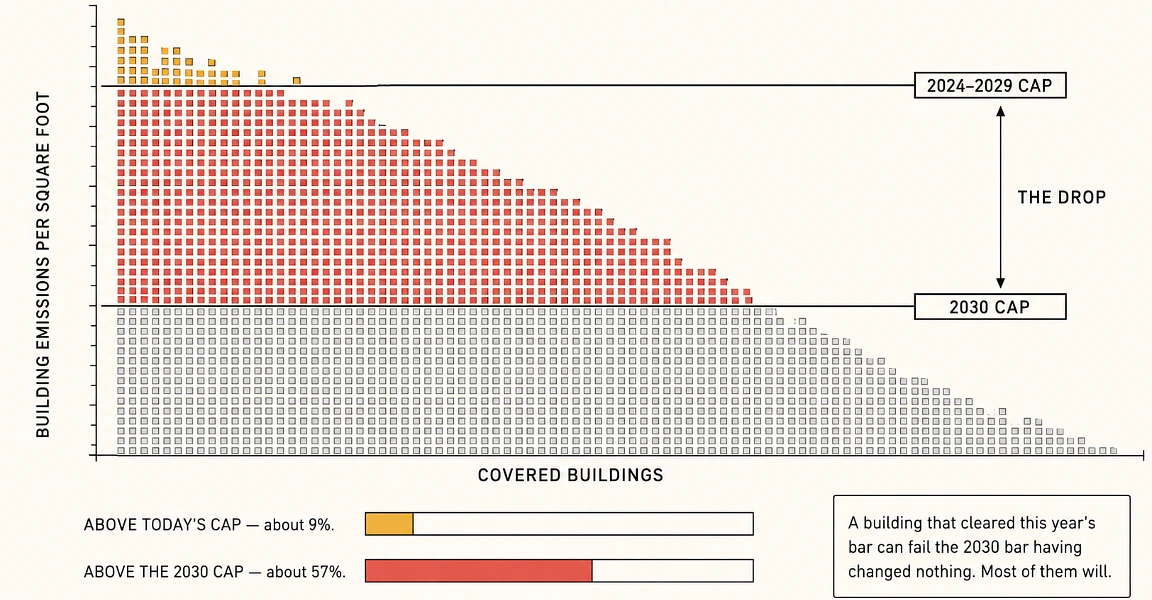
These are the forgiving years. High pass rates, soft caps, a sixty-day filing grace period, extensions into late August for owners who ask.
The rent-regulated owners who joined in January get one advantage the first wave never had, a scoreboard to study. It shows managed multifamily passing at 94% under easy caps, a twelve-point borough gap that tracks management quality, and a 2030 threshold that everyone analysing the data circles as the real exam.
Fourteen-ish months of meter data between now and the first report. What the building burns in that window is the filing. That is the arithmetic, and it favours the owners who started with the cheap fixes early.

 Decor & Improvement Accessories