Home & Decor Blogs: DIY, Interior Design & Lifestyle Ideas
Smart Glass Film: The Perfect Retrofit Option for Windows

Most people who want switchable privacy glass don’t actually need new windows. They want the function clear glass that turns opaque on demand without ripping out frames, scheduling glaziers, or living through days of construction dust. That’s exactly where smart glass film steps in.
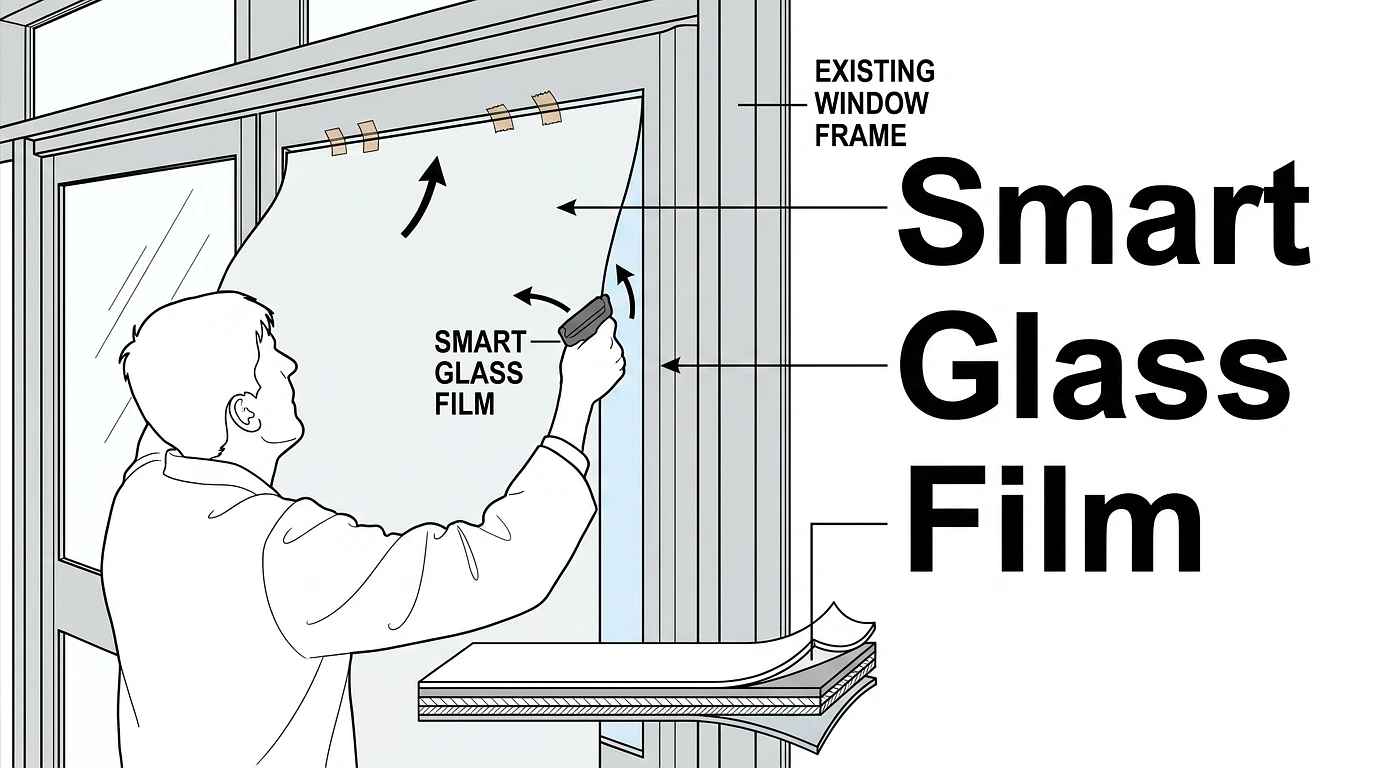
Smart glass film, also called switchable film or PDLC film, is a thin, self-adhesive layer that bonds directly onto existing glass. It uses polymer-dispersed liquid crystal (PDLC) technology to shift a window from fully transparent to frosted in under a tenth of a second, all controlled by a wall switch, remote, or smartphone app. No demolition. No new panes. No scaffolding outside your building.
How Smart Glass Film Actually Works
The film itself is roughly 0.4–0.5mm thick. Sandwiched inside are microscopic liquid crystal droplets suspended in a polymer matrix. When a low-voltage electric current passes through the film, those crystals align in a uniform direction. Light passes straight through and the glass looks clear. Cut the power, and the crystals scatter back into random orientations, diffusing light and turning the surface opaque.
This is why most smart films are “fail-safe private” they default to frosted when the power is off. A few newer products, sometimes marketed as “reverse-mode” or “FlipTint” film, work the opposite way, powering on to frosted and off to clear. But the standard configuration remains opaque-when-off for the majority of installations.
Power consumption is minimal. Most PDLC films draw around 3 watts per square metre when switched on, and nothing at all in the opaque state. You could cover an entire conference room wall and still use less electricity than a single desk lamp.
Why Retrofit with Film Instead of Replacing the Glass Entirely

The obvious alternative to smart film is integrated switchable glass a factory-laminated panel where the PDLC layer sits permanently sealed between two sheets of glass. It’s a solid product, but installing it means a full window replacement: remove the trim, pull the existing pane, fit the new unit, re glaze, and refinish. On a finished building, that process typically runs three to five days per opening, involves exterior access (sometimes scaffolding), and costs significantly more.
Smart film sidesteps all of that. Here’s how the two approaches compare on the factors that matter most during a retrofit.
- Cost. Film typically runs 30–50% of the price of equivalent integrated smart glass when you account for demolition, new-pane manufacturing, and reglazing labour. The film itself isn’t cheap quality PDLC material and professional installation carry real costs but you’re not paying for construction work on top of it.
- Timeline. A professional installer can film a standard window opening in a few hours. Most residential projects covering 50–100 square feet finish inside a single working day. Full glass replacement on the same scope can stretch across the better part of a week.
- Disruption. Film installation is interior only work. No one needs to touch the outside of the building. There’s no demolition, no dust event, no scaffolding, and no risk to exterior finishes. For occupied offices or lived in homes, the difference in disruption is dramatic.
- Privacy performance. On the dimension that matters most switching between clear and private film and integrated smart glass deliver essentially identical results. Both use the same PDLC technology. The switching speed, opacity level, and visual quality are comparable across well-made products from either category.
Where integrated glass does hold an advantage is in durability for exterior-facing applications, wet environments like showers, and situations where the PDLC layer needs to be fully encapsulated between sealed glass. Film is an interior product if the application is outdoors or regularly exposed to moisture, laminated smart glass is the more appropriate choice.
What You Need to Check Before Installing
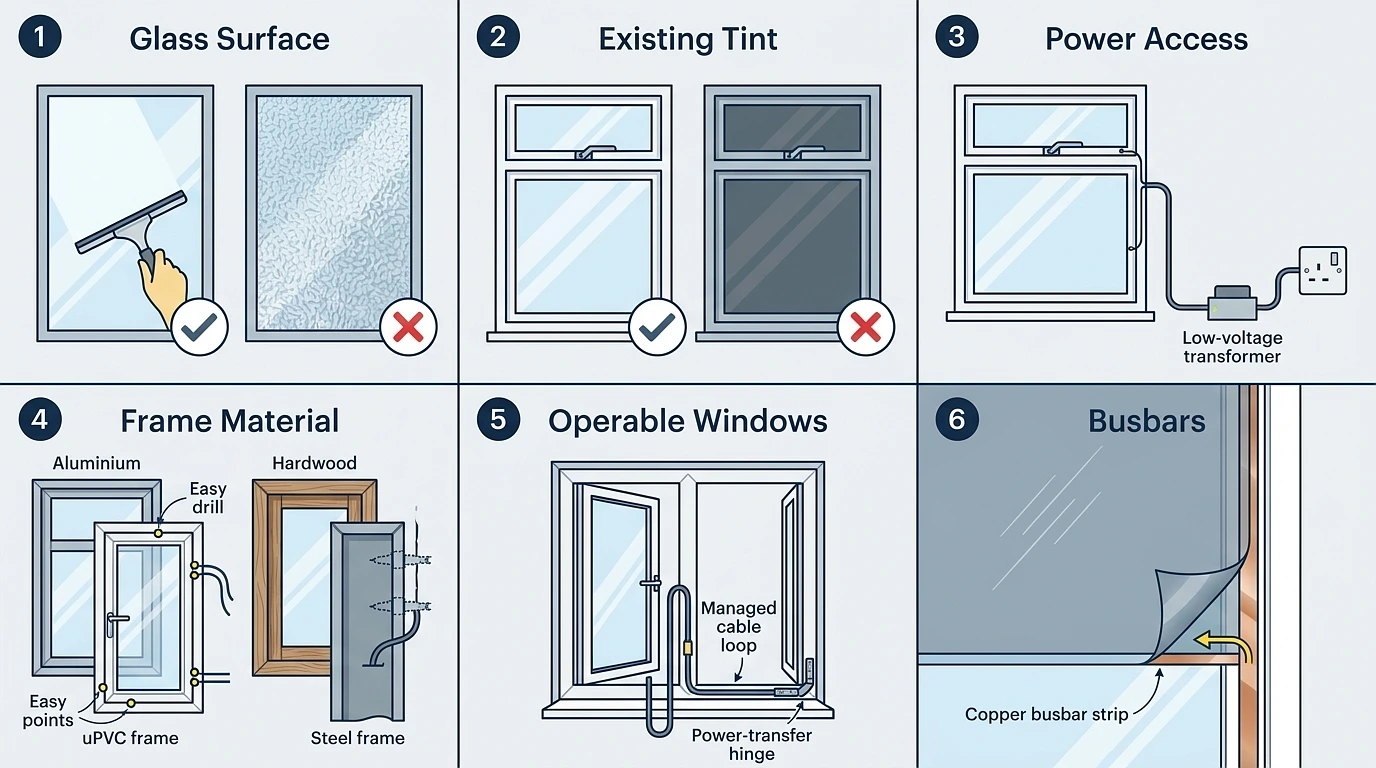
Smart film isn’t a universal fit. There are a handful of site conditions that determine whether it will work well on your specific windows, and sorting these out before ordering saves real headaches.
- Glass surface. The existing pane needs to be smooth and flat. Smart film bonds via a self-adhesive or static cling layer, and it won’t adhere properly to heavily textured, patterned, or deeply frosted glass. Minor imperfections are fine, but decorative glass with raised patterns is ruled out.
- Existing tint. Film applied over already tinted or heavily coated glass will underperform. The tint interferes with light transmission, reducing clarity in the transparent state and dulling the contrast between clear and opaque modes. Standard clear glass and lightly tinted glass work well. Anything darker than that should be assessed on a case by case basis.
- Power access. Smart film is an electrical product. It needs a connection to mains power via a low-voltage transformer, with wiring routed from the window frame to a power point ideally a fused spur within about five to ten metres. The film itself goes on quickly; the bulk of the installation time and complexity typically sits in the wiring, transformer placement, and control-system integration.
- Frame material. Aluminium and uPVC frames are generally straightforward to work with drilling for cable routing is uncomplicated. Hardwood and steel frames require more careful planning to hide wiring without damaging the frame profile.
- Operable windows. If the window opens (sliding, casement, tilt-and-turn), the installation needs managed cable loops or power-transfer hinges to prevent wire fatigue from repeated movement. It’s solvable, but adds complexity and cost.
- Busbars. Every piece of smart film has a busbar a narrow conductive copper strip running along one or two edges that carries current into the PDLC layer. The busbar isn’t invisible. On well-executed installations, it’s hidden behind the frame or under trim, but it does mean you won’t get a perfectly edge-to-edge transparent look without some planning around the concealment.
Where Smart Film Works Best
The technology suits some room types and building contexts far better than others. The strongest use cases tend to share a few characteristics: interior-facing glass, a genuine need for switchable privacy, and a building owner who wants to avoid construction-scale disruption.
Office conference rooms and glass partitions. This is probably the single most common application. Open-plan offices with glass meeting rooms need privacy on demand, and smart film delivers it without permanently frosting the glass or blocking natural light. Staff can see through the walls when the room is empty, then switch to opaque the moment a confidential meeting starts.
Residential bathrooms. Frosted-on-demand glass in a bathroom window removes the need for permanent vinyl, curtains, or blinds. When privacy isn’t needed say during the day when the room faces a private garden the window stays clear and lets in natural light.
Healthcare settings. Hospital rooms, clinics, and consultation spaces benefit from the combination of natural light and patient privacy. Glass partitions fitted with smart film let medical staff monitor patients when needed and provide visual seclusion during examinations or rest.
Retail storefronts. Shops can use smart film to reveal or conceal window displays, create after-hours privacy, or run rear-projection advertising smart film in its opaque state works well as a projection surface.
Home offices and living spaces. Ground-floor rooms facing a street, garden-level apartments, or any living space where privacy needs shift throughout the day these are all strong candidates for smart film over traditional blinds or curtains.
Energy and UV benefits
Smart film does more than toggle between clear and private. In its opaque state, it diffuses and partially blocks incoming sunlight, which has real implications for indoor temperature and UV exposure.
Most quality PDLC films block upwards of 98% of ultraviolet radiation in both states clear and opaque. UV light is the primary driver behind fading in furniture, carpets, artwork, and flooring, so the film acts as a passive preservation layer for interior design finishes even when it’s fully transparent.
On the infrared side, solar-control variants of smart film can reflect a meaningful percentage of IR radiation the wavelength range responsible for heat. In a hot climate or a south-facing room, this translates to noticeably cooler interiors without resorting to blackout blinds, and less strain on air conditioning systems. When the film is switched to opaque on a sunny day, infrared transmission drops further, roughly halving the heat load from direct sunlight in some installations.
The net effect is a reduction in both cooling costs in summer and reliance on artificial lighting year-round, since the film lets occupants manage solar gain without sacrificing daylight entirely. Traditional blinds tend to be binary block the light or don’t whereas smart film gives you a middle ground.
What About Lifespan and Maintenance
Quality PDLC film from a reputable manufacturer, professionally installed, carries a realistic working lifespan of ten or more years. Industry warranties vary some manufacturers offer two years, others five but the film itself, when properly applied and not subjected to conditions it wasn’t designed for (outdoor exposure, constant moisture, extreme heat beyond its rated range), holds up well over time.
Cheap film is a different story. Budget products from unverified suppliers are the most common source of problems in the smart film space. Yellowing, delamination from the glass surface, uneven switching, and edge failure within 12–24 months are all symptoms of substandard material. The film itself matters far more than the installer technique starting with the right material is the single most important decision in any smart film project.
Maintenance is minimal. The surface cleans like ordinary glass a soft cloth and standard glass cleaner. There are no moving parts, no motors, and nothing mechanical to service. The transformer and wiring should be installed accessibly in case servicing is ever needed, but in practice the electronics rarely require attention.
One thing to be aware of: a slight haze effect is a standard characteristic of all PDLC film, visible from certain angles, particularly in the transparent state. It’s inherent to the technology rather than a defect, and it’s become less pronounced with each generation of film, but if you’re expecting absolute optical perfection equivalent to bare glass, you’ll notice it.
Installation: What the Process Looks Like
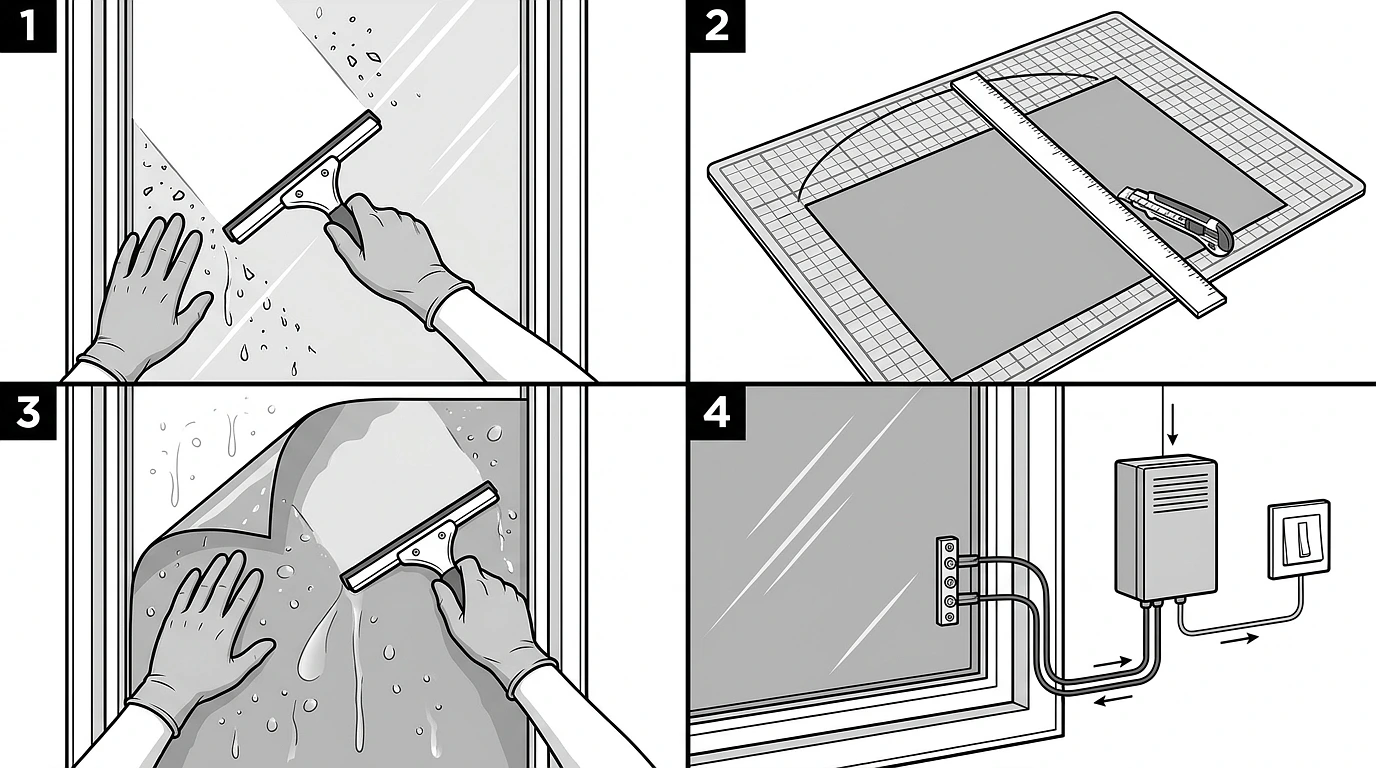
For a typical single-window residential or office installation, the workflow runs roughly like this.
The glass surface is cleaned thoroughly and inspected for damage or contamination. Any debris trapped under the film during application will show as a permanent blemish, so this step matters.
The film is cut to the exact dimensions of the glass pane, with allowances for the busbar placement and wire exit points. On irregular window shapes arched tops, raked angles the film is custom-cut to match.
The self-adhesive backing is peeled away and the film is applied wet, using a slip solution that allows repositioning before the adhesive sets. Once positioned, the installer squeezes out the solution and any trapped air with a flat tool, working from the centre outward.
Wiring is routed from the busbar through or along the window frame to the transformer location. The transformer connects to mains power, and the control interface wall switch, remote receiver, or smart-home bridge is configured and tested.
The whole process, film application through to switching test, typically takes two to four hours per window for a professional installer. Wiring complexity is the main variable. A single window near an existing power outlet with a simple switch goes fast. A multi-panel office buildout with centralised smart-home integration takes proportionally longer.
Cost Expectations
Pricing varies substantially depending on total square footage, number of panels, wiring complexity, and control-system requirements. As a rough framework: the film material plus professional installation for a single standard window (around 15–20 square feet) typically falls in the range of $400–$800 in the US market. Larger commercial projects benefit from volume pricing but add cost through more complex wiring runs and control integration.
That pricing sits well below the cost of full smart glass replacement for the same openings, which can run two to three times higher once you factor in demolition, new glass manufacturing, and construction labour.
Getting an accurate quote requires a site survey photos of the windows, frame profiles, and power access points at a minimum. Reputable suppliers will walk you through a consultation before committing to a price, because retrofit conditions vary enough that generic per-square-foot pricing rarely tells the full story. Companies like Pramie specialise in providing tailored smart glass and film solutions, working through the site assessment and specification process to match the right product to your actual conditions rather than offering a one-size-fits-all quote.
Common Mistakes to Avoid
A few recurring errors show up across retrofit projects, and most of them are avoidable with basic planning.
- Ordering film before assessing compatibility. If the glass is textured or the frames make cable routing impractical, you’ve bought material you can’t use. Always confirm surface condition, frame type, and power access before placing an order.
- Leaving control decisions to installation day. The wiring path, switch type, and smart-home integration should all be decided and planned before the electrician arrives. Changing the plan mid-install wastes time and money.
- Choosing the cheapest film available. Budget PDLC film is the single most common cause of retrofit failures. Yellowing, delamination, and inconsistent switching are almost always material problems, not installer problems. Invest in verified, warrantied film from an established manufacturer.
- Using the wrong sealant. Acid-cure silicone a common general-purpose sealant corrodes smart film and smart glass. Only neutral-cure, non-corrosive sealants should be used anywhere near the film edges.
- Skipping professional installation. Self-adhesive film sounds like a DIY project, but trapped air bubbles, misaligned busbars, and amateur wiring create problems that are expensive to fix after the fact. The installation itself is where the finish quality lives.
 Decor & Improvement Accessories