

Home & Decor Blogs: DIY, Interior Design & Lifestyle Ideas
What Gulf Coast Moisture Does to Wood Furniture – Popular Issues Discussed In Detail

Your Door Did Not Break. It Got Fat.
Somewhere between June and August every year, in Karachi, in Mumbai, in Tampa, in Lagos, in Manila, the same small domestic comedy plays out in a few million houses at once.
A person walks up to a door they have opened ten thousand times. They push. Nothing. They push harder. Still nothing. Then comes the shoulder, and the door gives way with a noise like it is annoyed about it, and the person stands there thinking, when exactly did this door start doing this.
In Urdu there is a phrase people use for exactly this and it is more accurate than anything in the manual. Darwaza phool gaya hai. The door has swollen up.
Not warped. Not broken. Not badly made. It has simply put on weight for the season, the way a fat man expands into a shirt he wore comfortably in January, and it will slim down again on its own once the air dries out.
Which brings us to the thing almost nobody explains before they sell you a beautiful solid wood dining table for a house that sits ten kilometres from an ocean.
Lakdi Saans Leti Hai
Wood breathes. It never stops breathing.
You can cut down the tree, saw it, kiln dry it, sand it, polish it, sell it, deliver it, and it is still sitting in your living room quietly exchanging moisture with the air around it. Forever. Until it is firewood.
There is a number for where it settles, called the equilibrium moisture content, and the number is decided by your climate rather than by your furniture shop.
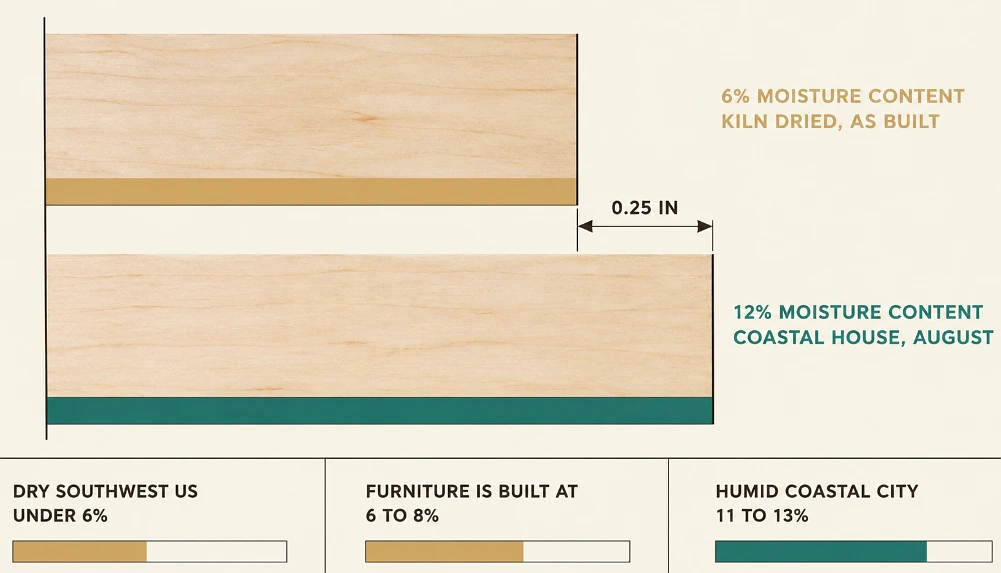
- Dry southwestern United States: wood settles below 6% moisture content
- Coastal Florida, and most humid coastal cities: wood settles around 11 to 13%
- What furniture is usually kiln dried to before it is built: 6 to 8%, which matches an indoor humidity of about 30 to 45%
Read those three lines together and something obvious falls out. Most furniture in the world is manufactured for a moisture level that a humid coastal house does not have and will never have.
How much movement does that produce? A useful figure to hold on to: a six percent change in moisture content moves a twelve inch wide maple board by roughly a quarter of an inch.
A quarter inch. On one board. Now imagine that happening across a wardrobe carcass, four drawer fronts, and a door that was fitted with a three millimetre gap by a carpenter working in February.
Arre, of course it sticks.
Now, The Part Where You Do Nothing
Here is my favourite piece of advice in this entire article, and it is free.
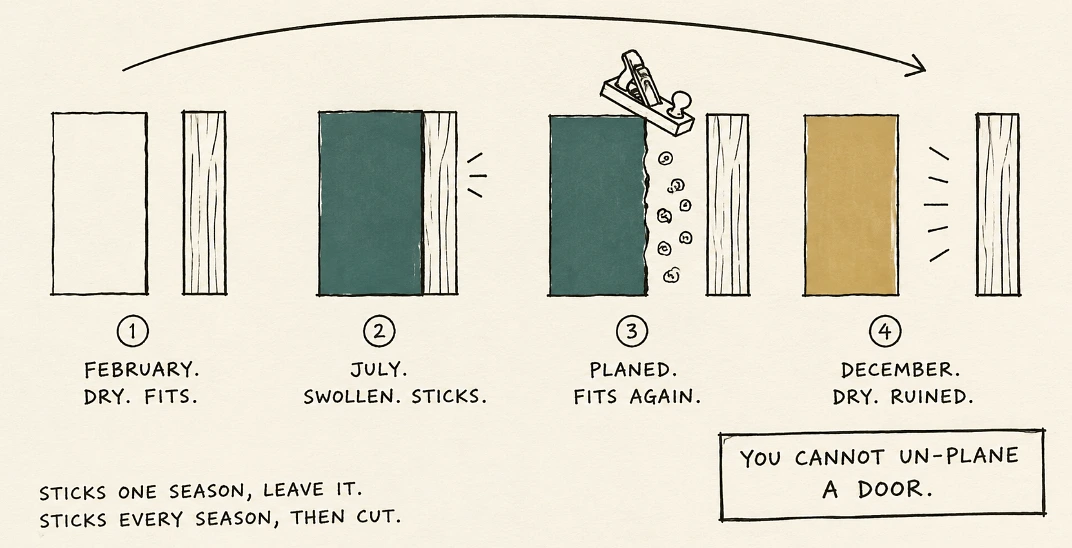
The swollen door in July. The drawer that will not close in the middle of barsaat. Leave them alone.
The instinct is to fetch a plane or sandpaper and take a few millimetres off the sticking edge, and it works beautifully, for about four months. Then the dry season arrives, the wood gives that moisture back, everything shrinks to its winter size, and now you own a door with a finger-width gap along one side that whistles and lets light through and cannot be un-planed.
You have solved a seasonal problem permanently. That is the wrong direction.
So the rule is simple. If it sticks in one season and behaves in the other, it is doing what wood does and you leave it. If it sticks all year round, in every season, then something has genuinely shifted and now the plane comes out.
Ohh, and one exception worth knowing. If the sticking is at the top corner near the hinge side and it is getting worse each year rather than seasonal, that is usually the hinge screws loosening in the frame, not the wood swelling. Two minutes with a screwdriver, or longer screws that reach the stud behind. Check that before you cut anything.
The Milky White Cloud On Your Table
This one causes real panic, because it appears overnight and it looks like the finish has died.
A pale, cloudy, whitish bloom spreading across a polished surface. Sometimes after a party. Sometimes after the air conditioning was off for a week. Sometimes with no explanation at all, which is the most annoying version.
That cloud is moisture trapped in the finish rather than damage to the wood. In a humid room the finish absorbs water vapour, and the light scatters differently through it, and your table goes foggy.
What usually brings it back:
- A hair dryer on low, held well back, moving constantly. Gentle warmth drives the moisture back out. Do not hold it in one place, and do not go anywhere near hot.
- Petroleum jelly or a thick furniture wax left on the cloudy patch overnight, then buffed off in the morning. Sounds like a village remedy. Works often enough that professional restorers still use it.
- A cloth dampened with a little mineral spirits, wiped fast and light, for stubborn patches on older finishes.
And the honest caveat, because I am not going to promise you a miracle. If the cloud has gone dark rather than white, the moisture has reached the wood underneath and gone past what a hair dryer fixes. That is a refinishing job.
Seelan Behind The Almirah
Every household in a humid city knows this smell before it knows the word for it.
You pull the wardrobe away from the wall to sweep behind it, once a year, and there it is. The back panel gone dark and spotted. That particular cold musty smell. Seelan. Damp.
The reason it lives specifically there and not on the front of the same furniture is airflow, or the total absence of it. Warm humid room air meets a cooler exterior wall, moisture condenses on the surface, and you have parked a large flat wooden panel against it with a two millimetre gap. Nothing moves. Nothing dries. Mould is delighted.
What actually stops it:
- Pull every large piece two to three inches off the wall. Not flush. This one change does more than everything else combined and costs nothing.
- Keep indoor relative humidity under 60%. That is roughly the line where mould stops finding your house hospitable.
- Run the air conditioning as a dehumidifier, not only as a cooler. Half the moisture removal in a coastal house happens through the AC without anyone thinking about it.
- Put the heaviest pieces on interior walls where you have the choice. Exterior walls run cooler and condense more.
Now, here is the part I find genuinely lovely about this problem. Look at an old almirah in a Karachi or Bombay house, one made properly seventy years ago by someone who had never heard the word dehumidifier. It stands on legs. There is air underneath it. Very often the back is not one sealed panel at all but slatted, or panelled with gaps, and the whole thing sits slightly proud of the wall.
That was not a style. That was somebody who had watched furniture rot and designed the problem out of it, using nothing but geometry.
Modern flat-pack sits flush to the floor, flush to the wall, sealed at the back, and then we buy machines to solve a problem that a carpenter in 1950 solved with four legs.
The Furniture That Arrived From Somewhere Dry
This is the one that catches people who move, and it is worth understanding because it inverts the usual story.
A cabinet that has spent thirty years in a humid coastal city is stable. It reached its 12% long ago and it has been happily fat ever since. Nothing dramatic is going to happen to it.
The cabinet that cracks is the one that arrives from Denver, or Lahore in winter, or anywhere the wood has been sitting comfortably at 6%. It lands, it starts drinking the local air, and over the following months it swells against joints that were glued tight at a completely different size.
The furniture did not fail because your city is humid. It failed because it moved.
So if you have shipped things in:
- Unwrap everything immediately and let it sit in the room it will live in. Plastic wrap traps the old climate against the wood and delays the adjustment rather than preventing it.
- Give it a few weeks before you tighten anything. Wobbly chair legs and loose joints in month one are the piece adjusting. Tighten during the adjustment and you lock in stress.
- Watch the widest panels first, table tops and wardrobe sides, since movement scales with width.
- Do not put a dry-climate antique in an un-airconditioned sunroom and expect a quiet retirement for it.
What To Buy Next Time, Which Is Not A Simple List
People want a species answer here. Buy teak, avoid pine, done. And teak genuinely does deserve its reputation, because the natural oils and silica in it repel water and resist rot, which is precisely why Kerala and Java and the old shipbuilders used it for centuries in exactly this kind of air. That is not marketing, that is four hundred years of evidence.
But species is only one of three answers, and honestly it is not the most useful one.
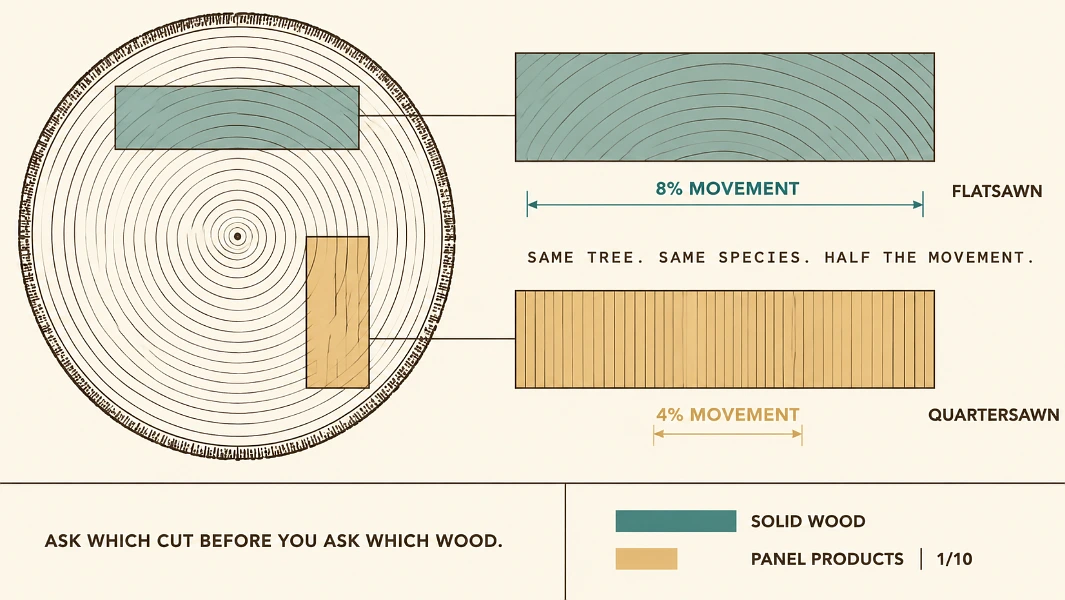
The cut matters as much as the wood. Wood shrinks roughly 8% along the tangential direction and only about 4% radially, which means quartersawn boards move about half as much as flatsawn ones. Same tree. Same species. Half the movement. Nobody in a showroom will mention this to you and it is a fair question to ask.
And then the construction answer, which offends people.
Plywood, MDF and other panel products move about one tenth as much as solid wood. One tenth. So a well-made veneer over a stable core is not the compromise it gets treated as in a humid climate, it is the technically better carcass, and the wardrobe that does not crack is worth more than the wardrobe with the purer pedigree.
I know how that sounds to anyone who loves solid wood. I would still take the veneered carcass with solid wood doors and drawer fronts, in a coastal house, every time.
And finishes, briefly, because they get oversold. A good polyurethane slows moisture exchange down. It does not stop it. Nothing stops it. Wood will reach equilibrium with the room eventually whatever you put on top of it, so maintain your finishes because a broken finish lets moisture in unevenly, which is worse than no finish at all, and stop expecting any coating to make wood waterproof.
Floors Are A Harder Problem Than Furniture
Everything above assumes the piece can move. 9. A table top expands, the leaves shift a fraction, nobody notices.
A floor cannot do that. It is fixed at every edge, boards packed against each other wall to wall, and when it swells there is simply nowhere for the movement to go. So it buckles upward, or it cups at the edges of every board, and the repair is not a repair, it is a replacement.
Which is why humid coastal installation is a genuine speciality rather than a marketing phrase. Species selection, moisture readings on both the subfloor and the boards before anything is laid, an acclimatisation period in the actual house, and expansion gaps sized for a climate that swings. Tampa is a good example of a market where all of that gets taken seriously, and the highly specialized installation techniques local installers use exist because the ones who skipped them learned expensively.
Ask any flooring quote in a humid city one question. What moisture content will the boards be at when they go down, and how long are they sitting in the house first. The answer tells you who you are dealing with.
The Way To Think About All Of This
Wood is not fighting you. It is doing the only thing it has ever done, which is come into balance with whatever air it finds itself in.
Once you accept that, the whole subject becomes calmer. You stop planing doors in July. You leave a gap behind the almirah. You buy the veneer carcass without feeling like you cheated. You let the shipped-in dresser settle for a month before you touch a single screw.
And when the door swells shut again next barsaat, and you put your shoulder into it, you will know exactly what is happening and roughly when it will stop.
It has got fat. It will slim down. Leave it be.

 Decor & Improvement Accessories