

Home & Decor Blogs: DIY, Interior Design & Lifestyle Ideas
Why Canadian Winters Change What You Buy – 5 Things You Would Buy Anywhere Else, And What We Buy Here Instead

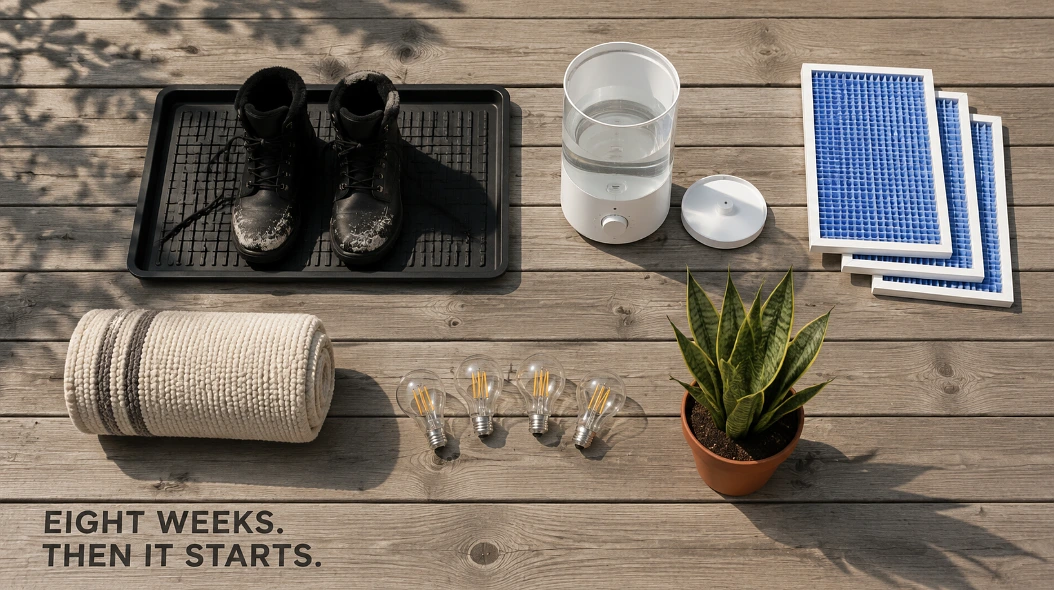
It is the end of August. Which means we have about eight weeks of pretending, and then it starts.
If you have just moved to Edmonton, or you are about to, this is the window where the shopping decisions get made. Paint colours, a sofa, some art for the hallway, all the normal things anybody buys when they move into a house.
The trouble is that half of what gets recommended in decor articles was written by somebody who has never watched a doormat freeze solid.
So here are five swaps. Same job, different product, and each one is different because of something specific about how a winter works up here rather than because of taste.
You Would Buy A Dehumidifier. Here You Buy A Humidifier.
This is the one that catches everybody, and it looks wrong on paper.
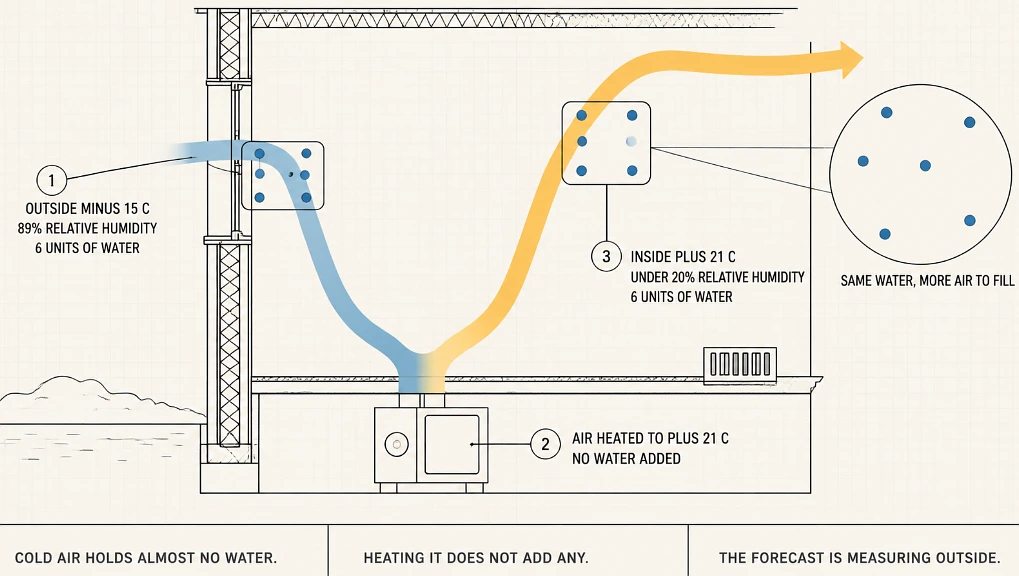
Pull up the weather for Edmonton in December and the relative humidity reads somewhere around 89%. January runs even higher. So why on earth would anyone be adding moisture to their house?
Because that 89% is outside, at minus fifteen, and cold air simply cannot hold much water in absolute terms. Bring that same air inside, heat it up to a comfortable twenty-one degrees, and the relative humidity collapses. **Your house ends up somewhere in the teens while the forecast is still telling you it is a humid day.**
What that dry air does to you and your things:
- Static shocks off every doorknob and every light switch
- Cracked lips, dry eyes, sore throat every single morning
- Solid wood furniture and floors shrinking and opening small gaps
- Houseplants dying without any obvious cause
- Musical instruments going out of tune and staying there
Buy the humidifier before the furnace starts running properly, not in January when every shop in the city has sold out. Whole-house units tied into the furnace are the better answer for a whole house, and a couple of decent room units will carry you through a first winter while you decide.
You Would Buy A Nice Coir Doormat. Here You Buy A Boot Tray.
The woven natural doormat is lovely. It is also completely wrong for a city that gets eleven snowfall days in December alone.
Coir holds meltwater, then freezes into a solid mat you cannot lift, and road salt chews through the fibres by February. Meanwhile every pair of boots coming through that door is carrying slush, grit and salt straight onto your floor.
What actually works at an Edmonton front door:
- A rubber boot tray with a raised lip, deep enough to hold the melt rather than let it run off
- A rubber-backed runner inside the door, washable, not decorative
- Hooks screwed into studs, because a soaking parka is heavy and drywall anchors give up
- A bench with storage underneath so nobody balances on one leg at minus twenty
The people who sell houses here talk about this constantly, which tells you something. Local agents at EdmontonRealEstate.ca put functional mudrooms high on the list during property tours, and their community guides for people moving to Edmonton keep circling back to the same point, that the entryway is the part newcomers underestimate and the part locals plan around first.
If your house has no mudroom, you build one out of a bench, a tray and four hooks. That is genuinely the whole project.
You Would Buy Bright Daylight Bulbs. Here You Buy Warm Ones.
Every bulb aisle pushes 4000K and up, sold as bright, sold as daylight, sold as the sensible choice.
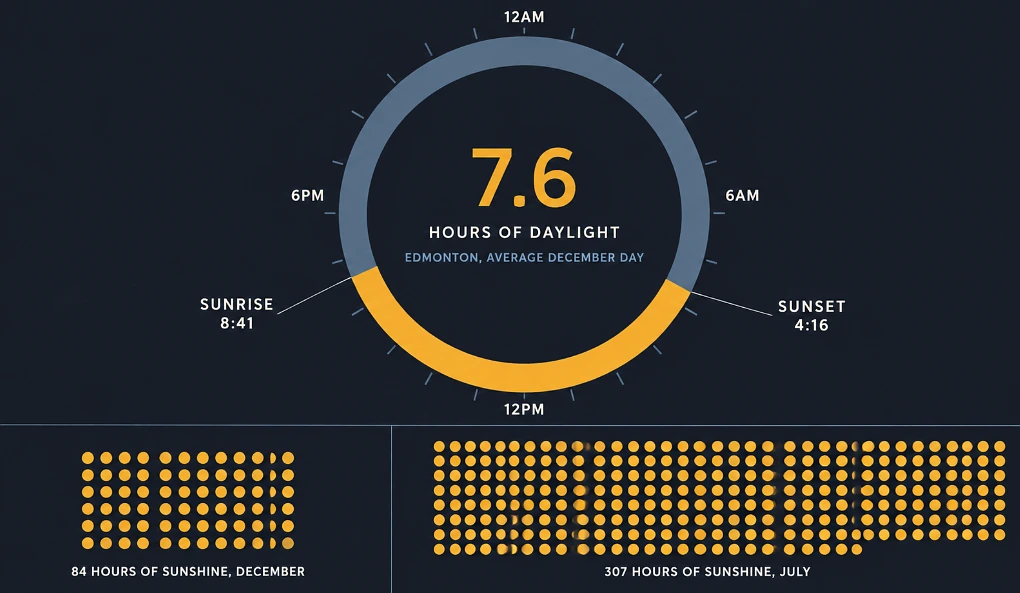
Now look at what December actually gives us. Sunrise at 8:41, sunset at 4:16, and 7.6 hours of daylight on the average day. Across the whole month Edmonton gets around 84 hours of sunshine, against 307 in July.
Read those two numbers next to each other for a second. Eighty-four against three hundred and seven.
You are going to be sitting under artificial light for most of your waking hours for months, and 4000K bulbs make a room feel like a waiting area at a walk-in clinic.
- 2700K to 3000K for living rooms and bedrooms, warm and yellow
- Lamps instead of the ceiling fixture, two or three low light sources beat one overhead every time
- Smart bulbs that brighten gradually in the morning, which is genuinely useful when 7am is still pitch dark
- Dimmers on anything you sit under after four in the afternoon
You Would Buy The Fiddle Leaf Fig. Here You Buy The Boring Plants.
Every plant that photographs well wants humidity. Calathea, maranta, fiddle leaf fig, most ferns, all of them come from places where the air is thick.
Then they meet a forced-air furnace running from October to April, and they crisp at the edges and drop leaves and die, and the new homeowner decides they are bad with plants. They are not bad with plants. They bought jungle plants for a prairie winter.
What survives here without a fight: snake plant, ZZ plant, pothos, rubber plant, cast iron plant, most succulents kept away from cold glass.
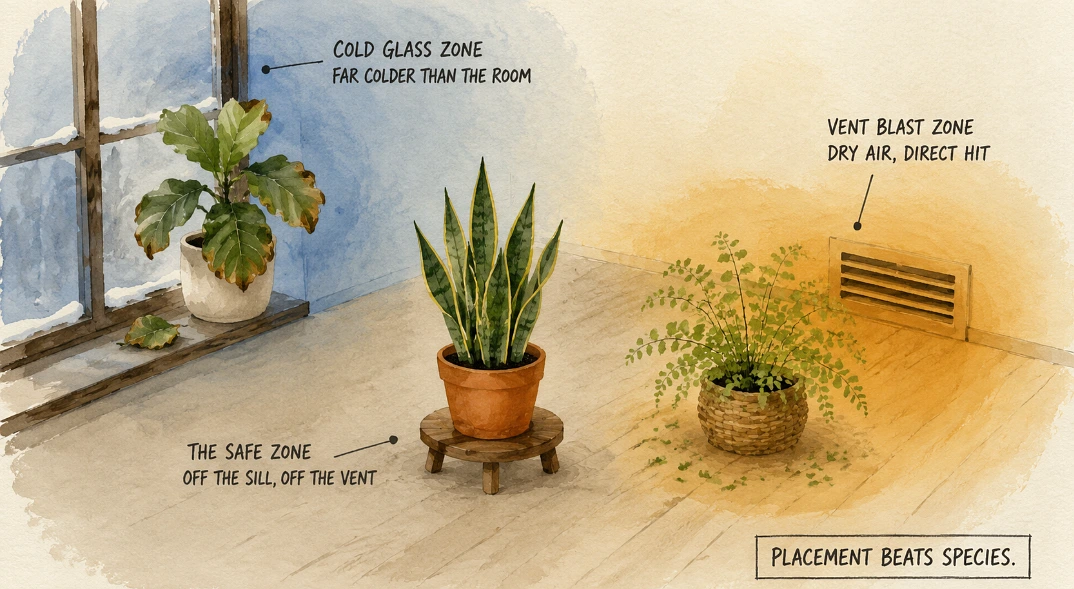
Two placement rules that matter more than the species does. Keep them off the windowsill, because the air right against a window at minus twenty-five is far colder than the room. And keep them away from the vents, because a furnace register pointed at a plant will finish it inside a week.
You Would Buy The Latex-Backed Rug On Sale. Here You Buy Wool.
Cheap synthetic rugs mostly come with a latex or rubberised backing, and that backing has a short life in a heated Canadian house. The same dry air that is cracking your lips dries the backing out until it crumbles, and you find grey rubber dust every time you lift the corner.
Wool is the swap, and it is not only about lasting longer:
- It genuinely insulates, holding a layer of warm air between your feet and a cold floor
- It handles dry air without degrading
- Natural fibres repel dirt rather than trapping it, which matters when the windows are shut for six months
- Secondhand wool rugs are everywhere and half of them are better made than anything new at the same price
Same logic applies to what you sit on. A leather sofa is beautiful and it holds the temperature of the room, so at seven in the morning in a house that dropped overnight, it is cold. Wool, boucle and heavy woven fabrics do not do that.
Before Any Of The Shopping, Two Boring Jobs
None of the five swaps above matters much if the heat is leaving through the windows.
Thermal drapes are worth the money, and the detail people miss is that they only work if they seal. Floor length, wider than the window, returned to the wall at both sides so warm air cannot slide down behind them. Hung properly they help lower heating bills, and hung like decoration they do very little.
Then the maintenance list. Furnace filter, window gaps, weatherstripping, detectors tested, and the general home safety pass that is easy in September and miserable in January.
Do those two while it is still warm enough to enjoy being outside.
The Short Version
- Humidifier, not dehumidifier. The forecast is lying to you about how dry your house will be.
- Boot tray, not doormat. Rubber, raised lip, washable runner behind it.
- 2700K bulbs, not 4000K. You will be under them for months.
- Dry-air plants, not tropical ones. Away from the glass, away from the vents.
- Wool, not latex-backed synthetic. Warmer underfoot and it survives the dry.
Nothing on that list is expensive and nothing on it is exciting. It is just the version of the shopping list that somebody who has already been through a winter here would write for you.
And you have got until roughly the end of October to sort it out, which sounds like plenty of time right up until it is not.
 Decor & Improvement Accessories