

Home & Decor Blogs: DIY, Interior Design & Lifestyle Ideas
What If Your Old Furnace Was Wrong For Your House All Along
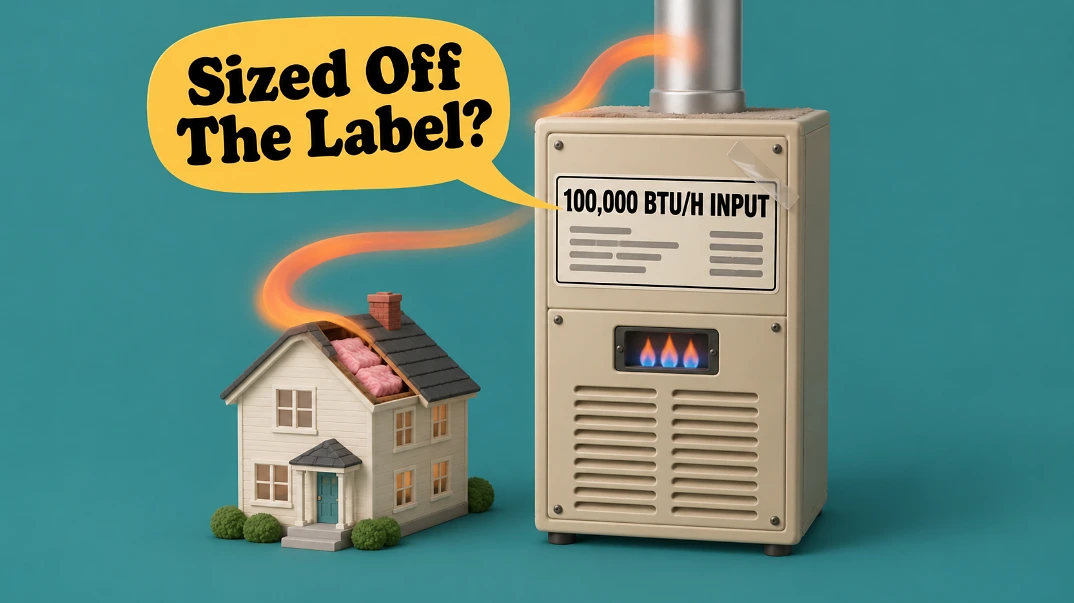
The furnace quits in January. The installer comes out. He reads the label on the old one and quotes a new one the same size. Done by Thursday.
That is how a lot of furnaces get replaced. No one questions the size because the old one ran for 20 years. If it was wrong, surely the house would have been cold.
Not necessarily. The old furnace may have been too big from the day it went in. Or the house may have changed around it. The label on the side answers neither question. Here is what does.
How A Furnace Should Be Sized, And How Many Of Them Were Sized Instead
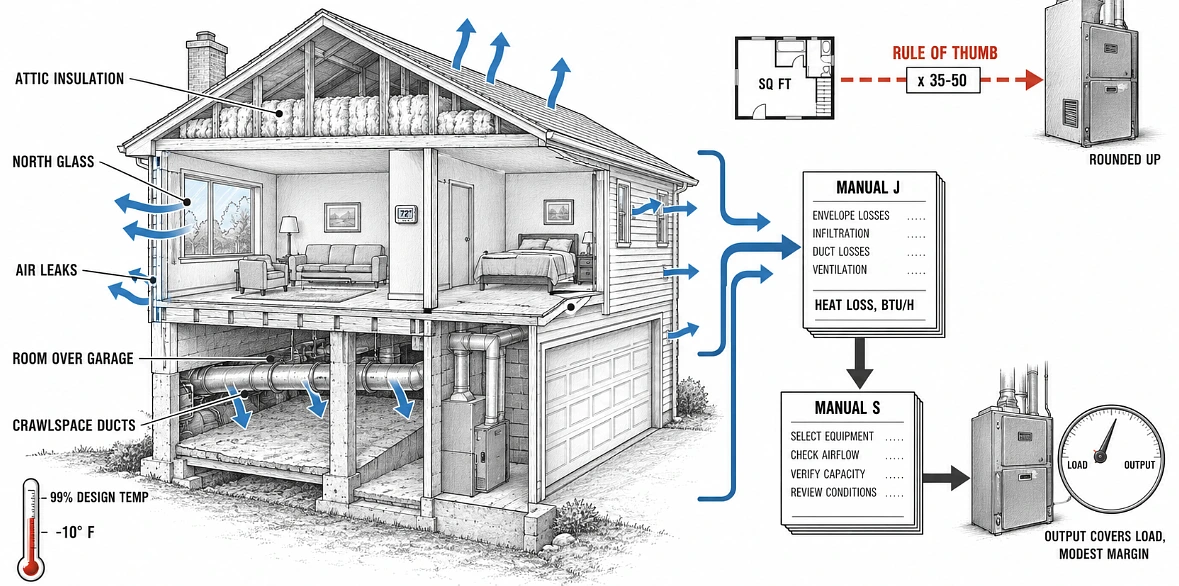
Proper sizing is a Manual J load calculation followed by a Manual S equipment selection. What a lot of older furnaces got was square footage times a number somewhere between 35 and 50.
The rule of thumb survived for decades for 1 reason. A furnace that is too big never produces a callback in February. A furnace that is too small does. So contractors rounded up. Then they rounded up again to be safe.
Manual J is the load method published by the Air Conditioning Contractors of America. It goes through the house wall by wall. Glass facing north. Insulation in the attic. How leaky the place is. Duct runs through the crawlspace. The outdoor design temperature for the area goes in against the indoor setting. That design temperature is not the record low. It is the 99% figure, the temperature that only about 1% of winter hours fall below, and the local building department usually publishes it. Out comes a heat loss number in Btu per hour. Manual S then picks a furnace whose rated output covers that number with a modest margin. Not double it.
Roots Heating and Air, who replace furnaces around the Denver suburbs, describe their process the same way. The load calculation comes first. Square footage, insulation, windows, duct layout and the airflow the ducts can carry all go in before a unit is named. That is the order the job should run in. Anyone searching for furnace installers in Thornton, CO or in any other town should ask a contractor whether that is the order they work in and what the calculation showed.
How common is the shortcut? The best public number is old and narrow but it is real. A Florida Solar Energy Center survey of 489 air conditioning contractors in the mid 1990s found that nearly 40% admitted to oversizing equipment on purpose on at least some jobs. That was cooling, in 1 state, 30 years ago. It is not a national furnace figure. It is the reason the Department of Energy wrote a fact sheet telling contractors to right size, and the habit it describes did not start or stop in Florida.
The Number On The Label Is Not The Number You Get At Altitude
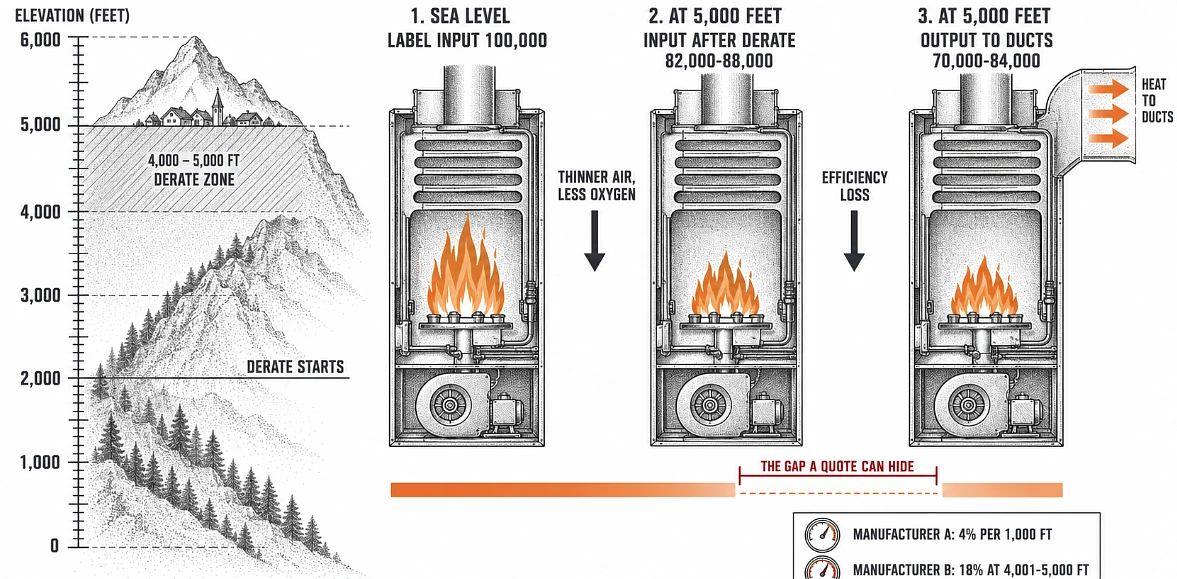
Above about 2,000 feet a gas furnace has to be derated because thinner air carries less oxygen to the burner. How much depends on the model. Size off the sea level label and the job is wrong before it starts.
The percentage is not a universal rule and 2 manufacturers’ manuals prove it. Rheem’s instructions say 4% off the input for every 1,000 feet above 2,000. Carrier’s manual for the 58PAV applies a 0.82 multiplier across the 4,001 to 5,000 foot band, which is 18% off. Same elevation, 2 different answers, and both are correct for the furnace they were written for. At 5,000 feet, which takes in most of the Front Range of Colorado plus a good part of Utah, Nevada and New Mexico, a furnace delivers somewhere between 12% and 18% less input than the box says depending on whose table applies.
That is input, the fuel going in. Output is the heat the furnace delivers to the ducts and it is a separate rating on the manufacturer’s data sheet. Output is the number that gets compared against the house, at every elevation, not only in the mountains.
The table below is an illustration of how far the numbers can move, not a sizing reference. It assumes a 12% derate and uses AFUE as a stand in for output. AFUE is a seasonal average, not a rated capacity, so the real output figure on the data sheet will differ.
| Label input, sea level | Input at 5,000 ft, 12% derate | Approximate output at 80% AFUE | Approximate output at 95% AFUE |
|---|---|---|---|
| 60,000 Btu/h | 52,800 Btu/h | 42,200 Btu/h | 50,200 Btu/h |
| 80,000 Btu/h | 70,400 Btu/h | 56,300 Btu/h | 66,900 Btu/h |
| 100,000 Btu/h | 88,000 Btu/h | 70,400 Btu/h | 83,600 Btu/h |
The point of the table is the gap between the first column and the last. A homeowner comparing the 100,000 on the old label against a Manual J result of 60,000 is comparing 2 different kinds of number.
Modern furnaces deal with altitude through a high altitude kit, an orifice and pressure switch change, or in a few modulating models an automatic adjustment. The installer should be able to say which applies to the quoted furnace and what its rated output is after the adjustment. That answer comes from the installation manual for that exact model and nowhere else.
The 3 Symptoms That Should Make You Question The Furnace Size
Short cycles. Temperature swings. Far rooms that never warm up. None of the 3 proves the furnace is oversized. All 3 are a reason to have sizing, controls and airflow checked together.
Start with the cycle. Stand near the furnace on a cold evening with a watch. A furnace that fires for 4 or 5 minutes and then sits for 10 is starting about 4 times an hour. If it does that all evening while the house struggles to hold temperature, something is wrong. Oversizing is 1 explanation. A clogged filter, restricted airflow, a limit switch tripping on overheating or a thermostat fault can produce the same pattern. Carrier’s own troubleshooting guidance lists all of them. Repeated brief runs are a reason to investigate, not proof of the cause.
Then the swing. Thermostat says 70. The room feels like 72 and then 67 and then 72 again. A big single stage furnace overshooting and then idling can do that. So can a badly placed thermostat. A 2 stage or modulating furnace holds a tighter band because it can run at a lower firing rate. A correctly sized single stage furnace still runs at its 1 rate and cycles. Sizing and staging are 2 different things.
Then the far rooms. The bedroom over the garage at the end of the duct run with 2 outside walls. It never gets warm. The usual fix is closing registers in the warm rooms to push more air down there. Closing registers raises duct pressure, cuts total airflow and can push the furnace toward overheating. That is bad on any furnace, not only an oversized one. The real question is whether that room’s heat loss and its duct run were ever matched, and that is a Manual J and Manual D question, not a thermostat one.
Excessive cycling does add wear. The DOE fact sheet says so plainly. It does not say by how much, and component ratings vary. A White-Rodgers hot surface igniter is rated at 100,000 cycles in its own installation sheet. So the argument against short cycling is not that the parts will fail next winter. It is that an oversized furnace cycles far more than it needs to and gives worse comfort while doing it.
The House Changed And The Furnace Did Not
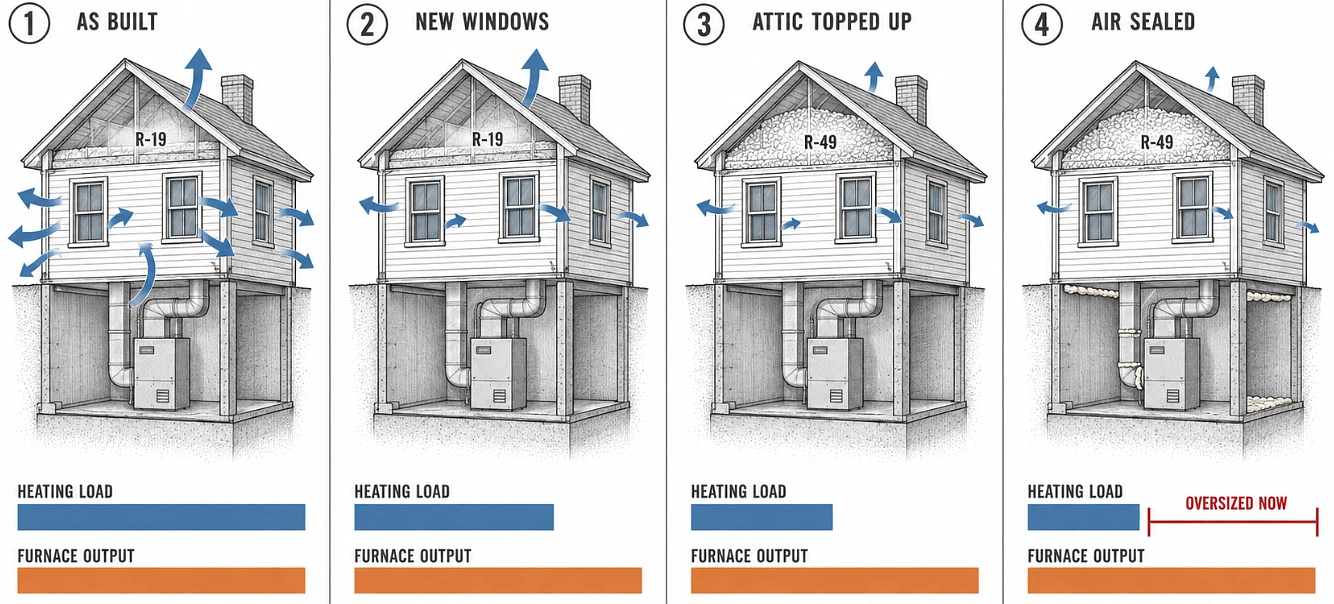
A furnace sized right in 1998 can be oversized in 2026 if the house has had new windows, more attic insulation or air sealing since. How much the load dropped depends on the house. The only way to know is to run the numbers again.
Picture a plausible sequence. Built with single pane aluminum windows and R-19 in the attic. 10 years in, the windows go to double pane low-e. A few years later the attic gets topped up to R-49 under a utility rebate. Then an energy audit points at the ducts and the rim joist and both get sealed. Each job was done for its own reason and each one took something off the design load. How much is not a fixed percentage. It depends on how much of the original loss came through that window or that attic in the first place. ENERGY STAR’s modeled estimate for air sealing plus attic and floor insulation together is about 15% off heating and cooling costs in a typical home, and that is 2 measures combined, not each.
So a house that once needed 60,000 Btu per hour might now need 45,000. Or 50,000. Or 40,000. The furnace in the basement is still whatever size it was, and no one has asked the current house what it needs.
It can go the other way. A finished basement, a sunroom, a converted attic. Each adds load and sometimes adds it to a furnace already at the limit of its ducts. Less common but worth checking.
ACCA’s own guidance is that an existing load calculation can be reused when the house and the ducts have not changed. That is fair. The problem is that most houses have no existing calculation to reuse. They have a label.
Old gas bills are not useless here, but they are not a shortcut either. Looked at raw, a winter bill only records what the old furnace burned, short cycles and all. Adjusted for weather and for the old furnace’s efficiency, the same billing history can be turned into a rough peak load estimate. The Massachusetts Clean Energy Center has used exactly that method to cross check Manual J results on its heat pump program. It is a check on the calculation, not a replacement for it, and it says nothing about which rooms need the heat.
What To Ask For Before The New Furnace Is Ordered
Ask for the load calculation on paper. Ask how the furnace was selected from it. Ask what the furnace’s rated output is at your elevation. A quote that shows only the label input has skipped all 3.
The load report is a few pages. Room by room heat loss and a total. A contractor who recommends 100,000 Btu per hour should be able to show where that number came from. If the answer is the old label or the square footage, ask for the calculation. If the answer is an existing report from a previous job on an unchanged house, that can be fine. Check the inputs on it. Outdoor design temperature and elevation should match where the house is. A Manual J run on default settings for the wrong place is the wrong calculation done carefully.
The selection step is the one most people have never heard of. Manual S takes the load and picks equipment whose rated output, at the installation conditions, covers it within set limits. That is where the altitude derate gets applied and where the furnace’s own data sheet comes in. Ask for the rated output figure, not the input.
2 smaller things. If the house has changed since the ducts went in, ask whether a Manual D duct check is part of the job. A right sized furnace on wrong sized ducts brings its own trouble. And if the load lands between 2 furnace sizes, ask about a 2 stage or modulating unit. Staging is not a substitute for sizing, but a furnace that can run at a lower rate most of the winter gives steadier heat than a single stage unit rounded up to the next size.
The old furnace may have been wrong. The new one does not have to be. The difference is a calculation and a selection step that take a few hours and that the quote should show.
 Decor & Improvement Accessories