

Home & Decor Blogs: DIY, Interior Design & Lifestyle Ideas
What the First Year in a House Made of Windows Teaches You

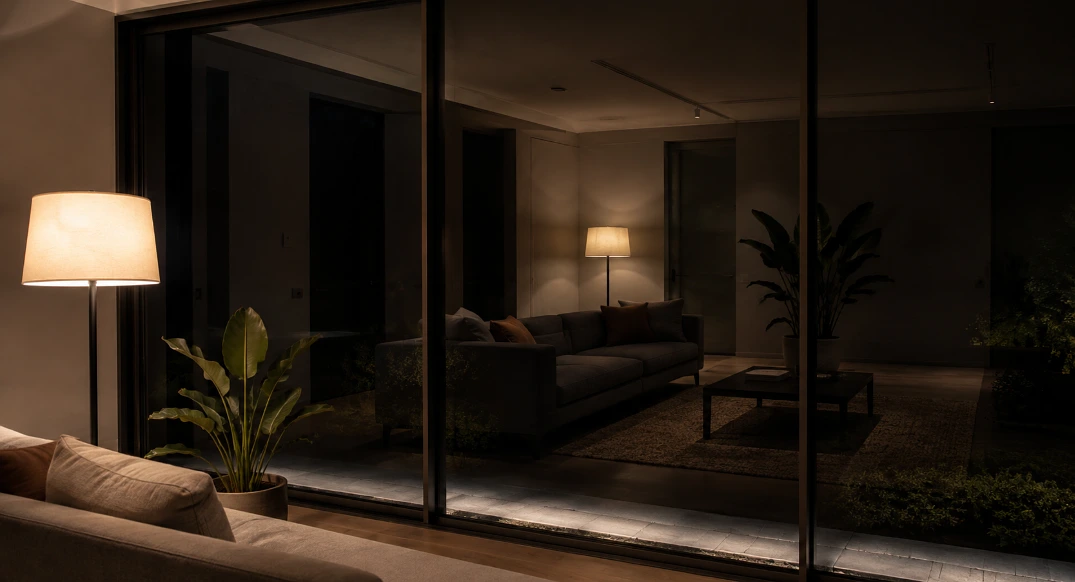
No one warns you that at night your windows stop being windows. They turn into mirrors, and everyone outside can see in perfectly
The thing that sells these houses is usually a single moment, standing in an empty living room at four in the afternoon while the light comes across the floor.
Two days after moving in comes the other side of it, up a stepladder with a bottle of glass cleaner, wondering whether the delivery driver could see through the foyer glass and whether the whole thing was a mistake.
It is not a mistake. The light is worth the hassle. But a glass house changes how you decorate, where furniture goes, and how you think about privacy, and none of that appears on the mood board.
The First Weekend Is Mostly Spent Staring at Shadows
Very little gets unpacked that first weekend. Most people just wander from room to room watching the light move.
You stop checking a weather app and simply look up. The visual line between sofa and garden disappears entirely, and that part never gets old.
Then the unpacking starts and the real problem surfaces.
Where does the television go? Where does the art go?
A glass house has almost no vertical surfaces. Pushing a bookshelf against a wall blocks the view you paid for, so furniture ends up floating in the middle of the room instead.
Learn the Three Numbers on Your Window Labels
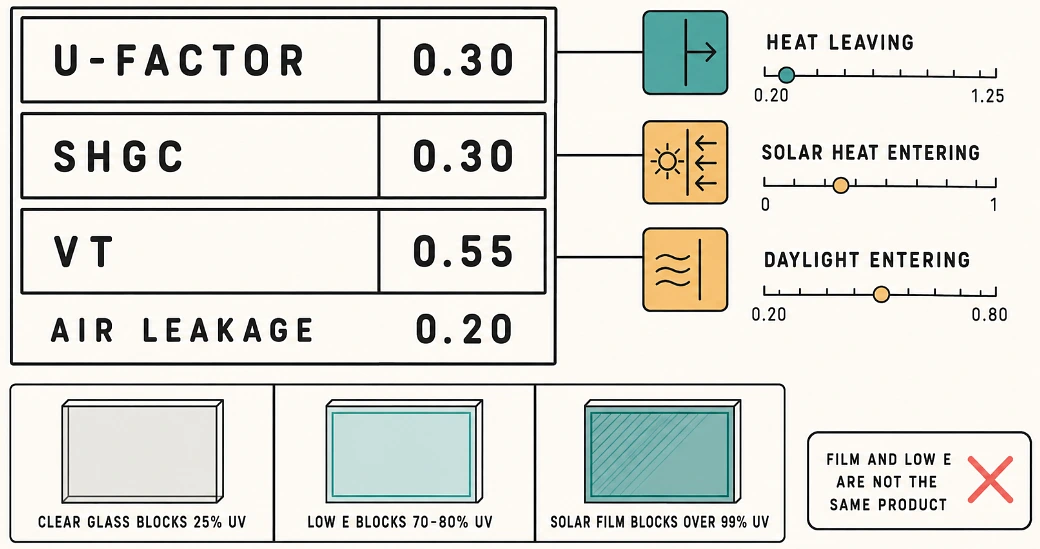
Before any decorating decision, it is worth understanding what the glass itself is doing, because every NFRC label carries three ratings that explain most of what happens in the room.
- U factor measures heat loss. It runs from about 1.3 on old single glazed aluminium down to around 0.2 on high performance units, and clear single pane sits near 1.0 while low e double glazing is closer to 0.30. A window at 0.6 loses twice the heat of one at 0.3.
- SHGC, the solar heat gain coefficient, measures how much of the sun’s energy comes through as heat, on a scale of 0 to 1. A window at 0.6 admits twice the solar heat of one at 0.3, which is why west facing glass in a warm climate wants a low number.
- VT, visible transmittance, measures how much daylight gets through. Clear glass runs 0.60 to 0.70, low e coated glass 0.40 to 0.60, and heavily tinted glass drops to 0.30 or below.
Low e coatings are the reason modern glass performs at all. They cut heat transfer by roughly 30 to 50 percent against clear glass and block 70 to 80 percent of UV, where plain clear glass stops only about 25 percent.
By Week Two the Furniture Starts Moving Away From the Sun
The thing few buyers think about is that sunlight destroys furniture, and it does it faster than seems reasonable.
Leather fades within months in direct light. Fading comes from UV at roughly 40 percent, infrared heat around 25, and visible light another 25, so blocking one of the three is never enough.
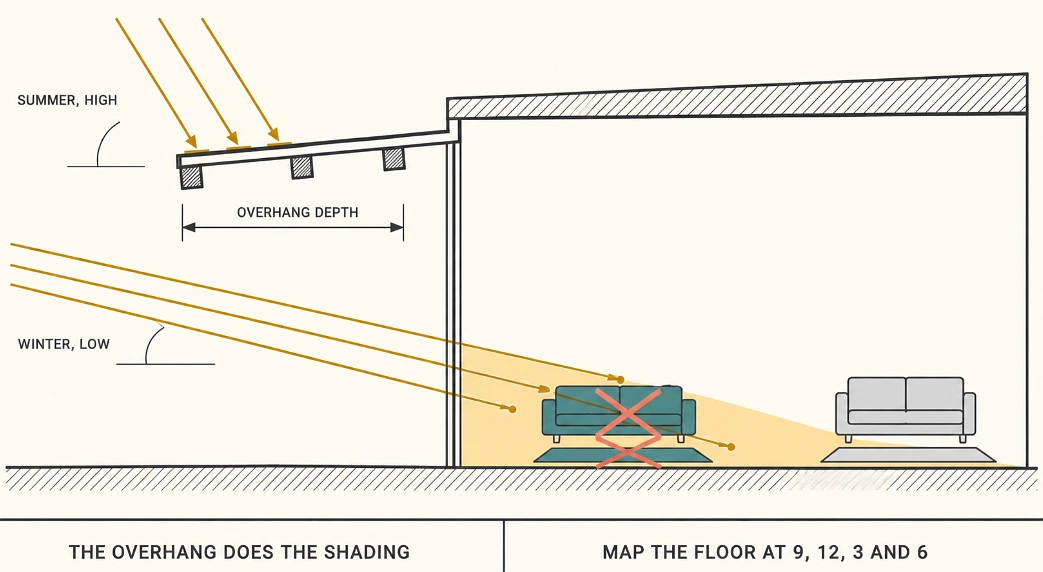
Mapping the sun is the fix. Walk the house at 9am, noon, 3pm and 6pm across a week and mark which floor and which pieces take the worst of it.
Then move everything delicate out of those zones, so antique wood, natural fibre upholstery, and any rug worth keeping.
For whatever has to stay there, solar control window film runs $5 to $20 per square foot installed, roughly $250 to $700 per window, and blocks over 99 percent of UV.
One correction worth knowing early. Solar film is not the same as low e glass. Film handles heat and UV coming in. Low e coatings mainly deal with heat escaping in winter. Different products for different problems, and film must be matched to your glass type, because the wrong film can trap heat between panes and stress the seals on double glazing.
How to Warm Up All That Glass
Pacific Northwest houses solve the aesthetic side better than anywhere else, largely because the rain and the dark winters make maximising daylight a necessity rather than a style choice.
The good ones never feel cold or sterile. The trick is structural warmth. Exposed timber beams, deep overhangs, sweeping rooflines that frame the glass rather than just holding it. You get transparency and shelter at the same time.
Real Estate’s guide to this aesthetic balance is worth reading before building or renovating, because the part worth copying is the framing rather than the glazing.
The deep overhangs matter most of all, since they shade the high summer sun while still letting the low winter sun reach into the room, and that only becomes obvious across a full year.
Month One Is About Making the Space Feel Warm Instead of Empty
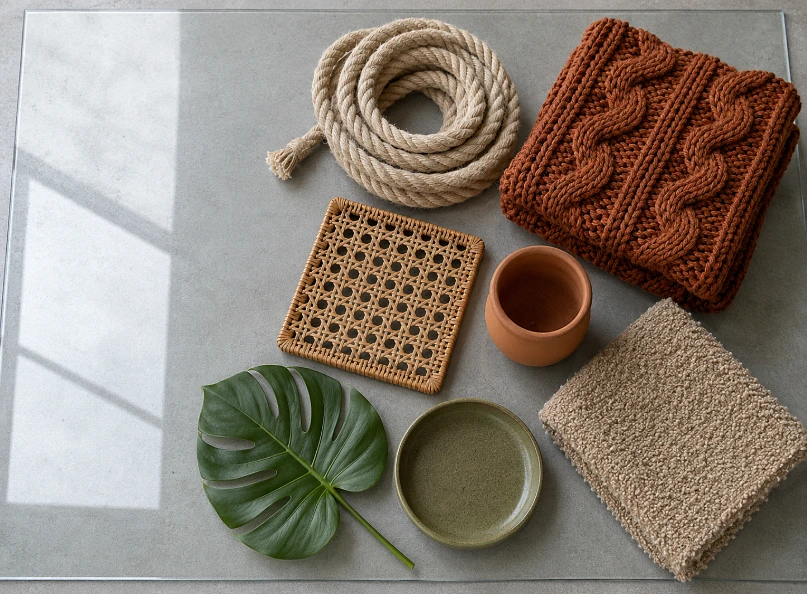
A glass house drifts naturally toward gallery minimalism, and that has to be actively resisted.
Everything about the architecture is a hard grid. Straight frames, straight lines, smooth cold surfaces. The furniture has to go the other way.
What works:
- Round and curved shapes instead of boxy ones, especially the coffee table
- Earthy colours, terracotta and olive and rust, rather than the grey most people plan for
- Heavy texture everywhere, rattan, wool rugs, chunky knit throws
- Big floor plants, which blur the line between inside and outside through the glass
Glass is smooth and cold, so everything else needs to be warm and tactile. Once that clicks, the room stops feeling like a showroom.
Month Three Is When the Fishbowl Problem Gets Solved
The novelty wears off around then, replaced by wanting to watch television in sweatpants without feeling like an exhibit.
Nights are the problem, because when it is dark outside and bright inside the glass turns into a black mirror, so you cannot see out at all while everyone on the pavement can see straight in.
Two layers fix it. Solar shades for daytime glare while keeping the view, blackout rollers behind them for night.
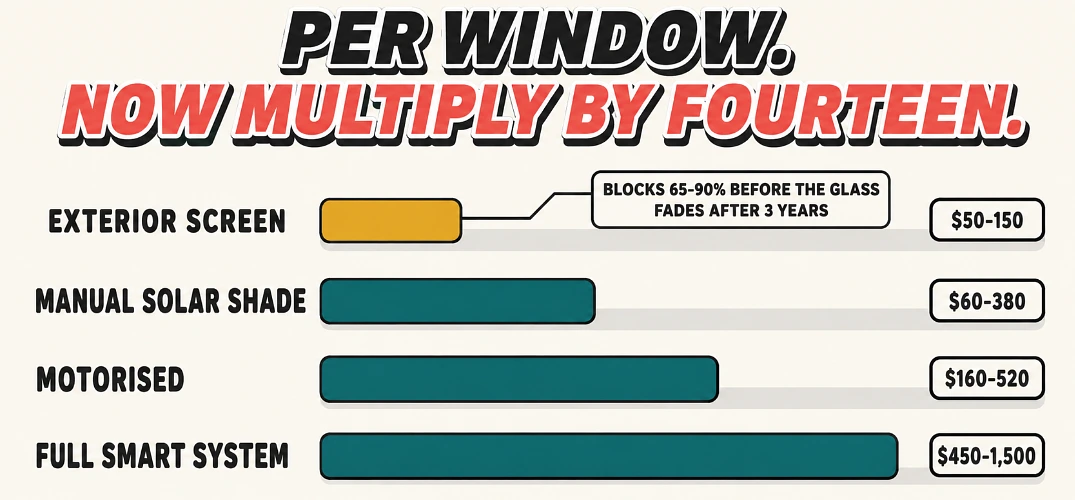
No one quotes these prices upfront so here they are. Manual solar shades run $60 to $380 per window installed. Motorised versions run $160 to $520, and full smart home systems reach $450 to $1,500 per window.
Exterior solar screens are the more effective option, since they stop heat before it reaches the glass and block 65 to 90 percent of it, at $50 to $150 per window. They also fade after about three years in direct sun and last roughly ten years overall.
Motorisation is not a luxury in a glass house. Most owners resist it on cost and then reconsider around the fourth evening of pulling fourteen shades down by hand.
One fix costs nothing at all. Pull out every bright overhead fitting near the glass, because they create blinding reflections. Floor lamps, table lamps and low ambient light positioned away from the windows drop the mirror effect dramatically and make the room cosier.
A Year In, the Trade Is Worth It
Living here makes you a more deliberate decorator, mostly because there is nowhere to hide anything. No dark corners exist.
You wake with the sunrise without meaning to. You watch storms roll in from the sofa. You are outdoors constantly without going outside.
The costs are real. An absurd amount goes on glass cleaner, hanging one piece of art can take weeks of deliberation, and the shades are not cheap.
Still worth it though, because when the late afternoon light comes across the floor and throws those long shadows over the rug, most people stop whatever they are doing and just look at it for a minute.
 Decor & Improvement Accessories