

Home & Decor Blogs: DIY, Interior Design & Lifestyle Ideas
Why Do Some Roof Repairs Fail After the Next Heavy Rain?
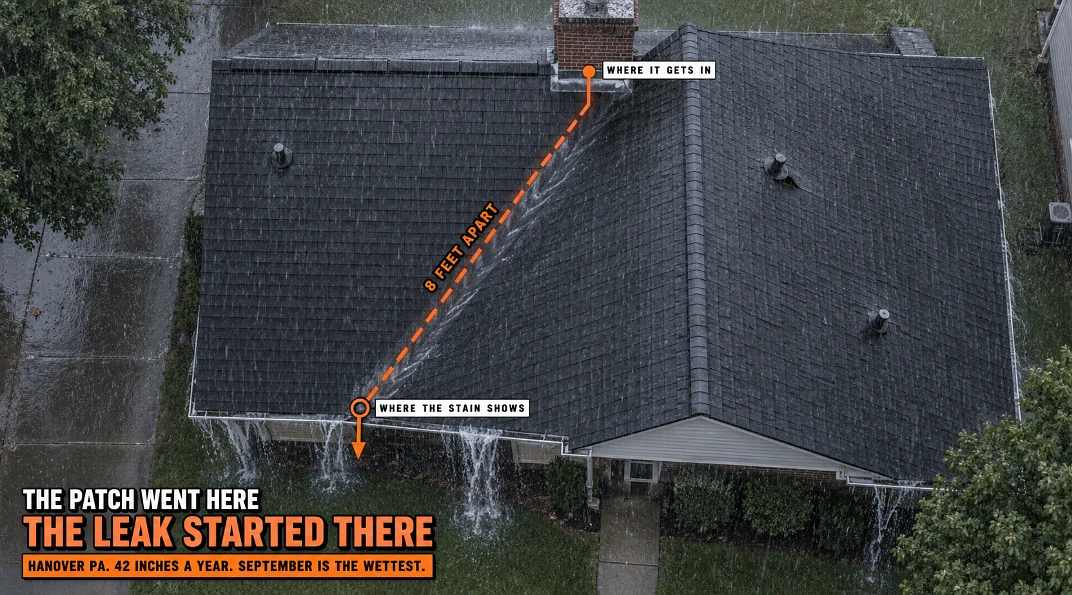
Rain, rain, go away, my roof is very weak today.
Our roofs can look fixed on a dry afternoon and then feel they are leaking again the moment the next hard rain is coming down, and it is not always the new work that has gone wrong. What has mostly happened is the repair was covering the spot where the water was showing up inside the house, and no one was looking for the path the water has been taking to get there. So we are dry for a week or 2 and then the same stain is coming back on the same patch of ceiling and we are standing under it wondering what we paid for.
Here in Hanover and the rest of south central Pennsylvania a leak that keeps coming back is more than a bother, because every time the water is getting in it is reaching the decking and the insulation and the drywall, and those are not drying out on their own the way a puddle on the porch does. A repair that is going to hold has to start with why the water came in, and sealing the place where it came out is not the same job at all.
Where The Water Is Really Coming In
The stain on our ceiling is showing us where the water finished, not where it started. We are looking at a wet patch, we are going up into the attic, we are looking straight above it, and we are seeing nothing wrong, because there is nothing wrong there.
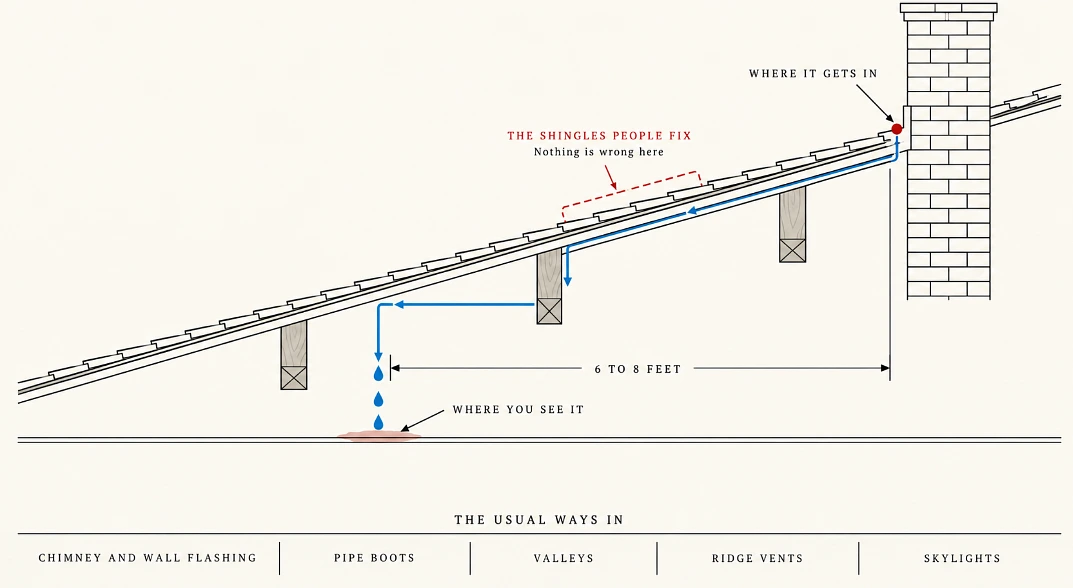
The water has been getting in at a joint somewhere higher up, it has been running down the underside of the decking or along a rafter, sometimes along a line of nails, and it is dropping off wherever it finally meets something it cannot cross. That can be 6 or 8 feet away from where it came in. These are the usual ways in:
- Flashing around the chimney, or where the roof is meeting a wall.
- Pipe boots, the rubber collars around the plumbing vents, which are cracking in the sun after a few years.
- Valleys, where 2 roof slopes are meeting and the water is running deepest.
- Ridge vents and any other vent that has been cut into the roof.
- Skylights, and the shingles right around them.
Fix the shingles straight above the stain and the joint that failed is still sitting open, and the next big rain is going to send the water down the same route it was using before.
What A Roofer Should Be Checking Before Any Sealant
Kennedy was saying it back in 1962, the time to repair the roof is when the sun is shining, and he was talking about the economy but roofers have been repeating it ever since because it is plainly true of roofs. Nothing is getting found in a storm. A proper repair is starting with someone up there on a dry day, checking the chimney flashing, the wall flashing, every pipe that is coming through, the ridge vent, the valleys, the skylights, and whether the attic is breathing at all, before a single tube of caulk is being opened.
So does sealant ever count as a real repair?
On a small nail hole or a lifted shingle tab, yes, it does. On a failed joint, no, it does not, and I was asking Jordan Roscoe about this as well, he is the sales manager at BealingRoofing and they are doing roof repair services for homeowners in Hanover, PA, and he affirmed it, he was saying the same thing we have been seeing on roofs for years. Caulk is sealing the easy route and it is leaving the broken flashing sitting underneath, so the roof is holding in light rain and failing in heavy rain, which is exactly the pattern people are calling in about. Wind is pushing rain sideways into openings that plain falling rain never touches, and a heavy storm is sending so much water down a valley that a weak joint is being overwhelmed even though it was holding last month.
Why Flashing Fails Without Anyone Seeing It
Flashing is the metal at every place where shingles alone cannot keep the water out, the chimney, the walls, the pipes, and it is the part we understand least because we cannot see most of it. It is sitting under the shingles and under the siding, and only the front edge is showing.
If it was put in wrong, or it has been pulling loose over the years, or it has simply rusted through, then smearing roofing cement over the top is doing something for a while and then it is doing nothing. The joint underneath is still open, and the cement is cracking with the first freeze. That is the whole reason a leak can be disappearing after a repair and coming back in a bigger rain, the surface was fixed and the flashing was not.
When An Old Roof Is Not Worth Repairing Anymore
Not every repeat leak is bad repair work. Sometimes the roof has simply got to the age where patching it is not making money sense anymore, and Longfellow had it right, into each life some rain must fall, every roof is getting there.
The 40% Line
Bealing’s rule is that if fixing the roof would be costing more than 40% of replacing it, replacement is usually the better spend. Jordan was giving me that number and the reasoning behind it, which is running like this:
- A repair has to be adding real life to the roof, and 7 to 10 years is the figure they are working to.
- If the repair is adding less than that, the money is going into a roof that is going to need replacing anyway.
- Past 40%, 4 in every 10 dollars of a new roof has already been spent and there is still an old roof sitting on the house.
Leaks Showing Up In 2 Or 3 Places
A roof with 1 leak in 1 place is a good candidate for repair. A roof over 20 years old with leaks in 2 or 3 places is telling us something different, because the shingles and the flashing and the pipe boots all went on at the same time and they are all wearing out at the same time. Fix 1 of them and the next one is showing up the following spring.
How Old Patches Hide The Real Leak
It never rains but it pours, and on a roof that has been patched a few times it is pouring in a few places. Layer after layer of cement and sealant and swapped shingles has been hiding the first failure without ever fixing it, so the roof is getting a history. 1 spot gets patched, a new stain is showing up 4 feet over, that gets patched, and from inside the house every one of them is looking like a new problem. From up on the roof they are usually all the same problem, 1 open joint that has been feeding 3 stains.
Bealing’s way of dealing with that is taking out what failed and putting in new, the wall flashing, the chimney flashing, the pipe flashings, the damaged shingles, the valley metal, the ridge vent, and not covering old material and hoping it stays dry.
What do you guys think, a roof that has been patched 3 times, is that a repaired roof or a roof waiting on its replacement?
How A Bad Attic Can Look Like A Roof Leak
A wet ceiling is not always rain. A hot damp attic with no proper airflow is making condensation on the underside of the decking and on the nail points, and that is dripping, and from below it is looking exactly like a leak. In winter the same poor airflow is melting the snow from underneath and the water is refreezing at the cold edge of the roof as an ice dam, and then the melt behind it is backing up under the shingles. New shingles are doing nothing about either one. Sometimes the right repair is a ridge vent or more intake at the eaves and no shingle work at all.
Why Heavy Rain Finds The Weak Repair Every Time
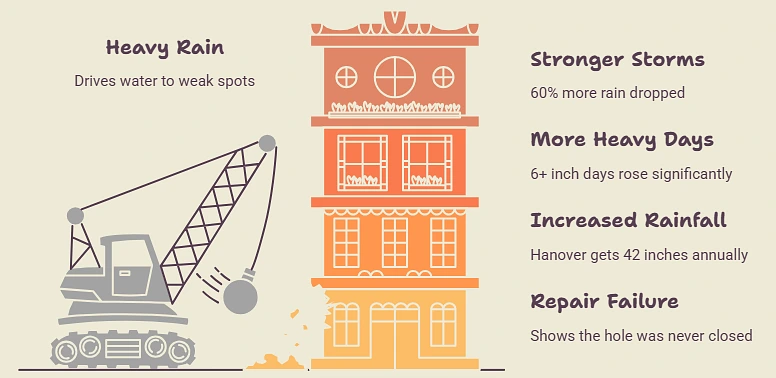
Light rain is not a test of anything. A marginal repair is looking perfect through a month of showers because hardly any water is reaching the weak spot, and then a real storm is coming and the valleys are running full and the wind is driving rain against the walls and the flashing, and the spot that was staying dry all month goes active. So the storm is getting blamed for breaking the repair, when it was only showing us that the repair never closed the hole.
And our storms are getting bigger. See the rain numbers for yourself:
- Hanover is getting 42 inches of rain a year, and the US average is 38.
- September is our wettest month at 4.3 inches, and February is the driest at 2.7.
- Something is falling on about 118 days of the year.
- Penn State Extension was looking at 58 weather stations across the Northeast, 14 of them in Pennsylvania, and they were finding that days with over 6 inches of rain went from 6 in the years 1979 to 1996 up to 25 in the years 1997 to 2014, and the 2 to 4 inch days rose 21%.
- The stations with the most heavy rain days were sitting in the eastern half of Pennsylvania, which is our half.
- Climate Central is putting it another way, the heaviest storms in Pennsylvania are now dropping 60% more rain than they were 60 years ago.
So a repair that would have been holding fine in the 1980s is being tested harder now than it ever was, and the rain that is testing it is not going to be getting lighter. September is the wettest month in Hanover, and it has already started.

 Decor & Improvement Accessories