

Home & Decor Blogs: DIY, Interior Design & Lifestyle Ideas
Creating a Home Office That You Want To Work In
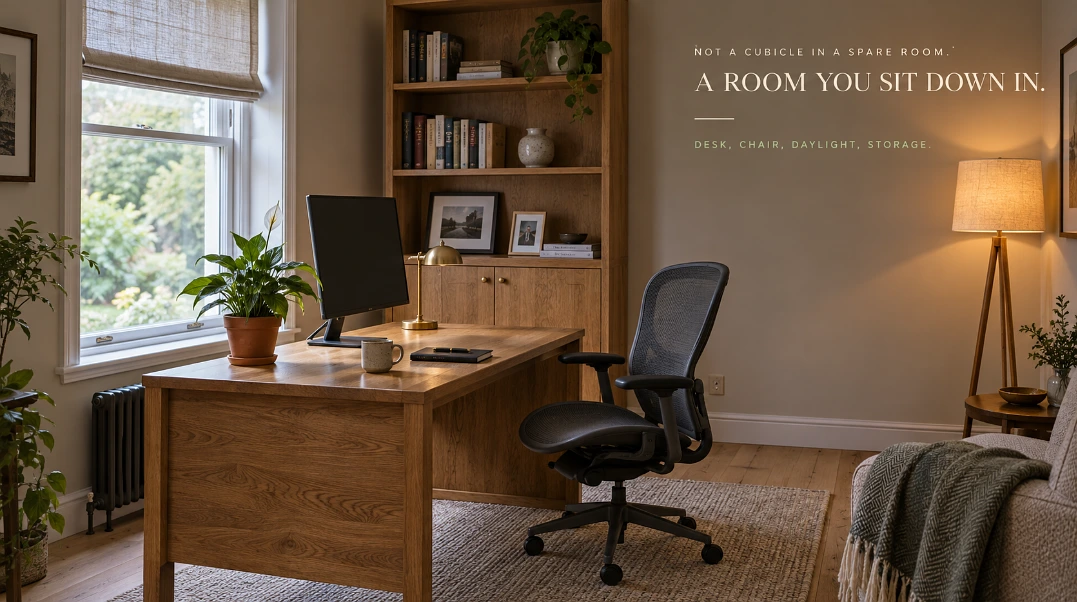
The way we use our homes has changed. For a whole bunch of us, the home office is no longer that corner of the house where you answer a few emails on a Sunday. It’s where the ideas get worked out, where the meetings happen, where the projects get finished, and where the working day starts and ends.
So the design of that space is worth some real thought, and here is the good news before we go anywhere: a home office that actually works does not have to look like a corporate cubicle farm. If anything, the opposite is true. Pull together some proper furniture, a bit of sensible organization and a bit of your own taste, and you end up with a room that is useful and still somewhere you want to be. The whole trick is the balance. You want a room where you can get down to work, where you can sit comfortably, and that doesn’t strip out the warmth and character that makes a house feel like a home.
Let me walk through how you actually get there.
Good Furniture Is the Foundation, and It Earns Its Keep
The furniture is the part that either carries the room every day or quietly lets you down, so it is the one thing worth getting right before anything else.
The sensible place to start is the furniture, when you are building out a space that has to perform day in and day out. And I do not mean “quality” as in “looks expensive.” I mean how the thing is actually built. The construction, the materials, the proportions, whether it is comfortable to use for six hours straight. That is the real difference between high-quality office furniture and a piece that just sits there taking up space, and you only find out which one you bought after a few months of actually using it.
The desk should be big enough to accommodate everything you use in a normal day, but not so big that it swallows the whole floor. Take the storage. It’s got to be handy, but you can’t forget that nobody wants to see the clutter. And the chair has to hold you in a decent position long after the excitement of getting a new chair wears off.
There is an old line, usually pinned on William Morris, and it is about the best rule for a workroom I know of:
“Have nothing in your house that you do not know to be useful, or believe to be beautiful.”
A good home office is basically that sentence made into a room. Pick the furniture well and those practical pieces sit alongside the rest of your house instead of announcing “this is the work bit.” Pick it badly and the office feels like a separate, slightly sad little office bolted onto your home. You can feel the difference the moment you walk in.
Start With the Room You Have, Not the Room You Want
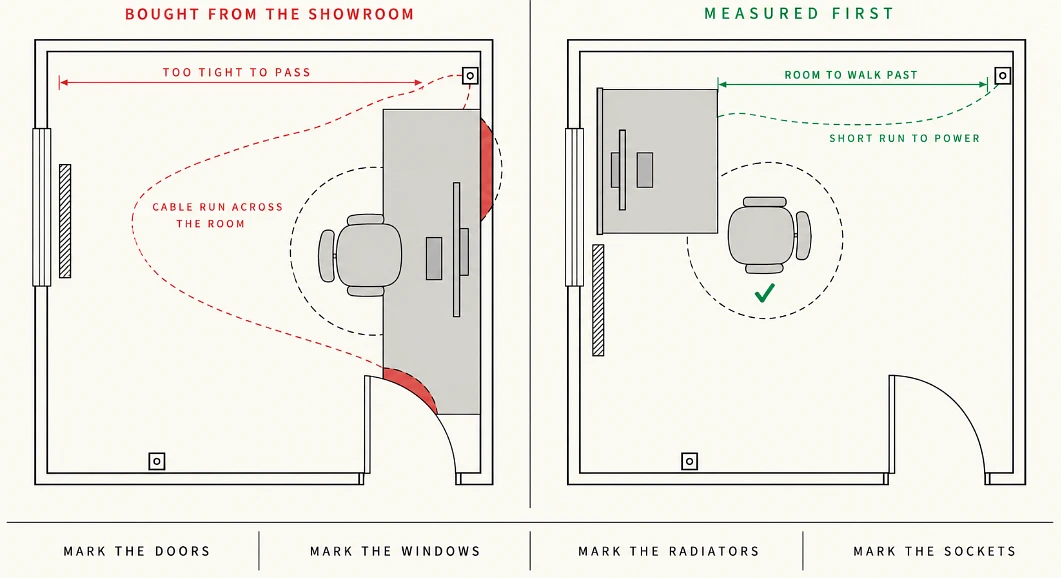
Before you buy anything, take ten minutes and look at the room, and measure the floor. Note where the doors, the windows, the radiators and the sockets are.
That one dull step saves you from the classic mistake. The desk that seemed so reasonable in the showroom suddenly feels enormous once it gets into your small room at home, and now you have to squeeze past it to make yourself a coffee.
Consider how you will use the space, too, so you can pull the chair out, reach the storage, and turn around without knocking anything over in the process.
If the Room Does More Than One Job
Many “home offices” are not really home offices at all. They are the spare bedroom that hasn’t been used in years, the corner of the living room, or the end of the dining table that has quietly been annexed. If that is you, then think about how the furniture behaves when you are not working.
Is that desk in a good spot if a guest is sleeping in that room over the holidays? Can you move things out of the way, or close them away, and turn it back into a bedroom for the weekend? A flexible layout makes a compromised, dual-purpose room genuinely functional. A more confining one just means you are annoyed at it half the year.
Choose a Desk That Fits How You Actually Work
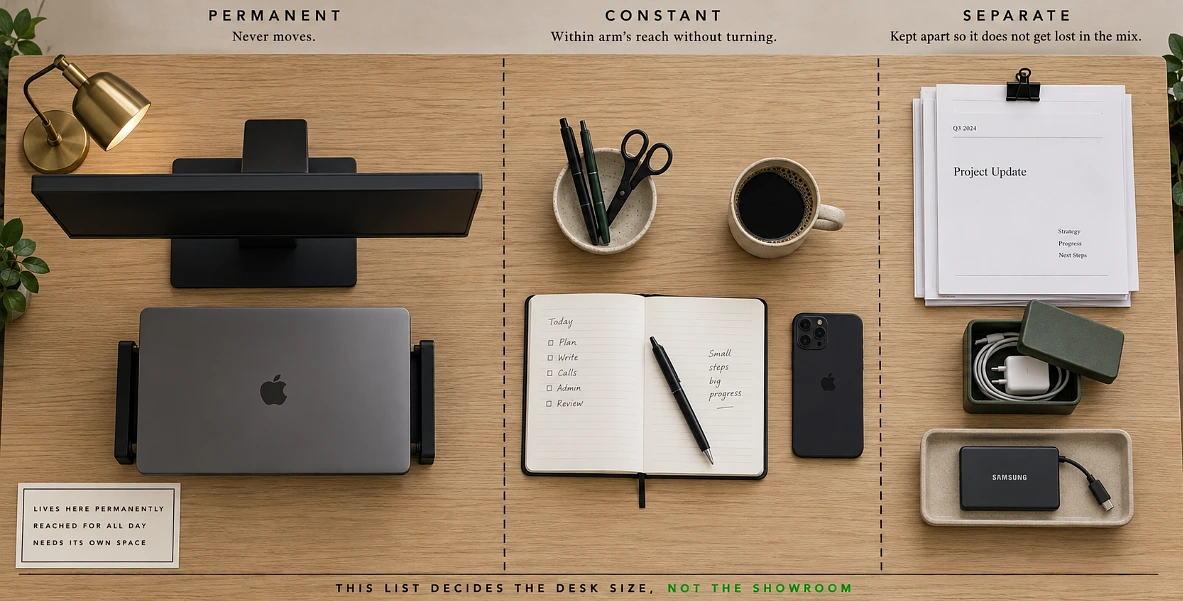
The right desk is not the biggest one or the prettiest one, it’s the one sized to what you actually put on it every day.
The desk is usually the middle of the whole thing, so it has to suit the way you work, not the way a catalog photo works. Somebody who lives on a laptop needs very little surface at all. Somebody else has two monitors, a stack of paperwork, three notebooks and a bit of specialist kit, and needs a proper spread. There is no one desk size that is right for everyone, whatever the “best desks 2026” listicles may say.
So do this instead. Picture a normal working day and write down what genuinely has to stay on the surface the whole time:
- The things that live there permanently, the monitor, the lamp, the laptop stand.
- The things you reach for constantly through the day, the notebook, the pens, the phone.
- The things that need their own space so they don’t get lost in the mix, paperwork, chargers, whatever your work throws at you.
That list, not a showroom photo, tells you how much surface you actually need. Then think about the desk storage: a couple of drawers for your odds and ends, and a top big enough to keep work areas separate, will do more for your day than any amount of clever styling.
Comfort Is Not a Luxury You Add Later
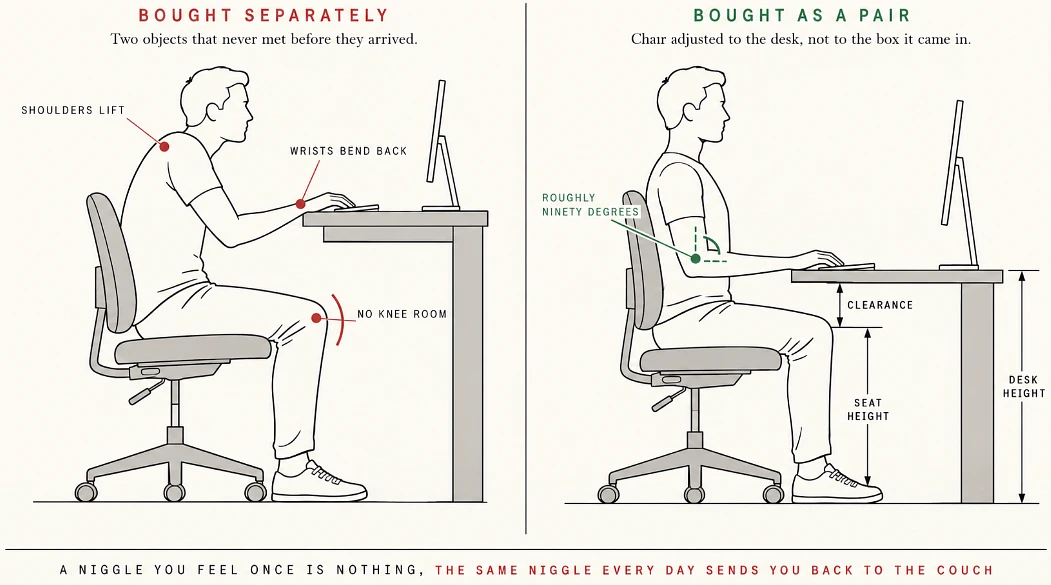
So is a comfortable chair really worth the money, or is that just something furniture sellers say?
It is worth the money, and it is not close.
You spend hours a day at that desk, and it is the one place you should not skimp. A good chair holds you comfortably in whatever position suits you and supports you where your body wants it, and adjustability earns its price because no two bodies are the same shape.
And the desk height matters just as much, because the chair and the desk have to work as a pair. Buy them as two unrelated objects and you end up hunched, or reaching up, or with your knees jammed underneath. A niggle you feel once is nothing. The same niggle every single day is what sends you back to working on the couch, which is exactly what the office was supposed to stop.
Make Natural Light Part of the Plan, Because the Science Is Not Subtle
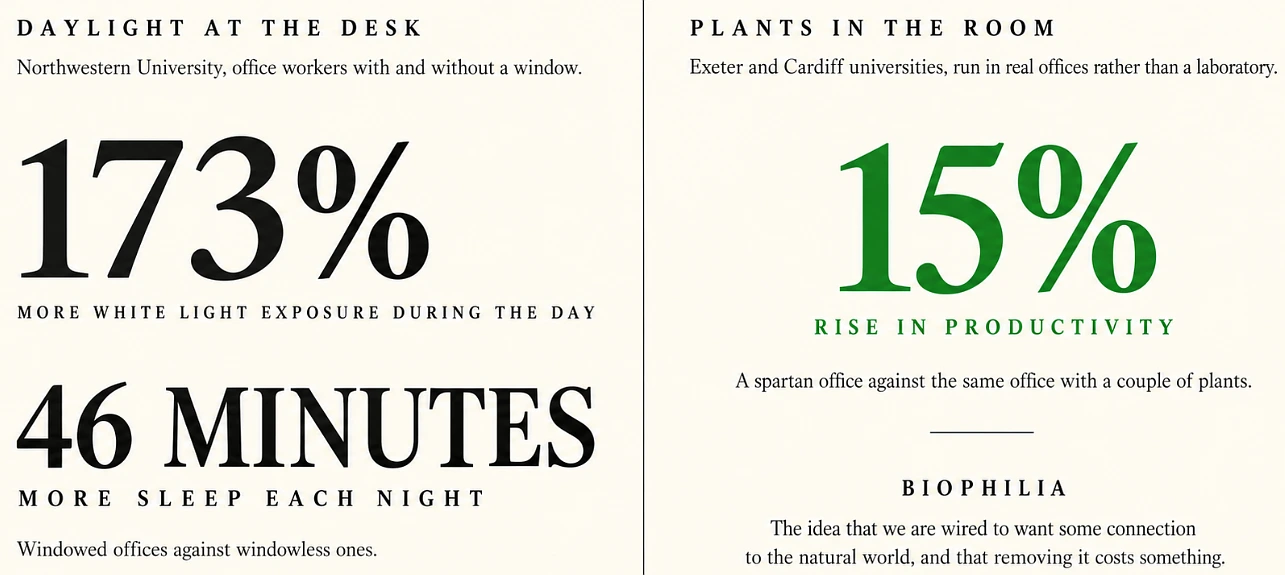
Daylight is not a nice-to-have, it measurably changes how well you work and sleep, so build the room around it.
Natural light does more to the feel of a room than almost anything else you can do to it. Put the desk where you get daylight but not direct sunlight dazzling onto your screen, and the whole room sings.
And this is not just a mood thing, which is the part I find genuinely interesting. There is actual research behind it. A Northwestern University study found that office workers in windowed offices received 173% more white light exposure during the day, and slept an average of 46 minutes longer per night than the ones in windowless spaces. That is forty-six minutes. That is your circadian rhythm doing its job, the internal clock that daylight sets and screen-light quietly wrecks. So a desk by a window is not decoration. It is you working with your own biology instead of against it.
Do watch the direction of the sun, though, and how it moves during the day. If the monitor catches direct rays, the display turns into a mirror and you cannot read a thing. Close the blind or draw the curtain when the glare is bad, open it again when the light is kind, and the window becomes part of the character of the room. A view of the garden, the street, whatever is out there, gives your eyes somewhere to rest and your head a change of scene halfway through a heavy afternoon.
Layer the Lighting for the Hours the Sun Clocks Off
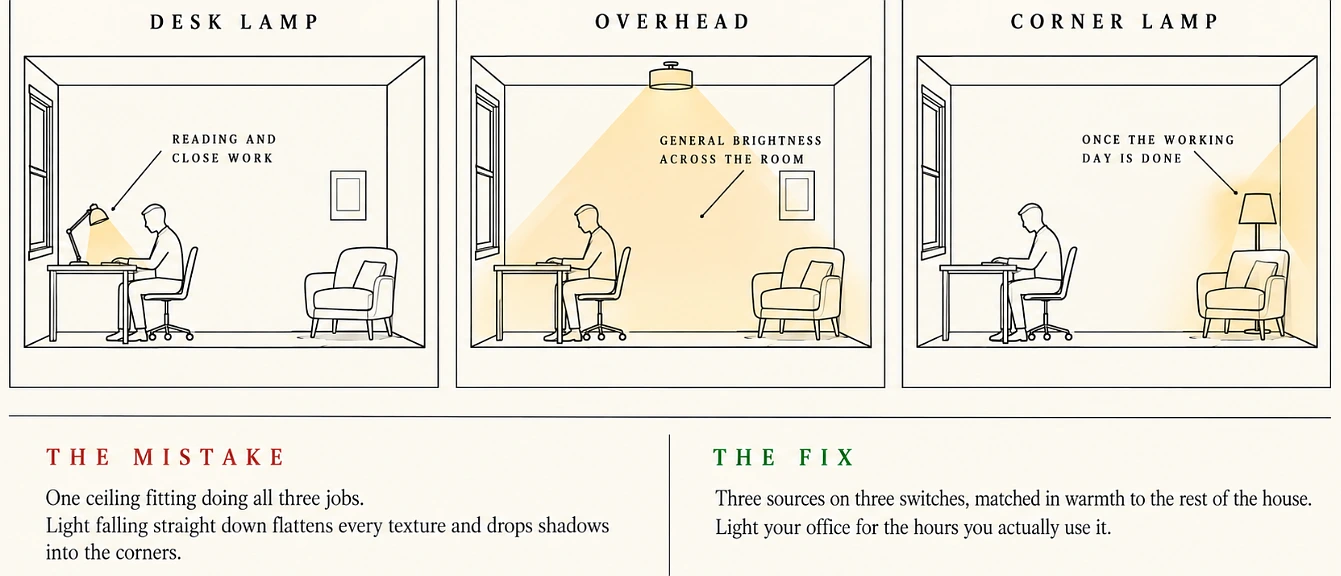
On the black winter mornings, or at five in the evening, daylight is not an option, but an array of lighting is far more versatile than the single bulb in most ceilings. Three sources cover the whole day between them:
- A desk lamp for reading and close work.
- An overhead for general brightness across the room.
- A softer lamp in the corner that takes the harshness out once the working day is done and you are just in there for a bit of quiet.
One thing though. The lighting should sit with the rest of your house, not fight it. If the whole home has a soft, warm feel to it, there is no earthly reason the office has to run on the same blue-white glare as a hospital corridor. Think about when you actually use the room, and light it for those hours.
Build the Storage Around Your Habits, Not a System
Good storage is one of the easiest ways to keep a workspace from descending into chaos, but it only works when it matches how you actually use the room. The stuff you touch every day has to be within reach. The stuff you need twice a year can go up high, or further away.
Each type of storage has a job it does best:
- Shelving takes your books, files, and the odd decorative thing you like looking at.
- Cupboards hide the equipment and paperwork so the room reads calm when it’s not in use.
- Vertical storage banks a lot of capacity into a small footprint when floor space is tight.
And no, the goal is not a bare, sterile, everything-hidden box. It’s a few chosen books, a couple of photographs, one nice object. That’s what gives the room a bit of you in it.
Get the Technology Under Control
Home offices always end up with more tech than you anticipate. The laptop, the monitor, the printer, the lamp, the chargers, the what-have-you, and before you know it there is a nest of cables under the desk that you are frightened to touch.
The biggest fix happens before you even set up: work out where everything is going to sit, keep the things you use most near a decent power point, and don’t create long, pointless cable runs across the room.
Then a few cheap bits, some cable trays, a handful of clips, a basic organizer, keep the wires in line. And where the furniture allows, you can route cables through built-in openings so the whole thing looks clean from the front. It’s not just a pretty face either. Once you can see which cable is which, unplugging or moving something no longer turns into a ten-minute game of follow-the-wire.
Create a Background You Actually Like Looking At
Because the office is part of where you live, how it looks genuinely matters, and it works on you quietly all day whether you notice it or not.
Choose colors and materials that fit in with the rest of your house. Neutral tones give you a calm backdrop to think against. Warmer ones make the room feel like somewhere you would actually want to spend time. And art does its bit too. A print you love, a framed photo, a small collection of something, any of it makes the space feel like yours without getting in the way of the work.
The Case for a Plant or Two
A couple of plants is the cheapest upgrade in this whole article, and it’s the one with a real study behind it.
They sound like a last-minute afterthought but turn out not to be, and this one is possibly my favorite bit of the whole thing. A “lean versus green” experiment, run in real working offices at Exeter and Cardiff universities rather than a laboratory, found productivity rose by about 15% when a couple of plants were brought into a spartan office. One of the researchers went as far as calling a clean, plant-free, minimalist space “the most toxic” environment you can put a human in.
Why does a bit of greenery do that? It is called biophilia, the fairly well-established idea that we are wired to want some connection to the natural world, and that taking it away from us costs something. So a plant on the corner of the desk is not just filler or frill. It is a small, cheap piece of the outdoors, doing quiet work on your attention and your mood. Would I stake my life on the exact 15%? No. But the direction of it is not really in dispute, and a peace lily is cheaper than a fancy mouse mat.
Keep the Whole Thing Adaptable
Your setup grows over time. A laptop this year. A laptop and a monitor next year. Then a printer, then who knows what.
So choosing furniture with a bit of give in it makes life much easier when the moment comes, because you can adapt the room instead of gutting it and starting over. Modular storage, shelving you can move, a desk that is not locked to one single use, all of it helps. Every little choice adds up when needs change, and in that multi-function room that is your home, this flexibility isn’t just a bonus. It’s the whole point.
Do Not Ignore the Small Details
It’s the big stuff that gets all the attention in a room, but the little stuff shapes how it actually feels to work in.
The space around the monitor. Where the pens you reach for twenty times a day live. How far the desk is from the storage. And whether you have got somewhere to set a coffee, a notebook and your phone without the working surface turning into a yard sale.
None of these sounds like much on its own. Put them together, though, and they decide whether the room runs smoothly or fights you. A well-sorted office makes the ordinary stuff feel easy. You shouldn’t be shoving things around just to do a normal task.
Make It Feel Like Part of Your Home
One of the real gifts of working from home is that you get to build a space that is actually you. Nothing here has to look like it was bought from a corporate office supplier and delivered by forklift.
You can take the practical furniture and mix it in with the materials, the colors and the bits and pieces you have in the rest of your place. A wooden desk can sit happily next to what you already own. Choose the storage with a bit of care and it gets absorbed into the room, becoming part of a place of work rather than something flimsy trying to excuse itself.
Quality Is About More Than the First Impression
When you are picking furniture, yes, how it looks matters. Of course it does. But quality runs a good deal deeper than how something looks on the day it turns up at your door.
The materials, the construction, how well it is put together. That is what decides whether a piece lasts months and years or not. A well-made desk, a solid storage unit, becomes a part of the house you never think about again, instead of the thing you are hauling out to the curb eighteen months later because a joint gave way. So ask, before you buy, how it will cope with daily use, how easy it is to clean and look after, and whether it will still suit you once your work has moved on. Get those answers right and you stop second-guessing the room. You walk in, you like what you see, and you sit down.
Build a Space You Actually Want to Use
A good home office does not have to be big, or expensive, or elaborate. It just has to solve the problem of what you use it for, every single day.
Sort out the basics first: a desk that fits you, a chair you could sit in all day, lighting that works, and enough storage. Everything else comes after that. The personal touches. The way you keep your things in order. The furniture that looks like it belongs in your home and not in an office block.
And that is really all there is to it. A calm, tidy room that suits the way you work is worth more than people give it credit for, because you spend your whole day in there and it rubs off on the work you do. Get it right and you stop paying the room any attention at all, which is precisely what you want. You just get on with the job.

 Decor & Improvement Accessories