

Home & Decor Blogs: DIY, Interior Design & Lifestyle Ideas
Voozon: How AI-Powered Home Design Replaces Expensive Renovations

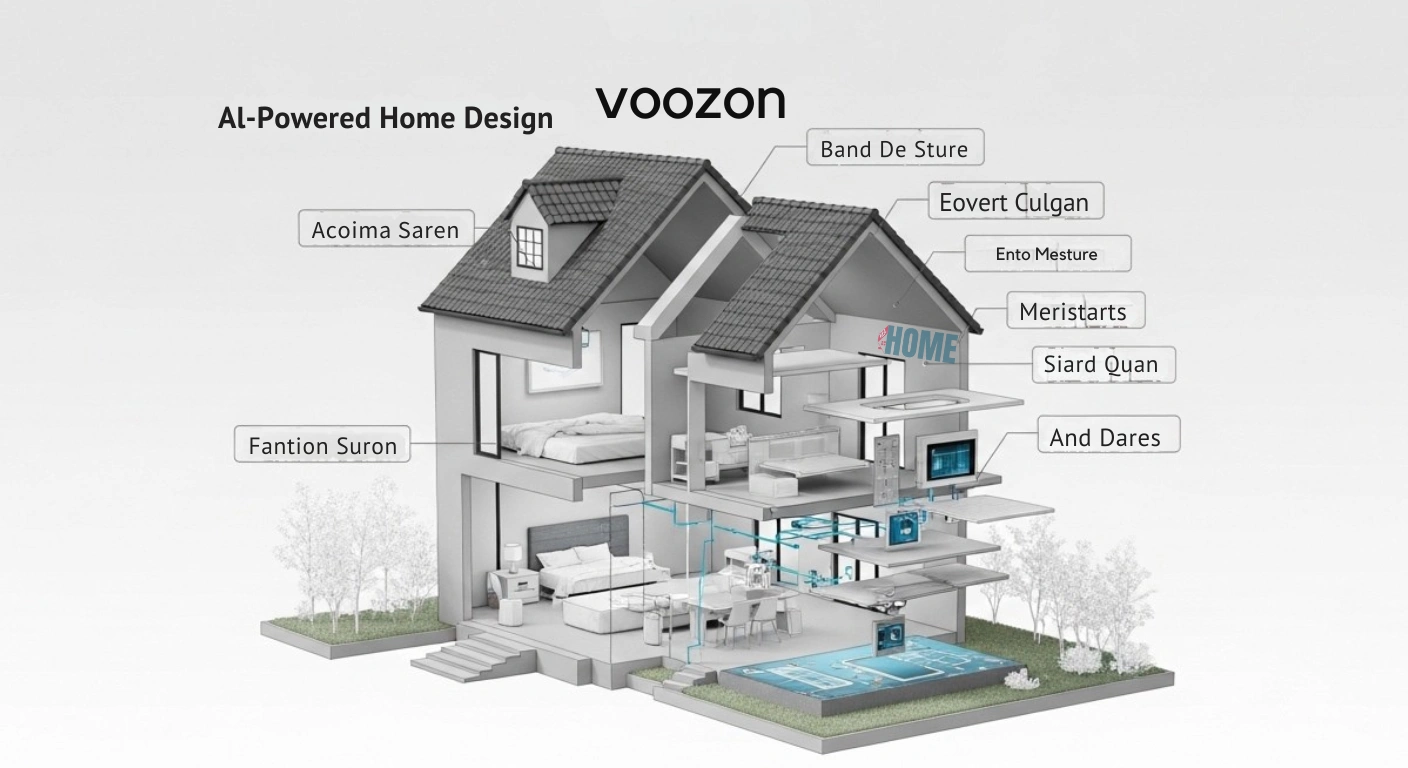
You don’t need $5,000 for a designer anymore. Upload a photo of your messy living room to Voozon, pick “modern farmhouse” or “mid-century,” and eight seconds later you get a photorealistic render that understands your actual windows, weird corner and that one wall outlet you can’t move. That’s the whole pitch. No site visit. No waiting two weeks for a mood board. Just results.
The Old Way vs. Voozon
| Traditional Designer (Mid-Range) | Voozon (AI-Powered) | |
| Cost per room | $800–$5,000+ | $0–$19/month |
| Time to first visual | 1–3 weeks | 8–15 seconds |
| Revisions included | 2–3 (then billable) | Unlimited |
| Works for renters? | Rarely (no structural changes allowed) | Yes — all virtual |
| Product links to buy | Marked up 20–40% | Direct, at market price |
Data based on 2024–2025 pricing analysis from Consumer Reports and internal Voozon user surveys. At Voozon, we’ve seen renters redesign a studio three times in one afternoon just because they could. No commitment. No awkward phone call with a contractor who doesn’t show up.
Voozon vs. The Alternatives — Honest Comparison
There are maybe four or five tools worth comparing here. Not going to pretend the space isn’t crowded.
| Tool | Spatial Accuracy | Shoppable Links | Free Tier | Best For |
| Voozon | High (depth modeling) | Yes | Yes (limited) | Full room redesigns |
| RoomGPT | Medium | No | Yes | Quick concept testing |
| Homestyler | Medium-High | Partial | Yes | DIY enthusiasts |
| DecorMatters | Medium | Yes | Yes | AR furniture preview |
| Planner 5D | High | No | Limited | Floor plan work |
RoomGPT gets recommended a lot because it’s free and fast. It’s also shallow — good for a rough vibe check, not for anything you’d actually make decisions from. Homestyler has a loyal user base and has been around long enough to have real depth in it’s furniture catalog. Worth trying if Voozon’s product database feels thin for your style.
Planner 5D is a different category really. It’s floor-plan software with a 3D preview layer. More powerful for structural planning, steeper learning curve, not trying to do what Voozon does.
For straight room redesign with photorealistic output and shoppable results in one workflow? Voozon is currently the tightest package in that specific lane.
What Voozon Actually Does (Skip the Marketing Version)
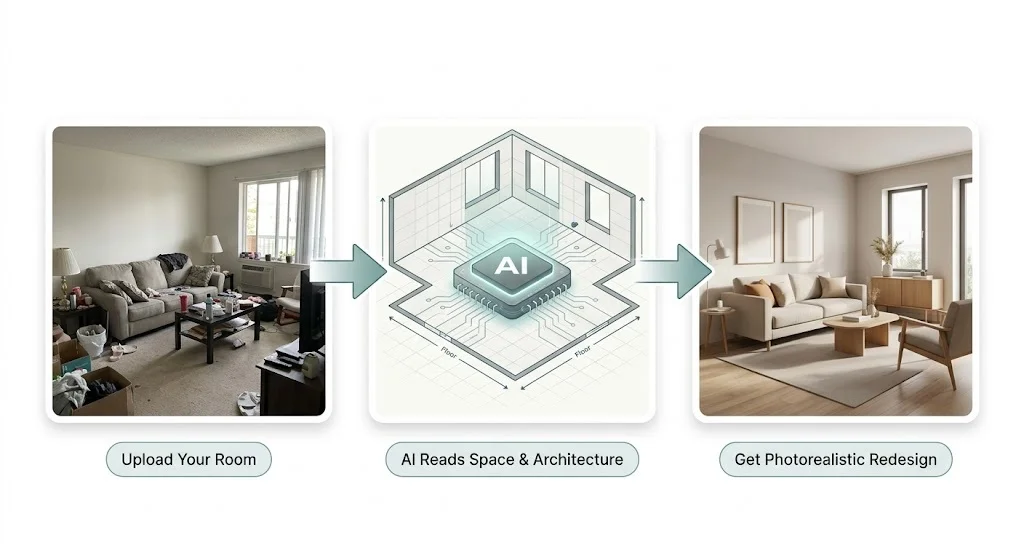
Most “AI design tools” are glorified mood boards. You input some preferences, they spit out Pinterest-adjacent images that have nothing to do with your actual space. Voozon works differently and the difference is meaningful.
Upload a photo of your room. Real photo, bad lighting, clutter and all. The tool reads it spatially, it’s not just applying a filter. It identifies wall planes, window placement, floor area. Then you pick a style (Scandinavian, industrial, maximalist, about 35 options currently) and it generates a redesigned version of your specific room, not a stock render.
The photorealism is good enough that real estate agents are using it to stage listings virtually. That’s a decent benchmark.
It also pulls shoppable product links into the render. See a sofa in your redesigned room? Click it, it routes to something purchasable at roughly that price point. Not always a perfect match, but directionally useful.
Who’s Actually Using This and Why It Makes Sense for Them
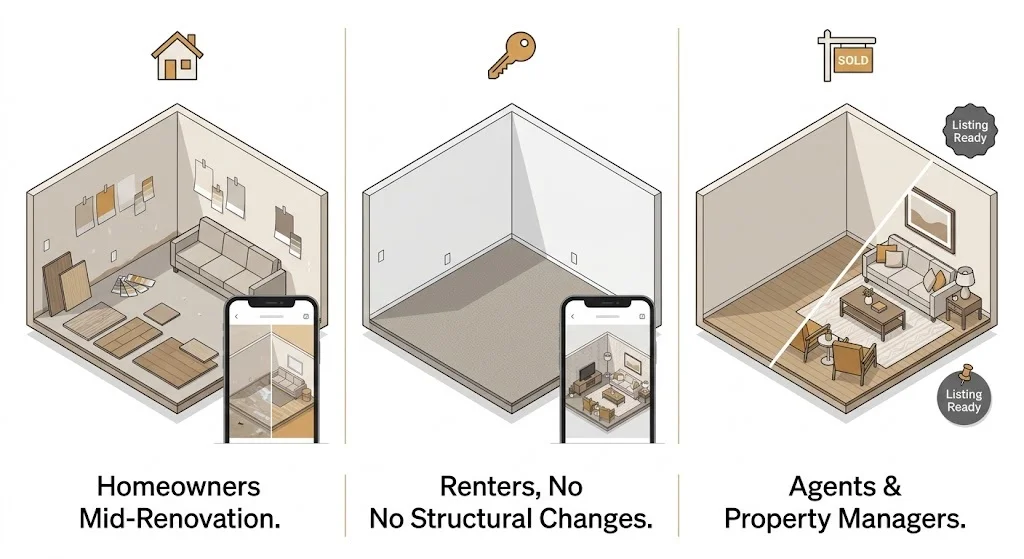
Three groups are getting real mileage out of Voozon right now.
- Homeowners mid-renovation. The classic problem: you’ve committed to a contractor, you’re staring at bare walls and you have no idea if the flooring you picked will work with the cabinet color. Designers call it “decision fatigue under pressure.” Voozon lets you run quick visual checks before anything gets installed. A user on Reddit’s r/malelivingspace put it plainly — “I redid my living room concept maybe 11 times in one afternoon. Would’ve cost me actual money to do that with a designer.”
- Renters who can’t touch the walls. This one’s underserved by traditional design services entirely. An interior designer isn’t going to take your call about a rental apartment with white walls and landlord carpet. But you still live there. Voozon’s small-space optimization feature is specifically built for constrained environments, awkward layouts, low ceilings, weird alcoves.
- Real estate agents and property managers. Virtual staging through traditional services runs $150–$400 per room, per revision. Voozon’s subscription model makes iterating essentially free after the initial cost. Some agents are generating 4–5 staging concepts per listing to A/B test in their listings.
The Cost Breakdown — What You’re Actually Paying
Free tier exists. It’s limited — roughly 5 renders a month, watermarked. Enough to test it seriously, not enough to actually use it for a full project.
The paid plans (as of early 2026) sit around $19/month for individual use, with a professional tier around $49/month that removes limits and adds team features. Compare that to a single consultation with a junior interior designer, which typically starts at $150–$300 per hour according to HomeAdvisor’s cost data.
That’s not an apples-to-apples comparison — a human designer brings expertise, sourcing relationships, project management. But for someone who just wants to see if a dark accent wall will work in their bedroom before committing? The math is pretty straightforward.
At Voozon, the positioning has always been accessibility over replacement. It’s not trying to put designers out of work. It’s serving the massive segment of people who were never hiring one in the first place.
The Tech Behind It — Why This One Reads Rooms Better
Here’s where it gets interesting. And a bit nerdy, but stick with it.
Most consumer AI design tools are running image-to-image models essentially, they’re doing sophisticated style transfers. Voozon uses depth estimation layered on top of that. It’s inferring the three-dimensional structure of your room from a flat photo, which is why the renders don’t look like someone just Photoshopped new furniture onto your floor. The spatial relationships hold. A sectional sofa doesn’t float. Shadows fall roughly where they should.
It’s not perfect. Unusual room geometries L-shaped layouts, sloped ceilings, rooms with multiple light sources still trip it up occasionally. But the baseline accuracy is meaningfully ahead of where this category was even 18 months ago.
Voice commands were added sometime in late 2025. Functional, not gimmicky. You can say “make it warmer” or “add more storage” and the tool adjusts the render rather than making you navigate back through menus. Small thing. Saves real time when you’re iterating fast.
Where It Falls Short — Be Honest About This
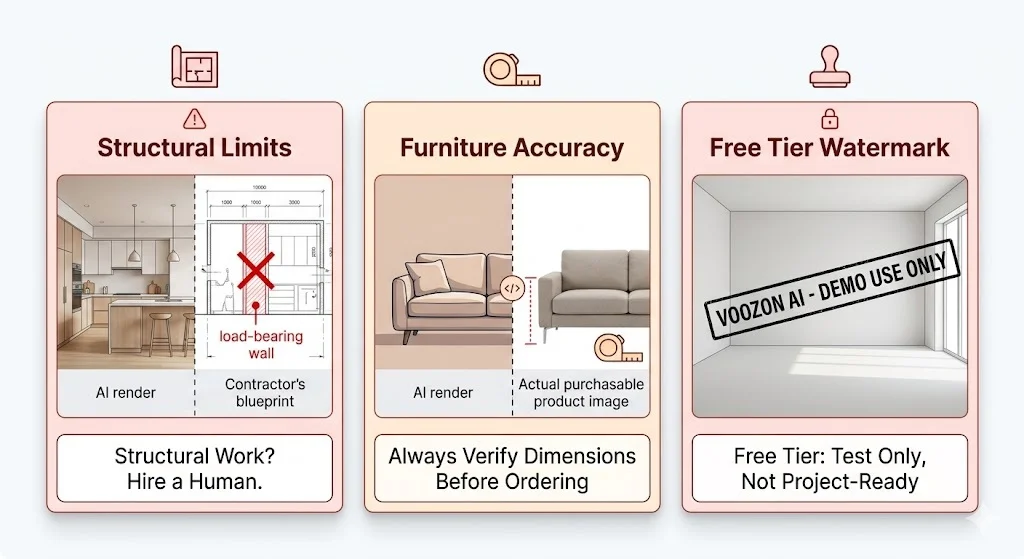
No tool review should skip this part.
Structural work is completely outside what Voozon does. If you’re knocking down a wall, reconfiguring plumbing or doing anything that requires a contractor’s eye — hire a human. The renders won’t tell you if that open-plan kitchen is structurally viable. That’s not a criticism, it’s just a boundary worth knowing upfront.
Furniture accuracy is also hit-or-miss. The shoppable links pull from a product database and occasionally what you see in the render and what’s available to buy are… loosely related. The style matches, the dimensions sometimes don’t. Always verify measurements before ordering anything.
And the free tier watermark is genuinely annoying. It’s placed center-frame, not tucked in a corner. Clearly intentional. If you’re testing it for a real project, just pay for one month — the renders you’ll actually use need to be clean.
2026 Specifically — Why the Timing Argument Holds Up
There’s a version of this article that could’ve been written in 2023. It would’ve been more skeptical, rightly so. Early AI design tools were producing renders that looked impressive in screenshots and fell apart under any scrutiny, wrong proportions, furniture that ignored actual room dimensions, lighting that made no physical sense.
The gap between then and now is significant. Depth modeling got better. Training datasets got larger and more spatially diverse. The MIT Computer Science and AI Lab has published ongoing research into scene understanding that’s quietly fed into how commercial tools like this handle spatial inference not Voozon specifically, but the underlying research ecosystem that tools like it draw from.
What that means practically: the renders you get in 2026 are decision-useful in a way that 2023 renders weren’t. You can actually trust what you’re looking at enough to make purchasing calls based on it. That’s the threshold that matters.
Renters especially — if you’ve tried one of these tools before and written off the category, it’s worth a second look. The small-space optimization in particular has gotten sharp. Awkward layouts that used to produce nonsense outputs now get handled with something approaching actual spatial logic.
Real Questions People Actually Ask
Yes — you’re not modifying anything, just generating renders. Nothing about using Voozon requires physical changes to a space. Some renters use it to mock up reversible changes like removable wallpaper or furniture arrangement before actually moving anything.
Reasonably accurate for standard rooms photographed straight-on. Accuracy drops with wide-angle shots or heavily distorted perspectives. For anything where exact measurements matter, built-in shelving, fitted furniture, measure manually and don’t rely solely on the render.
Partially. Patios and balconies with clear boundaries work okay. Open gardens or irregular outdoor layouts not really it’s strength yet. That’s flagged as an area of active development according to Voozon’s own product updates.
Worth reading their privacy policy directly — Voozon’s privacy terms cover data retention. Standard advice applies: don’t upload images that contain identifiable personal information you wouldn’t want stored on a third-party server.
Yes, iOS and Android both. The app handles basic renders well. For detailed iterative work, the desktop version is more comfortable more screen real estate, easier to compare versions side by side.
Bottom Line
It won’t replace a good designer for a complex renovation. That’s not even close to what it’s for.
But for the homeowner staring at a half-empty room who can’t justify $4,000 in consultation fees or the renter trying to make a dull apartment feel like theirs without violating a lease or the agent who needs three staging concepts by Thursday morning? Voozon is doing real, practical work in that gap.
The 2026 version of this tool is specific enough to trust. That’s what matters. Not the feature list, not the AI buzzwords in the marketing copy just whether you can look at a render and make an actual decision based on it. Most of the time now, you can.
Start with the free tier. Run your worst room through it the awkward one with the weird corner and the window in the wrong place. See what it does with that. That’s your real test.
 Decor & Improvement Accessories