

Home & Decor Blogs: DIY, Interior Design & Lifestyle Ideas
The Reason Your Home Lead Test Probably Came Back Clean (Even If Your Water Isn’t)
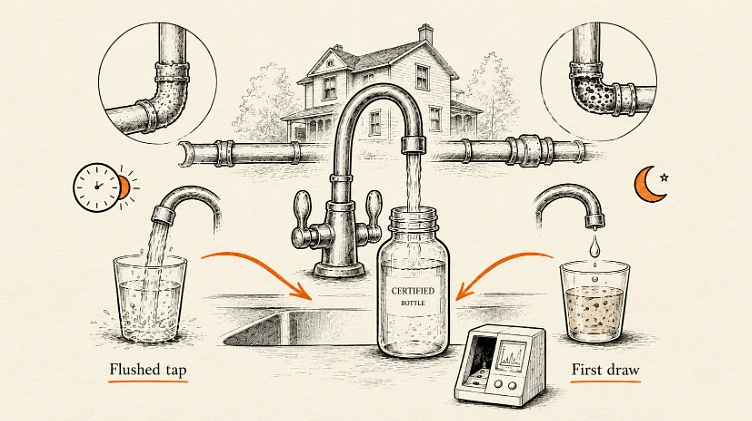
A neighbor of mine ordered a home water test kit last spring. House built in 1962, original copper supply lines, lead solder at the joints, a textbook candidate for elevated lead at the tap. His result came back at 2 parts per billion. Basically nothing.
He showed me the result, relieved. I asked him how he collected the sample.
“Ran the tap for a couple minutes first to make sure it was clean water.“
That’s the mistake. That single decision, running the tap before filling the sample bottle, is the reason a huge percentage of home lead tests give results that look fine when the water actually isn’t. And once you understand why, the rest of how a water testing lab actually works starts to make a lot more sense.
What “First Draw” Actually Means and Why It Matters
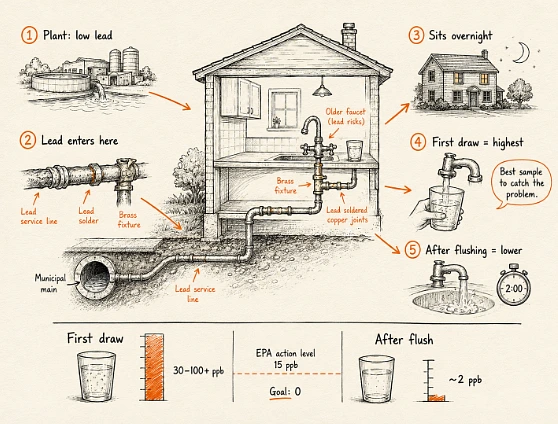
Lead in drinking water doesn’t usually come from the source. Municipal water leaves the treatment plant essentially lead-free in most US systems. The lead enters somewhere between the street and your glass, old service lines, brass fixtures with high lead content, lead solder at copper pipe joints, sometimes the fixture itself if it’s pre-1986.
The way lead gets into your water is by sitting. When water stops moving in a lead-containing pipe overnight, lead leaches into it slowly. The longer it sits, the more it accumulates. First thing in the morning, before anyone in the house has flushed a toilet or run a faucet, the water sitting in those pipes has the highest lead concentration it’s going to have all day.
That is the sample you want.
If you run the tap for two minutes first, you’ve flushed all that high-lead water down the drain. What you’re now sampling is fresh water that hasn’t had time to pick up much of anything. Your result comes back at 2 ppb and you go to bed thinking the house is safe. Meanwhile every morning when your kid pours a glass of water before school, they’re drinking from the batch that sat in those pipes for eight hours.
The EPA’s own action level for lead is 15 ppb. The newer health-based goal is zero. A first-draw sample in an old house can easily come back at 30, 50, sometimes north of 100 ppb when the same house gives you a 2 ppb result after flushing.
The Bottle Matters Too
Here’s something else that gets ignored. The sample container is not a random plastic bottle. Lead testing requires a bottle that’s been acid-washed and certified contaminant-free. sometimes with a preservative already inside it to stabilize the sample during transit.
Reusing a water bottle from the recycling bin, transferring water between containers to “consolidate” multiple samples, or letting the sample sit in your car for two days in summer heat all of these will give you a number that has nothing to do with what’s actually in your water.
This is why the bottle a real lab sends out is part of the test, not just packaging.
What Happens to the Sample Once It Leaves Your Kitchen
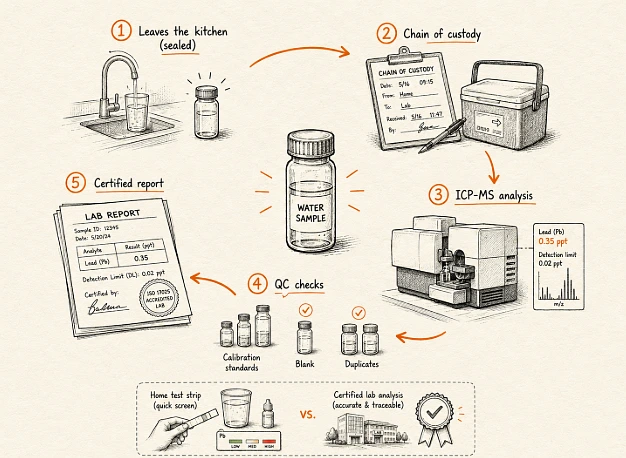
Most people picture a lab as a place with microscopes and beakers. For trace metals like lead, that’s not really what’s happening. The actual instrument doing the work is an ICP-MS. inductively coupled plasma mass spectrometer. It can detect lead at parts per trillion. Not parts per billion. Parts per trillion. That’s roughly equivalent to finding a single drop of ink in an Olympic swimming pool.
But the instrument is only as good as everything around it. Chain of custody — who handled the sample, when, at what temperature, in what container — gets documented at every step. Calibration standards traceable to NIST get run alongside your sample. Method blanks get run to make sure the lab’s own water and glassware aren’t contributing background lead. Duplicates get run to confirm the result is reproducible.
This is the part where the lab you pick actually matters. A drugstore test strip or a $15 mail-in kit isn’t running any of this. It’s running a colorimetric reaction that gives you a visual band — pass or fail at a relatively crude threshold. For something like “is my water hard,” that’s fine. For lead in a house with kids, it isn’t.
A certified water lab like ETR Labs runs the actual instrumental analysis with the chain of custody, the validated methods, and the QC checks that make a result defensible. The difference shows up in two places first, the number you get back is actually accurate, and second, if there’s a problem, the report tells you specifically what’s there, at what concentration, with the detection limit of the method clearly noted. You can take that report to a plumber, to your pediatrician, or to your municipal water authority and have an actual conversation.
What to Actually Do
If you’re testing water in an older home and you want a result that means something, the protocol is straightforward:
- Don’t run the tap before sampling. First thing in the morning, before anyone flushes anything or runs a faucet, fill the sample bottle directly. This is your first-draw sample.
- Use the bottle the lab sends. Not a substitute. Not a rinsed-out water bottle.
- Get the sample shipped same day if possible. Cold pack included, overnight if the lab requires it. Heat and time degrade some parameters.
- If you want the full picture, order a second sample after running the tap for two minutes. Compare the two. The difference between them tells you how much lead your specific plumbing is contributing. That comparison is what a remediation plumber actually wants to see.
Most homeowners stop at one sample, taken wrong, and trust the result. That’s how houses with real lead problems end up with clean-looking test reports sitting in a kitchen drawer.
The Result You Want Is the One That Tells You the Truth
Water testing is one of those things where a wrong answer is worse than no answer. A wrong “clean” result gives you a false sense of safety for months or years. The cost of doing it right — the right sample, the right bottle, a lab actually equipped to detect trace metals at the levels that matter — is somewhere around $40 to $80 depending on what panel you order. That’s not a lot of money for the only number in your kitchen that tells you what your kids are actually drinking.
Worth doing once. Worth doing properly.

 Decor & Improvement Accessories