

Home & Decor Blogs: DIY, Interior Design & Lifestyle Ideas
Buying Kitchen Cabinets Wholesale in Akron: What the Price Gap Actually Looks Like and Where Orders Go Wrong

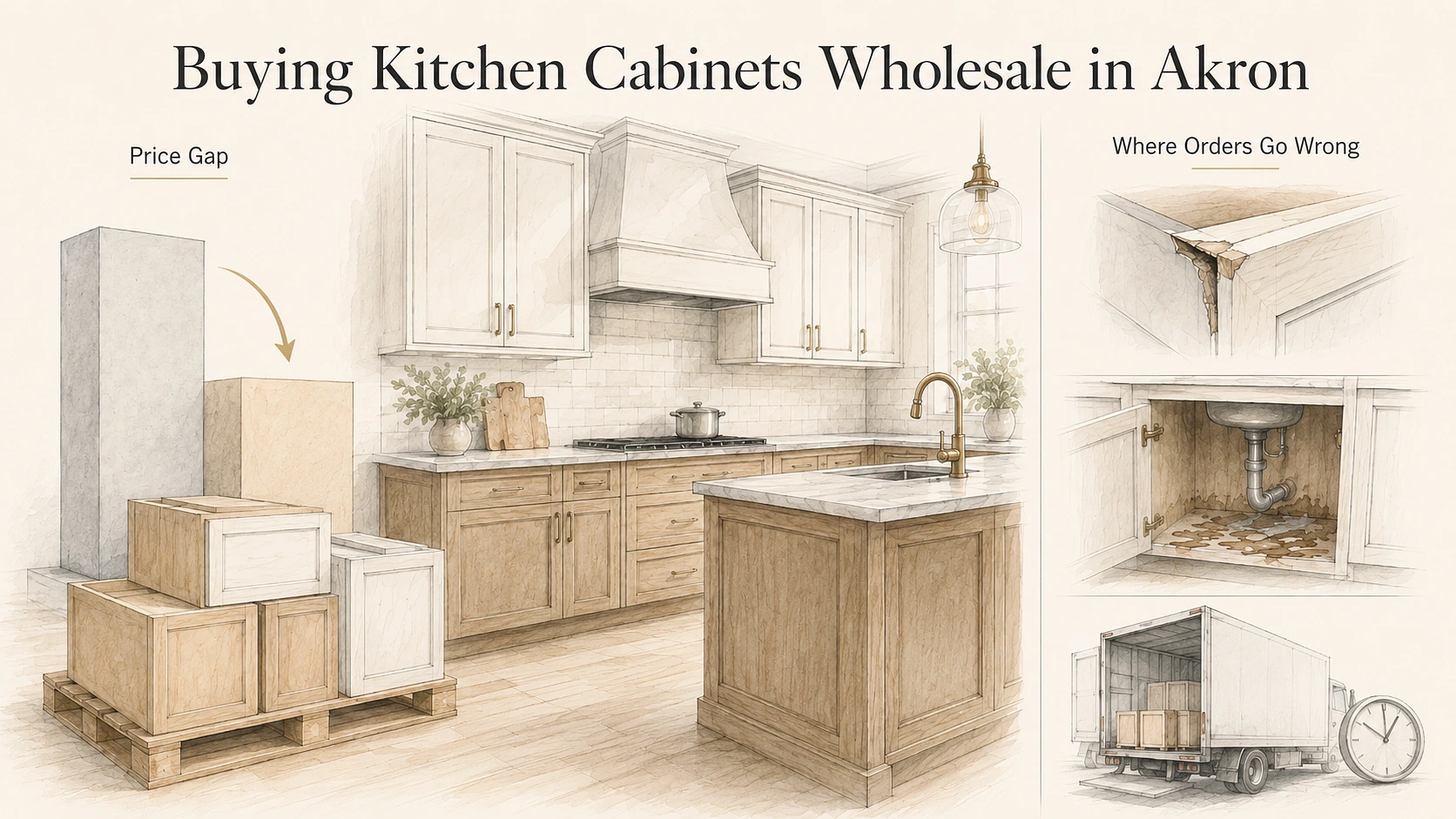
The difference between retail and wholesale cabinet pricing on a standard ten-by-ten kitchen layout runs somewhere between thirty and fifty percent. In a kitchen with thirty cabinet boxes — uppers, lowers, pantry, lazy susan — that gap can be three to six thousand dollars in real money. Not a coupon. Not a sale. Just the structural cost difference between buying through a showroom that marks up every box and buying from a supplier that sells at volume pricing.
That is the appeal. And for contractors in Akron running three or four kitchen renovations at a time, wholesale is the default. But homeowners doing a single renovation have access to the same suppliers now, and most of them have no idea what to check before placing a bulk cabinet order.
Here is what actually matters, what goes wrong, and which suppliers in the Akron market have the track record to back up what they promise.
What “Wholesale” Actually Means and Why the Savings Are That Large
Wholesale cabinet pricing skips the retail showroom layer entirely. A retail kitchen cabinet store buys from a distributor, marks up forty to sixty percent, adds design consultation fees, and charges delivery separately. A wholesale supplier sells directly — sometimes from their own factory, sometimes from a dedicated import operation — at the cost-plus-margin price that the retailer was paying before their markup.
The cabinets themselves are often identical in construction. Same plywood boxes, same soft-close hinges, same dovetail drawers. What you are not paying for is the showroom lease, the sales team, and the retail marketing budget.
Does that mean wholesale cabinets are lower quality? Not necessarily, but this is where the variation between suppliers becomes massive. Some wholesale operations sell all-wood construction with plywood boxes and solid wood face frames. Others sell particleboard boxes with a vinyl wrap that photographs well but delaminates within three years in a humid kitchen. The word “wholesale” tells you nothing about material quality. You have to check the construction specs yourself.
The Four Things That Actually Separate Good Wholesale Suppliers From Bad Ones
In-Stock Inventory vs Made-to-Order
This is the single biggest variable, and nobody ranks it high enough.
A supplier with deep in-stock inventory ships your cabinets in days. A supplier that orders from an overseas factory after you place your order ships in six to twelve weeks — and that timeline is optimistic if there is a port delay, a container shortage, or a production backlog at the factory.
For a homeowner who has already demoed their old kitchen and has a contractor scheduled to install next week, the difference between a four-day delivery and a six-week wait is the difference between eating takeout for a few days and eating takeout for two months.
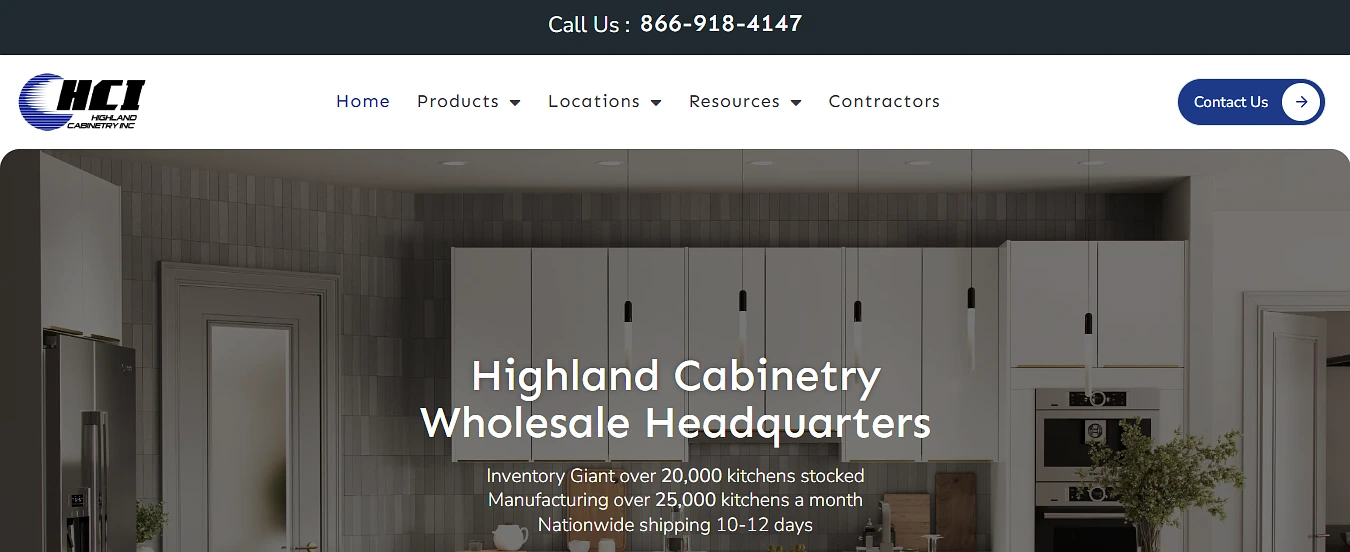
Highland Cabinetry keeps a substantial in-stock inventory — their site references 20,000+ kitchens stocked at any given time, with manufacturing output north of 25,000 kitchens a month from their Vietnam facility. Average freight delivery runs in the four to seven day range, depending on the origin warehouse, with realistic delivery to Akron typically landing around five to eight days from their primary US warehouse stock. That inventory depth is genuinely uncommon — most wholesale suppliers operate on much thinner stock and longer lead times, which is why delivery delays are the number one complaint across the industry.
All-Wood vs Particleboard Construction
This is the spec that determines whether your cabinets last eight years or twenty-five.
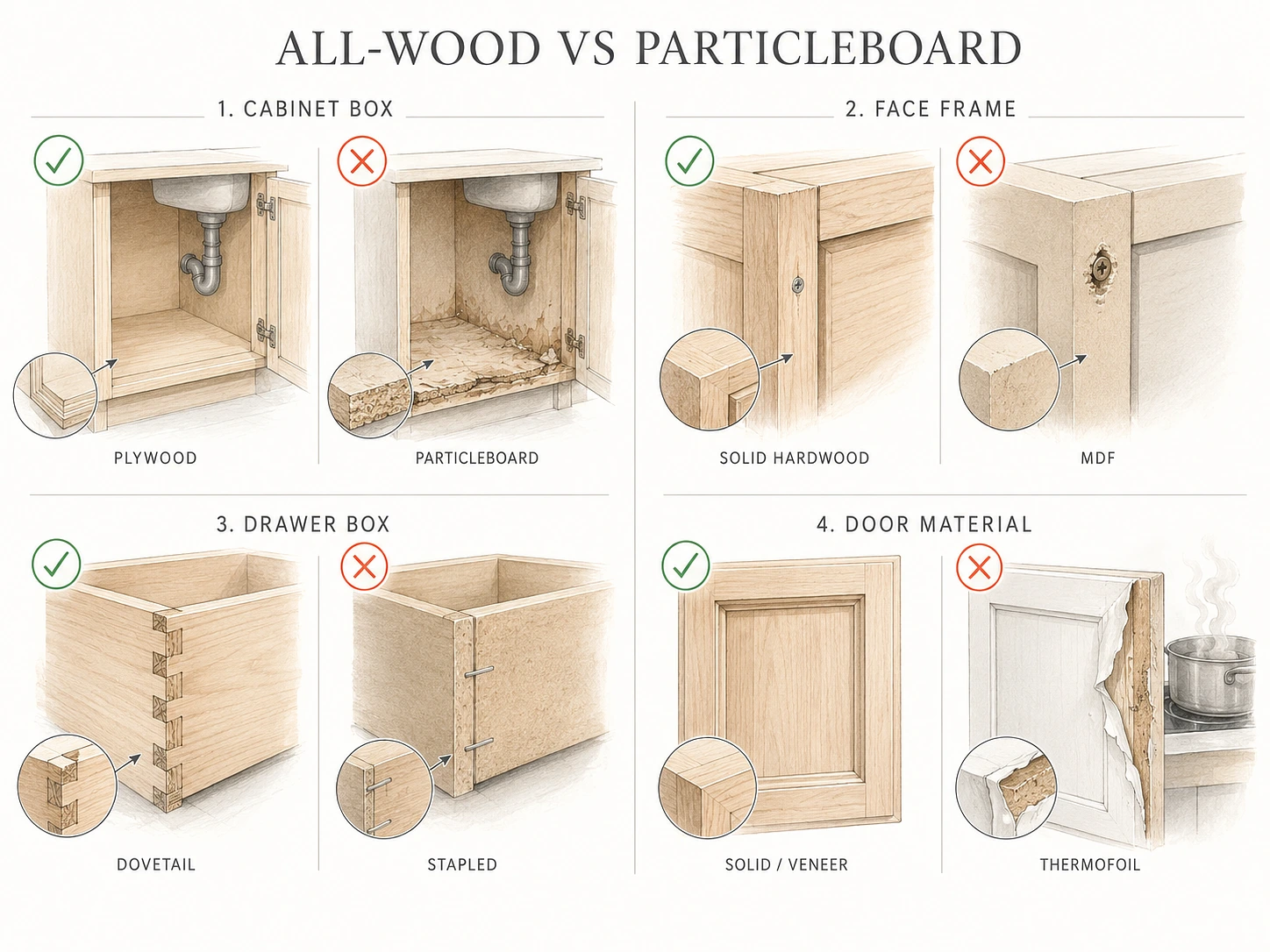
Particleboard swells when it absorbs moisture. Under a kitchen sink, where a supply line drips slowly for six months before anyone notices, a particleboard cabinet box will warp and crumble at the base. Plywood tolerates that same slow leak without structural failure because the cross-grain lamination resists swelling.
What to check on any wholesale order:
- Cabinet box material — plywood or particleboard. If the listing says “wood composite” or “engineered wood” without specifying, assume particleboard until proven otherwise.
- Face frame material — solid hardwood (birch, maple) or MDF. MDF face frames dent easily and do not hold screw threads for hinge adjustments over time.
- Drawer box construction — dovetail joints or stapled butt joints. Dovetail holds, stapled separates.
- Door material — solid wood, MDF with veneer, or thermofoil over MDF. Thermofoil peels near heat sources like ovens and dishwashers.
J&K Cabinetry, another wholesaler that serves the broader Ohio market through authorized distributors in the Cincinnati and Columbus areas, plus nationwide shipping, builds exclusively with solid birchwood and plywood — no MDF, no particleboard across their entire line. Dovetail drawer construction and soft-close hardware come standard on every SKU. That kind of blanket material commitment is worth something because it means you do not have to check every SKU individually.
Freight Damage and Who Eats the Cost
Cabinet boxes ship on pallets via freight truck. They get stacked, shifted, and occasionally dropped during transit. Freight damage on kitchen cabinet orders is not rare — it is a known industry problem that good suppliers plan for and bad suppliers treat as your problem.
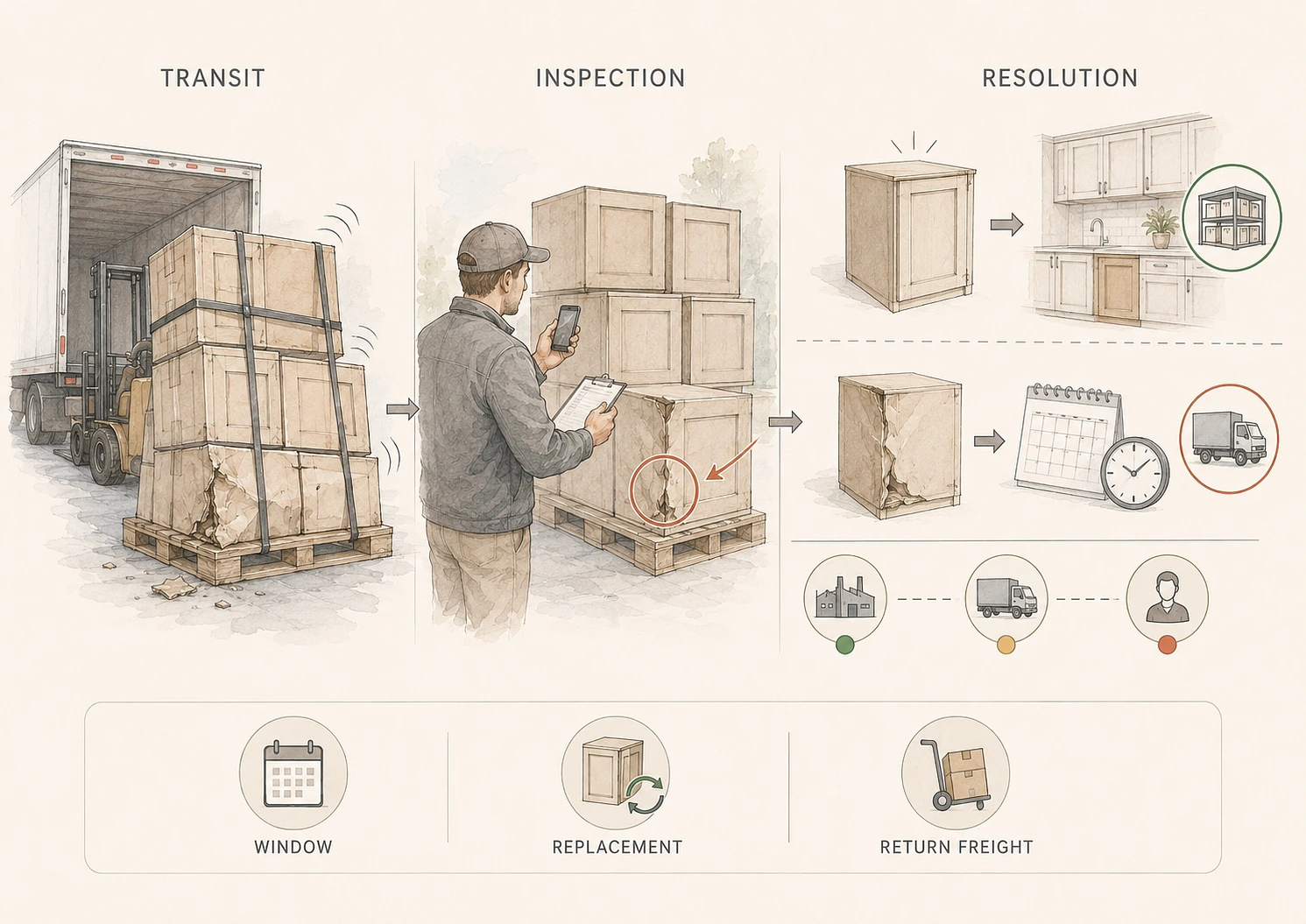
What matters is the supplier’s damage resolution process. Some replace the damaged box immediately from stock and ship it the next day. Some file a freight claim that takes four to six weeks to resolve while your kitchen sits half-installed. Some require you to document the damage within 24 hours of delivery or forfeit any claim.
Before placing any wholesale order, ask these three questions:
- What is the damage inspection window — 24 hours, 48 hours, or longer?
- Do you replace from stock or reorder from the factory?
- Who pays return freight on damaged items?
A supplier with deep in-stock inventory can replace a damaged box from inventory the same week. A supplier running on thin stock might not have your finish in the right size available for weeks. Worth noting — some buyer reviews describe Highland’s return and damage policy as fairly rigid, which makes it even more important to inspect thoroughly at delivery and get the damage resolution terms in writing before you order, not after.
Design Support or No Design Support
Some homeowners know exactly what they need — they have a floor plan, cabinet sizes mapped, and a cut list ready. Most do not.
Wholesale suppliers are split into two categories here. Some are pure fulfilment operations — you order the exact SKUs, they ship the boxes, no questions asked. Others offer design assistance, 3D layout rendering, and help with the cabinet schedule before you commit.
Kabinet King USA, out of New York, runs in-house 3D design services alongside their wholesale catalog, which fills a gap for homeowners who want to see the full kitchen layout before locking in a thirty-box order. Wholesale Cabinet Supply in South Carolina takes a similar approach through their PRO Division, adding personalized design help on top of tiered volume pricing that brings costs down by up to twenty percent on larger orders.
For a homeowner placing their first wholesale cabinet order, that design support can be the difference between ordering the right thirty boxes and ordering twenty-eight right ones plus two that do not fit.
What a Wholesale Kitchen Cabinet Order Actually Costs in Akron
Pricing varies by material quality, finish, and supplier, but here are the ranges that reflect what Akron-area buyers are actually paying at wholesale:
- Entry-level (particleboard box, thermofoil doors): $80–$150 per box.
- Mid-range (plywood box, solid wood doors, soft-close standard): $150–$300 per box.
- Premium (all-wood construction, dovetail drawers, specialty finishes): $300–$500 per box.
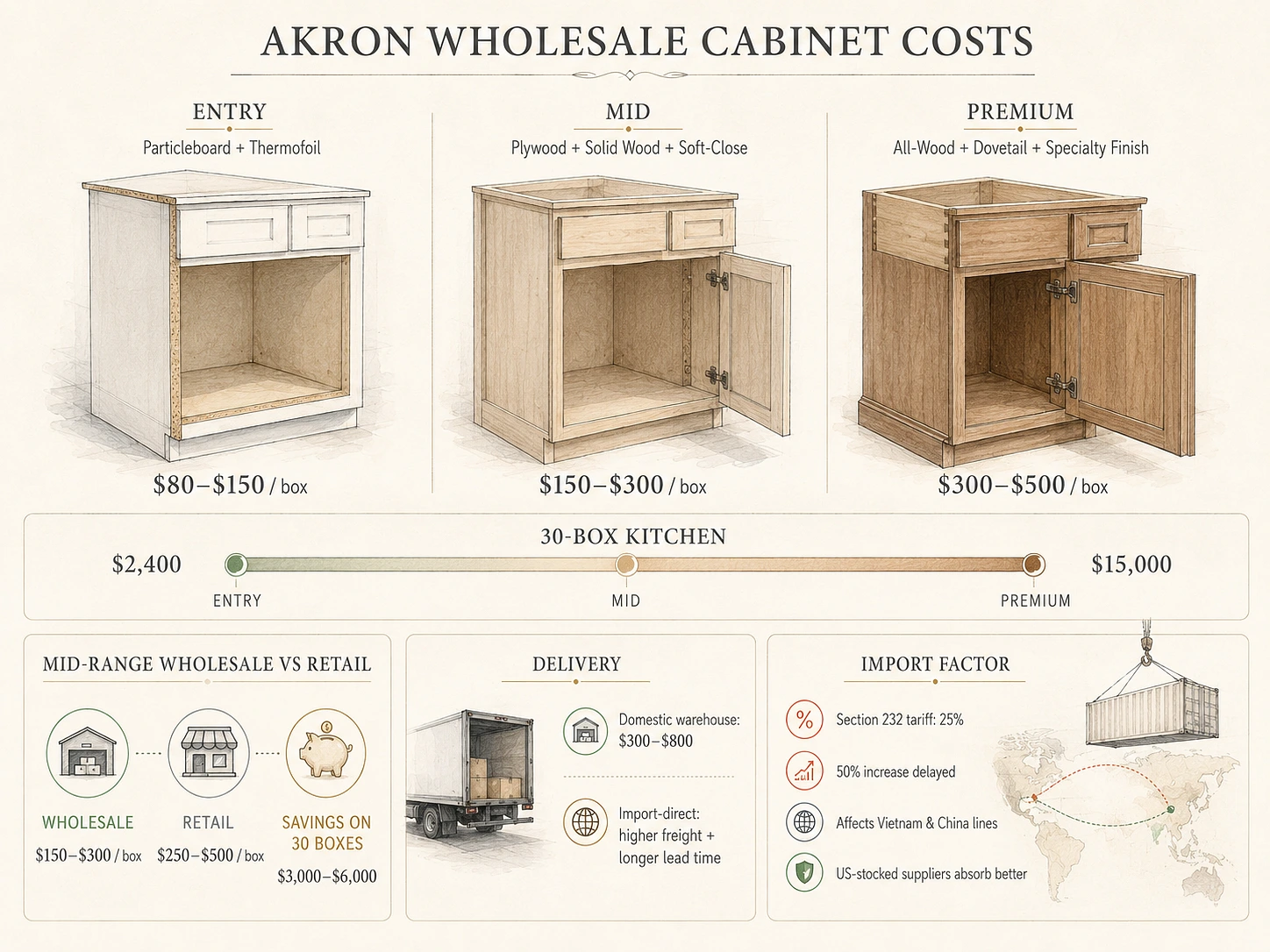
On a thirty-box kitchen, the spread runs from roughly $2,400 at the low end to $15,000 at the high end. The equivalent retail pricing on the mid-range tier would typically run $250–$500 per box, meaning the wholesale saving on a thirty-box order lands somewhere in the $3,000–$6,000 range.
Delivery cost is separate and depends on the distance from the supplier’s warehouse. Freight to Akron from a domestic warehouse typically runs $300–$800 for a full kitchen set. From an overseas factory with no domestic stock, container freight and last-mile delivery can push that significantly higher, and the timeline stretches with it.
One cost factor worth knowing about right now: imported cabinet lines currently carry a 25% Section 232 tariff, imposed in late 2025. A planned increase to 50% has been delayed until at least early 2027. This affects Vietnam and China-origin lines — including many of the cabinets stocked by major wholesalers —, but the tariff is already baked into current quoted wholesale pricing from suppliers who stock domestically. Where it bites harder is on pure import-direct orders placed straight with an overseas factory, where tariff exposure, freight cost, and timeline risk all stack on top of each other. Stocked US-warehouse suppliers like Highland and J&K absorb this better because the import cost is already priced into their standing inventory.
The Realistic Order-to-Installation Timeline
From a stocked supplier (Highland Cabinetry, J&K Cabinetry):
- Order placed → 1 day for processing.
- Freight delivery → 4–8 days depending on warehouse location.
- Total: roughly one to two weeks from order to your garage.
From a made-to-order or semi-custom supplier:
- Order placed → production queue, 3–6 weeks.
- Freight delivery → 1–2 weeks after production.
- Total: 5–8 weeks, assuming no production delays.
From an import-direct supplier with no domestic stock:
- Order placed → overseas production, 6–10 weeks.
- Ocean freight → 4–6 weeks.
- Last-mile delivery → 1–2 weeks.
- Total: 11–18 weeks. Nearly five months in a worst-case scenario.
Your contractor’s install crew is not waiting five months. They are moving on to the next job and will come back when your cabinets finally show up — if they come back at all. Lead time is not just a convenience issue; it is a project-scheduling issue that cascades into countertop templating, plumbing rough-in, and appliance delivery coordination.
How to Place a Wholesale Cabinet Order Without Getting Burned
There is no magic to this. It is a short checklist that most people skip because they are focused on the finish colour and the price per box.
- Get the cabinet schedule right before ordering. Measure twice. Map every box to a wall position. Account for fillers, end panels, and crown moulding. A wrong-size box at wholesale is a return, a restock fee, and a wait for the replacement.
- Order 5–10% extra filler and trim stock. Cuts go wrong. Walls are not perfectly square. Having spare filler strips and matching trim on hand prevents a second freight shipment for two small pieces.
- Inspect every box at delivery before signing the freight receipt. Open corners, check for cracks, and verify finish colour. Once you sign the delivery receipt as “received in good condition,” your leverage for a damage claim drops significantly.
- Confirm soft-close is standard, not an upgrade. Some wholesalers include soft-close hinges and drawer slides on every box. Others charge it as an add-on that bumps the per-box cost by $15–$30. Ask before you compare pricing across suppliers.
Wholesale cabinet buying in Akron is not complicated once you know what to check. The suppliers who stock deep, ship fast, build with plywood and solid wood, and handle freight damage without a six-week claim process are the ones worth ordering from. Everything else — the showroom finish, the website design, the marketing copy — is noise. The cabinet box is either built right and in stock, or it is not.
 Decor & Improvement Accessories