

Home & Decor Blogs: DIY, Interior Design & Lifestyle Ideas
How to Give Your Interior Walls a Stylish Makeover on a Budget, Part 2

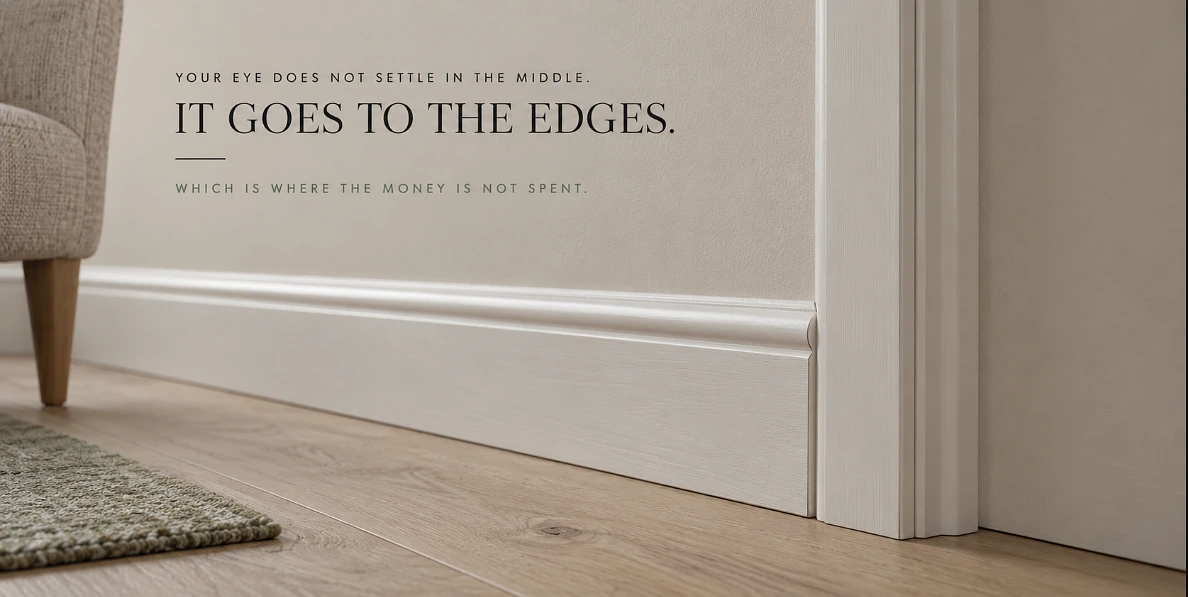
Way back in January I published a guide to doing your walls on a budget, and you guys read that one more than anything else I put up this year, so this is the part 2, and it is about the bits I skipped. It is September now, the evenings are pulling in, and the first night you switch a lamp on before dinner is the night your walls are being looked at properly again, the same as they were in January when everyone was stuck indoors. Daylight forgives a wall. Lamplight does not, and what lamplight is picking out is the edges.
Because that is where your eye goes. It does not settle in the middle of a wall, there is nothing there to look at, it travels to where the wall stops and something else starts, the floor, the door, the ceiling, and it is judging the whole room from those few inches. Two rooms in the same house, one painted a lovely warm white with decent furniture and still looking like a rental, the other in plain magnolia and looking like someone designed it, and the difference is nearly always at the edges. So this post is the edges, and the skirting most of all, since that is the part I gave 1 sentence to last time.
Paint, And What January Already Covered
Colour choice, priming, rolling in a W, testing swatches through the day, all of that is in the January post and I am not repeating it. Warm whites, soft greys and creams are still holding up in living rooms and bedrooms because they take on whatever light is falling on them, and the deeper greens and blues are still earning their place on 1 wall and not 4.
The 1 thing I would add now is about the edges again. Test your paint sample against the trim, not against bare plaster. Painters know this and homeowners rarely do. That wall colour is going to spend its whole life next to the skirting and the door frame, and a white that is looking warm against pink plaster is turning grey against a cool white gloss. Paint the test patch so it touches the trim, then look at it at breakfast, at 4 in the afternoon, and under the lamp.
Texture, And Where To Stop
Back in January the texture idea was brick, thin brick veneer on the TV wall, and judging by the photos some of you sent it went on a lot of TV walls. So I am not doing brick again. What has moved since is panelling, half height and fluted mostly, and the peel and stick panels and papers are doing it now at a fraction of the cost with no tradesman, 1 wall behind a sofa or a bed and the room is carried.
The new bit I am adding is where texture should stop, because the wall people are getting wrong now is the one next to the textured one. Bold pattern or heavy texture on 1 wall wants quiet on the other 3, and the moment a second wall starts competing the room is reading as busy instead of considered. Flat walls in a well furnished room can still look unfinished, which is why panelling keeps coming back, but 1 is the number.
The Line Where The Wall Meets The Floor
No one hangs a canvas without a frame and then wonders why it looks unfinished, and a wall with builder skirting is that canvas. This is the section I skipped, and it is roughly why so many freshly decorated rooms still look slightly wrong.
A skirting board, or baseboard if you are reading this from the States, is doing 2 jobs at once. It is taking the knocks from the vacuum cleaner, shoes and furniture legs, and it is drawing the line that tells your eye the wall has ended on purpose and not because the paint ran out. The second job is the one deciding how the room reads.
How Tall It Should Be

There is a proportion rule that designers and every skirting supplier in the country are passing around, and no one seems to know who first wrote it down, so the test is your own room. Skirting height sits at 7 or 8 percent of ceiling height. A standard ceiling in a modern home is 2.4m, and 7 or 8 percent of that is landing somewhere near 170 to 190mm. It is the same way a jacket is wrong by an inch at the sleeve and you cannot say why it looks cheap, you only know it does.
Go and measure yours. Most people come back with 95mm and a face.
95mm or 120mm is what volume builders are fitting, and it is roughly half of what the proportion rule is asking for. The most popular height people are choosing when they replace it themselves is 145mm, which sits between the builder’s number and the designer’s number and is pleasing nearly everyone. A rough guide by ceiling:
| Ceiling height | Skirting that works | Notes |
| 2.1m to 2.4m | 95mm to 145mm | 145mm is the safe default for a standard room |
| 2.4m to 2.7m | 145mm to 200mm | Taller ceilings need more weight at the base |
| 2.7m and above | 200mm to 250mm | Period proportions, where the rule was written |
| Small rooms, any ceiling | Stay at the lower end | A tall board eats a small room |
Period houses are where this is going properly wrong. Victorian and Edwardian rooms ran somewhere between 150 and 220mm, and the grander ones went past 250. Replacing original tall skirting with modern builder height during a refurbishment is stripping out the character people paid extra for the house to have. It is a common decision, it is saving very little money, and it cannot be undone cheaply. David Kaihoi, one of Elle Decor’s A List designers, was asked about renovation mistakes and said that renovation is house healing, and that if someone took a shortcut in the past and made strange soffits or bizarre lighting plans, you do not continue down that road. Inherited cheap trim is that kind of shortcut, and matching it because it is already there is how 1 previous owner’s saving becomes permanent.
The Profile Only Works If It Has Room
Profile is the shape cut into the top edge. Ogee, torus, chamfered, square, lamb’s tongue, and a few dozen variations of each. A detailed profile needs enough height to read, and an ogee below about 120mm is no longer looking like an ogee. The curve compresses into a bump and you have paid for decoration no one can see from standing height. Square edge and chamfered are not having that problem, they look intentional at any height, which is part of why they suit modern rooms and small ones. So the order to decide in is height first, profile second, and choosing an ornate profile and then finding out your room only takes a short board is the wrong way round.
Where It Meets The Door

Skirting runs into the architrave, the moulding framing your doorway, and that joint is visible from most of the room. 2 things to get right, and both are about the relationship and not about either piece on its own:
- Match the profile. Torus skirting wants torus architrave. Different profiles meeting at a corner never quite resolve and the eye keeps going back to it.
- Keep the scale sensible. Thin architrave next to a tall heavy board is looking top heavy, and a board projecting further from the wall than the architrave is clashing at the joint.
The traditional arrangement has the architrave slightly narrower than the skirting is tall, and matching the profile matters more than matching the measurements exactly. If you are only replacing the skirting and keeping the doors, hold a sample against the architrave before ordering anything.
Mirrors And Lighting
Where is the mirror hanging in your living room? Over the fireplace, probably, because that is where your grandmother put hers and it has not moved since. Now, is the fireplace opposite the window? Usually not. So that mirror is spending its whole life reflecting the wall on the other side of the room, which is a wall you can already see, and it is decoration at that point, perfectly nice decoration doing none of the work people buy mirrors for. Put a large one where it is facing the window and the room is borrowing daylight it did not have before, which in a dim room is doing more than another lamp, and it is costing nothing beyond moving a hook.
Gallery walls, quickly. A hammer in one hand and a guess in the other is how every crooked gallery wall in the country got hung, so lay the whole arrangement out on the floor first and measure the gaps. And the frames are carrying more weight than what is inside them, so charity shop frames with cheap prints in them are beating good prints in mismatched frames every time.
That lovely low light a room gets in autumn is sideways light, which is the whole point of this section. 1 ceiling fitting is why so many rooms look like a waiting area after dark, because light falling straight down is flattening everything, killing every texture you paid to add and dropping shadows into the corners. You cannot see a brick wall by torchlight from above, and that is what a single pendant is doing to the veneer from January. 3 sources is the minimum a room wants, something ambient, something where you read, and something aimed at the panelling or the artwork, and wall lights and floor lamps are throwing light sideways across a surface, which is the only direction texture shows up at night.
Making It Hold Together
How do you know whether the pieces agree with each other before you have bought them?
You put them next to each other. A phone album of photos, a couple of paint chips, a scrap of the flooring, and whatever you are considering for the trim, all sitting on the table together in daylight. Half an hour, and it is telling you what a showroom cannot, because in a showroom everything is lit to flatter and nothing is sitting next to your existing doors.
And you are under no obligation to do this in a weekend. Start with whichever wall annoys you most when you walk through the door, get its edges right, and leave the rest until the next long evening, of which September has plenty.
 Decor & Improvement Accessories