

Home & Decor Blogs: DIY, Interior Design & Lifestyle Ideas
Dishwasher Leak in Campbell: Can the Cabinets Be Dried, or Do They Need Replacing?
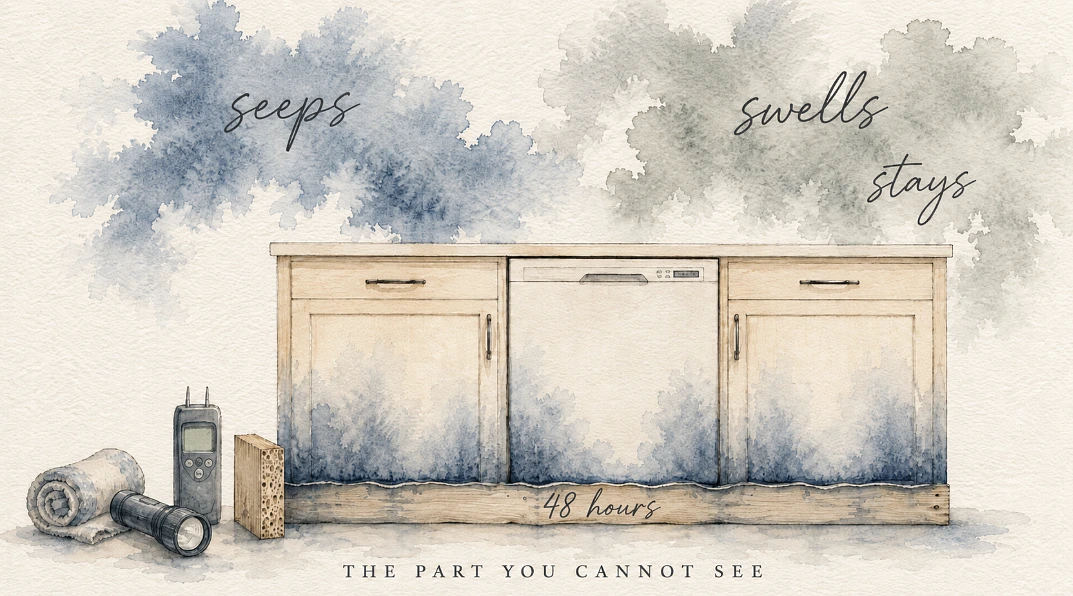
The puddle on the floor is the smallest part of a dishwasher leak, and by the time you are mopping it up the water has usually already gone somewhere you cannot see.
It runs under the toe kick, along the seams in the flooring, and into the bottom edge of the cabinet box next door, and those bottom edges are almost never sealed on the underside because no one was expected to look there. So the surface dries, the kitchen looks fine, and the actual question stays open. Can these cabinets be saved, or are you buying new ones? The answer comes down to three things, what the water came out of, how long it sat there, and what your cabinet boxes are made of.
A Supply Leak and a Drain Leak Are Two Different Jobs
This is the first thing a good technician will ask about and the thing most homeowners have never thought about.
Under the IICRC S500 standard, which is the rulebook restoration companies work from, water gets classified by contamination. A clean supply line burst is Category 1, sanitary water, the easiest situation there is. Water off the drain side of a dishwasher, with food residue and detergent in it, is Category 2, and that changes the cleaning protocol and what porous material can be kept.
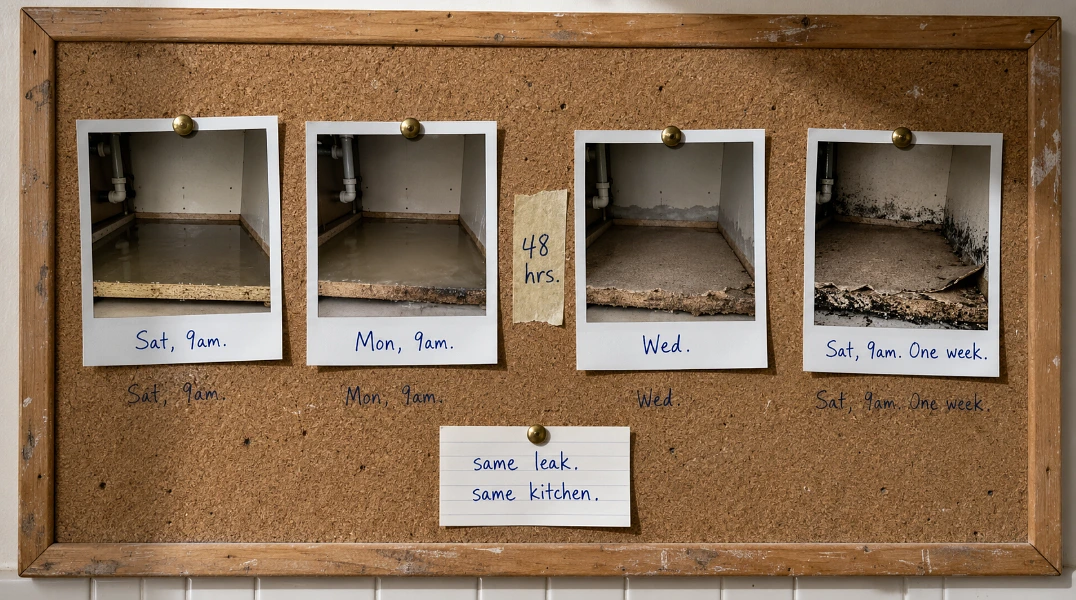
Here is the part that matters more than either of those. Categories are not fixed to the source, they are assessed at the moment someone looks at it, and clean water sitting in a warm kitchen degrades. Category 1 becomes Category 2 in about 48 hours. Another day or two after that and it can be Category 3, which is the one where porous materials come out rather than get dried. A dishwasher supply leak found on Saturday morning is a very different job from the identical leak found the following weekend.
The First Two Days Decide Most of the Outcome
Mold growth starts on wet porous materials inside 24 to 48 hours, and that window is the whole reason restoration work is priced and scheduled the way it is.
Water damage restoration in Campbell runs on that same clock, so a crew that can be in the kitchen the same afternoon is worth more than one that quotes slightly cheaper for Thursday. Local conditions push it around a bit too. Dry Santa Clara summer air genuinely helps drying, and humidity below 40 percent with cooler temperatures can stretch those windows out, while a warm kitchen sitting above 60 percent relative humidity, which is easy enough during a wet winter with the house closed up, compresses them by 25 to 50 percent.
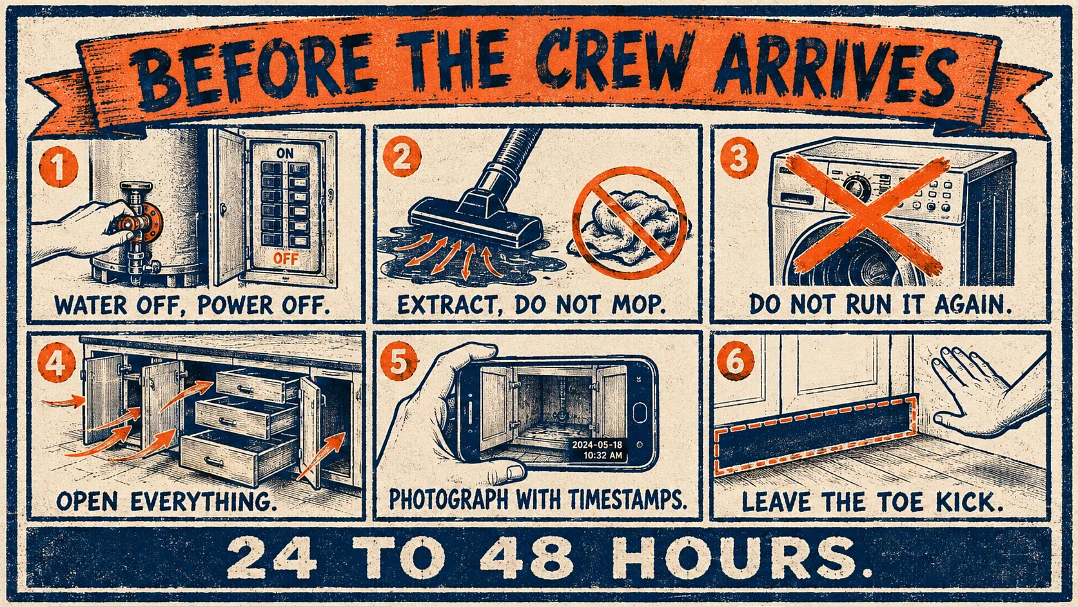
What to do before anyone arrives:
- Turn the dishwasher off at the appliance and close its water valve, and kill the circuit if you can reach the panel safely.
- Extract standing water rather than pushing it around, because towels only ever clean the part you can see.
- Do not run another cycle to test the leak, since one more cycle can release a lot more water into the same cavity.
- Open every cabinet door and drawer near the appliance, pull the drawers out, and let air at the boxes.
- Photograph everything with timestamps before anything gets moved, which your insurer will want later.
- Leave the toe kick alone until someone can look behind it properly, because it is the access point the technician will want.
What Water Does to a Cabinet Box, and Why the Material Decides Everything
Most cabinet boxes in a kitchen of any age are particleboard or MDF with a veneer or laminate over them, and that material behaves in a way that decides this whole question.
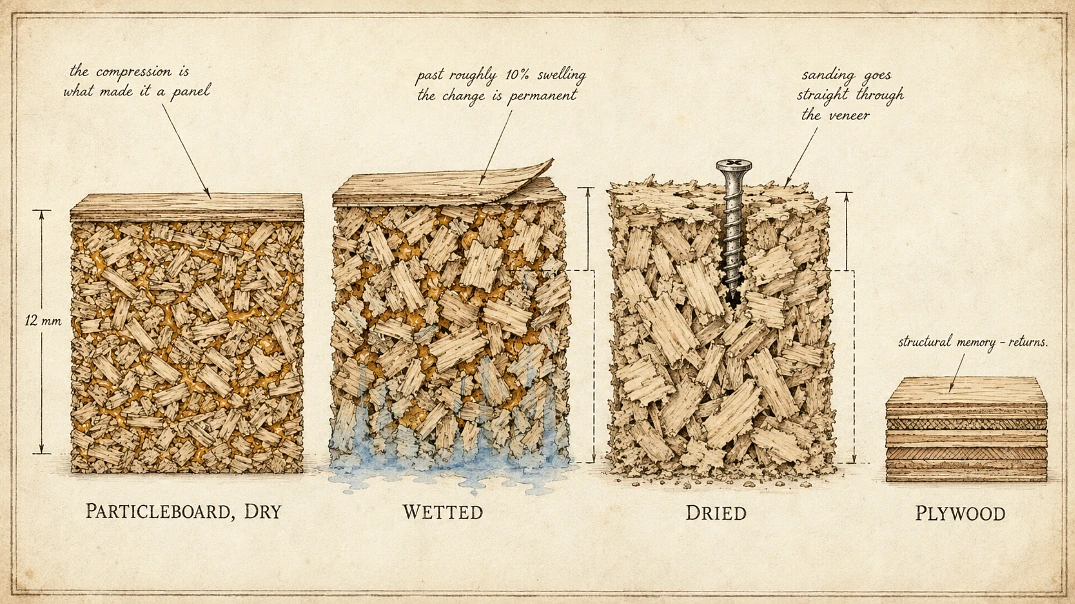
Particleboard is wood chips compressed under heat and pressure and held with resin. Water gets in through those unsealed bottom edges, the resin bonds let go, and the compressed chips expand back out. And they stay expanded. The panel does not shrink back when it dries, because the compression that made it a flat panel in the first place is gone, so what you are left with is thicker, softer, and structurally weaker than what you started with. Once swelling passes roughly 10 percent the change is permanent, and sanding it flat does not help either, since sanding goes straight through the thin veneer and then you are refinishing anyway.
Plywood and solid wood are a different story because they have some structural memory, they tolerate a limited wetting and come back, which is why plywood boxes are worth the money at the point you buy a kitchen rather than at the point you flood one.
How to Tell What You Have
Open a drawer and look at the raw edge, or look at the underside of the cabinet floor where nothing was finished. Layers stacked like a sandwich means plywood. A uniform speckled brown that looks like compressed sawdust means particleboard, and that is the material this article is mostly about.
Dry or Replace, Side by Side
| What you are looking at | Usually dries | Usually gets replaced |
|---|---|---|
| Box material | Plywood or solid wood | Particleboard or MDF, once swollen |
| Panel condition | Firm, holding shape, fasteners tight | Swollen, soft edges, screws pulling out |
| Surface | Veneer still bonded | Laminate bubbling or peeling away |
| Access | Toe kick removable, air can reach the cavity | Sealed cavity with no way to get airflow in |
| Water category | Category 1 caught early | Category 2 or 3, or unknown water sitting for days |
| Smell | Nothing unusual after drying | Musty odour that stays after the material is dry |
| Meter readings | Falling steadily toward the goal | Flat readings that will not come down |
The useful thing about this table is that most kitchens land in both columns at once. A swollen toe kick and a base panel under the dishwasher can come out while the boxes either side of them dry in place, and a decent contractor will propose exactly that rather than condemning the run.
How You Know the Drying Worked
Equipment running is not evidence, and this is where homeowners get talked into signing off on something unfinished.
Proper drying works to a drying goal, which is a target moisture reading for each material, set by comparing against an unaffected piece of the same material somewhere else in the house. Readings get taken from the same marked spots every day and they should fall steadily toward that goal. Flat readings usually mean the air is not reaching the wet material, so equipment gets moved or another access opening gets cut, rather than everyone waiting another day.
Thermal cameras are useful for finding suspicious areas quickly, and worth knowing that a thermal image shows temperature difference and not moisture, so a meter has to confirm every spot the camera flags. Ask for the daily readings in writing at the end, with the locations named. Your insurer will want them and it is the only real proof the kitchen is dry.
Kitchen Mitigation and Restoration Costs
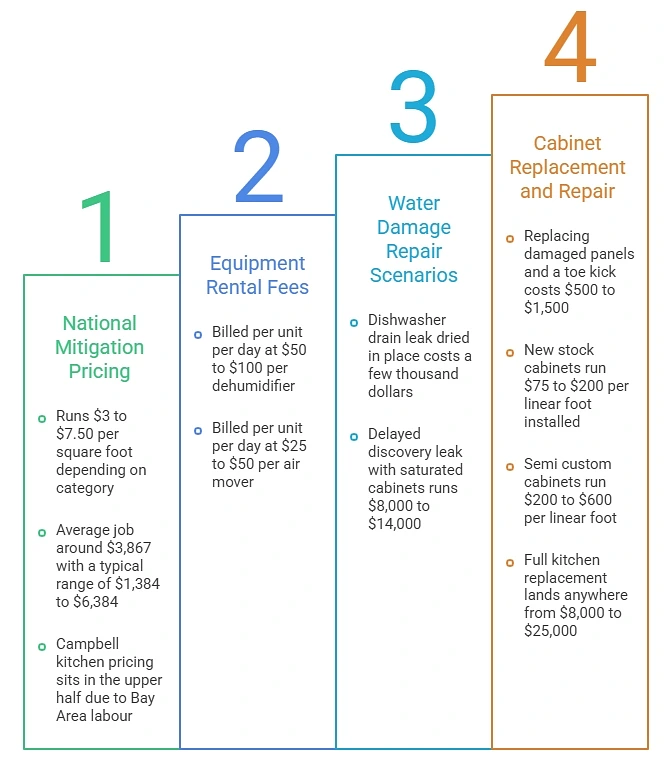
National mitigation runs $3 to $7.50 per square foot depending on category, with an average job around $3,867 and a typical range of $1,384 to $6,384. Bay Area labour sits above those national numbers, so a Campbell kitchen tends to price in the upper half.
- Equipment is usually billed per unit per day, roughly $50 to $100 per dehumidifier and $25 to $50 per air mover.
- A dishwasher drain leak found early and dried in place is generally a few thousand dollars all in.
- The same drain leak discovered a week later, spread across 400 square feet with saturated cabinets and subfloor, gets reclassified at assessment and runs $8,000 to $14,000 before any mold work.
- Replacing a few damaged panels and a toe kick sits at the $500 to $1,500 end.
- New stock cabinets run $75 to $200 per linear foot installed, semi custom $200 to $600, so a full kitchen replacement lands anywhere from $8,000 to $25,000.
One insurance point worth knowing before you call. Homeowners policies generally cover sudden and accidental water damage and exclude gradual seepage, which is exactly the argument that comes up with dishwashers, because a slow drain hose weep that has been going for months reads as maintenance rather than an event. Mold remediation is usually capped separately at around $5,000 to $10,000. Document the discovery, keep the failed part, and get the moisture readings, since those three things are what turn a disputed claim into a paid one.

 Decor & Improvement Accessories