

Home & Decor Blogs: DIY, Interior Design & Lifestyle Ideas
Heating Oil Prices Swing by $2 or More Per Gallon Depending on When You Buy

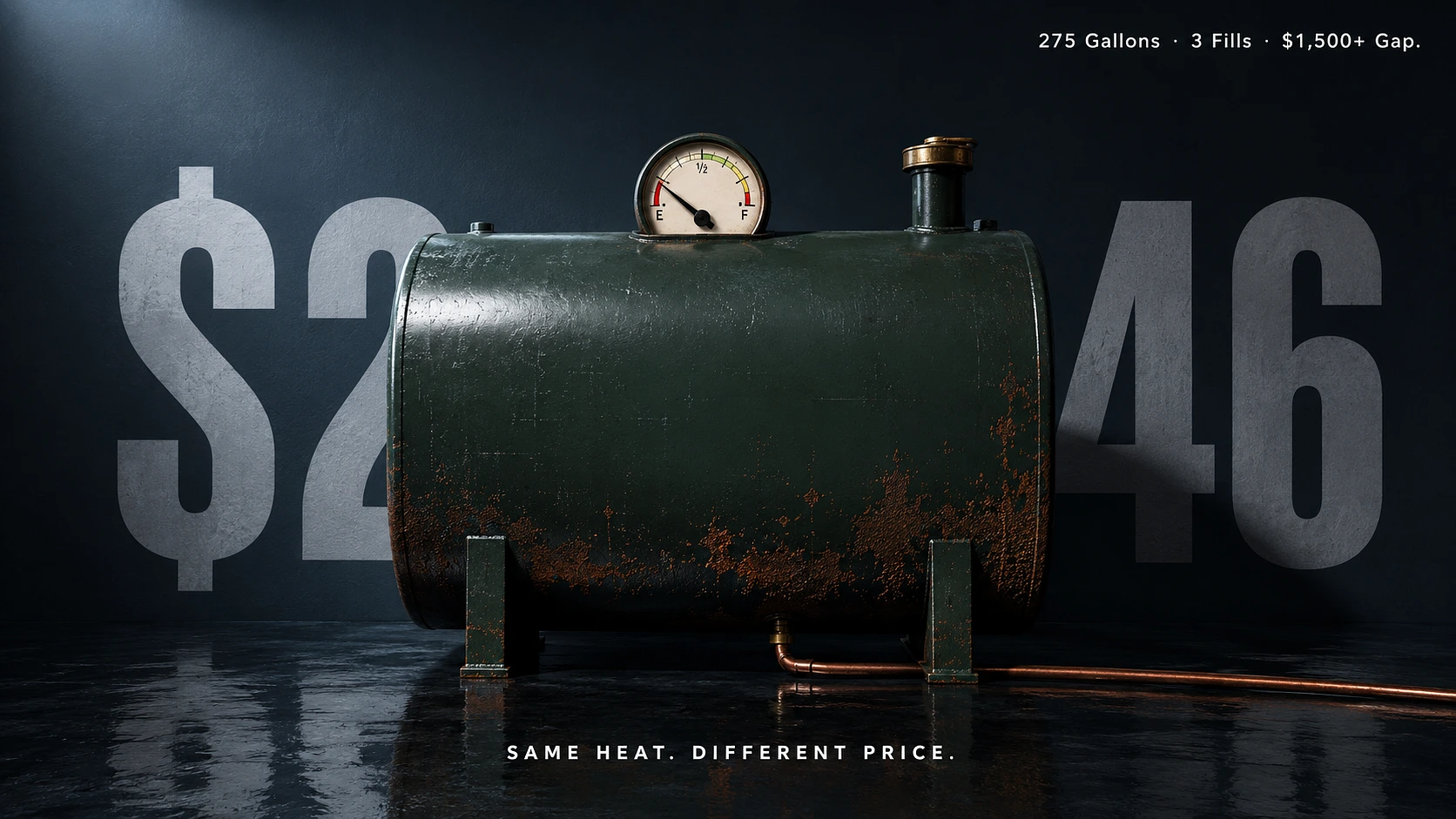
Residential heating oil hit $5.90 per gallon in November 2022 according to EIA data. By the winter of 2024/25, the national average had settled around $3.44. Then in March 2026 it jumped back to $4.46 after tensions with Iran rattled supply expectations. On a standard 275 gallon residential tank, a $2 per gallon swing is $550 per fill, and most Northeast households fill three to four times per season. So the annual gap between buying at the wrong time and buying at the right time can run $1,500 to $2,200 for the same amount of heat.
You cannot control crude oil prices or what happens in the Strait of Hormuz. What you can control is when you order, who you order from, and which pricing setup you agree to. Most of the savings happen in those three decisions and the rest is noise.
Will Call Versus Automatic Delivery Is Where the Real Money Goes
This is the part that gets left out of most guides because it’s awkward for oil companies to talk about openly.
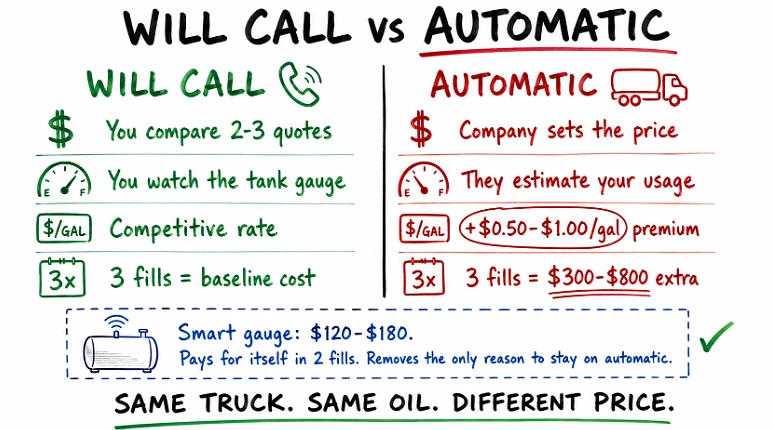
On automatic delivery, the company estimates when your tank is getting low and sends a truck without you asking. You don’t have to think about it, don’t have to check your gauge, don’t have to call anyone. And for that convenience, according to industry data compiled by FuelSnap, you typically pay $0.50 to $1.00 more per gallon than will call customers buying from the same company. Same truck, same oil, same driver sometimes. Just a higher price because you are not shopping around.
On a 200 gallon delivery, that’s an extra $100 to $200. Over a full season with three or four fills, you’re looking at $300 to $800 gone. Not because the oil costs more. Because you didn’t pick up the phone and compare.
Will call means you watch your own tank gauge, and when it reads around a quarter, you call two or three companies, take the best price, and schedule the delivery. The company knows you are comparing quotes so they quote competitively. That pricing pressure disappears the moment you sign up for automatic.
The common objection is that you might forget to check the gauge and run dry on a freezing night. Fair enough. A Wi-Fi enabled smart oil gauge runs about $120 to $180, mounts on the tank with an ultrasonic sensor, and sends your level to your phone. That sounds like a lot for a tank monitor until you realize it pays for itself within the first two fills by moving you from automatic pricing to will call pricing. The fact that oil companies don’t mention this option tells you something about where their margins come from.
The Three Pricing Plans and Why None of Them Are as Simple as They Sound
Every heating oil company offers some version of these three, and they all have a catch.
- Market price is what you pay on the day of delivery, no contract. The rate moves with crude oil, with seasonal demand, with whatever is happening globally that week. You could pay $3.20 in October and $4.50 in February on back to back deliveries and there is nothing to negotiate. This is the default for most will call customers and over multiple seasons it tends to cost less than locked plans, but you absorb every spike in between.
- Pre buy means you agree to purchase a set number of gallons before the season starts, usually 400 gallon minimum, at a locked rate. Pay upfront, get a guaranteed price per gallon all winter. This sounds great until you remember 2014/15, when customers locked in at summer prices and then watched the market drop well below their rate. They paid more for every single gallon than their neighbors who did nothing. It’s a bet, and like any bet, you win some years and lose others. Over the long run the math doesn’t consistently favor locking in.
- Cap price sets a ceiling on your rate. Market goes above the cap, you pay the cap. Market drops below, your price drops too. The problem is the fee, usually around $25 a month, which over six months is $150 before you’ve saved anything. The cap only puts money in your pocket if the market spikes significantly above your cap rate, and in mild winters that doesn’t happen. Some companies also build their fee into a slightly inflated base price instead of charging it separately, which makes the plan look free when it isn’t.
Honestly, the right answer probably depends on how much the uncertainty bothers you. If a surprise $400 swing in your February bill causes real financial stress, a pre buy or cap gives you predictability and that has genuine value even if the raw numbers don’t always favor it. If you can absorb the swings and you are willing to shop around each time, the market price on will call tends to win.
Buying in August Saves More Than Most of These Plans
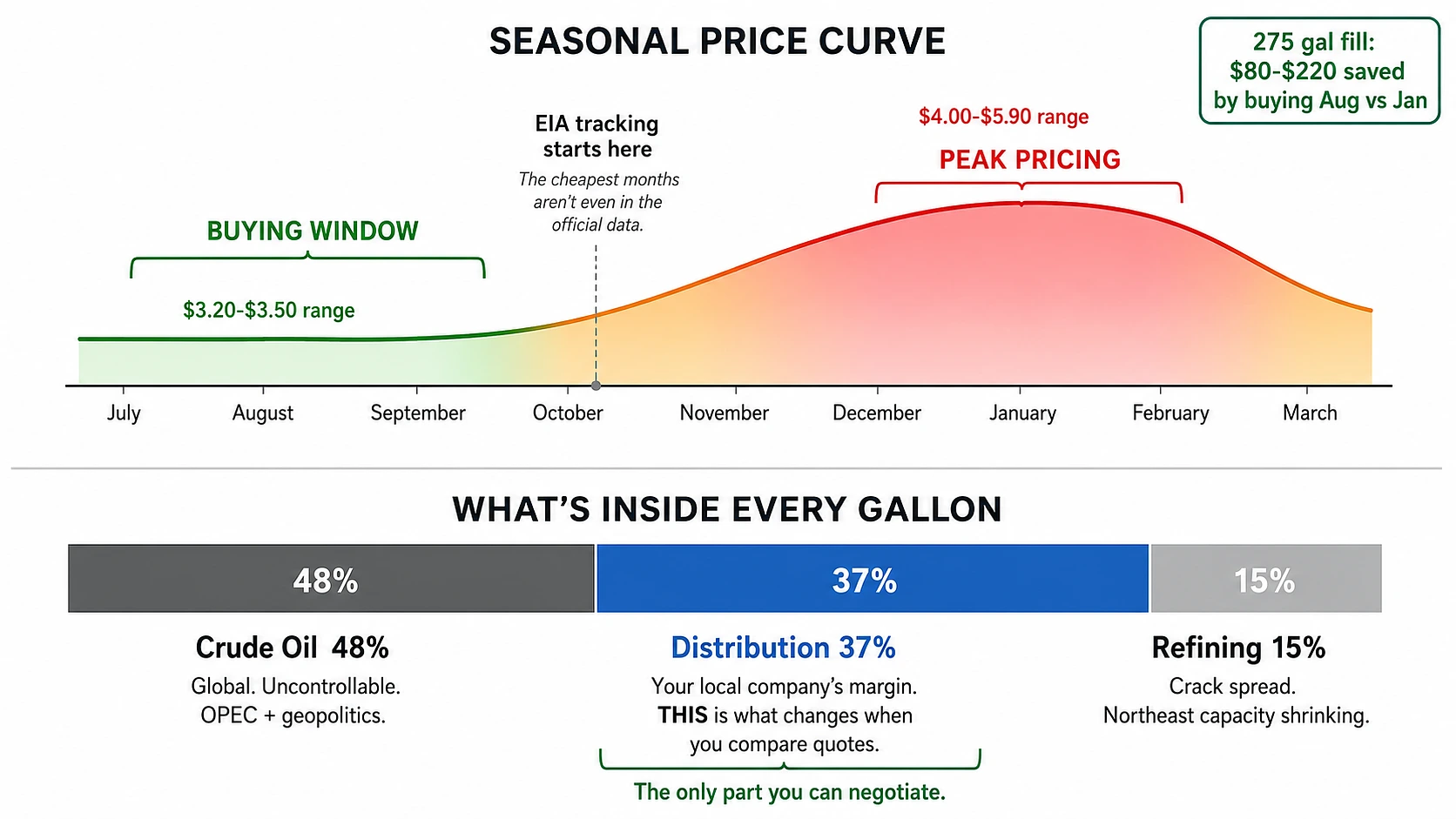
The EIA collects residential heating oil prices from October through March. But the market starts moving before October, and it starts settling after March, which means the cheapest buying window usually falls in a period that doesn’t even show up in the official data.
Prices tend to sit lowest between late July and early October. Demand is minimal, refineries are running, and inventories are building. By late November, the numbers climb. The peak usually lands somewhere in January or February when everyone needs a fill at the same time and the regional supply tightens.
In the wild 2022/23 season, prices ran from roughly $4.00 in September up to $5.90 by early November. In calmer years the seasonal gap is smaller, usually $0.30 to $0.80 per gallon, but it’s consistently there. Fill a 275 gallon tank in August and you are saving $80 to $220 compared to waiting until January on that single delivery alone.
The people who save the most combine this with will call. Fill the tank early when prices are low, monitor the gauge through winter, and reorder on the next dip rather than waiting until the tank is almost empty and having to take whatever price is available that day.
What You Are Actually Paying For Inside Every Gallon
According to EIA data covering the winters of 2012/13 through 2021/22:
- Crude oil: 48% of your retail price. Global, uncontrollable, moves on OPEC decisions and geopolitics.
- Distribution and marketing: 37%. This is your local delivery company’s slice. Truck costs, driver wages, route efficiency, and margin.
- Refining: 15%. The crack spread between crude and finished product. Northeast refinery capacity has been shrinking, which keeps this higher than it used to be.
That 37% distribution slice is the only part of the price that changes based on who you buy from. Two companies in the same town buying wholesale at the same rack price can charge you different retail rates depending on their overhead, their delivery efficiency, and how much margin they add for automatic versus will call customers.
This is why comparing local suppliers matters more than watching crude oil futures. You can’t do anything about the 48% that’s tied to Brent crude. You can do something about the 37% that depends on which truck shows up at your house. Town Oil Company puts their pricing on their site which not every company does, and that kind of transparency gives you a baseline to check other quotes against. If someone else quotes you significantly higher for the same delivery window in the same area, you know to ask why.
Your Tank Is Probably Older Than You Think
This part has nothing to do with buying oil at a better price and everything to do with not losing thousands of dollars to a problem you didn’t know you had.
A standard indoor 275 gallon steel tank lasts roughly 15 to 20 years. The bottom rusts first because condensation settles there, water pools under the oil, and corrosion eats through from the inside. You won’t see it until oil starts seeping onto the basement floor. Indoor tank leak cleanups run $5,000 to $15,000.
Underground tanks are worse because the leak is invisible. Oil goes into the soil, potentially into groundwater, and by the time anyone notices you are looking at environmental remediation costs of $20,000 to $100,000 or more. Homeowner’s insurance may not cover it if the tank was past its expected lifespan, and most states require disclosure of underground tanks during a home sale. An aged buried tank can kill a real estate deal entirely.
If you moved into a house with a heating oil system and nobody told you when the tank was installed, that is a question worth answering before it answers itself.
The Boring Stuff That Actually Cuts Your Bill
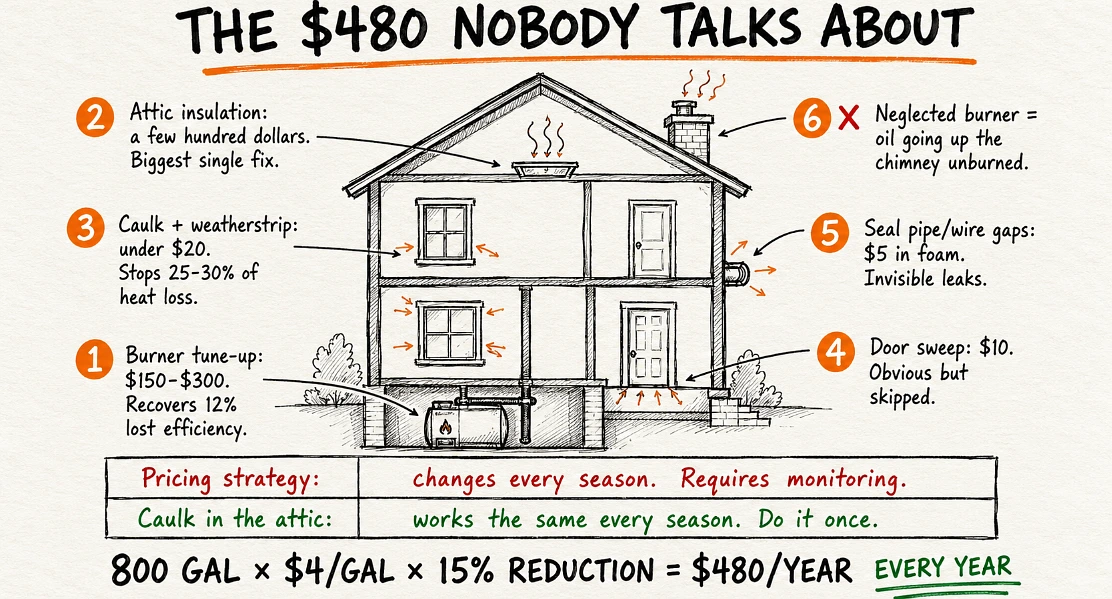
Buying at a better price per gallon gets the attention. Burning fewer gallons gets the results. Most households can reduce consumption by 10 to 20% with changes that cost very little and never need to be done again.
An oil burner running at 83 to 87% efficiency is normal. A neglected one drops to 75% or lower, which means up to 12% of the oil you buy goes up the chimney unburned. A tune up runs $150 to $300 and usually pays for itself by December.
Air leaks are the other one. The Department of Energy estimates 25 to 30% of heating energy in a typical home escapes through gaps around windows, doors, the attic hatch, and penetrations where pipes and wires enter. Caulk is a few dollars. Attic insulation is a few hundred. On a household burning 800 gallons per winter at $4 per gallon, a 15% reduction in consumption saves roughly $480 a year, and the improvement doesn’t expire.
None of this is interesting to read about. But $480 every year, silently, without monitoring prices or calling suppliers or timing the market, is more reliable savings than any pricing strategy on this list. The pricing game changes every season. Caulk in your attic works the same in every season. Probably worth noting which one you have more control over.
 Decor & Improvement Accessories